

A standard static traffic report is often the primary bottleneck standing between your complex development and its planning approval. Traditional modeling frequently fails to satisfy council skepticism regarding high-density site access and internal circulation. This is why VISSIM traffic simulation for complex developments is now a critical technical asset for developers. By utilizing PTV Vissim version 2025.00-08, released in July 2025, you can replace theoretical assumptions with high-fidelity, dynamic evidence. This approach provides the technical certainty required to overcome perceived congestion issues that standard assessments miss.
You’ve likely experienced project delays caused by repetitive Request for Information (RFI) cycles when authorities doubt your site’s operational feasibility. It’s a common frustration in an industry where the transportation simulation market is projected to reach $5,219.1 million by 2033. This article explains how microscopic modeling de-risks your project by proving that access points and internal flows work under real-world conditions. You’ll learn how to leverage this technology for faster planning approvals, fewer RFI cycles, and a clear return on investment through evidence-based reporting.
Key Takeaways
- Identify why microscopic modeling provides a more accurate representation of individual vehicle behavior than aggregate flow models for high-stakes projects.
- Discover how VISSIM traffic simulation for complex developments captures critical interactions like queue spillback that standard static tools cannot visualize.
- Learn the specific data collection and validation requirements necessary to build a reliable model that withstands council scrutiny.
- Understand the strategic advantage of direct senior principal involvement in the modeling process to streamline planning approvals and reduce RFI cycles.
Understanding VISSIM Microscopic Simulation for High-Stakes Projects
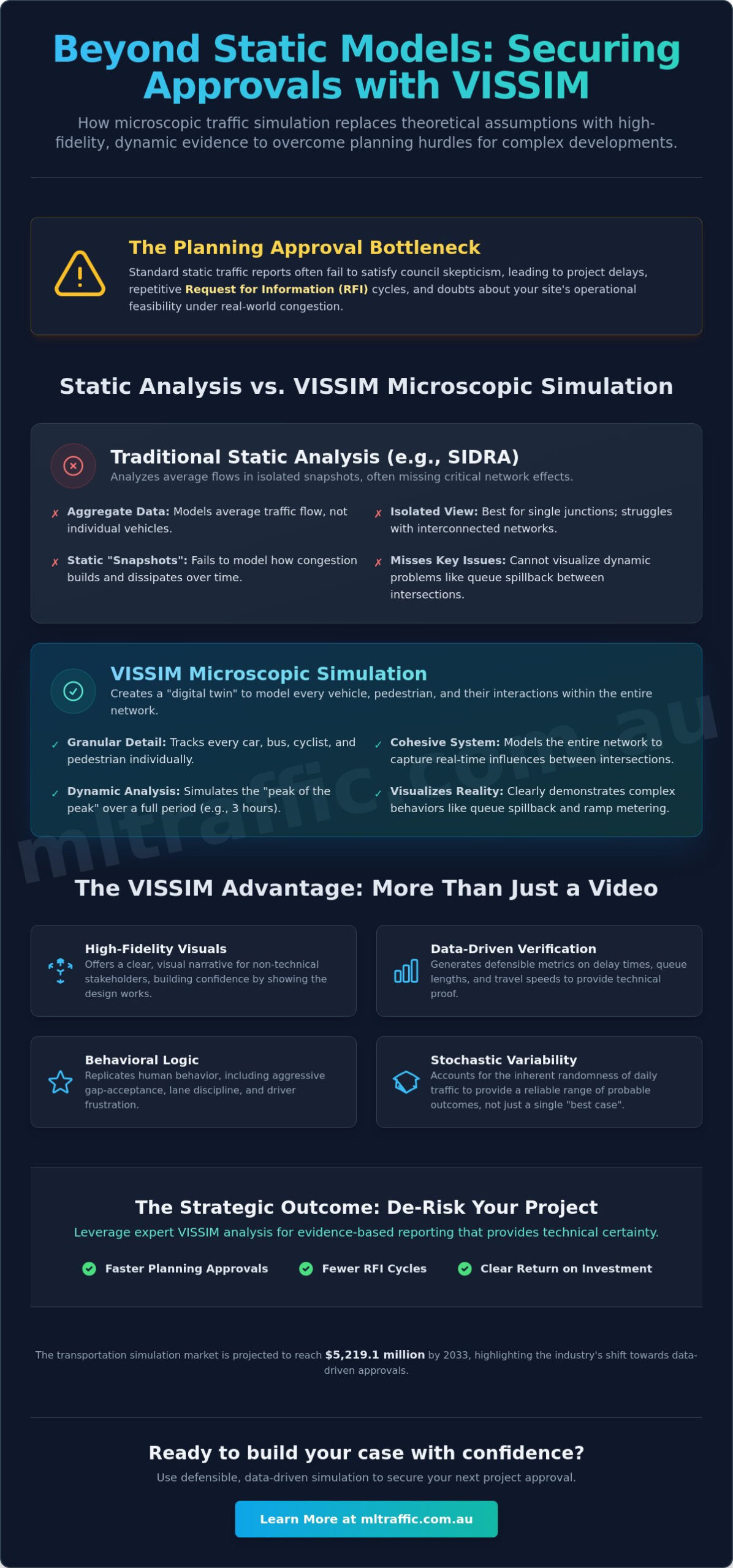
VISSIM is a microscopic traffic flow simulation tool used to model individual vehicle movements within a digital twin of a proposed development. Unlike traditional macro-models that analyze average flows and aggregate data, VISSIM microscopic simulation tracks the specific interactions between every car, bus, pedestrian, and cyclist. This level of granular detail is essential for a high-quality Traffic Impact Assessment (TIA) in the modern Australian planning environment. It’s the difference between guessing average delays and seeing exactly how a specific driveway performs during peak demand.
Councils often view static models with skepticism because they don’t account for the chaotic reality of peak-hour congestion. VISSIM traffic simulation for complex developments bridges this gap by providing a high-fidelity environment where site access and internal circulation are tested against realistic traffic patterns. These models allow developers to present a defensible case for site feasibility based on dynamic movement rather than static calculations.
To better understand this concept, watch this helpful video:
High-fidelity visuals serve a dual purpose in the approval process. They provide technical proof of operational feasibility while offering a clear, visual narrative for non-technical stakeholders. Seeing a 3D simulation of a vehicle navigating a complex basement ramp or a multi-lane intersection eliminates ambiguity. It builds confidence that the proposed design won’t fail once it’s built and operational.
The Science of Microscopic Modelling
The software relies on sophisticated car-following and lane-changing logic to replicate human behavior. It simulates real-world driver frustration, such as aggressive gap-acceptance or bottlenecks caused by poor lane discipline. Because it uses stochastic variability, the model accounts for the inherent randomness of daily traffic. This ensures your results aren’t just a “best case” scenario but a reliable range of probable outcomes that stand up to rigorous technical review.
VISSIM vs. Visualisations: More Than Just a Video
It’s vital to distinguish between simple 3D animations and data-driven simulation. While the 3D output is visually impressive, the true value lies in the underlying data used for technical reporting. Every vehicle movement generates metrics on delay times, queue lengths, and travel speeds. VISSIM is a data-driven verification tool for complex urban infrastructure. This technical rigor ensures that the specialised traffic engineering services provided are backed by defensible evidence that helps secure faster planning approvals.
Microscopic Simulation vs. Static Analysis: Why VISSIM Matters
Static analysis tools like SIDRA INTERSECTION are industry standards for isolated Intersection Analysis. They provide reliable data for single junctions or simple layouts where traffic flow is predictable. However, these models struggle with high-density urban precincts where multiple intersections influence one another in real-time. VISSIM traffic simulation for complex developments addresses these limitations by modeling the entire network as a single, cohesive system rather than a series of disconnected parts.
Standard static models often overlook the dynamic nature of urban traffic. They rely on peak hour snapshots that fail to account for the transition between free-flow and heavy congestion. Using a robust VISSIM modelling process for planning approvals ensures that your technical reports reflect the “peak of the peak.” This provides Council with the technical certainty that your development won’t cause systemic failure in the surrounding road network. It also allows for detailed analysis of how traffic builds up and dissipates over a full three-hour peak period, rather than just a single 60-minute window.
When Static Models Fail
The primary weakness of static modeling is its inability to accurately capture “queue spillback.” This occurs when a queue from one intersection grows long enough to block an upstream junction or site access point. If your development is located near a major signalized intersection, a static model might suggest your driveway works in isolation. In reality, that driveway could be blocked for 20 minutes every morning. VISSIM traffic simulation for complex developments identifies these hidden bottlenecks. It allows engineers to adjust the Car Park Design or site entry points before the planning application is lodged.
Dynamic Traffic Assignment (DTA)
Drivers don’t always follow a fixed path. They react to congestion and seek out faster routes through side streets or alternative entries. Dynamic Traffic Assignment (DTA) allows VISSIM to simulate this human behavior. Instead of assuming every vehicle takes the shortest route, the model recalculates paths based on current travel times. This is particularly valuable for large-scale residential subdivisions where multiple access points are available. By predicting real-world driver behavior, you reduce the risk of unexpected congestion and demonstrate a more sophisticated understanding of local traffic impacts. This level of detail is often what separates a successful approval from a costly refusal.
Critical Use Cases for VISSIM in Large-Scale Australian Developments
Australian planning authorities increasingly mandate VISSIM traffic simulation for complex developments when standard modeling cannot resolve site-specific conflicts. While SIDRA is often sufficient for simple intersections, large-scale projects like high-density residential towers, commercial office blocks, or major retail centers require microscopic detail. This is especially true for sites with restricted frontage or multiple access points that interact with high-frequency public transport corridors. Councils require proof that the proposed intensity of use will not degrade the existing road network’s performance.
In hospital and airport precincts, the need for Expert VISSIM Analysis is critical. These environments involve high shuttle frequency, emergency vehicle priority, and constant pedestrian movement. A failure to model these interactions accurately can lead to gridlock at critical entry points. By simulating these specific conditions, developers provide evidence that their Traffic Impact Assessment (TIA) Report is based on operational reality rather than theoretical averages. This technical rigor ensures that every Vehicle Swept Path Analysis is integrated into a dynamic flow model, reflecting real-world constraints.
Internal Circulation and Car Park Efficiency
Complex car park structures often suffer from internal bottlenecks during peak hours. VISSIM allows engineers to test the layout against AS 2890.1 compliance in a dynamic environment. It’s not just about meeting the minimum grade requirements; it’s about ensuring that internal ramp queues don’t spill back into the public road network. The simulation identifies conflict points between service vehicles and passenger cars. This is vital for mixed-use developments where loading docks share access with resident car parks. Proving that a waste truck can exit without halting all inbound traffic is a common requirement for planning approval.
Multimodal Interactions: Pedestrians, Cyclists, and Transit
Modern urban design prioritizes active transport and public transit. Integrating PTV Viswalk into your VISSIM traffic simulation for complex developments allows for detailed pedestrian flow analysis. This is essential for sites near light rail stations or major bus interchanges where foot traffic is high. The model accounts for how transit priority signals affect general traffic. It proves that the development can coexist with high-frequency transit without causing unacceptable delays. Showing that cyclists and pedestrians can move safely through the site access points further de-risks the approval process by addressing safety concerns before they are raised in RFI cycles.
Navigating the VISSIM Modelling Process for Planning Approvals
The successful deployment of VISSIM traffic simulation for complex developments relies on a rigorous, four-stage procedural framework. At our firm, the senior principal who initiates your project performs the technical work to ensure total accountability. It begins with comprehensive data collection, including SCATS signal data, manual turning counts, and tube counts. This data forms the baseline for the entire simulation. Without accurate inputs, the model cannot produce defensible results. Developers must ensure their traffic consultant uses the most recent traffic data to avoid immediate rejection by Council engineers.
Once the data is processed, the model enters the calibration phase. This is the most critical technical step in the VISSIM modelling process. It ensures the digital twin behaves exactly like the existing road network. Only after the model is validated can we begin testing the impact of the proposed development. The final stage involves distilling complex simulation data into a concise Traffic Impact Assessment (TIA) Report. We present findings through clear tables, queue length graphs, and visual animations. This evidence-based approach often preempts the need for multiple RFI cycles.
The Importance of Model Calibration
A model must replicate real-world observed traffic before it can be used for predictive testing. We use GEH statistics and other validation metrics to prove that the simulation matches current queuing and delay patterns. Council engineers scrutinize the calibration report to ensure the model isn’t biased toward favorable results. If the GEH values don’t meet the required thresholds, the entire assessment may be deemed unreliable. Our senior-led approach ensures that calibration is meticulous and stands up to the most rigorous peer reviews.
Scenario Testing for Future Growth
Scenario testing allows us to compare the “Base Case” against the “Proposed Development” across various timelines. We typically incorporate 10-year background growth projections to satisfy long-term planning requirements. This phase tests the impact of proposed road upgrades or signal changes. VISSIM traffic simulation for complex developments is also used to justify modified access or a Car Parking Demand Assessment that deviates from standard rates. By showing that the network remains functional under future loads, you provide a clear pathway to approval. This level of detail helps justify design choices that static models might flag as problematic.
If your project requires high-fidelity modelling to satisfy Council requirements, contact our senior principals for a technical consultation.
Leveraging Expert VISSIM Analysis for Seamless Project Approvals
The technical complexity of microscopic modeling requires more than just software proficiency; it demands a specialised traffic engineering consultancy that understands how to apply simulation results to Australian planning law. While the earlier sections of this guide detailed the mechanics of calibration and scenario testing, the final hurdle for any developer is the successful negotiation of these results with road authorities. ML Traffic Engineers Australia provides this bridge between raw data and planning approval. By ensuring that VISSIM traffic simulation for complex developments is managed by senior leadership, we eliminate the technical disconnect often found in larger, multi-layered firms.
Our firm operates on a model of total accountability where the senior principal who initiates the client relationship is the same expert performing the technical simulation work. This ensures that the person defending the model during Council meetings has a granular understanding of every car-following parameter and lane-changing logic used in the study. With a 15-year track record in securing approvals for high-stakes projects, ML Traffic Engineers Australia delivers a level of reliability and deep-seated expertise that de-risks the development process from the outset.
Beyond the Software: The Consultant Advantage
A sophisticated model is only as effective as the arguments it supports within the final Traffic Impact Assessments. We translate complex data outputs into clear, persuasive narratives that address the specific concerns of planning officers. This proactive engagement strategy identifies potential objections before they result in formal Request for Information (RFI) cycles. By presenting evidence-based solutions for site access and internal circulation, we provide authorities with the technical certainty they require to support high-density urban developments.
Getting Started with Your VISSIM Model
To provide a tailored fee proposal for your project, our senior principals require a comprehensive project brief and the most recent architectural site plans. The timeline for a microscopic study depends on the scale of the network and the specific requirements of the local transport authority. Early engagement is essential to ensure that data collection and model validation are completed well before your submission deadlines. Contact ML Traffic Engineers Australia today to discuss how our senior-led approach to VISSIM traffic simulation for complex developments can streamline your next project approval. We provide a direct line to our experts, ensuring your technical queries are answered with authority and precision.
Contact the senior principals at ML Traffic Engineers Australia to request a technical consultation for your complex development.
Secure Your Planning Approval with Technical Certainty
Microscopic modeling is the definitive method for resolving the technical bottlenecks that frequently stall high-density projects. As established throughout this guide, VISSIM traffic simulation for complex developments provides the dynamic evidence required to satisfy council skepticism where static models fall short. By capturing real-world driver behavior and multimodal interactions, this technology ensures your site access and internal circulation work under peak demand. It provides a level of technical certainty that protects your project from costly delays and repetitive RFI cycles.
ML Traffic Engineers Australia brings over 15 years of experience in securing approvals for the most challenging urban precincts. Our senior-led technical analysis ensures that the same expert who initiates your relationship performs the modeling work, providing total accountability. We have a proven track record with complex Australian planning approvals across diverse project environments. This hands-on approach distinguishes our service from larger, impersonal firms and guarantees that your technical reporting is both meticulous and defensible.
Discuss your complex development with our senior traffic engineers at ML Traffic Engineers Australia today. We look forward to providing the technical rigor necessary to achieve a successful project outcome.
Frequently Asked Questions
Is VISSIM required for all development applications in Australia?
VISSIM is not a mandatory requirement for every development application. Standard projects often only require a SIDRA-based Traffic Impact Assessment (TIA) Report for simple junctions. However, authorities generally request VISSIM traffic simulation for complex developments where intersections are closely spaced or site access interacts with high-frequency public transport corridors. You should check with your specific local council or state road authority to confirm their modeling thresholds for your project type.
How much longer does a VISSIM model take compared to a standard SIDRA report?
A microscopic simulation typically takes three to five times longer than a standard SIDRA report. This is because VISSIM requires extensive network coding, vehicle behavior calibration, and multiple simulation runs to ensure statistical validity. While a standard Intersection Analysis might be completed in a few days, a robust microscopic model often requires several weeks of technical work to meet the rigorous calibration standards required for planning approvals.
Can VISSIM model pedestrian movements alongside vehicles?
VISSIM accurately models pedestrian movements when integrated with the PTV Viswalk module. This allows for the simulation of complex interactions between foot traffic, cyclists, and vehicles within a single environment. It’s particularly useful for transit-oriented developments or major retail centers where pedestrian crossing delays significantly impact the overall performance of the road network. This multimodal capability provides a holistic view of site safety and operational efficiency.
What data is required to start a VISSIM traffic simulation?
You must provide high-quality input data to build a reliable model. This includes recent manual turning counts, SCATS signal data, and tube counts for background traffic volumes. Detailed architectural site plans and accurate signal timing phases are also critical for the calibration process. Without this granular data, the simulation cannot produce the high-fidelity evidence required to satisfy council skepticism regarding your project’s traffic impacts.
Can VISSIM be used to justify a reduction in required parking spaces?
VISSIM supports a Car Parking Demand Assessment by proving that a site can operate efficiently with specific parking volumes. It demonstrates that reduced parking won’t lead to external queuing or internal circulation failure during peak periods. By simulating real-world arrival and departure patterns, developers can provide data-driven justification for parking rates that deviate from standard council requirements, provided the operational evidence is technically sound.
How does VISSIM help with Council negotiations for high-density projects?
VISSIM traffic simulation for complex developments provides a visual and technical narrative that simplifies negotiations with authorities. It allows our senior principals to show council engineers exactly how a site performs under peak load. This transparency builds trust and often resolves technical disputes regarding perceived congestion. It transforms theoretical arguments into evidence-based discussions, which significantly reduces the likelihood of repetitive and costly RFI cycles.
Is VISSIM analysis accepted by all state road authorities in Australia?
VISSIM is a globally recognized tool accepted by all major Australian state road authorities, including Transport for NSW, the Department of Transport in Victoria, and other equivalent state transport agencies. While each authority has specific guidelines for model calibration and validation, the software itself is considered the industry standard for microscopic simulation. Our experts ensure all technical work complies with these varying state-level regulatory standards to ensure your project remains compliant.
What is the difference between VISSIM and VISUM?
VISSIM is a microscopic simulation tool that models individual vehicles and their specific interactions within a local network. In contrast, VISUM is a macroscopic tool used for strategic, city-wide planning and demand forecasting across entire regions. For a specific site assessment or car park design, VISSIM is the appropriate choice. It captures the granular details of intersection performance and site access that macroscopic models are not designed to represent.

Article by
Michael Lee
Practising traffic engineer with over 35 years experience.
Disclaimer
The content on www.mltraffic.com.au, including all technical articles, guides, and resources, is provided for general informational and educational purposes only. It is not intended to constitute professional advice in traffic engineering, transportation planning, development approvals, or any other technical or legal field.
While ML Traffic Engineers makes every reasonable effort to ensure the accuracy, completeness, and timeliness of the information published, we do not provide any warranties or representations (express or implied) regarding its reliability, suitability, or availability for any particular purpose. Any reliance you place on the content is strictly at your own risk.
In no event shall ML Traffic Engineers, its directors, employees, authors, or affiliates be liable for any direct, indirect, incidental, special, consequential, or punitive damages (including, without limitation, loss of profits, data, or business opportunities) arising out of or in connection with the use of, or inability to use, any information provided on this website.
The articles and guides on this site are not a substitute for engaging a qualified, registered professional traffic engineer (such as an NPER or RPEQ engineer) to assess your specific project requirements. For tailored advice, compliance assessments, or traffic engineering services, please contact a competent professional.
This disclaimer may be updated from time to time without notice. By accessing or using this website, you agree to be bound by the most current version of this disclaimer.
