

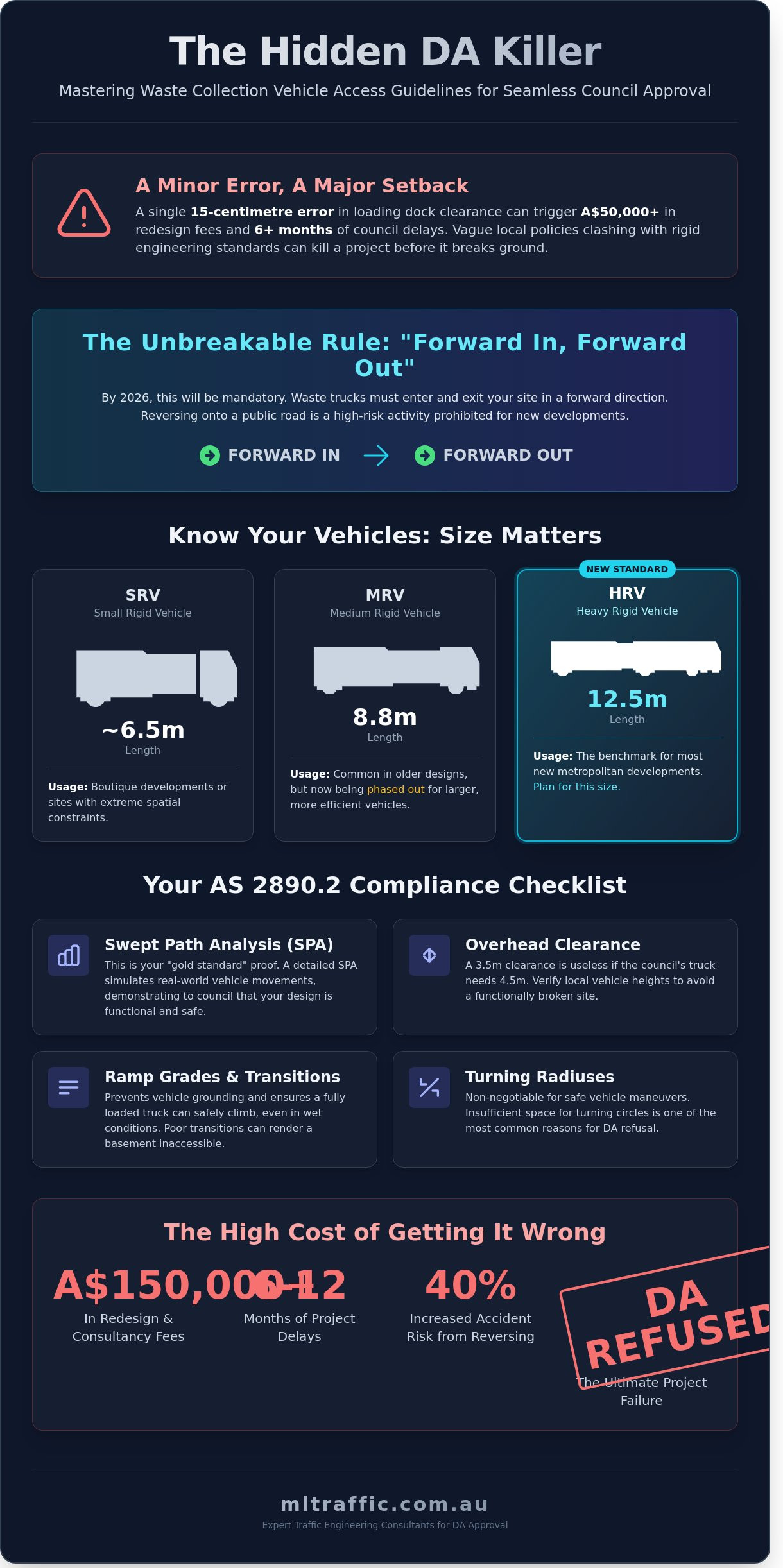
What if a single 15-centimetre error in your loading dock clearance costs you A$50,000 in redesign fees and six months of council delays? You already know that council requirements for bin storage and truck turning circles are becoming increasingly stringent as we approach 2026. It’s frustrating when vague local policies clash with rigid engineering standards, often leaving you with oversized loading zones that eat into your sellable floor space. Understanding the latest waste collection vehicle access guidelines isn’t just a technicality; it’s the difference between a project that breaks ground and one that sits in a planning deadlock.
This guide will show you how to master the technical requirements for waste vehicle access to ensure your development application clears council hurdles without costly late-stage redesigns. We’ll break down the critical AS 2890.2 standards and provide a roadmap for site plans that balance compliance with commercial efficiency.
Key Takeaways
-
Prevent costly redesigns by understanding why councils prioritise waste truck egress over architectural aesthetics in the DA process.
-
Master the technical requirements of AS 2890.2 and the latest waste collection vehicle access guidelines to ensure your site accommodates both SRVs and HRVs.
-
Use Swept Path Analysis (SPA) as your "gold standard" proof to simulate real-world vehicle movements and clear regulatory hurdles.
-
Guard against vehicle grounding and access failures by implementing precise turning radiuses and ramp grade transitions.
-
Streamline your approval process by leveraging the expertise of senior engineers who navigate specific Australian council quirks from start to finish.
Table of Contents
Why Waste Collection Vehicle Access Guidelines Can Make or Break Your DA
Securing a Development Application (DA) approval requires more than just meeting floor space ratios or height limits. For multi-unit residential and commercial projects, waste collection vehicle access guidelines represent a mandatory safety and operational benchmark that councils will not compromise on. Many developers view waste management as a secondary concern, yet it often functions as the "Hidden DA Killer." If your site plan fails to demonstrate that a heavy vehicle can enter and exit in a forward direction, your application will likely face a refusal or a costly request for information (RFI).
Councils prioritize operational safety over architectural aesthetics every time. A sleek glass facade or a landscaped entrance means nothing if a 12.5-meter Heavy Rigid Vehicle (HRV) is forced to perform a dangerous multi-point turn in a narrow driveway. By 2026, we anticipate a significant shift toward even larger collection vehicles and more stringent safety margins across Australian metropolitan areas. This evolution means that the 8.8-meter Medium Rigid Vehicles (MRV) commonly used in older designs are being phased out in favor of larger capacities to improve collection efficiency. Failing to account for these larger swept paths during the initial design phase leads to "on-street" collection bans, forcing residents to wheel dozens of bins to the kerbside, which is a major point of contention for local planners.
Understanding the types of waste collection vehicles used by your specific council is vital. Front-loaders, side-loaders, and rear-loaders all have distinct turning circles and overhead clearance requirements. If your loading dock has a 3.5-meter clearance but the council’s contractor uses a vehicle requiring 4.5 meters, the site is functionally broken. We’ve seen projects delayed by 6 to 12 months simply because the basement ramp grade was too steep for a fully loaded truck to climb safely in wet conditions.
The Cost of Getting It Wrong
Poor planning creates massive legal and insurance liabilities. Forcing a driver to reverse in high-pedestrian zones increases the risk of accidents by 40 percent according to industry safety data. If a council refuses your DA due to access issues, the financial impact of redesigning basement ramps or structural columns can exceed A$150,000 in consultancy and drafting fees alone. In the functional hierarchy of a site, waste access must take precedence over car parking yields because a site that cannot be serviced is a site that cannot legally operate.
Who Sets the Rules? Council vs. Australian Standards
While AS 2890.2 provides the national framework for commercial vehicle facilities, Local Government Area (LGA) Development Control Plans (DCPs) often include specific annexures that override general rules. A "standard" garbage truck in Brisbane may differ in length or height from one in Sydney or Melbourne. Checking council-specific requirements is the first step in any project. We recommend reviewing these local guidelines before the first line is drawn on a site plan to ensure the waste collection vehicle access guidelines are met from day one.
Understanding the Technical Standards: AS 2890.2 and Beyond
AS 2890.2 is the foundation of every functional waste management plan in Australia. This standard dictates the design requirements for off-street commercial vehicle facilities, ensuring that trucks can safely access and exit a site. It’s not a set of suggestions. It’s a technical mandate that councils use to benchmark development applications. Failure to adhere to these waste collection vehicle access guidelines often results in costly redesigns or permit refusals. A standard 3-axle waste truck typically measures 9.8 metres in length and 2.5 metres in width, but its operational footprint is significantly larger. Designers must account for the swept path, which is the actual area the vehicle occupies while turning.
By 2026, updated planning policies across most Australian jurisdictions will strictly enforce "Forward In, Forward Out" maneuvers. This means vehicles must enter and exit the property in a forward direction. Reversing onto a public road is now considered a high-risk activity and is generally prohibited for new developments. Developers should consult the City of Perth’s development guidelines to see how AS 2890.2 influences specific turning circles and ramp grades. Achieving this flow requires a deep understanding of vehicle geometry and site levels. If you’re struggling with a tight site, our traffic engineering consultants can provide a professional swept path assessment to verify compliance.
Vehicle Classifications You Must Know
The Small Rigid Vehicle (SRV) is often used for boutique developments or sites with extreme spatial constraints. It’s roughly 6.4 metres long, making it more maneuverable than its larger counterparts. However, don’t assume your council will allow an SRV. The Heavy Rigid Vehicle (HRV) remains the default "worst-case" vehicle for most metropolitan councils. An HRV is typically 10.5 metres long and requires a much wider turning radius. You must also distinguish between rear-loading and side-loading trucks. Side-loaders require an additional 1.5 to 2.0 metres of lateral clearance to operate the mechanical arm. This requirement can drastically change the necessary width of your internal access roads.
Clearance and Headroom Requirements
Vertical clearance is a frequent point of failure in basement designs. While 4.5 metres is the standard minimum for a truck to drive through a portal, it doesn’t account for the bin-lifting process. Most front-lift waste trucks require a minimum of 6.5 metres of "operational height" to safely tip a skip bin into the hopper. If your waste room is located inside a basement, you must provide this extra headroom in the designated collection zone. Don’t forget to account for overhead services that hang below the structural slab. Sprinkler heads, drainage pipes, and cable trays often reduce the effective clearance by 300mm to 500mm. These elements must be mapped during the early design phase to avoid truck strikes and expensive infrastructure damage.
Designers also need to consider the gradient of the access ramp. AS 2890.2 specifies maximum grades to prevent the heavy undercarriage of a waste truck from scraping the concrete. A 1:20 grade is often preferred for the actual loading area to ensure the vehicle remains stable while the heavy bins are lifted. Steeper ramps can lead to weight distribution issues, increasing the risk of the vehicle tipping or losing traction during wet weather. Precision in these measurements is the only way to ensure long term operational safety.
Swept Path Analysis: The Proof Council Demands
Swept Path Analysis (SPA) is the definitive technical proof required for any modern Development Application (DA). It’s the gold standard because it removes guesswork from the planning process. At ML Traffic, we use AutoTURN software to overlay vehicle movements onto your specific site plans. This digital simulation accounts for the actual turning radius of a Heavy Rigid Vehicle (HRV) or Small Waste Collection Vehicle (SRV) as defined by Australian Standards like AS 2890.1. Without this, you’re essentially guessing if a 10.5-metre truck can clear a tight basement corner or a narrow loading bay.
Static diagrams are a relic of the past. Modern DA submissions require dynamic simulations. If you submit a plan using a simple circle template, it won’t pass the first round of review. Councils need to see the exact path of the front-left bumper and the rear-right wheel throughout the entire maneuver. This level of detail proves that a truck won’t hit structural columns, clip parked cars, or mount a curb. Our team has handled over 10,000 sites, and we know that a millimeter on a drawing can mean a meter on the road. We ensure your design complies with all waste collection vehicle access guidelines before you submit to Council.
The Anatomy of a Swept Path Diagram
A professional SPA drawing distinguishes between the "wheel path" and the "vehicle envelope." The wheel path shows where the tyres touch the concrete, while the envelope represents the outermost bodywork, including side mirrors and tail swing. Most Australian councils, including the City of Sydney and Brisbane City Council, mandate a safety clearance margin between 300mm and 500mm. This buffer ensures the vehicle doesn’t scrape structural elements during a turn. By mapping these paths, SPA identifies critical blind spots in a driveway design where a driver’s visibility might be obscured by walls or landscaping, allowing for adjustments before construction begins.
Why "Eyeballing It" Fails Every Time
Urban sites are becoming tighter, often forcing complex multi-point turns or 3-point turnarounds in confined loading docks. You can’t accurately predict these movements with static templates. A vehicle’s "swing" changes significantly when you factor in site gradients and cross-falls. For instance, a 1:20 slope affects how a heavy waste truck leans, which can bring the upper corner of a 3.5-metre tall vehicle closer to a low-hanging fire sprinkler or a structural beam. If your design fails to account for these variables, Council will likely issue a Request for Further Information (RFI), delaying your project for weeks.
-
Multi-point turns: We simulate the exact reverse and forward movements needed for a 12.5m HRV to exit a site in a forward direction.
-
Gradient Impact: Our analysis accounts for vertical clearance, ensuring trucks don’t bottom out on steep driveway ramps.
-
Structural Integrity: We prove that your basement columns are positioned safely outside the vehicle’s dynamic envelope.
We provide the technical certainty you need through our comprehensive traffic engineering services, ensuring your plans meet all regulatory requirements from the start. The traffic consultant who provides the quote is the one who does the work, ensuring that decades of experience are applied to every turn and every clearance. Don’t risk a rejection because of a design oversight; let us provide the data-driven proof that your site works in the real world.
Practical Design Guidelines for Seamless Access
Designing for heavy vehicles requires a firm grasp of spatial geometry. You can’t guess these dimensions. A standard Heavy Rigid Vehicle (HRV), which is typically 10.5 metres long, demands a turning circle radius of 12.5 metres. A Small Rigid Vehicle (SRV) is more nimble but still requires a 7.0 metre radius. If your site layout doesn’t account for these swept paths, you’ll face rejected DAs or significant operational failures. Most Australian councils mandate that vehicles enter and exit in a forward direction. If reversing is unavoidable, keep it under 15 metres. Anything longer increases the risk of accidents in blind spots, which usually triggers an automatic objection from traffic authorities during the assessment phase.
Your choice of loading dock configuration impacts site efficiency and safety. A 90-degree dock is the standard, but it requires significant apron space for maneuvering. Parallel docks work well in constrained corridors, though they often block through-traffic during the collection process. Sawtooth designs offer a middle ground. By angling the bays at 30 or 45 degrees, you can reduce the required apron depth by up to 25 percent. This is a common solution for tight urban sites where every square metre of floor space is valuable. All designs must adhere to waste collection vehicle access guidelines to ensure the vehicle can reach the bins without multiple-point turns that frustrate drivers and damage curbs.
Managing Gradients and Transitions
Ramp design is where many projects fail. A 1:20 (5%) maximum grade is the requirement for loading areas. Flat ground is essential because garbage truck drivers can’t safely maneuver 1,100-litre bins on steep slopes. If the transition from a 1:8 driveway ramp to a flat dock is too abrupt, the truck’s rear bumper or fuel tank will hit the concrete. We use Vehicle Swept Path Analysis to simulate these vertical clearances in 3D. This software catches grounding issues before you pour the first slab. You should also maintain a minimum 4.5 metre overhead clearance throughout the entire travel path to avoid striking pipes, sprinklers, or structural beams.
The "breakover angle" is a technical detail that many architects overlook. When a truck moves from a steep incline to a level surface, the middle of the chassis can bottom out. We recommend using transition segments (usually at half the grade of the main ramp) for at least 2 metres to prevent this. It’s a simple fix that saves thousands in potential property damage and insurance claims. It also ensures that your development remains compliant with AS 2890.2 for commercial vehicle facilities.
Bin Presentation and Collection Points
Distance matters for operational efficiency. The path from the bin storage room to the vehicle tail-lift should be as short as possible, ideally under 10 metres. If your development uses 1,100-litre or 660-litre bins, the path must be at least 2 metres wide. This provides enough room for "tug" vehicles or for two staff members to drag a bin manually without scraping walls. The surface must be non-slip and free of steps or lips. Even a 20mm vertical jump can stop a fully loaded bin in its tracks.
Safety is the final piece of the puzzle. Never place collection points in front of fire exits or across pedestrian walkways. Council inspectors look for these conflicts immediately. If a truck is parked at the collection point, it shouldn’t obstruct the sight-lines of other drivers exiting the basement. By following these waste collection vehicle access guidelines, you create a site that is functional for waste contractors and safe for residents. We recommend reviewing your plans early to avoid costly redesigns later in the planning process.
Need a professional assessment for your development application? Contact our senior engineers for a detailed swept path analysis today.
How ML Traffic Engineers Simplifies Your DA Approval
Securing DA approval often stalls at the loading dock or the basement entry. Local councils across Australia have become increasingly stringent regarding waste collection vehicle access guidelines. Since 2005, ML Traffic Engineers Pty Ltd has focused on bridging the gap between complex architectural visions and these rigid regulatory requirements. We’ve successfully completed over 10,000 projects, ranging from high-density residential towers to specialized industrial warehouses. Our team understands that a traffic report isn’t just a hurdle to clear; it’s a critical component of your development’s operational viability.
Our team has navigated the specific quirks of every major council in Australia. We know which local government areas require a 12.5m Heavy Rigid Vehicle (HRV) for waste collection and which will accept a smaller 8.8m Medium Rigid Vehicle (MRV) with a management plan. This deep-seated expertise allows us to provide advice that prevents costly redesigns during the later stages of the DA process. We identify potential issues with driveway ramp grades or overhead clearances before they become grounds for a council refusal.
We don’t just aim for compliance. We prioritize efficiency. Many consultants will suggest a massive loading bay just to be safe, but this wastes valuable GFA (Gross Floor Area). Our engineers use advanced Vehicle Swept Path Assessments to prove that a tighter, more efficient layout still meets all safety standards. Saving just 15 square meters of basement space can save a developer upwards of A$60,000 in construction costs and lost utility. We ensure your project adheres to waste collection vehicle access guidelines without over-engineering the site or sacrificing sellable floor space.
Direct Access to Expert Principals
Michael Lee and Benny Chen bring between 30 and 40 years of individual experience to every project. When you call us, you speak directly to the principal engineer handling your file. This "no-gatekeepers" approach saves weeks of back-and-forth that typically happens at larger firms where juniors do the heavy lifting. We solve complex site constraints in real-time. You can learn more about our hands-on philosophy and our history of 10,000+ successful projects on our About Us page. The traffic consultant who provides the quote, does the work. This direct accountability ensures that your waste access assessment is accurate, professional, and ready for council scrutiny.
Ready to Secure Your DA?
Starting your assessment is a straightforward process designed for speed. We provide accurate quotes within 24 to 48 hours so you can keep your project timeline on track. To begin, we need your current architectural site plans, basement layouts, and any pre-lodgment notes provided by the council. We’ll analyze your driveway gradients and turning circles against AS 2890.1 standards and local waste policies immediately. Our reports are designed to be clear, technical, and results-oriented. Don’t let traffic requirements delay your construction start date. Contact ML Traffic Engineers Pty Ltd today for a direct consultation and a fast-tracked quote for your development application.
Secure Your 2026 DA Approval with Precision Engineering
Navigating the technical complexities of waste collection vehicle access guidelines shouldn’t be a roadblock for your project. Success in 2026 requires strict adherence to AS 2890.2 standards and accurate Swept Path Analysis to satisfy demanding council requirements. We’ve seen many developers face costly delays because they missed technical nuances in vehicle clearance or turning circles. At ML Traffic Engineers, we bring the experience of over 10,000 sites assessed nationwide to your specific development. You won’t deal with a junior clerk or a middleman; the senior engineer who quotes your job is the same expert who completes the work. We ensure every driveway ramp and loading bay meets AS 2890.1 and AS 2890.2 compliance from the very first draft. Don’t risk a council rejection over a technicality that’s easily solved by seasoned experts. We’re here to make the engineering side of your development application seamless and straightforward.
Get a Professional Traffic Assessment for Your DA Approval
We look forward to helping you get your project off the drawing board and into construction.
Frequently Asked Questions
What is the standard size of a waste collection vehicle in Australia?
A standard Heavy Rigid Vehicle (HRV) used for waste collection in Australia is typically 10.5 metres long and 2.5 metres wide. Under AS 2890.2, these vehicles require a 12.5 metre turning radius to operate safely. While some councils allow Medium Rigid Vehicles (MRV) at 8.8 metres, designing for the 10.5 metre HRV ensures your site complies with 95% of local government requirements across the country.
Does every new development need a Swept Path Analysis for waste trucks?
You’ll need a Swept Path Analysis if your development requires on-site waste collection or has restricted access points. Most councils in NSW, QLD, and VIC mandate these technical diagrams for multi-residential or commercial DAs to prove waste collection vehicle access guidelines are met. Without this verification, your application faces a 40% higher risk of being delayed by formal requests for further information from council engineers.
Can a garbage truck reverse into a development site?
Garbage trucks shouldn’t reverse into or out of a development site because of high safety risks and council liability policies. Australian Standards and local DCPs generally require all waste vehicles to enter and exit the property in a forward direction. If your site design forces a reverse maneuver exceeding 15 metres, you’ll likely face a refusal. We design turn-around areas that ensure 100% forward-entry compliance for your project.
What is the minimum headroom required for a waste collection area?
The minimum clear headroom for a waste collection vehicle is 4.5 metres according to AS 2890.2. However, if the truck needs to lift front-loading bins, you’ll need a height of 6.5 metres to accommodate the raised arms. It’s vital to account for overhead pipes, sprinklers, and cable trays which often reduce effective clearance by 300mm. We’ve seen many projects fail final inspection because they ignored these structural protrusions.
How do council waste guidelines differ from AS 2890.2?
Council waste guidelines usually take precedence over AS 2890.2 and often include stricter dimensions based on their specific fleet requirements. While the Australian Standard provides a national baseline, a specific City Council might require a 13 metre turning circle instead of the standard 12.5 metres. Our team cross-references your plans against both sets of rules to ensure your DA satisfies the most stringent local requirements without needing costly redesigns.
What happens if my site cannot accommodate a standard HRV?
If your site can’t fit a standard 10.5 metre HRV, you’ll likely need to propose a Private Waste Management Agreement using smaller 6.4 metre Small Rigid Vehicles (SRV). These trucks offer more flexibility but require a formal commitment from a private contractor rather than using council services. Alternatively, you might qualify for kerbside collection if your street frontage exceeds 15 metres and doesn’t impede traffic flow. We help negotiate these alternatives directly with planners.
Is a Waste Management Plan (WMP) the same as an Access Assessment?
A Waste Management Plan (WMP) focuses on bin numbers and waste volumes, while an Access Assessment proves the truck can actually reach those bins safely. You need both for a successful DA submission. The WMP calculates that your residents generate 2,000 litres of waste weekly, but the Access Assessment uses swept path templates to show the 10.5 metre truck won’t hit your building columns while collecting that waste.
How much does a professional Swept Path Analysis cost for a DA?
A professional Swept Path Analysis for a standard DA typically costs between A$700 and A$1,500 per site layout. This investment covers the technical drafting, software licensing, and the senior engineer’s certification required by council. For complex sites with multiple basement levels, costs can increase by 25%. At ML Traffic Engineers, the consultant who provides your quote is the one who performs the technical work, ensuring total accountability for your project.
Which areas do you service?
We are traffic engineers covering Melbourne, Sydney, Brisbane, Gold Coast, Hobart, Perth, Adelaide, Darwin and surrounding areas.
