

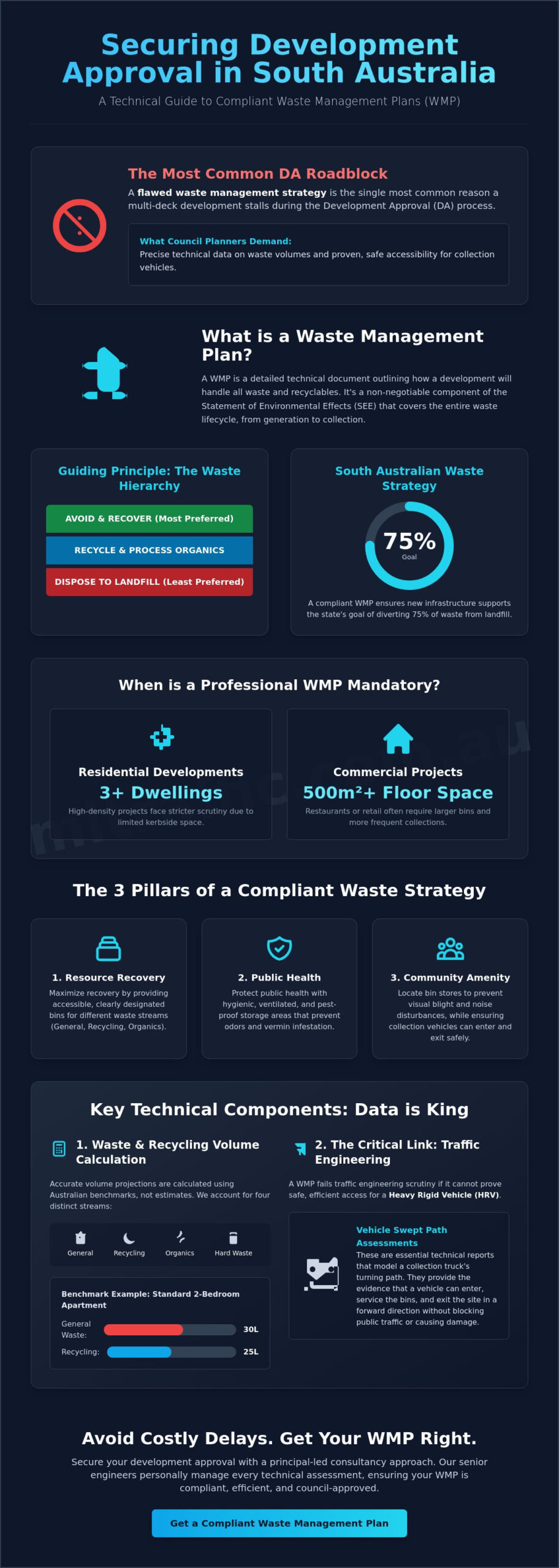
A flawed waste management strategy is the single most common reason a multi-deck residential or commercial development stalls during the Development Approval (DA) process in South Australia. You probably know that council planners require more than just a designated bin area. They demand precise technical data on waste volumes and collection vehicle accessibility. Securing a waste management plan Adelaide councils will approve requires a meticulous approach to site layout and operational logistics.
We understand the frustration of facing DA delays due to non-compliant waste storage or restricted site access for heavy vehicles. This professional guide details the technical requirements and compliance standards necessary for urban developments. You’ll gain a clear understanding of waste generation rates, bin dimensions, and the necessity of vehicle swept path assessments to ensure your site accommodates collection trucks safely. Our focus is on providing the technical evidence required to satisfy municipal standards. We provide the expertise needed to transition from a conceptual design to a compliant, council-approved plan that functions efficiently for the life of the building.
Key Takeaways
- Understand the technical role of a Waste Management Plan as a mandatory document for demonstrating compliant waste handling from generation to collection.
- Learn how to apply precise waste generation rate calculations and design storage areas that meet strict spatial and ventilation standards.
- Discover why proving Heavy Rigid Vehicle (HRV) access is critical for your waste management plan Adelaide to pass traffic engineering scrutiny.
- Navigate complex regulatory frameworks, including the Environment Protection (Waste to Resources) Policy and specific metropolitan council approval criteria.
- Secure development approval by leveraging a principal-led consultancy approach where senior engineers personally manage every technical assessment.
Table of Contents
-
What is a Waste Management Plan for Development Applications?
-
Professional Waste Management Consultancy with ML Traffic Engineers
What is a Waste Management Plan for Development Applications?
A Waste Management Plan (WMP) is a detailed technical document required for most development applications in South Australia. It serves as a formal roadmap for how a proposed project will handle refuse and recyclables. This report covers every stage of the waste lifecycle, from initial generation within a dwelling or business to the final collection by council or private contractors. For developers, a professional waste management plan Adelaide is a non-negotiable component of the Statement of Environmental Effects (SEE).
Technical assessments must align with the ‘Waste Management Hierarchy’. This framework prioritizes waste avoidance and resource recovery over landfill disposal. What is a Waste Management Plan involves demonstrating how a design facilitates the separation of organics, recyclables, and general waste at the source. This alignment with the South Australian Waste Strategy 2020-2025 ensures that new infrastructure supports the state’s goal of diverting 75% of waste from landfill.
To better understand how these systems operate in a local context, watch this helpful video:
When is a Professional WMP Mandatory?
Councils in the Greater Adelaide area set specific triggers for mandatory reporting. Most residential developments involving three or more dwellings require a formal waste report. For commercial projects, a threshold of 500 square meters of floor space often necessitates a detailed submission. High-density multi-unit developments face stricter scrutiny because of limited kerbside space. If a project can’t accommodate standard council bin collections, a technical report must justify private collection arrangements and vehicle swept paths. You can view our range of technical consultancy services to see how these assessments are structured.
Objectives of a Compliant Waste Strategy
A compliant waste management plan Adelaide focuses on three core pillars. First, it maximizes resource recovery by providing accessible bins for different waste streams. Second, it protects public health through ventilated and hygienic storage areas that prevent vermin and odors. Third, it addresses community amenity. This means placing bin stores where they don’t create visual blight or noise disturbances during early morning collections. Technical reports must prove that collection vehicles can enter and exit the site safely without blocking traffic. These requirements ensure the development remains functional and compliant throughout its operational life.
Key Technical Components of a Waste Management Plan
Development approval in South Australia requires a robust technical framework that addresses logistics, hygiene, and safety. A professional Key Technical Components of a Waste Management Plan ensures that a project doesn’t just meet environmental goals but remains functional for the life of the building. For a waste management plan Adelaide councils will accept, engineers must provide data-driven calculations rather than estimates. We analyze the specific land-use types to determine how much waste will be generated and how it will be moved through the site.
Calculating Waste and Recycling Volumes
Benchmarks for a standard two-bedroom apartment often sit at 30 litres for general waste and 25 litres for recycling per week. Commercial sites like restaurants or retail hubs require higher frequencies and larger equipment, often utilizing 660-litre or 1100-litre bins collected multiple times weekly. Waste generation rates are calculated using specific Australian benchmarks, such as the South Australian Better Practice Guide for Waste Management in Residential or Commercial Developments, to ensure precise volume projections. We account for four distinct streams: general waste, co-mingled recycling, green organics (FOGO), and dedicated hard waste storage areas to prevent illegal dumping on Adelaide streets.
Designing Compliant Storage Facilities
Storage rooms must be more than just empty spaces in a basement. They require mechanical ventilation to prevent odour build-up and non-slip floors with integrated drainage for high-pressure wash-down procedures. Access is a critical failure point in many development applications. Residents need clear, well-lit paths of travel, while collection staff require unobstructed access for heavy bin tugs or manual handling. For commercial developments, the loading area must comply with AS 2890.2 standards to accommodate heavy rigid vehicles (HRVs) or medium rigid vehicles (MRVs) safely.
The plan must specify if collection occurs on-site or at the kerbside. Kerbside collection is typically restricted for developments with over 10 dwellings or sites with significant street frontage constraints. In these cases, a private contractor usually enters the site. We define who moves the bins from the storage room to the collection point. If a facility manager handles this, the path must be level or have a gradient no steeper than 1:14 to meet safety standards. If you’re unsure about your site’s capacity for heavy vehicle entry, our traffic engineering services can provide swept path analysis to confirm clearance and turn circles.
The Critical Link: Waste Collection and Traffic Engineering
Waste collection represents the most challenging traffic manoeuvre on any development site. Unlike standard passenger vehicles, waste trucks require significant spatial tolerances and have restricted visibility. A waste management plan Adelaide must prove that a site can accommodate these movements without compromising the structural integrity of the building or the safety of other road users. Failure to address these traffic engineering requirements early often leads to costly redesigns during the Development Approval (DA) process.
Heavy Rigid Vehicles (HRV) typically used for Adelaide municipal and private collection range from 8.8 to 12.5 metres in length. These vehicles have large turning circles and high vertical clearance requirements. Integrating waste collection into car park design is a technical necessity. We often see designs where bin storage is placed in locations that are inaccessible to the intended vehicle. If a truck can’t reach the bins safely, the waste management plan will be rejected by the council or the waste contractor.
Safety remains the primary concern during the design phase. Collection windows often overlap with high pedestrian activity or peak traffic hours. Engineers must account for several safety factors:
-
Pedestrian sightlines at the point of entry and exit to prevent accidents.
-
Conflict points between reversing trucks and parked cars within the basement or loading area.
-
The impact of collection on street traffic flow and the safety of cyclists.
Swept Path Analysis for Waste Vehicles
We use AutoTURN software to conduct a technical simulation of garbage truck movements. This analysis ensures the vehicle can enter and exit the site in a forward motion, which is a standard requirement for most Adelaide councils. We also verify vertical clearance; for example, an overhead collection arm needs at least 4.5 metres of height to operate safely. You can learn more about Swept Path Analysis for developments to understand how these simulations prevent operational failure.
Manoeuvring and Loading Dock Compliance
All off-street loading facilities must comply with AS 2890.2. Designing turn-around areas is critical to avoid dangerous reversing manoeuvres onto public roads. A Sight Distance Assessment is mandatory to ensure drivers have a clear view of pedestrians and oncoming traffic before exiting. We verify that the loading dock area provides enough space for the driver to alight and operate the equipment without entering a live traffic lane. Proper planning ensures the waste management plan Adelaide meets both Australian Standards and local government expectations.
Navigating Regulatory Standards and Council Approval
Compliance with the Environment Protection (Waste to Resources) Policy 2010 is the foundation of any successful development application in South Australia. This policy mandates that waste management systems prioritize resource recovery and landfill diversion. When developing a waste management plan Adelaide councils will scrutinize, you must demonstrate how the proposed infrastructure supports these state-level objectives. Each metropolitan council, from the City of Adelaide to the City of Charles Sturt, maintains specific requirements regarding bin dimensions, collection frequencies, and vehicle access heights.
Council rejection often stems from technical oversights rather than conceptual flaws. Common issues include insufficient vertical clearance for waste collection vehicles (typically requiring 4.5 metres) or inadequate "swept path" room for heavy rigid vehicles (HRVs). A waste management plan Adelaide must also align perfectly with the Traffic Impact Assessment (TIA). If the TIA defines a specific driveway gradient, the waste plan must confirm that collection vehicles can safely navigate that slope while loaded. Discrepancies between these two documents often lead to Request for Further Information (RFI) letters, which delay project timelines by weeks or months.
Best Practices for Council Submission
Precision is mandatory for approval. All site plans must be drawn to a recognized scale, such as 1:100 or 1:200, and clearly show bin storage areas, wash-down points, and drainage. If your development deviates from standard bin sizes, you must provide a technical justification. For instance, replacing several 240L bins with a single 1100L bulk bin requires proof that the floor structure can support the concentrated load and that the caretaker can maneuver the weight. Explore our comprehensive range of traffic engineering services to ensure your site plans meet these rigorous standards.
Operational Waste Management Plans (OWMP)
An OWMP differs significantly from a construction waste plan. While construction plans focus on demolition debris, the OWMP addresses the building’s long-term functionality. It’s vital to document the ‘Path of Travel’ for waste caretakers. This includes ensuring that any ramps used for moving bins have a gradient no steeper than 1:14 (7%) to prevent workplace safety incidents. You must also specify whether the site will utilize council services or private collection contracts. Private contracts often require a Section 7 statement or a formal indemnity agreement if the vehicle needs to enter the private property to perform the pickup.
Our senior engineers ensure your waste strategy meets every technical and regulatory hurdle. Contact ML Traffic Engineers for a professional assessment of your development’s waste requirements.
Professional Waste Management Consultancy with ML Traffic Engineers
ML Traffic Engineers has operated as a specialist consultancy since 2005. We focus on providing technical reports for private clients seeking development approval. Our team has secured approvals for more than 10,000 sites across Australia. When you require a waste management plan Adelaide councils will accept, you need a consultant who understands the local regulatory framework and Australian Standards like AS 2890.1. We provide a principal-led service. This means the senior engineer who quotes your project is the professional who performs the technical analysis. You won’t deal with junior staff or administrative gatekeepers.
Our methodology integrates waste planning with broader traffic engineering requirements. We combine your waste management plan with Traffic Impact Assessments (TIA) and Vehicle Swept Path Assessments. This holistic approach ensures that heavy rigid vehicles or small waste collection vehicles can navigate your site safely. By calculating precise turning circles and driveway ramp grades, we help developers maximize their developable site area. Efficient designs mean less space is wasted on oversized collection zones, which directly protects your project’s bottom line.
Why Experience Matters in Waste Planning
Senior engineers at ML Traffic Engineers identify access and compliance issues before they reach the council desk. We’ve worked on a vast range of land uses including high-rise apartments, taverns, medical centers, and industrial warehouses. This deep experience allows us to spot problems with sight-line assessments or overhead clearances that less experienced firms might miss. Council feedback requesting a redesign is expensive and time-consuming. We reduce this risk by ensuring your waste management plan Adelaide submission is technically sound from the first day.
Get Started with Your Waste Management Plan
Obtaining a professional assessment is a straightforward process. We provide direct quotes based on the specific needs of your development. To begin, our consultants require your latest architectural site plans and floor layouts. We also need details regarding the proposed land use to calculate accurate waste generation volumes. This data allows us to determine the necessary bin numbers and collection frequencies for your site. You can Contact ML Traffic Engineers for a professional quote to discuss your project requirements with a senior engineer today.
Secure Your Development Approval with Technical Precision
A successful development application depends on the seamless integration of traffic engineering and waste logistics. Your waste management plan Adelaide must account for specific council standards, vehicle swept paths, and safe collection points to avoid planning delays. Addressing these technical requirements early prevents site layout conflicts and ensures long-term operational efficiency for your project. Professional documentation is the bridge between a conceptual design and a compliant, approved development.
ML Traffic Engineers brings over 15 years of industry experience to your project. We’ve successfully managed technical assessments for over 10,000 sites since our establishment in 2005. You’ll work directly with senior traffic engineers who understand the nuances of regulatory compliance. We maintain a hands-on approach where the consultant who provides your quote is the same expert who performs the work. This direct accountability ensures your technical reports meet the highest standards of accuracy and reliability.
Request a Waste Management Plan Quote from Our Senior Engineers at mltraffic.com.au to streamline your approval process. We’re ready to help you navigate the complexities of Adelaide’s technical requirements.
Frequently Asked Questions
What is a Waste Management Plan and why is it needed for a DA?
A Waste Management Plan is a technical document detailing how waste is stored, collected, and minimized throughout a project’s lifecycle. South Australian planning authorities require a waste management plan Adelaide for Development Approval to ensure compliance with the Planning, Development and Infrastructure Act 2016. It proves the site can handle expected waste volumes without impacting public safety or local amenity. Our engineers ensure every plan meets specific council criteria.
How much does a professional waste management plan cost?
Professional fees for a waste management plan depend on project scale and technical complexity. Industry benchmarks indicate that basic reports for small residential developments often start from A$800. Complex commercial or high-density residential projects requiring detailed swept path analysis and equipment specifications involve more intensive engineering hours. You’ll receive a direct quote from the traffic consultant who actually performs the work on your file.
Can I prepare a waste management plan myself for a small development?
You can attempt to prepare documentation yourself, but most South Australian councils require technical assessments that exceed basic knowledge. Plans must adhere to the South Australian Better Practice Guide for Waste Management. Technical requirements like swept path diagrams for 8.8-metre Heavy Rigid Vehicles (HRV) require specialized software. Using an experienced consultant prevents costly Requests for Further Information (RFI) and project delays during the assessment phase.
What is the difference between a Construction WMP and an Operational WMP?
A Construction WMP focuses on waste generated during demolition and building phases, targeting specific resource recovery rates. An Operational WMP manages ongoing waste needs once the building is occupied. It covers bin storage dimensions, collection frequencies, and vehicle access maneuvers. Both are critical components of a waste management plan Adelaide submission. We provide comprehensive reports that cover both phases to ensure total site compliance.
How do I calculate the number of bins required for my development?
Bin requirements are calculated using standard waste generation rates from Zero Waste SA guidelines. Multi-unit dwellings typically allow 30 litres of residual waste and 25 litres of recycling per bedroom each week. We divide these totals by standard bin sizes, such as 240-litre or 1,100-litre MGBs, to determine the storage footprint. Meticulous calculations ensure your bin room is neither undersized nor wasting valuable floor space.
What happens if a garbage truck cannot safely enter my site?
If a standard 12.5-metre Heavy Rigid Vehicle cannot enter, we must propose an alternative collection strategy. This might involve a private contractor using a 6.4-metre Small Waste Collection Vehicle or implementing a kerbside presentation model. Our engineers use Vehicle Swept Path Assessments to prove maneuverability. We identify these constraints early to negotiate viable solutions with the council or private waste contractors before you lodge your application.
Does every council have the same waste management requirements?
No, requirements differ between local government areas like the City of Adelaide and the City of Charles Sturt. While the South Australian Planning and Design Code provides a general framework, individual councils have specific mandates for bin enclosure aesthetics and collection hours. We review the specific requirements for your exact site location. Our 30 years of experience ensures we understand the nuances of different council jurisdictions across South Australia.
How long does it take to prepare a compliant waste management plan?
A standard waste management plan Adelaide typically takes 5 to 10 business days to complete once we receive your final architectural plans. This timeframe allows for accurate waste volume calculations and necessary vehicle access simulations. Complex sites requiring custom turnaround areas or specialized equipment might take longer. We prioritize direct communication and accountability, so you always know the exact status of your technical report.
Which areas do you service?
We are traffic engineers servicing Aberfoyle Park, Adelaide, Adelaide Airport, Albert Park, Alberton, Aldinga, Aldinga Beach, Allenby Gardens, Angle Park, Ascot Park, Athelstone, Auldana, Beaumont, Belair, Bellevue Heights, Blackwood, Brighton, Broadview, Burnside, Camden Park, Campbelltown, Christie Downs, Christies Beach, Clarence Park, Clearview, Clovelly Park, Coromandel Valley, Croydon, Daw Park, Dernancourt, Dulwich, Eden Hills, Edwardstown, Elizabeth, Enfield, Felixstow, Findon, Flagstaff Hill, Fulham, Gawler, Gepps Cross, Gilles Plains, Gillman, Glen Osmond, Glenelg, Glenelg North, Glengowrie, Glenunga, Golden Grove, Goodwood, Grange, Greenacres, Hackham, Hackney, Hallett Cove, Happy Valley, Hawthorn, Henley Beach, Highbury, Hindmarsh, Hope Valley, Ingle Farm, Kensington, Kent Town, Keswick, Kilburn, Kilkenny, Kingswood, Kurralta Park, Largs Bay, Linden Park, Lockleys, Magill, Malvern, Marion, Mawson Lakes, Melrose Park, Mile End, Mitcham, Modbury, Morphett Vale, Mount Barker, Mount Osmond, Myrtle Bank, Nailsworth, Netherby, Newton, Noarlunga Centre, North Adelaide, North Plympton, Norwood, Oaklands Park, Panorama, Para Hills, Parafield Gardens, Paralowie, Parkside, Pasadena, Payneham, Pennington, Plympton, Pooraka, Port Adelaide, Port Noarlunga, Prospect, Regency Park, Reynella, Richmond, Rose Park, Rostrevor, Salisbury, Seacliff, Seaton, Semaphore, Somerton Park, St Marys, St Peters, Stepney, Stonyfell, Sturt, Tea Tree Gully, Tennyson, Toorak Gardens, Torrensville, Tranmere, Tusmore, Unley, Vale Park, Walkerville, Warradale, Wayville, West Beach, West Lakes, Woodville, Wynn Vale.

Disclaimer
The content on www.mltraffic.com.au, including all technical articles, guides, and resources, is provided for general informational and educational purposes only. It is not intended to constitute professional advice in traffic engineering, transportation planning, development approvals, or any other technical or legal field.
While ML Traffic Engineers makes every reasonable effort to ensure the accuracy, completeness, and timeliness of the information published, we do not provide any warranties or representations (express or implied) regarding its reliability, suitability, or availability for any particular purpose. Any reliance you place on the content is strictly at your own risk.
In no event shall ML Traffic Engineers, its directors, employees, authors, or affiliates be liable for any direct, indirect, incidental, special, consequential, or punitive damages (including, without limitation, loss of profits, data, or business opportunities) arising out of or in connection with the use of, or inability to use, any information provided on this website.
The articles and guides on this site are not a substitute for engaging a qualified, registered professional traffic engineer (such as an NPER or RPEQ engineer) to assess your specific project requirements. For tailored advice, compliance assessments, or traffic engineering services, please contact a competent professional.
This disclaimer may be updated from time to time without notice. By accessing or using this website, you agree to be bound by the most current version of this disclaimer.
