

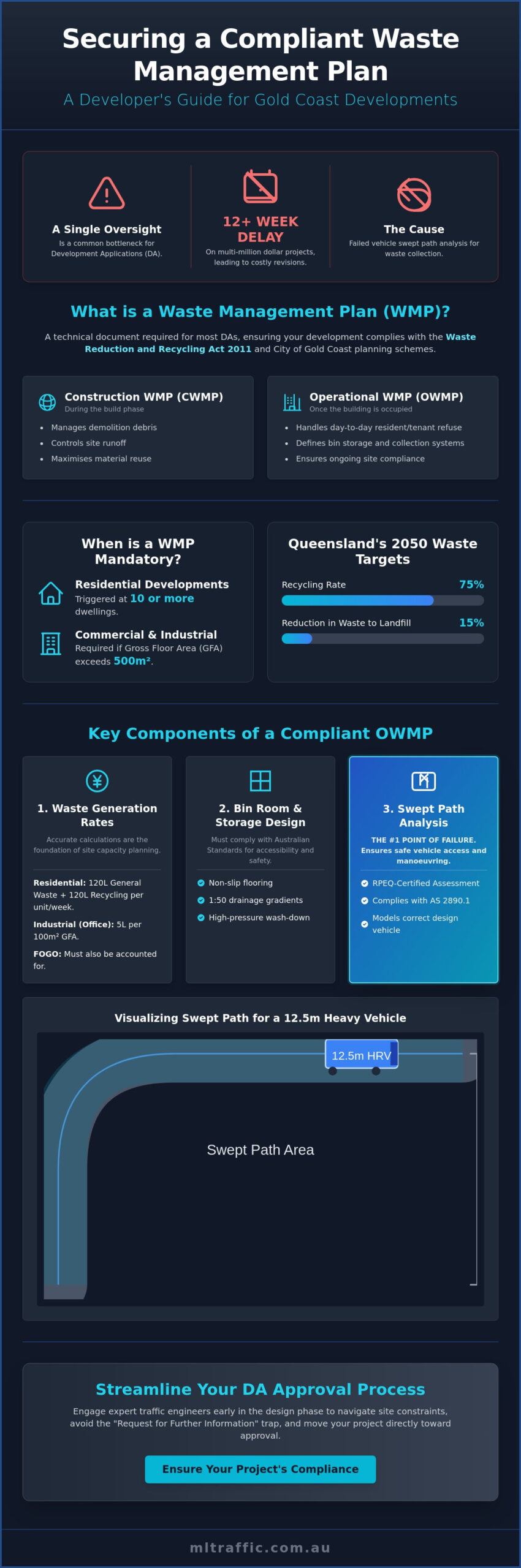
A single oversight in your vehicle swept path analysis can delay a multi-million dollar development by twelve weeks or more. You’ve likely experienced the frustration of a project stalling because a 12.5 metre heavy waste vehicle cannot safely manoeuvre on site according to Council’s strict 2024 guidelines. It’s a common bottleneck that turns a straightforward application into a cycle of costly revisions.
We understand that navigating the City of Gold Coast’s evolving waste reduction targets is a technical hurdle you’d rather clear on the first attempt. This guide provides the technical framework needed to secure a compliant waste management plan Gold Coast that satisfies both environmental standards and physical site constraints. We’ll examine the requirements for RPEQ-certified swept path assessments and the specific driveway ramp grades required by AS 2890.1. You’ll gain the insights necessary to avoid the "Request for Further Information" trap and move your project directly toward approval.
Key Takeaways
- Understand the technical requirements of a waste management plan Gold Coast to ensure your development complies with the Waste Reduction and Recycling Act 2011.
- Learn how to accurately calculate waste generation volumes and design storage facilities that meet specific council requirements for ventilation and wash-down.
- Identify why vehicle swept path analysis is the most common point of failure and how to select the correct design vehicle for site access.
- Discover the benefits of engaging traffic engineers early in the design phase to navigate site constraints and streamline the DA approval process.
- Find out how direct access to senior principals ensures your technical reports are handled by experienced experts rather than junior staff.
Table of Contents
-
What is a Waste Management Plan for Gold Coast Developments?
-
Essential Components of a Compliant Operational Waste Management Plan
What is a Waste Management Plan for Gold Coast Developments?
A waste management plan Gold Coast is a technical document required for most Development Applications (DAs) submitted to the City of Gold Coast. It details the specific systems for storing, managing, and collecting waste during both the construction phase and the ongoing operation of a site. This report ensures that the development aligns with the Waste Reduction and Recycling Act 2011 and the City of Gold Coast’s local planning schemes. By providing a clear strategy for waste management, developers demonstrate how they’ll handle refuse without compromising public health or local amenity.
To better understand what a comprehensive plan involves, watch this helpful video:
The City of Gold Coast requires these plans to meet specific diversion targets. Under the Queensland Waste Management and Resource Recovery Strategy, there’s a target to reduce waste to landfill by 15% and achieve a 75% recycling rate by 2050. A professional waste management plan Gold Coast separates waste into two distinct categories. Construction Waste Management Plans (CWMP) focus on demolition debris, site runoff, and material reuse during the build. Operational Waste Management Plans (OWMP) address the day-to-day refuse generated by residents or commercial tenants once the building is occupied.
When is a Waste Management Plan Mandatory?
Council mandates a WMP based on the scale and land-use of the project. For residential developments, this usually triggers at 10 or more dwellings. Commercial and industrial sites often require a report if they exceed 500 square metres of gross floor area. The complexity of the report increases with the land-use type. A high-rise apartment block requires more detailed chutes and compaction systems than a small warehouse. This document is a critical component of the broader Statement of Environmental Effects (SEE) required for DA approval.
Key Objectives of Australian Local Governments
Local authorities use WMPs to achieve several infrastructure and environmental goals:
-
Maximising resource recovery to meet the 70% diversion target for municipal solid waste.
-
Ensuring hygienic storage areas that prevent odour and pest issues.
-
Designing efficient collection cycles that don’t block traffic or create safety hazards.
-
Minimising noise disruption by calculating appropriate collection times and vehicle swept paths.
Our team at ML Traffic Engineers ensures every WMP meets these strict criteria to avoid RFI (Request for Information) delays from Council. We focus on providing practical, compliant solutions for private clients with their development applications.
Essential Components of a Compliant Operational Waste Management Plan
A professional waste management plan Gold Coast must align strictly with the City of Gold Coast (CoGC) Solid Waste Management Guidelines and relevant Australian Standards. It’s a technical blueprint that dictates how a building functions daily. Failure to address these components during the design phase leads to operational bottlenecks and potential DA refusals. Our approach focuses on data-driven calculations and spatial efficiency to ensure your project meets every regulatory hurdle.
Calculating Waste Generation Rates
Generation rates are the foundation of site capacity planning. For residential developments, CoGC typically requires specific volume allocations such as 120L for general waste and 120L for recycling per unit, per week. Industrial sites require a different metric, often calculated at 5L per 100sqm of Gross Floor Area (GFA) for office components and higher rates for manufacturing zones. You must also account for the emerging Food Organics and Garden Organics (FOGO) requirements, which increase the total bin footprint. Precise modeling prevents the health hazards associated with bin overflows.
Bin Room and Storage Area Design
Storage areas must comply with Australian Standards for accessibility and safety. The design requires non-slip flooring, 1:50 drainage gradients, and high-pressure wash-down facilities connected to the sewer. Integrated ventilation systems are mandatory to mitigate odors and maintain air quality. We ensure all rooms include:
-
Clear signage meeting CoGC color-coding standards.
-
Artificial lighting at a minimum of 80 lux.
-
Vermin-proof construction with tight-fitting doors.
-
Sufficient overhead clearance for bin maneuvering.
Integrating these spaces into the architectural aesthetic is vital. We work to conceal these functional zones without compromising the 1100L MGB (Mobile Garbage Bin) access paths. If you need assistance with spatial planning, our technical services include detailed waste facility layouts.
Collection Methodology
The choice between kerbside and on-site collection depends on the development’s scale and street frontage. Small-scale projects may utilize kerbside pickup if there’s enough curb space for the total bin count. Large developments require on-site collection. This necessitates a vehicle swept path analysis to prove a Heavy Rigid Vehicle (HRV) can enter and exit the site in a forward direction. Detailed turn-path templates are essential to confirm that the overhead clearance, often 4.5 meters, is sufficient for the collection arm to operate.
Management Responsibilities
Operational success depends on clear management workflows. The waste management plan Gold Coast must define who’s responsible for moving bins from the storage area to the collection point. In multi-story developments, this often involves a building manager using mechanical bin tugs or specialized lifts. For commercial tenants, the plan should outline the frequency of private contractor pickups. Defining these roles early ensures the site remains clean and compliant long after the occupancy permit is issued.
The Critical Link: Waste Collection and Swept Path Analysis
Vehicle access is the most frequent point of failure for a waste management plan Gold Coast. If a collection truck cannot physically navigate the site, the entire strategy collapses. Council assessors prioritize the safety of pedestrians and other motorists, meaning theoretical access isn’t enough. You must provide technical proof of maneuverability.
The design vehicle dictates the layout of your service area. For larger residential or commercial projects, the 10.2-metre Heavy Rigid Vehicle (HRV) is the standard benchmark. Smaller developments might utilize a 6.4-metre Small Waste Collection Vehicle (SRV) if site constraints are significant. All designs must adhere to AS 2890.2, which governs off-street commercial vehicle facilities. Our engineers use AutoTURN software to validate these movements. This software creates a digital simulation of the vehicle’s wheel paths and body overhangs, ensuring no part of the truck strikes a structural column or curb.
Ensuring Safe Entry and Exit
Safety standards dictate that vehicles must enter and exit the site in a forward direction. Reversing onto a public road is a high-risk maneuver that councils rarely approve for heavy vehicles. Vertical clearance is another critical factor, especially for basement collection. A standard HRV typically requires 4.5 metres of clear height, though specialized low-profile trucks can operate in tighter spaces. Detailed requirements are outlined in our Swept Path Analysis: A Developer’s Guide to Council Approval.
Loading Dock and Service Area Design
The loading dock must allow for efficient bin transfers without obstructing internal traffic flow. We analyze turning circles and limit reversing distances to ensure driver safety and operational speed. Driveway ramp grades are equally important. If a ramp is too steep, the heavy vehicle will scrape its undercarriage or rear bumper. Integrating swept path analysis during the early design phase is the most effective way to avoid these issues. It ensures your waste management plan Gold Coast is grounded in physical reality, preventing expensive structural modifications after the DA has been lodged.
-
Design Vehicles: HRV (10.2m) or SRV (6.4m) based on site scale.
-
Compliance: Strict adherence to AS 2890.2.
-
Software: AutoTURN validation for all maneuvers.
-
Ramp Grades: Specific assessments to prevent vehicle damage.
How to Prepare Your Site for Waste Management Approval
Securing approval for a waste management plan Gold Coast requires a systematic approach that aligns with the City of Gold Coast’s Solid Waste Management SC6.11 City Plan Policy. Developers often treat waste as an afterthought. This leads to costly redesigns when the Council identifies non-compliance during the DA stage. Follow these five steps to ensure your site is technically sound and ready for submission.
-
Step 1: Engage a traffic engineer early. You must assess site constraints before the architectural layout is locked. At ML Traffic Engineers, we identify potential access issues for Heavy Rigid Vehicles (HRVs) during the initial design phase to prevent structural conflicts later.
-
Step 2: Determine waste generation based on the final use-case. Calculation rates differ significantly between a 50-unit residential complex and a 200sqm commercial kitchen. We use specific generation rates to calculate the exact number of 240L, 660L, or 1100L bins required for your project.
-
Step 3: Map the internal waste journey. You need a clear path from the waste source to the bin storage area. This include assessing corridor widths, lift capacities, and the gradient of any ramps.
-
Step 4: Conduct swept path analysis. We use industry-standard software to simulate the movement of specific collection vehicles. This proves the truck can enter, turn, and exit the site in a forward gear without striking curbs or structures.
-
Step 5: Finalise the report for DA submission. The final Waste Management Plan (WMP) consolidates all calculations, swept paths, and operational procedures into a single professional document for Council assessment.
Common Pitfalls to Avoid in Your Submission
Many developers underestimate the physical footprint required for bin manoeuvring. You must provide enough space for a staff member to rotate and move bins without obstructing fire exits. Height is another critical failure point. Modern side-loading waste trucks require a minimum vertical clearance of 6.5 metres during the bin lift cycle. Finally, check your "bin tug" distances. Most collection contractors won’t pull a bin more than 15 metres from the storage area to the truck. If your distance exceeds this, you’ll need an on-site collection strategy.
Coordinating with Other Technical Reports
Your WMP cannot exist in a vacuum. It must be perfectly aligned with your Traffic Impact Assessment to ensure vehicle movements are consistent across all reports. Discrepancies between the WMP and the landscape or stormwater plans will trigger a Request for Further Information (RFI) from the Council. For instance, a proposed street tree cannot block the overhead clearance required for a waste truck. A unified engineering approach is the most reliable way to achieve DA success on the Gold Coast.
The engineer who provides your quote is the person who does the work. Contact our senior consultants to finalise your waste management plan Gold Coast today.
Expert Engineering Support for Your Development Reports
ML Traffic Engineers provides a distinct advantage for developers through over 15 years of national experience. Since we began trading in 2005, our team has completed more than 10,000 successful site assessments across various sectors. We don’t use junior staff for critical reporting. The senior principal who quotes your project is the person who performs the engineering analysis. This direct accountability ensures that your waste management plan Gold Coast is technically sound and ready for Council scrutiny.
Our expertise spans a comprehensive range of development types, including:
-
Residential apartments, townhouses, and mixed-use towers
-
Childcare centres, schools, and educational facilities
-
Medical centres, hospitals, and allied health hubs
-
Industrial warehouses, showrooms, and factories
-
Shopping centres, retail strips, and supermarkets
-
Service stations, fast food outlets, and car washes
We coordinate every technical aspect required for a successful DA, from Traffic Impact Assessments (TIA) to detailed Swept Path Analysis and operational waste management strategies.
Why Professional Certification Matters
Reducing the risk of Council RFIs is essential for maintaining project timelines. An incomplete or non-compliant report can cause delays of 4 to 8 weeks, impacting your financing and construction schedules. We ensure full compliance with Australian Standards, including AS 2890.1 for off-street car parking and AS 2890.2 for commercial vehicle facilities. This technical rigor is why developers trust our ML Traffic Engineers Services for complex submissions. We focus on getting the engineering right the first time so your project stays on track.
Streamlining Your Planning Approval
Modern developments frequently involve tight access points and difficult site layouts that complicate waste collection. We specialize in solving these spatial challenges through precise Vehicle Swept Path Assessments. Our engineers simulate the exact movements of heavy rigid vehicles to prove they can maneuver safely within your site boundaries. This level of detail is a core component of a high-quality waste management plan Gold Coast.
We offer an accountable, results-oriented consultancy. You’ll have direct access to our senior principals, Michael Lee or Benny Chen, both of whom bring between 30 and 40 years of industry experience to your project. This no-gatekeepers approach means you get technical answers immediately. Contact our team today for a direct quote to secure your planning approval without unnecessary complications.
Secure Your Development Approval with Technical Waste Planning
Achieving DA approval requires a precise waste management plan Gold Coast councils can verify. Success depends on integrating operational components like bin storage capacity with engineering requirements like swept path analysis. Without accurate vehicle maneuvering data, your project risks rejection or expensive late-stage redesigns. It’s essential to address these logistics early to maintain your development timeline and ensure compliance with Australian Standards.
ML Traffic Engineers brings over 15 years of industry experience to your project. We’ve assessed more than 10,000 sites, providing the technical data needed for complex approvals. You’ll have direct access to our principal engineers throughout the process. We operate on a simple principle: the traffic consultant who provides the quote, does the work. This ensures accountability and high-level expertise on every site assessment. Our team understands the specific bureaucratic requirements of Australian local authorities and delivers compliant, fact-based solutions.
Get a professional Traffic and Waste Assessment for your Gold Coast project today. Move your development forward with confidence.
Frequently Asked Questions
What is an Operational Waste Management Plan (OWMP)?
An OWMP is a technical document that details how waste and recycling will be managed once a development is occupied. It outlines the types of waste generated, the number of bins required, and the specific collection logistics for the site. This report ensures your project complies with the City of Gold Coast Solid Waste Management Guidelines and the SC6.13 City Plan policy.
Do I need a separate Waste Management Plan for a small subdivision?
Yes, you typically need a waste management plan Gold Coast for most subdivisions to prove that collection vehicles can safely access the new lots. Even for a simple two-lot split, Council requires evidence that bin presentation won’t block pedestrian footpaths or create traffic hazards. We provide the necessary site diagrams to satisfy these specific DA conditions.
What vehicle size should I use for swept path analysis in waste planning?
You must use a 12.5-meter Heavy Rigid Vehicle (HRV) as the standard design vehicle for most Gold Coast multi-residential and commercial developments. In some restricted cases, Council might allow a 10.5-meter Medium Rigid Vehicle (MRV) if site constraints are proven. Our engineers use specialized software to ensure these specific vehicles can navigate your site layout without hitting curbs or structures.
Can garbage trucks reverse on a public road to access my site?
No, the City of Gold Coast strictly prohibits waste collection vehicles from reversing on or off a public road. All developments must be designed so the truck can enter and exit the site in a forward gear. This usually requires an on-site turnaround area or a drive-through configuration that meets AS 2890.2 standards for heavy vehicles.
How do I calculate how many bins my development will need?
Bin numbers are calculated using the waste generation rates specified in the City of Gold Coast SC6.13 City Plan policy. For a standard residential unit, you’ll typically need to account for 120 litres of general waste and 120 litres of recycling per week. We multiply these rates by your total number of dwellings to determine if you need individual 240-litre wheelie bins or larger 1,100-litre bulk bins.
What happens if my Waste Management Plan is rejected by Council?
If your plan is rejected, Council will issue an Information Request (IR) identifying the specific areas of non-compliance. You generally have a 3-month window to submit an amended report addressing these technical concerns. Most rejections occur due to incorrect swept path assessments or insufficient bin storage space for the calculated waste volume.
Is a Waste Management Plan the same as a Traffic Management Plan?
No, these are two different documents. A Traffic Management Plan (TMP) deals with vehicle movements and safety during the construction phase of the project. A waste management plan Gold Coast focuses on the permanent, day-to-day logistics of waste disposal and collection once the building is finished and residents have moved in.
How long does it take to prepare a compliant waste report?
A standard compliant waste report takes between 5 and 10 business days to complete once we have your final architectural drawings. This timeline allows our team to perform the necessary volume calculations and run the swept path simulations. Complex mixed-use developments with high waste outputs may require additional time for detailed design coordination.
Which areas do you cover?
We are traffic engineers servicing Advancetown, Alberton, Arundel, Ashmore, Austinville, Beechmont, Benobble, Benowa, Biddaddaba, Biggera Waters, Bilinga, Birnam, Bonogin, Broadbeach, Broadbeach Waters, Bundall, Burleigh Heads, Burleigh Waters, Carrara, Cedar Creek, Clagiraba, Clear Island Waters, Coolangatta, Coombabah, Coomera, Currumbin, Currumbin Valley, Currumbin Waters, Elanora, Gaven, Gilberton, Gilston, Guanaba, Helensvale, Highland Park, Hollywell, Hope Island, Jacobs Well, Kingsholme, Labrador, Lower Beechmont, Luscombe, Main Beach, Maudsland, Mermaid Beach, Mermaid Waters, Merrimac, Miami, Molendinar, Mount Nathan, Mudgeeraba, Natural Bridge, Nerang, Neranwood, Norwell, Numinbah Valley, Ormeau, Ormeau Hills, Oxenford, Pacific Pines, Palm Beach, Paradise Point, Parkwood, Pimpama, Reedy Creek, Robina, Runaway Bay, South Stradbroke, Southport, Southern Moreton Bay Islands, Springbrook, Stapylton, Steiglitz, Surfers Paradise, Tallai, Tallebudgera, Tallebudgera Valley, Tugun, Upper Coomera, Varsity Lakes, Willow Vale, Wongawallan, Woongoolba, Worongary, Yatala

Disclaimer
The content on www.mltraffic.com.au, including all technical articles, guides, and resources, is provided for general informational and educational purposes only. It is not intended to constitute professional advice in traffic engineering, transportation planning, development approvals, or any other technical or legal field.
While ML Traffic Engineers makes every reasonable effort to ensure the accuracy, completeness, and timeliness of the information published, we do not provide any warranties or representations (express or implied) regarding its reliability, suitability, or availability for any particular purpose. Any reliance you place on the content is strictly at your own risk.
In no event shall ML Traffic Engineers, its directors, employees, authors, or affiliates be liable for any direct, indirect, incidental, special, consequential, or punitive damages (including, without limitation, loss of profits, data, or business opportunities) arising out of or in connection with the use of, or inability to use, any information provided on this website.
The articles and guides on this site are not a substitute for engaging a qualified, registered professional traffic engineer (such as an NPER or RPEQ engineer) to assess your specific project requirements. For tailored advice, compliance assessments, or traffic engineering services, please contact a competent professional.
This disclaimer may be updated from time to time without notice. By accessing or using this website, you agree to be bound by the most current version of this disclaimer.
