

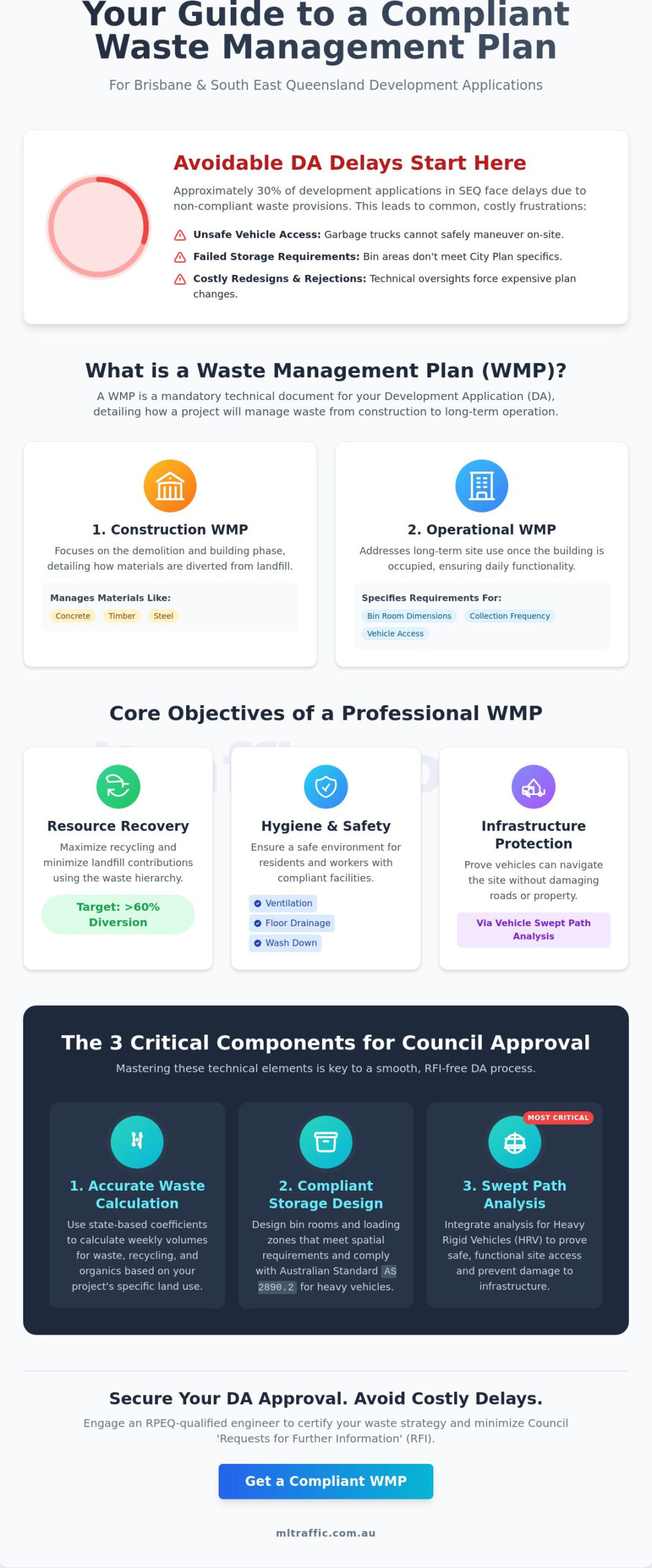
Did you know that approximately 30% of multi-residential and commercial development applications in South East Queensland face avoidable delays due to non-compliant waste provisions? It’s a common frustration for developers when a project stalls because a garbage truck cannot safely maneuver on-site or because bin storage areas fail to meet the City Plan’s specific requirements. You understand that every square metre of your site is valuable, and a technical oversight in your waste management plan Brisbane submission can result in costly redesigns and council rejections.
This guide provides the technical expertise you need to develop a compliant Waste Management Plan (WMP) that satisfies council requirements and ensures seamless vehicle access. We’ll show you how to calculate waste generation rates accurately and design for efficient site use. You will gain a clear understanding of the operational differences between private and council collection, the necessity of vehicle swept path assessments, and the steps required to secure a council-approved WMP for your next project.
Key Takeaways
- Understand how a professional waste management plan Brisbane developers require ensures your Development Application (DA) aligns with council-specific storage and collection mandates.
- Learn to accurately calculate waste generation rates for residential, retail, and industrial land uses using precise state-based coefficients.
- Identify the spatial requirements for bin storage rooms and ensure your loading zones comply with AS 2890.2 standards for heavy vehicles.
- Discover why integrating swept path analysis for Heavy Rigid Vehicles (HRV) is the most critical technical component for proving safe and functional site access.
- Minimize the risk of Council ‘Requests for Further Information’ (RFI) by engaging an RPEQ-qualified engineer to certify your waste strategy.
Table of Contents
-
What is a Waste Management Plan (WMP) and Why is it Essential?
-
How to Calculate Waste Generation Rates for Your Development
-
Securing Council Approval for Your Waste Management Strategy
What is a Waste Management Plan (WMP) and Why is it Essential?
A Waste Management Plan (WMP) is a technical document that details how a development will handle the generation, storage, and collection of waste and recyclables. Understanding What is a Waste Management Plan (WMP) is vital for developers because it’s a mandatory component of the Development Application (DA) process across Australia. For a waste management plan Brisbane councils require, the document must align with the Brisbane City Council (BCC) City Plan 2014 and specific waste utility guidelines to ensure the site remains functional and compliant.
To better understand how waste processes integrate with local city infrastructure, watch this video from the Brisbane City Council:
Developers must distinguish between two distinct phases of a project. A Construction WMP focuses on the demolition and building period, detailing how materials like concrete, timber, and steel are diverted from landfill. An Operational WMP addresses the long term use of the site. It specifies bin room dimensions, collection frequencies, and vehicle access requirements once the building is occupied. Councils demand professional certification for medium to high density projects to guarantee that these strategies are practical. Without accurate waste calculations, a building may face significant operational failures, such as overflowing bins or inaccessible collection points.
The Core Objectives of a Professional WMP
-
Resource Recovery: Professionals use the waste hierarchy to maximize recycling and minimize landfill contributions, often aiming for state mandated diversion targets of 60% or higher.
-
Hygiene and Safety: Plans ensure bin rooms include adequate ventilation, floor drainage, and wash down facilities to maintain a safe environment for residents.
-
Infrastructure Protection: We use vehicle swept path analysis to prove that heavy rigid vehicles (HRVs) can navigate the site without damaging the local road network or internal driveways.
When Does Your Project Require a Professional WMP?
Thresholds for requiring a waste management plan Brisbane often depend on the scale and land use type. Multi unit residential developments with more than 3 dwellings typically trigger the requirement. Commercial precincts exceeding 500 square meters of Gross Floor Area (GFA) also need a formal assessment. Mixed use sites are particularly complex because they involve competing waste streams. For instance, a retail tenant’s organic waste must be managed separately from a resident’s comingled recycling to prevent contamination. If you’re planning a complex development, Learn more about our traffic and waste services to ensure your DA meets all regulatory standards.
How to Calculate Waste Generation Rates for Your Development
Accurate calculations form the technical foundation of a compliant
**waste management plan Brisbane
**developers must submit for council approval. You must categorize the development into specific land-use types, such as Residential, Retail, Office, or Industrial, as each has distinct output profiles. Brisbane City Council and other South East Queensland authorities provide specific coefficients to estimate these volumes. For instance, a retail space generates waste at a different rate than a high-density apartment complex. A waste generation rate is the volume produced per unit of measure over time.
The
[Waste Management Plan Guide
](https://seqmayors.qld.gov.au/initiatives/seq-waste-management-plan)published by the Council of Mayors (SEQ) provides a regional framework that informs these local standards. You must calculate the total weekly volume for general waste, commingled recycling, and organic streams. Collection frequency directly impacts bin requirements; a twice-weekly collection reduces the physical bin count needed on-site compared to a standard weekly service.
Step 1: Assessing Land Use and Occupancy
Residential assessments require a breakdown by bedroom count. A three-bedroom unit generates more waste than a studio; council guidelines often allocate specific liters per unit based on this occupancy. Commercial waste calculations rely on Gross Floor Area (GFA). For example, an office may require 10L of general waste per 100sqm of GFA per day, whereas a restaurant might require 50L per 100sqm. Our team at ML Traffic Engineers ensures these figures align with current regulatory benchmarks to prevent site under-performance.
Step 2: Selecting the Appropriate Bin Sizes
Once you establish the weekly volume, you must select bin hardware that fits the building’s operational constraints. Standard Mobile Garbage Bins (MGBs) include:
-
240L MGB: Standard size for low-density or specialized streams.
-
660L MGB: Common for medium-density residential and small retail.
-
1100L MGB: Preferred for high-volume commercial and large residential developments.
Each bin type requires a specific spatial footprint. An 1100L bin typically measures 1240mm by 1070mm. You must allow for maneuvering space within the bin storage room to ensure waste contractors can safely rotate and move bins to the collection point. Designing for a 1.2-meter clearance between rows of bins is a common industry standard to prevent operational bottlenecks. If you require technical assistance with layout design, view our engineering services for detailed site planning and compliance support.
Designing Functional Waste Storage and Collection Areas
Designing a compliant storage area requires more than just allocating floor space. For a waste management plan Brisbane developers must adhere to specific spatial requirements defined by the number of residential units or the gross floor area of commercial tenancies. Bin rooms must accommodate the full inventory of general waste, recycling, and organic bins while allowing a 150mm gap between containers for easy maneuverability. All facilities must feature non-absorbent floors graded to a central floor waste, connected to the sewerage system under a Trade Waste agreement where required.
Ventilation is a mandatory requirement to manage odors and safety. Natural ventilation requires openings equal to 5% of the floor area, while internal rooms need mechanical exhaust systems compliant with AS 1668.2. For mixed-use developments, waste streams must remain segregated. Commercial tenants shouldn’t share bin storage with residents to prevent cost disputes and contamination of recycling streams. Security is maintained through keyed access or electronic fobs, ensuring only authorized users access the area while maintaining equitable access for people with disabilities.
Bin Room Layout and Accessibility
Efficiency starts with the user’s journey. Residents shouldn’t travel more than 30 meters from their door to a waste disposal point. If your site uses a centralized bin room, the path must be unobstructed and level. Doorways must provide a clear opening of at least 1.5 meters to accommodate 1100L bins. When moving bins to a collection point, the maximum allowable ramp grade is 1:14 for manual handling. Steeper grades require motorized tugs or specialized equipment. For detailed guidance on integrating these requirements into your site’s broader traffic flow, refer to our Guide to AS 2890.1 and Parking Design.
Collection Point Logistics: On-Street vs. On-Site
Brisbane City Council generally prefers on-site collection for developments exceeding 10 dwellings or significant commercial footprints. On-site collection areas must comply with AS 2890.2 for heavy vehicle loading. This requires a dedicated loading bay that doesn’t obstruct traffic or pedestrian sightlines. Architects must design ‘Reversing Bays’ or ‘Turnaround Areas’ that allow waste vehicles to enter and exit the site in a forward direction. A three-point turn is the maximum acceptable maneuver for a Heavy Rigid Vehicle (HRV).
Height clearance is a common point of failure in a waste management plan Brisbane. You need a minimum of 4.5 meters of clear headway throughout the vehicle’s path. This clearance must be measured from the lowest point, including fire sprinklers, cable trays, and service pipes. If the site relies on on-street collection, the designated ‘bin presentation area’ must provide at least 1 meter of clear space per bin along the kerbside, situated away from intersections, bus stops, and street trees.
Integrating Swept Path Analysis for Waste Vehicle Access
Swept path analysis represents the most critical technical component of a waste management plan Brisbane developers submit to Council. It provides empirical proof that a specific vehicle can safely enter, circulate, and exit a site in a forward gear. Without this simulation, a development application risks immediate rejection due to safety and operational concerns. We map movements for both Heavy Rigid Vehicles (HRV), typically 12.5 metres in length, and Small Rigid Vehicles (SRV) based on the project’s specific collection needs.
Identifying ‘pinch points’ in driveway design is a primary objective. These are areas where the vehicle’s body or tail-swing might strike structural columns, walls, or parked cars. We also ensure compliance with sight distance requirements as defined in AS 2890.1. A truck exiting a site must have an unobstructed view of pedestrians and oncoming traffic to prevent collisions. If the driveway geometry doesn’t allow for these margins, the waste management strategy isn’t viable.
Simulating Waste Truck Movements
Our engineers use AutoTURN software to verify entry and exit maneuvers with precision. This simulation goes beyond basic tyre tracks. It accounts for the vehicle’s overhead clearance and the physical space required for bin lifter clearance and stabilizer leg deployment. If the simulation shows a 0.1-metre overlap with a structural element, the design fails. For a deeper technical breakdown, read our Complete Guide to Swept Path Analysis.
Common Access Mistakes in Development Design
Insufficient vertical clearance is a frequent error in Brisbane developments. Rear-loading and side-loading trucks often require a minimum of 4.5 metres of clear height to operate hydraulic arms and lift bins safely. If a basement ceiling is too low, the truck can’t service the site. Ramp grades also pose challenges. Grades that exceed 15% without appropriate transitions cause heavy collection vehicles to bottom out or lose traction. A swept path must account for both the vehicle body and the ‘bin swing’ radius.
If your project needs a waste management plan Brisbane assessors will accept, contact our senior engineers to book a swept path assessment today.
Securing Council Approval for Your Waste Management Strategy
Engaging a Registered Professional Engineer of Queensland (RPEQ) is a critical step for any development application. A professional waste management plan Brisbane councils will approve requires more than basic bin counts. It demands technical validation of vehicle access and storage logistics. When an RPEQ signs off on your strategy, it provides assessors with immediate confidence that the design complies with Australian Standards such as AS 2890.2. This technical weight is often the difference between a swift approval and a stalled project.
Councils frequently issue a Request for Further Information (RFI) when submissions lack detail on overhead clearances or bin presentation areas. Addressing these technicalities early prevents the 28-day assessment clock from restarting, saving weeks of project time. Beyond compliance, a professional WMP reduces long-term operational costs. Optimizing collection frequencies and bin sizes can reduce annual waste service fees by 15% to 20%. This ensures the developer isn’t paying for oversized systems that remain half-empty.
ML Traffic Engineers offers a direct, accountable service model. The engineer who provides your quote is the same senior consultant who performs the technical work. This eliminates the risk of information loss between sales staff and junior drafters. With over 30 years of experience, we ensure every technical detail is handled by a seasoned expert who understands the nuances of local regulations.
Navigating Local Government Requirements
Each local government area in South East Queensland maintains specific waste utility bylaws that dictate how refuse is stored and collected. Your WMP must integrate seamlessly with the Statement of Environmental Effects to prove the development won’t negatively impact local amenity. We specialize in aligning these strategies with specific council expectations for industrial, commercial, and high-density residential sites. You can contact our expert engineers for a WMP quote to ensure your project meets these localized standards.
Final Checklist for a Compliant Submission
A compliant waste management plan Brisbane submission must be data-driven and technically sound. Before lodging your application, verify that the WMP aligns perfectly with the Traffic Impact Assessment (TIA) to avoid conflicting data. Use the following checklist to ensure all technical bases are covered:
-
Bin Verification: Precise calculation of bin numbers and storage dimensions based on specific land-use yield rates.
-
Collection Frequency: Defined pickup schedules that prevent overflow while maintaining cost efficiency.
-
Swept Path Analysis: Certified swept path diagrams showing the design vehicle, typically a Heavy Rigid Vehicle (HRV), navigating the site safely.
-
Operational Alignment: Confirmation that driveway grades and sight-line assessments support the weight and dimensions of collection trucks.
Our meticulous approach ensures that your waste strategy is not just a document for approval, but a functional blueprint for the life of the building. We focus on practical, results-oriented engineering that satisfies both council requirements and developer budgets.
Secure Your Development Approval with a Compliant Waste Strategy
Navigating local council requirements demands technical precision. Your development’s success relies on accurate waste generation calculations and functional storage area design. Overlooking vehicle access requirements often leads to rejected applications. By integrating professional swept path analysis early, you ensure waste collection vehicles can navigate your site without safety risks or structural conflicts. This proactive approach prevents costly redesigns during the construction phase.
ML Traffic Engineers brings over 15 years of experience in traffic and waste consultancy to your project. We’ve successfully assessed more than 10,000 sites across Australia, providing reliable data for diverse land uses. You’ll have direct access to senior engineers Michael Lee and Benny Chen throughout the process. Our firm operates on a clear principle: the consultant who provides your quote is the expert who does the work. This hands-on accountability ensures your waste management plan Brisbane meets all technical standards and local planning codes.
Get a professional Waste Management Plan for your development from ML Traffic Engineers
We’re ready to help you move your project through the approval process with confidence and technical certainty.
Frequently Asked Questions
What is the difference between a residential and commercial Waste Management Plan?
Residential plans focus on domestic waste streams like general refuse, recycling, and organic matter based on per-unit generation rates. Commercial plans prioritize high-volume waste specific to the business type, such as cardboard balers for retail or grease traps for food services. Brisbane City Council’s City Plan 2014 sets distinct bin ratios and collection frequencies for each specific land-use category.
When is on-site waste collection mandatory for a development?
On-site collection is mandatory when a development’s waste volume exceeds kerbside capacity or when roadside collection poses safety risks to pedestrians and traffic. This typically applies to residential projects with more than 10 dwellings or any site where a 12.5 metre Heavy Rigid Vehicle cannot safely stop on the street. We use AS 2890.2 standards to determine if your site requires internal loading bays.
How do I calculate the number of bins required for my apartment project?
Calculating the number of bins for a waste management plan Brisbane requires applying the generation rates found in the BCC Waste Smart Development Guide. For a standard multi-unit dwelling, you should allow for 240 litres of general waste and 240 litres of recycling per unit per week. Our engineers use these exact figures to ensure your bin storage room meets the minimum square metre requirements for council approval.
What are the standard dimensions for a garbage truck swept path?
A standard Heavy Rigid Vehicle (HRV) used for waste collection is 12.5 metres long and requires a minimum vertical clearance of 4.5 metres. We perform a Vehicle Swept Path Assessment to prove the truck can enter and exit the site in a forward direction with a 12.5 metre turning radius. This technical data is essential for any DA that doesn’t rely on standard kerbside pickup.
Can a Waste Management Plan be combined with a Traffic Impact Assessment?
Yes, integrating these documents is often the most efficient approach for a Development Application. Since waste collection directly impacts driveway grades, turn-around areas, and parking layouts, combining them ensures consistency across your technical reports. At ML Traffic Engineers, the consultant who provides your quote does the work, ensuring your traffic and waste strategies align perfectly without conflicting data.
What happens if my development doesn’t meet council waste requirements?
Council will issue an Information Request (IR) under the Planning Act 2016 if your plan is non-compliant. This process typically delays a project by 20 to 40 business days and adds unnecessary costs to the application phase. If the site layout can’t accommodate the required 12.5 metre HRV swept path, you might be forced to redesign the entire ground floor or basement level.
Who is qualified to prepare a Waste Management Plan for a DA?
Qualified traffic engineers or environmental consultants with experience in local government planning schemes should prepare these plans. For complex sites in Queensland, an RPEQ (Registered Professional Engineer of Queensland) certification is often necessary to sign off on the Vehicle Swept Path Assessment. Our team has over 20 years of experience ensuring every waste management plan Brisbane meets these rigorous technical standards.
Do I need a separate plan for construction waste and operational waste?
Yes, these are two distinct requirements for your DA. A Construction Waste Management Plan (CWMP) details how you’ll handle debris and recycling during the build phase, often targeting a 90% resource recovery rate. An Operational Waste Management Plan (OWMP) focuses on the building’s long-term use. You must submit the OWMP during the initial application, while the CWMP is often a condition of approval before works start.
Which areas do you cover?
We are traffic engineers servicing Brisbane, Brisbane City, Fortitude Valley, New Farm, Teneriffe, Kangaroo Point, East Brisbane, South Brisbane, West End, Highgate Hill, Dutton Park, Woolloongabba, Ascot, Clayfield, Albion, Bowen Hills, Newstead, Bulimba, Hawthorne, Morningside, Balmoral, Indooroopilly, Taringa, Toowong, Auchenflower, Milton, Paddington, Red Hill, Bardon, Ashgrove, The Gap, Enoggera, Mitchelton, Aspley, Chermside, Kedron, Stafford, Everton Park, Gordon Park, Wilston, Grange, Alderley, Kelvin Grove, Herston, Lutwyche, Windsor, Nundah, Wavell Heights, Chermside West, Zillmere, Carseldine, Bald Hills, Bracken Ridge, Brighton, Sandgate, Shorncliffe, Deagon, Taigum, Fitzgibbon, Boondall, Virginia, Banyo, Nudgee, Northgate, Hamilton, Hendra, Eagle Farm, Murarrie, Cannon Hill, Seven Hills, Norman Park, Coorparoo, Camp Hill, Carina, Carindale, Mount Gravatt, Upper Mount Gravatt, Mansfield, MacGregor, Robertson, Sunnybank, Sunnybank Hills, Acacia Ridge, Inala, Oxley, Corinda, Graceville, Sherwood, Yeronga, Annerley, Moorooka, Tarragindi, Holland Park, Holland Park West, Coopers Plains, Greenslopes, Fairfield, Yeerongpilly, Stones Corner, Wynnum, Wynnum West, Manly, Manly West, Tingalpa, Hemmant, Lota, Wakerley, Rochedale, Eight Mile Plains, Runcorn, Calamvale, Parkinson, Algester, Doolandella, Forest Lake, Richlands, Darra, Wacol, Archerfield, Rocklea, Salisbury, Nathan, Mount Gravatt East, Wishart, Karawatha, Stretton, Kuraby, Belmont, Chandler, Gumdale, Lytton, Port of Brisbane, Kenmore, Jindalee, Mount Ommaney, Sinnamon Park, Fig Tree Pocket, Chapel Hill, St Lucia, Petrie Terrace, Spring Hill, Wooloowin, Newmarket, Gaythorne, Keperra, Ferny Grove, Upper Kedron, Bridgeman Downs, McDowall, Stafford Heights, Geebung, Pinkenba, Brisbane Airport, Nudgee Beach, Kalinga, Albion (duplicate avoided), Anstead, Bellbowrie, Brookfield, Chelmer, Chuwar, England Creek, Enoggera Reservoir, Jamboree Heights, Karana Downs, Kenmore Hills, Kholo, Lake Manchester, Middle Park, Moggill, Mount Coot-tha, Mount Crosby, Pinjarra Hills, Pullenvale, Riverhills, Seventeen Mile Rocks, Upper Brookfield, Westlake, Banks Creek, Burbank, Drewvale, Durack, Ellen Grove, Heathwood, Larapinta, Mackenzie, Pallara, Sumner, Tennyson, Willawong, Carina Heights, Ransome, Cannon Hill (duplicate avoided), Carindale, Manly, Moreton Island, Bulwer, Cowan Cowan, Kooringal.
Can you help with developments outside of Brisbane, like the Gold Coast or Sunshine Coast?
Yes. While we have deep expertise in Brisbane, our senior engineers have extensive experience securing DA approvals with councils across Queensland, including the Gold Coast, Sunshine Coast, Moreton Bay, Logan, and Ipswich.

Disclaimer
The content on www.mltraffic.com.au, including all technical articles, guides, and resources, is provided for general informational and educational purposes only. It is not intended to constitute professional advice in traffic engineering, transportation planning, development approvals, or any other technical or legal field.
While ML Traffic Engineers makes every reasonable effort to ensure the accuracy, completeness, and timeliness of the information published, we do not provide any warranties or representations (express or implied) regarding its reliability, suitability, or availability for any particular purpose. Any reliance you place on the content is strictly at your own risk.
In no event shall ML Traffic Engineers, its directors, employees, authors, or affiliates be liable for any direct, indirect, incidental, special, consequential, or punitive damages (including, without limitation, loss of profits, data, or business opportunities) arising out of or in connection with the use of, or inability to use, any information provided on this website.
The articles and guides on this site are not a substitute for engaging a qualified, registered professional traffic engineer (such as an NPER or RPEQ engineer) to assess your specific project requirements. For tailored advice, compliance assessments, or traffic engineering services, please contact a competent professional.
This disclaimer may be updated from time to time without notice. By accessing or using this website, you agree to be bound by the most current version of this disclaimer.
