

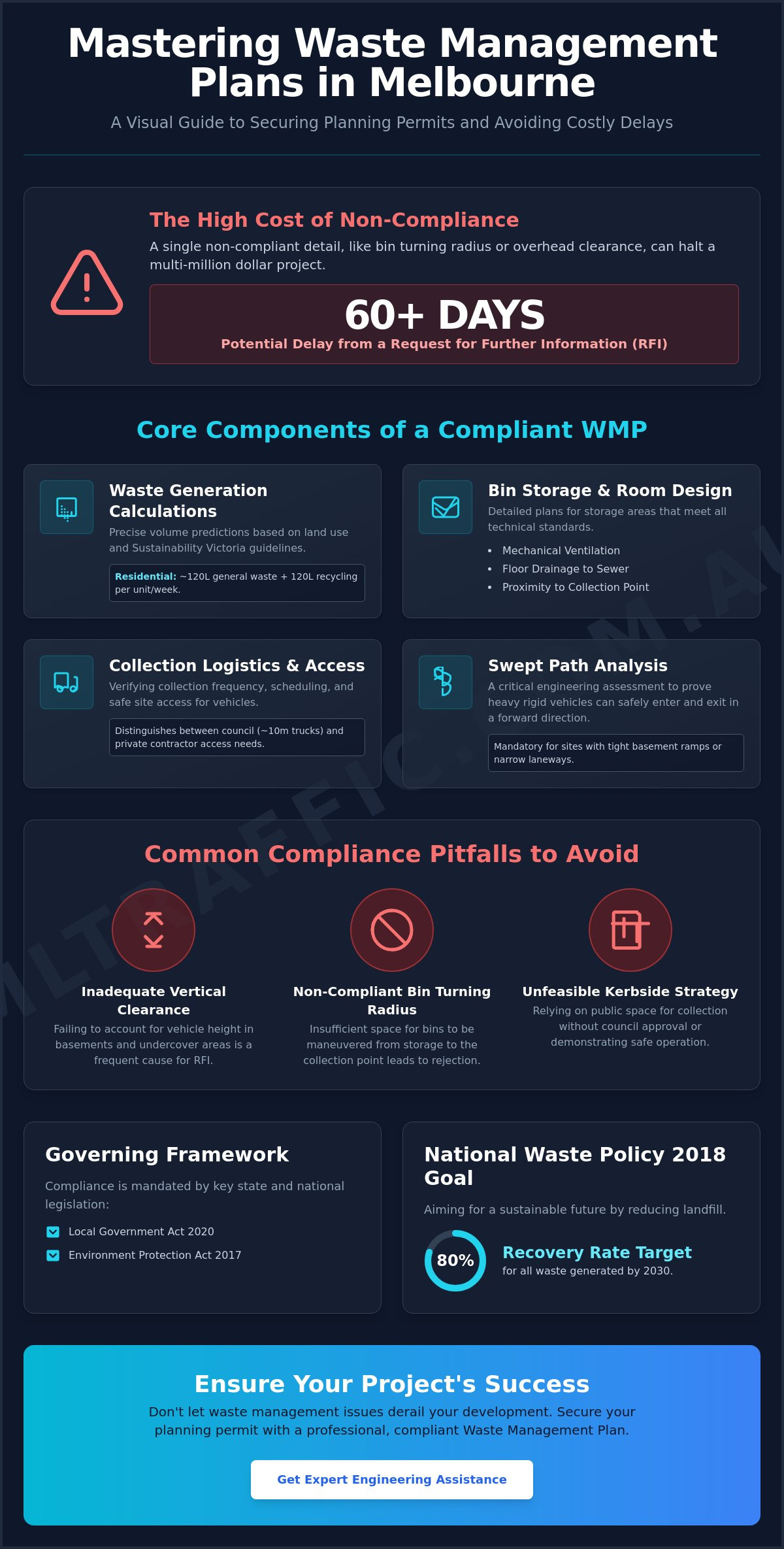
A single non-compliant bin turning radius or an overlooked overhead clearance height can stall a multi-million dollar development for 60 days or more during the Request for Further Information (RFI) stage. You likely understand that securing a planning permit in Victoria requires more than just a conceptual layout. It demands a precise waste management plan Melbourne councils can verify against specific technical benchmarks and Australian Standards like AS 2890.1. Coordinating heavy rigid vehicle access within limited site footprints is often the most difficult hurdle in the modern design phase.
This article provides the technical roadmap you need to master these requirements and ensure your development meets all regulatory criteria from the outset. You’ll gain the expertise to integrate waste services seamlessly into your site plan, preventing costly redesigns and fast-tracking your approval process without bureaucratic delays. We’ll examine the critical engineering specifications for bin room ventilation, vehicle swept path assessments, and the specific nuances found across Melbourne’s 31 local government areas.
Key Takeaways
- Understand the mandatory role a waste management plan Melbourne plays in securing planning permits for residential, commercial, and mixed-use developments.
- Identify essential technical requirements for bin storage rooms, including specific standards for ventilation, drainage, and collection point proximity.
- Learn how Swept Path Analysis functions as a critical engineering tool to verify heavy vehicle access and onsite collection feasibility.
- Avoid common compliance failures such as inadequate vertical clearance in basement areas and non-compliant kerbside collection strategies.
- Streamline the DA process by utilizing integrated traffic and waste reports designed to meet rigorous council and Australian Standards.
Table of Contents
-
What is a Waste Management Plan (WMP) and Why is it Required?
-
The Engineering Intersection: Waste, Traffic, and Swept Paths
What is a Waste Management Plan (WMP) and Why is it Required?
A Waste Management Plan (WMP) is a technical document that details how a building manages its waste streams from generation to final disposal. It’s a mandatory requirement for most planning permit applications in Victoria, covering residential, commercial, and mixed-use developments. The document provides a framework for Waste management that prioritizes resource recovery, public health, and operational safety. By outlining bin storage, collection methods, and transport routes, a WMP ensures that a development functions efficiently without impacting the surrounding neighborhood.
To better understand the practical implementation of these strategies in an urban context, watch this video from the City of Melbourne:
Councils mandate a waste management plan Melbourne to prevent common issues like illegal dumping and inadequate bin storage. These plans provide certainty that municipal or private services can access the site safely. For developers, a professional WMP is a tool to demonstrate compliance with the Victorian Waste and Resource Recovery Infrastructure Planning Framework. It ensures that waste volumes are calculated accurately based on the specific land-use, whether it involves apartments, retail spaces, or warehouses.
The Legal Framework and Compliance Standards
Waste management in Victoria is governed by the Local Government Act 2020 and the Environment Protection Act 2017. These laws support Australia’s National Waste Policy 2018, which targets an 80% recovery rate for all waste generated by 2030. A professional plan must distinguish between council-provided services and private contractors. Many urban sites require private collection because council trucks, which are often 10 metres long, cannot navigate tight basement ramps or narrow laneways. We ensure every waste management plan Melbourne meets these specific logistical constraints.
When Does Your Project Need a Professional WMP?
While requirements vary between municipalities, most councils trigger the need for a WMP when a project exceeds 10 residential dwellings or a commercial floor area of 500 square metres. Mixed-use developments face the most intense scrutiny from planning authorities. These sites must manage conflicting waste streams, such as food waste from restaurants and general rubbish from residents, without cross-contamination. Relying on generic templates often results in permit refusals. Professional assessments include vehicle swept path analysis to prove that collection trucks can enter and exit the site in a forward direction, as required by many Victorian planning schemes. For expert assistance with your application, you can view our engineering services or contact our senior consultants directly.
Core Components of a Compliant Waste Management Plan
A compliant waste management plan Melbourne councils approve must include precise technical data. It isn’t a generic document; it’s a detailed engineering report that dictates how a building operates daily. Every plan must specify land use types, calculated waste generation volumes, and the exact number of bins required. We ensure these figures align with the Sustainability Victoria Better Practice Guide to avoid RFI (Request for Further Information) delays during the planning process.
Storage rooms require more than just floor space. They must feature mechanical ventilation, floor drainage connected to the sewer, and proximity to collection points that minimize manual handling. Logistics are equally critical. Your plan must detail collection frequency and the specific scheduling of private waste contractors. This includes verifying that collection vehicles can safely enter and exit the site using swept path analysis.
Calculating Waste Generation Rates
We use industry-standard formulas to predict weekly waste and recycling volumes. For high-density residential developments, calculations typically start at 120 litres per unit for general waste and 120 litres for recycling. Hospitality uses differ significantly; a cafe might generate 350 litres of waste per 100 square metres of floor area daily. Our assessments account for all mandated streams, including general waste, commingled recycling, glass, and FOGO (Food Organics and Garden Organics). Accurate projections prevent the common issue of overflowing bins or excessive collection costs.
Designing Functional Bin Storage Areas
Functional design prevents operational failure. Storage rooms must provide enough space for bin manoeuvring, typically requiring a minimum of 1.5 metres of clear width for 1,100-litre bins. Compliance with health and safety standards is mandatory to protect cleaners and contractors. We integrate wash-down facilities, non-slip flooring, and pest control measures into the layout. If your project involves complex vehicle movements, our
[specialised engineering services
](https://www.mltraffic.com.au/services/)
The Engineering Intersection: Waste, Traffic, and Swept Paths
Waste collection is primarily a traffic engineering challenge. A robust waste management plan Melbourne requires more than just bin calculations; it demands rigorous proof that heavy vehicles can navigate the site safely. If a truck cannot access the collection point without obstructing traffic or hitting infrastructure, the entire waste strategy fails. Council engineers scrutinise these plans to protect the surrounding road network and ensure internal traffic flow remains fluid during service hours.
Authorities typically focus on the "worst-case scenario" vehicle. In most Melbourne municipalities, this is the 12.5-metre Heavy Rigid Vehicle (HRV). Engineers insist on designing for the HRV because it ensures that any smaller vehicle used by private contractors or council services will also fit. Failure to account for the turning radius and tail-swing of an HRV often leads to permit delays or expensive redesigns during the construction phase.
Vehicle Access and AS 2890.2 Compliance
Developers must design waste facilities in accordance with AS 2890.2, the Australian Standard for off-street commercial vehicle facilities. This standard dictates the physical requirements for loading areas and access paths. Key engineering considerations include:
-
Vertical Clearance: Most front-lift waste trucks require a minimum of 4.5 metres of clear height to operate. This is a critical factor in basement or under-croft designs.
-
Loading Bay Geometry: Bays must be wide enough to allow personnel to move around the vehicle and load bins without stepping into active traffic lanes.
-
Gradient Limits: Driveway ramps must not exceed specific grades to prevent heavy trucks from bottoming out or losing traction.
Our traffic engineering services ensure these dimensions are integrated into the initial architectural drawings to avoid compliance issues with local councils.
Manoeuvring and Swept Path Analysis for Waste Trucks
Council engineers review the waste management plan Melbourne specifically to ensure the HRV does not mount kerbs, strike building columns, or require multi-point turns in dangerous locations. The primary requirement is that waste trucks must enter and exit the site in a forward direction. This is often difficult on tight urban sites or developments bordering narrow Melbourne laneways where space is at a premium.
We use Swept Path Analysis to provide the necessary technical verification. This process involves digital simulations that map the exact footprint of a vehicle as it moves through a turn. AutoTURN software validates waste truck turning circles on a site plan by overlaying the vehicle’s wheel paths and body envelopes onto the proposed layout. This data-driven approach removes guesswork and provides the certainty council planners require for approval.
Common Pitfalls in Waste Management Planning
The most frequent error developers make is assuming kerbside collection is a guaranteed right. While smaller residential builds might rely on council services, larger developments in Melbourne face strict limitations. A poorly conceived waste management plan Melbourne often fails at the planning permit stage because it ignores the physical and legal constraints of the site. If your design doesn’t account for heavy vehicle access or waste stream separation from the start, retrofitting these solutions is expensive and often impossible.
Vertical clearance is a critical technical failure point. Basement collection areas must accommodate the height of a waste collection vehicle (WCV) plus a safety margin. According to AS 2890.2, heavy rigid vehicles often require a minimum clearance of 4.5 metres. Many developers design for standard passenger vehicles at 2.1 metres, effectively rendering the basement inaccessible for private waste contractors. This mistake leads to bins being permanently stored in loading zones or on-street, which councils rarely approve.
Noise and amenity issues also derail projects. Collection times are strictly governed by EPA Victoria guidelines and local council local laws to protect residential sleep patterns. If your waste room is located directly adjacent to a bedroom wall without acoustic treatment, or if collection requires a truck to idle in a narrow laneway at 6:00 AM, you’ll face significant pushback from authorities and future residents.
Finally, developers often forget secondary waste streams. Since July 2019, e-waste has been banned from Victorian landfills. Your plan must include dedicated space for:
-
Hard waste and bulky goods (furniture and mattresses).
-
E-waste (computers, batteries, and lighting).
-
Charity donations and textile recycling.
-
Green waste or organic composting systems.
Kerbside vs. On-Site Collection Challenges
Melbourne councils are moving away from kerbside collection for high-density projects to maintain pedestrian safety and streetscape aesthetics. Placing 40 bins on a narrow footpath creates a significant liability. It violates DDA (Disability Discrimination Act) compliance by blocking access for wheelchairs and prams. As a project scales, you must plan for the transition to internal collection. This requires a waste management plan Melbourne that includes detailed swept path assessments to prove a WCV can enter, turn, and exit the site in a forward direction.
Safety and Liability in Waste Operations
Waste rooms shouldn’t create blind spots or security risks in car parks. Pedestrian conflict zones are high-risk areas that require clear signage and physical separation. Managing the risks of reversing vehicles is a primary concern for WorkSafe Victoria. Integrating your waste strategy with professional Traffic Management Plans ensures that vehicle movements don’t endanger residents or staff. Meticulous planning prevents the "forgotten" corners of a basement from becoming liability hotspots.
Don’t risk permit delays with an inadequate waste strategy. Contact ML Traffic Engineers to ensure your development meets all Victorian engineering standards.
Securing Approval with a Professional Engineering Approach
Securing council approval for a waste management plan Melbourne requires a technical engineering perspective rather than a generic template approach. Melbourne councils frequently issue Requests for Further Information (RFIs) when waste plans are submitted in isolation from the broader traffic and structural context of the site. A professional engineering report provides the technical certainty planning officers require to approve a development application without unnecessary delays.
At ML Traffic Engineers, we operate with a hands-on philosophy. The consultant who provides your quote is the same senior engineer who completes the technical work. This direct accountability ensures that complex logistics, such as heavy vehicle swept paths and overhead clearances, are calculated accurately from the start. Our firm has been trading since 2005. We have completed over 10,000 site assessments across Australia, giving us the deep-seated expertise needed to navigate specific local government requirements.
The Advantage of Integrated Traffic Engineering
Combining a WMP with a Traffic Impact Assessment creates a much stronger application. When senior engineers overlook waste logistics, they align bin storage locations with driveway gradients and vehicle turn circles. This integrated approach prevents the common mistake of designing a waste room that is inaccessible to the required collection vehicle.
Our professional design approach often yields tangible spatial benefits. In a recent multi-residential project in Melbourne, our team optimized the bin storage layout and collection point to save 12% of ground floor space. This allowed the developer to meet all council waste requirements while maximizing the functional area of the building. We focus on compliance with Australian Standards (AS 2890.1) to ensure every design is safe and functional.
Next Steps for Your Development Application
You should engage a traffic engineer during the early design phase. Engaging us before you finalize your plans helps avoid costly redesigns later. If the waste truck cannot safely enter and exit the site in a forward direction, the council will likely reject the application. Starting early ensures the waste management plan Melbourne developers need is baked into the architectural footprint.
To begin a professional waste assessment, we require the following documentation:
-
Current architectural site plans.
-
Detailed floor plans, including basement and ground levels.
-
A clear summary of the proposed land-use types and unit counts.
-
Expected vehicle access points.
Our approach is direct and results-oriented. We provide the technical certification that reduces the likelihood of council RFIs and keeps your project on schedule. Contact ML Traffic Engineers today for a direct quote from our principal consultants.
Achieve Planning Compliance with Technical Engineering Expertise
Securing council approval requires more than just a basic document. It demands a technical strategy that integrates waste collection with traffic safety and site constraints. A compliant waste management plan Melbourne must strictly adhere to AS 2890.1 and AS 2890.2 standards to ensure heavy collection vehicles navigate your site without incident. Neglecting vehicle swept paths or driveway ramp grades during the initial design phase often leads to expensive redesigns and rejected applications.
ML Traffic Engineers delivers the precision required to meet these regulatory demands. We’ve assessed over 10,000 sites across Australia, providing a deep understanding of local council expectations and Australian Standards. You get direct access to our principal engineers, Michael Lee and Benny Chen, ensuring your project benefits from decades of industry experience. We operate on a hands-on basis; the consultant who provides your quote is the expert who completes your assessment. This accountability ensures your engineering requirements are met correctly the first time.
Get a Professional Waste Management Plan Quote to ensure your development stays on track. We’re ready to help you clear the final hurdle in your application process.
Frequently Asked Questions
What is a Waste Management Plan and why is it needed for a planning permit?
A Waste Management Plan (WMP) is a technical document detailing how waste will be stored, managed, and collected from a property. Melbourne councils require this for planning permits to ensure developments meet the Sustainability Victoria Better Practice Guidelines. It prevents issues like overflowing bins and blocked access. Most Victorian councils, including the City of Melbourne and City of Port Phillip, mandate a WMP for all multi-unit and commercial applications.
When is a Waste Management Plan required for a new development?
A waste management plan Melbourne is required for any development that increases waste generation or changes collection requirements. This includes residential developments with 3 or more dwellings, commercial buildings, and mixed-use sites. Specific triggers depend on the local planning scheme. For example, the City of Stonnington requires a WMP for any residential development with 10 or more dwellings or any commercial project exceeding 2,000 square meters of floor area.
Can I use a generic template for my Waste Management Plan?
No, you can’t use a generic template because every site has unique constraints and waste generation rates. Councils reject generic submissions that fail to address site-specific bin storage dimensions or vehicle access requirements. A compliant WMP must calculate exact waste volumes based on the 2019 Sustainability Victoria guidelines. It must also include scaled drawings showing bin layouts and collection points tailored to your specific architectural plans.
How much space do I need to allocate for bin storage in a multi-unit development?
Bin storage space must accommodate the total number of waste, recycling, and organic bins required for the development. For a typical 10-unit apartment complex, you might need 15 to 20 square meters of dedicated floor area. This calculation includes 240-litre or 660-litre bins plus 1.5 metres of clearance for maneuverability. We use the Sustainability Victoria calculator to determine precise requirements, ensuring compliance with AS 2890.1 for access.
What is the role of swept path analysis in a Waste Management Plan?
Swept path analysis uses specialized software like AutoTURN to simulate the movement of waste collection vehicles through a site. It proves that a 8.8-metre Heavy Rigid Vehicle (HRV) or a 6.4-metre Small Garbage Compactor can enter and exit the property in a forward direction. This is a critical engineering requirement for Melbourne councils. Without this technical verification, your planning permit may be refused due to safety and traffic flow concerns.
Does a Waste Management Plan cover both construction and operational waste?
A standard waste management plan Melbourne for a planning permit primarily covers operational waste generated once the building is occupied. Construction and Demolition (C&D) waste is usually managed through a separate Site Management Plan or a Construction Management Plan (CMP). The operational WMP focuses on long-term sustainability. It outlines how residents will dispose of daily refuse, recycling, and green waste over the building’s 50-year or 100-year lifespan.
How do I know if my site requires private waste collection or council services?
Site constraints and the scale of the development determine whether you need private waste collection or council services. Councils typically won’t enter private property to collect bins. If your development requires a truck to enter a basement or private driveway, you must engage a private contractor. Most Melbourne councils, such as the City of Yarra, mandate private collection for developments where on-street bin placement exceeds 5 bins per 10 metres of frontage.
Who is qualified to prepare a Waste Management Plan for council approval?
Professional traffic engineers or waste consultants with experience in Victorian planning law should prepare your Waste Management Plan. At ML Traffic Engineers, we’ve completed over 10,000 sites since 2005. The traffic consultant who provides your quote does the work. This ensures your WMP meets the technical standards required by councils and the Department of Energy, Environment and Climate Action (DEECA) for a successful planning permit application.
Which areas do you cover?
We are traffic engineers servicing Abbotsford, Aberfeldie, Aintree, Airport West, Albanvale, Albert Park, Albion, Alphington, Altona, Altona Meadows, Altona North, Ardeer, Armadale, Arthurs Seat, Ascot Vale, Ashburton, Ashwood, Aspendale, Aspendale Gardens, Attwood, Avondale Heights, Balaclava, Balwyn, Balwyn North, Bangholme, Bayswater, Bayswater North, Beaconsfield, Beaumaris, Bellfield, Bentleigh, Bentleigh East, Berwick, Bittern, Blackburn, Blackburn North, Blackburn South, Bonbeach, Boronia, Box Hill, Box Hill North, Box Hill South, Braeside, Braybrook, Brentford Square, Brighton, Brighton East, Broadmeadows, Brooklyn, Brunswick, Brunswick East, Brunswick West, Bulla, Bulleen, Bundoora, Burnley, Burnside, Burwood, Burwood East, Cairnlea, Camberwell, Campbellfield, Canterbury, Carlton, Carlton North, Carnegie, Caroline Springs, Carrum, Carrum Downs, Caulfield, Caulfield East, Caulfield North, Caulfield South, Chadstone, Chelsea, Chelsea Heights, Cheltenham, Chirnside Park, Clarinda, Clayton, Clayton South, Clematis, Clifton Hill, Coburg, Coburg North, Cocoroc, Coldstream, Collingwood, Coolaroo, Craigieburn, Cranbourne, Cranbourne East, Cranbourne North, Cranbourne South, Cranbourne West, Cremorne, Croydon, Croydon Hills, Croydon North, Croydon South, Dandenong, Dandenong North, Dandenong South, Deer Park, Delahey, Derrimut, Diamond Creek, Diggers Rest, Dingley Village, Docklands, Doncaster, Doncaster East, Donnybrook, Donvale, Doreen, Doveton, Eaglemont, East Melbourne, Edithvale, Elsternwick, Eltham, Eltham North, Elwood, Emerald, Endeavour Hills, Epping, Essendon, Essendon Fields, Essendon North, Essendon West, Fairfield, Fawkner, Ferntree Gully, Ferny Creek, Fitzroy, Fitzroy North, Flemington, Footscray, Forest Hill, Frankston, Frankston North, Frankston South, Gardenvale, Gladstone Park, Glen Huntly, Glen Iris, Glen Waverley, Glenroy, Greensborough, Greenvale, Guys Hill, Hadfield, Hampton, Hampton East, Hampton Park, Harkaway, Hawthorn, Hawthorn East, Heathmont, Heidelberg, Heidelberg Heights, Heidelberg West, Highett, Hillside, Hoppers Crossing, Hughesdale, Huntingdale, Hurstbridge, Ivanhoe, Ivanhoe East, Jacana, Kalkallo, Kealba, Keilor, Keilor Downs, Keilor East, Keilor Lodge, Keilor North, Keilor Park, Kensington, Kew, Kew East, Keysborough, Kings Park, Kingsbury, Kingsville, Knoxfield, Lalor, Langwarrin, Laverton, Laverton North, Lilydale, Lower Plenty, Lynbrook, Lyndhurst, Lysterfield, Macleod, Maidstone, Malvern, Malvern East, Maribyrnong, McCrae, Meadow Heights, Melbourne, Mentone, Mernda, Mickleham, Middle Park, Mill Park, Mitcham, Mont Albert, Mont Albert North, Montmorency, Moonee Ponds, Moorabbin, Mooroolbark, Mordialloc, Mornington, Mount Waverley, Mulgrave, Murrumbeena, Narre Warren, Narre Warren North, Narre Warren South, Newport, Niddrie, Noble Park, Noble Park North, North Melbourne, Northcote, Notting Hill, Nunawading, Oak Park, Oaklands Junction, Oakleigh, Oakleigh East, Oakleigh South, Officer, Ormond, Pakenham, Parkdale, Park Orchards, Pascoe Vale, Pascoe Vale South, Patterson Lakes, Plenty, Point Cook, Port Melbourne, Portsea, Prahran, Preston, Princes Hill, Reservoir, Richmond, Ringwood, Ringwood East, Ringwood North, Ripponlea, Rosanna, Rosebud, Rowville, Roxburgh Park, Rye, Sandhurst, Sandringham, Scoresby, Seabrook, Seaholme, Seddon, Seaford, South Kingsville, South Melbourne, South Morang, South Wharf, South Yarra, Southbank, Spotswood, St Albans, St Helena, St Kilda, St Kilda East, St Kilda West, Strathmore, Sunshine, Sunshine North, Sunshine West, Surrey Hills, Sydenham, Tarneit, Taylors Hill, Taylors Lakes, Templestowe, Templestowe Lower, Thomastown, Thornbury, Toorak, Tottenham, Travancore, Truganina, Tullamarine, Vermont, Vermont South, Viewbank, Wantirna, Wantirna South, Watsonia, Watsonia North, Werribee, Werribee South, West Footscray, West Melbourne, Westgarth, Wheelers Hill, Wildwood, Williamstown, Williamstown North, Windsor, Wonga Park, Wyndham Vale, Yallambie, Yarraville.

Disclaimer
The content on www.mltraffic.com.au, including all technical articles, guides, and resources, is provided for general informational and educational purposes only. It is not intended to constitute professional advice in traffic engineering, transportation planning, development approvals, or any other technical or legal field.
While ML Traffic Engineers makes every reasonable effort to ensure the accuracy, completeness, and timeliness of the information published, we do not provide any warranties or representations (express or implied) regarding its reliability, suitability, or availability for any particular purpose. Any reliance you place on the content is strictly at your own risk.
In no event shall ML Traffic Engineers, its directors, employees, authors, or affiliates be liable for any direct, indirect, incidental, special, consequential, or punitive damages (including, without limitation, loss of profits, data, or business opportunities) arising out of or in connection with the use of, or inability to use, any information provided on this website.
The articles and guides on this site are not a substitute for engaging a qualified, registered professional traffic engineer (such as an NPER or RPEQ engineer) to assess your specific project requirements. For tailored advice, compliance assessments, or traffic engineering services, please contact a competent professional.
This disclaimer may be updated from time to time without notice. By accessing or using this website, you agree to be bound by the most current version of this disclaimer.
