

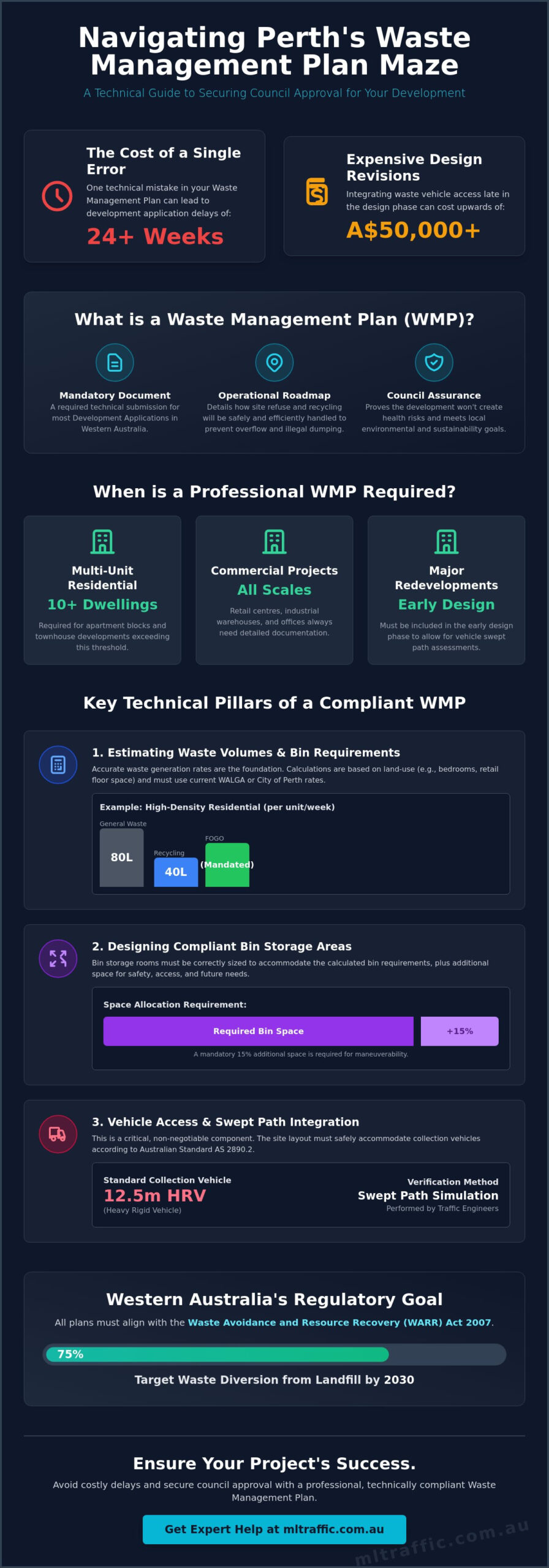
A single technical error in your waste management plan Perth can stall a multi-million dollar development application for 24 weeks or more. You’re likely aware that Perth’s metropolitan councils have moved beyond basic bin counts, now requiring rigorous evidence of operational viability. It’s a common challenge to integrate a 12.5 metre Heavy Rigid Vehicle (HRV) into a constrained site layout while maintaining project yield. We understand the pressure of meeting Western Australian planning policies and the specific local government requirements that vary across the 30 councils in the Perth metro area.
This guide details the technical standards and regulatory benchmarks you must meet to secure council approval. We provide the technical clarity needed to master these requirements and ensure your development application meets every council standard. You’ll learn how to optimize your site layout for collection, ensure compliance with AS 2890.2 for service vehicles, and avoid the typical pitfalls that lead to costly DA delays. We’ll examine the exact documentation required for a professional submission that satisfies both planners and waste engineers to ensure a clear path to approval.
Key Takeaways
- Identify the mandatory technical requirements for a waste management plan Perth to ensure your development application meets strict council standards.
- Learn the critical differences between Operational and Construction Waste Management Plans to maintain compliance throughout the entire project lifecycle.
- Master the calculation of waste generation rates and design specifications for storage areas to ensure your site meets Australian Standards.
- Understand why traffic engineers are essential for performing swept path simulations and integrating waste access with site design.
- Discover the step-by-step roadmap to securing council approval through professional technical reporting and direct consultant accountability.
Table of Contents
-
Understanding Waste Management Plans for Australian Developments
-
Key Technical Components of a Compliant Waste Management Plan
-
Operational vs. Construction Waste Management: Key Differences
-
Expert Traffic Engineering: Integrating Waste and Access Design
Understanding Waste Management Plans for Australian Developments
A Waste Management Plan (WMP) is a mandatory technical document. It’s required for most development applications in Western Australia. The document acts as a roadmap for site refuse and recycling handling. Its primary goal is safe, efficient, and sustainable material recovery. Developers use it to show they’ve met standards for Understanding Waste Management. This ensures resources are recovered rather than sent to landfill. Proper planning prevents issues like bin overflow or illegal dumping on public verges.
Local councils require a waste management plan Perth prior to issuing building permits or development approvals. It’s a core part of the Statement of Environmental Effects (SEE). The plan proves the land use doesn’t create health risks or environmental harm. Projects without a compliant plan often see approval delays of 12 weeks or more. This document provides the technical assurance that the waste generated by the building’s occupants can be managed within the site’s footprint.
To better understand the challenges of waste in Western Australia, watch this helpful video:
The Regulatory Framework and Council Expectations
WA developers must follow Local Government Area (LGA) guidelines. These vary significantly between the City of Perth and the City of Canning. All local rules fall under the Waste Avoidance and Resource Recovery (WARR) Act 2007. This Act targets a 75% waste diversion rate from landfill by 2030. Professional waste planning aligns projects with these urban sustainability goals. It focuses on bin storage capacity, wash-down facilities, and collection vehicle access. These elements ensure the development contributes to the state’s circular economy objectives.
When is a Professional Waste Plan Required?
Project scale determines the need for a professional waste management plan Perth. Multi-unit residential projects with 10 or more dwellings require one. Commercial developments, like retail centers or industrial warehouses, always need detailed documentation. This is due to the volume of specialized waste they generate. Major redevelopments must include waste planning in the early design phase. This allows for vehicle swept path assessments. It ensures 12.5-meter heavy rigid vehicles can maneuver safely within the site. Integrating these requirements early prevents structural revisions that can cost A$50,000 or more in design fees. Minor redevelopments might only need a simplified waste memo, but professional oversight ensures compliance with the latest Australian Standards.
Key Technical Components of a Compliant Waste Management Plan
Developing a robust waste management plan Perth requires technical precision to ensure the site functions safely and efficiently. Local governments require specific data to verify that a development can handle its own refuse without impacting public infrastructure or amenity. It’s not just a paperwork exercise; it’s a functional blueprint for site operations.
Estimating Waste Volumes and Bin Requirements
Accurate waste generation rates are the foundation of any submission. Engineers calculate these based on specific land-use categories, such as the number of bedrooms in residential units or the square meterage of retail floor space. For instance, a high-density residential development might generate 80 litres of general waste and 40 litres of recycling per unit per week. Achieving Perth council approval depends on using current WALGA or City of Perth generation rates. Designers must also account for FOGO (Food Organics and Garden Organics) mandates, which are increasingly required across WA municipalities. Bin storage rooms must be sized to accommodate these specific ratios while allowing 15% additional space for maneuverability and future growth.
Vehicle Access and Swept Path Integration
Heavy vehicle access is often the most scrutinized element of a waste management plan Perth. All designs must comply with AS 2890.2, the Australian Standard for off-street commercial vehicle facilities. A critical requirement is that Waste Collection Vehicles (WCV) must enter and exit the site in a forward motion. Reverse maneuvers onto public roads are generally prohibited for safety reasons. Engineers use swept path analysis to simulate the exact turning radius of a 12.5-metre Heavy Rigid Vehicle (HRV). This ensures the truck doesn’t clip curbs or encroach on pedestrian zones. Vertical clearance is another bottleneck; basement or loading dock access requires a minimum of 4.5 metres of clear height to accommodate the lifting mechanisms of rear-loading or side-loading trucks.
Operational impacts like noise and smell require proactive management. Acoustic mitigation might involve using rubber floor matting in bin rooms or scheduling collections between 7:00 AM and 7:00 PM to comply with Environmental Protection (Noise) Regulations 1997. Odour control is managed through mechanical ventilation and dedicated wash-down facilities with grease traps. For complex sites with tight spatial constraints, you can contact our senior engineers to discuss specific design solutions that meet both operational and regulatory needs.
Operational vs. Construction Waste Management: Key Differences
Perth local governments distinguish between the build phase and the functional life of a development. A waste management plan Perth must address these stages as separate regulatory requirements to secure planning approval. The Construction Waste Management Plan (CWMP) governs the site from demolition through to lock-up. The Operational Waste Management Plan (OWMP) dictates how the building functions once occupied by tenants or residents.
Council conditions of consent in Western Australia typically separate these requirements into distinct milestones. The CWMP focuses on meeting the Waste Avoidance and Resource Recovery Strategy 2030 targets. This strategy mandates a 75% recovery rate for construction and demolition waste. The OWMP ensures future tenants have adequate space for landfill, recycling, and organic streams. Engaging professional consultancy services ensures both plans meet specific local council criteria and Australian Standards.
Managing Waste During the Construction Phase
Contractors must implement rigorous on-site sorting protocols to meet resource recovery targets. Separating concrete, timber, and steel into dedicated skip bins is standard practice to maximize recycling rebates. Logistics planning is essential; skip bin placement must not obstruct site access or traffic flow. Frequency of removal depends on project scale, with high-density builds often requiring daily collection to prevent overflow. Site managers must also implement controls to mitigate dust and liquid runoff during waste handling. This prevents debris from entering local drainage systems or impacting neighboring properties.
-
Dedicated zones for masonry, metal, and timber recycling.
-
Documented waste tracking notes for council compliance audits.
-
Strict schedules for bin rotations to avoid site congestion.
-
Erosion and sediment control measures around waste storage areas.
Long-term Operational Efficiency for Tenants
Efficiency for end-users depends on early-stage design integration. Multi-level developments often incorporate bin tugs, hoists, or chute systems to move waste from upper levels to centralized collection points. Strata and facility managers hold the responsibility for ongoing bin presentation and cleaning. They must ensure that collection vehicles can access the site based on approved swept path templates. Clear signage using Western Australian standard colors for recycling and general waste is mandatory. This education ensures residents and staff use the systems correctly, which reduces contamination rates in communal bins and avoids extra council levies.
Effective management requires a hands-on approach from the facility team. They coordinate with private contractors or municipal services to ensure bins aren’t left on verges for extended periods. This maintains the local amenity and adheres to the specific waste management plan Perth guidelines established during the DA process.
The Step-by-Step Process for Securing Council Approval
Securing approval for a waste management plan Perth involves a specific technical sequence. We begin with an initial site assessment alongside the project architect. This ensures the bin storage room size meets the calculated waste generation rates for the specific land use. We then draft the technical report and perform vehicle swept path simulations. These simulations prove that collection vehicles can enter and exit the site in a forward gear, which is a non-negotiable requirement for most Perth metropolitan councils.
We review the draft against Local Planning Policies (LPPs). Each Local Government Area (LGA), from the City of Stirling to the City of Canning, maintains distinct requirements regarding bin types and collection frequencies. Finally, we liaise with council waste officers to resolve design conflicts before the formal Development Application (DA) submission. This proactive communication prevents costly redesigns during the assessment phase.
Avoiding Common DA Delays and RFI Requests
Designs that require waste vehicles to perform complex maneuvers in high-traffic areas are immediate red flags. Council assessors look for impacts on the public realm, specifically ensuring that bin presentation doesn’t obstruct sightlines or pedestrian movement on the verge. We ensure the plan is signed off by a qualified engineer to verify that all technical data, including driveway gradients and overhead clearances, complies with AS 2890.2. Missing these details often leads to a formal Request for Further Information (RFI), which can stall a project for weeks.
-
Identify "red flag" designs that impede waste vehicle maneuvers.
-
Address public realm impacts and streetscape amenity.
-
Ensure the plan is signed off by a qualified engineer.
Submitting the Plan with Your Development Application
You must coordinate your waste management plan Perth with the Traffic Impact Assessment. Discrepancies between these documents regarding access points or vehicle sizes will trigger a delay. If the council provides feedback or requires post-submission amendments, we update the swept paths and report logic to maintain compliance. This ensures the waste strategy aligns with the broader traffic movements of the development.
For a professional review of your site’s constraints and to avoid common submission errors, consider contacting a consultant for a pre-DA review.
Expert Traffic Engineering: Integrating Waste and Access Design
A professional waste management plan Perth requires more than a simple bin count. It demands a technical understanding of vehicle dynamics and spatial constraints. Traffic engineers are the most qualified professionals to draft these documents because waste collection is fundamentally a traffic movement issue. We ensure your site complies with AS 2890.1 for parking and AS 2890.2 for commercial vehicle access simultaneously. Since 2005, ML Traffic Engineers has applied this dual-compliance approach to over 10,000 sites across Australia. This ensures that bin storage areas don’t conflict with required parking bays or pedestrian sight-lines.
Our firm operates on a direct-responsibility model. The traffic consultant who provides your quote is the same expert who performs the technical work. This eliminates communication gaps often found in larger firms where junior staff handle the drafting while senior principals only sign off. You get 15+ years of personal experience applied to every swept path and clearance calculation. We’ve seen thousands of site configurations and understand how to navigate the specific bureaucratic requirements of local councils. We don’t guess; we use engineering data to prove your site works.
Optimizing Loading Docks and Service Areas
Efficient design requires balancing parking demand with waste collection requirements in tight urban spaces. We don’t just design for average conditions. We design for "worst-case" vehicle scenarios to ensure safety and prevent property damage. If a 12.5-metre Heavy Rigid Vehicle (HRV) can’t clear the overhead height or make the turn safely, the plan won’t pass. We provide the technical evidence needed to satisfy Council requirements while maximizing usable site area. It’s about finding the balance between commercial viability and operational safety. Explore our full range of services to see how we integrate these elements into a cohesive site strategy.
The ML Traffic Engineers Advantage
Clients get direct access to principals Michael Lee and Benny Chen. We don’t hide behind account managers or administrative layers. Our track record includes complex residential and commercial Development Applications (DAs) for everything from high-rise apartments and bars to warehouses and temples. We provide no-nonsense, fact-based engineering reports that withstand Council scrutiny. Our commitment is simple: we provide the technical data required to get your waste management plan Perth approved without unnecessary delays. We’ve been trading for nearly 20 years, focusing on private clients who need reliable, expert results and a direct line to the engineers doing the work.
Secure Your Development Approval with Expert Engineering
Securing council approval for your project depends on a technically sound waste management plan Perth that meets specific local government requirements. You must address both construction waste and long term operational logistics, ensuring vehicle swept paths align with Australian Standards. ML Traffic Engineers brings over 15 years of technical expertise to every project, having completed more than 10,000 successful site assessments nationwide. You’ll work directly with senior principals Michael Lee or Benny Chen; the engineer who quotes your project is the one who delivers the technical report. This direct accountability ensures your DA submission is meticulous and ready for council scrutiny. Don’t leave your compliance to chance when experienced traffic and waste specialists are available to manage the technical process. We’re ready to help you move your development into the construction phase with confidence.
Get a Professional Waste Management Plan for Your DA
Frequently Asked Questions
What is a waste management plan and why is it required for my DA?
A waste management plan Perth is a technical document detailing how waste will be stored, handled, and collected within a proposed development. Local councils in Western Australia require these documents to ensure compliance with the WALGA Better Practice Guidelines. It’s a mandatory submission for most multi-residential and commercial Development Applications to prevent hygiene issues and ensure public safety during collection cycles.
How do I calculate the number of bins required for my development?
Bin numbers are calculated by applying generation rates found in the WALGA Waste Management Plan Guidelines or specific local government policies. For a standard residential unit, calculations often start at 240 litres for general waste and 240 litres for recycling per week. Our engineers use these precise ratios to determine the total storage volume and bin count required for your specific site footprint.
Can I use a standard template for my waste management plan?
You can’t rely on generic templates because every development site has unique constraints regarding access, gradients, and storage. Perth councils require site-specific details including bin store dimensions, collection frequency, and internal transport routes. A template typically fails to address the technical requirements of AS 2890.2 for heavy vehicle access, which often leads to immediate rejection during the DA process.
What is the difference between a construction and operational waste plan?
A construction waste plan manages debris and recycling during the building phase, while an operational plan covers the building’s daily use after occupancy. Construction plans must detail how the project will meet the 75% recovery target for construction and demolition waste. Operational plans focus on long-term bin storage, hygiene, and the logistics of regular collection by local council or private contractors.
Why does council require swept path analysis for waste trucks?
Councils require swept path analysis to prove that a 12.5-metre Heavy Rigid Vehicle can safely enter and exit your site in a forward gear. This technical assessment uses CAD software to simulate the vehicle’s turning circle, ensuring it doesn’t strike curbs, structures, or parked cars. We provide these drawings to ensure your waste management plan Perth meets Australian Standard AS 2890.2 and council access requirements.
How much clearance height is needed for a waste collection vehicle?
Most front-lift waste trucks require a minimum vertical clearance of 6.5 metres to operate lifting arms safely during the collection process. If your development includes a basement or undercover loading area, you must provide at least 4.5 metres of clearance for vehicle transit. These specific measurements are based on standard vehicle dimensions used by waste contractors across Western Australia.
What happens if my waste management plan is rejected by council?
If your plan is rejected, the council will issue a Request for Further Information detailing the specific non-compliance issues. This typically adds 4 to 8 weeks to your approval timeline. You’ll need to revise the technical data, such as bin calculations or swept path assessments, and resubmit the document for a secondary review by the council’s waste department.
Which areas do you cover?
We are traffic engineers servicing Alexander Heights, Alfred Cove, Alkimos, Anketell, Applecross, Ardross, Armadale, Ascot, Ashby, Ashendon, Ashfield, Attadale, Atwell, Aubin Grove, Aveley, Balcatta, Baldivis, Balga, Ballajura, Banksia Grove, Bassendean, Bateman, Bayswater, Beaconsfield, Beckenham, Bedford, Beechboro, Beeliar, Beldon, Bellevue, Belmont, Bentley, Bertram, Bibra Lake, Bicton, Booragoon, Brentwood, Brigadoon, Brookdale, Bull Creek, Bullsbrook, Burns Beach, Burswood, Butler, Byford, Canning Vale, Cannington, Carine, Carlisle, Carramar, Casuarina, Caversham, Champion Lakes, Chidlow, Churchlands, City Beach, Claremont, Clarkson, Cloverdale, Cockburn Central, Connolly, Coogee, Coolbellup, Coolbinia, Cottesloe, Craigie, Crawley, Currambine, Dalkeith, Darch, Doubleview, East Perth, Edgewater, Ellenbrook, Floreat, Fremantle, Girrawheen, Greenwood, Guildford, Hamilton Hill, Heathridge, Hillarys, Inglewood, Joondalup, Kallaroo, Kingsley, Leeming, Mandurah, Maylands, Melville, Midland, Mindarie, Morley, Mosman Park, Mount Hawthorn, Mount Lawley, Mullaloo, Nedlands, North Perth, Northbridge, Ocean Reef, Osborne Park, Padbury, Perth, Piara Waters, Rockingham, Scarborough, South Perth, Subiaco, Swanbourne, Thornlie, Tuart Hill, Victoria Park, Wangara, Wanneroo, Warwick, Wembley, West Perth, Willetton, Woodvale, Yokine.

Disclaimer
The content on www.mltraffic.com.au, including all technical articles, guides, and resources, is provided for general informational and educational purposes only. It is not intended to constitute professional advice in traffic engineering, transportation planning, development approvals, or any other technical or legal field.
While ML Traffic Engineers makes every reasonable effort to ensure the accuracy, completeness, and timeliness of the information published, we do not provide any warranties or representations (express or implied) regarding its reliability, suitability, or availability for any particular purpose. Any reliance you place on the content is strictly at your own risk.
In no event shall ML Traffic Engineers, its directors, employees, authors, or affiliates be liable for any direct, indirect, incidental, special, consequential, or punitive damages (including, without limitation, loss of profits, data, or business opportunities) arising out of or in connection with the use of, or inability to use, any information provided on this website.
The articles and guides on this site are not a substitute for engaging a qualified, registered professional traffic engineer (such as an NPER or RPEQ engineer) to assess your specific project requirements. For tailored advice, compliance assessments, or traffic engineering services, please contact a competent professional.
This disclaimer may be updated from time to time without notice. By accessing or using this website, you agree to be bound by the most current version of this disclaimer.
