

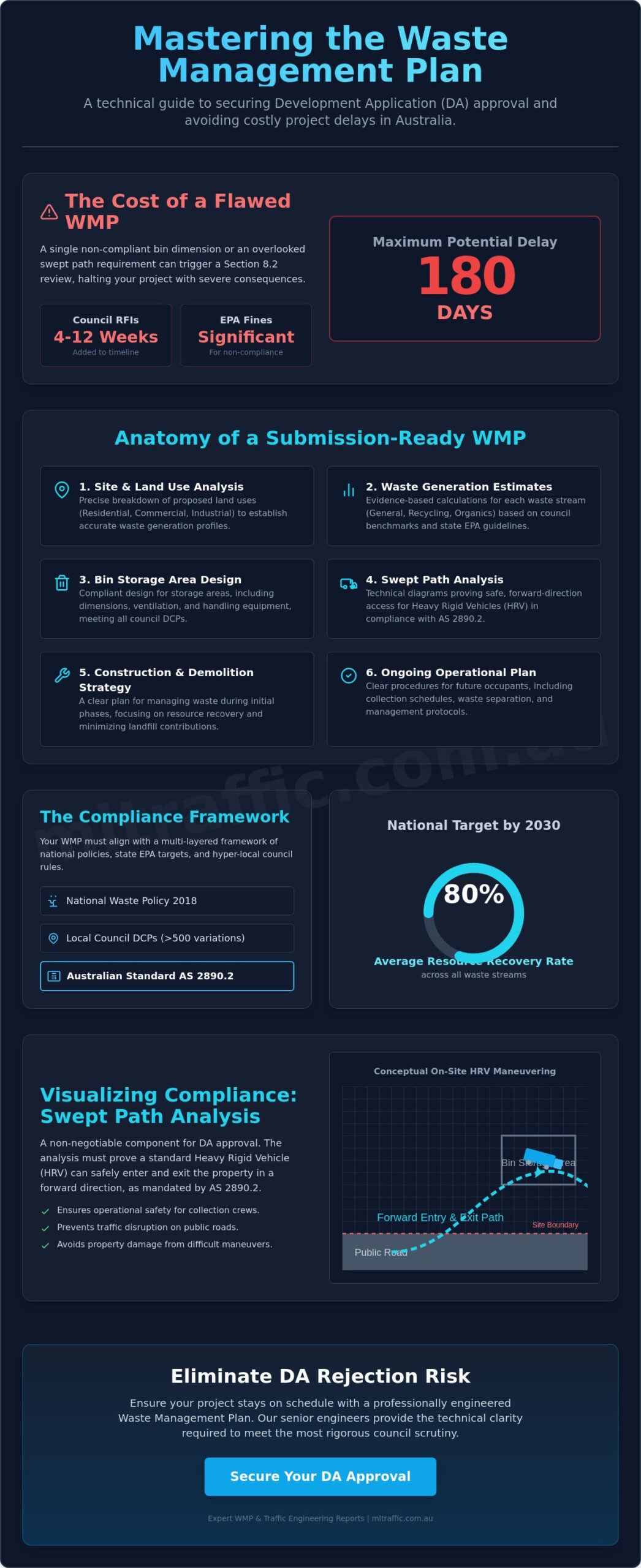
A single non-compliant bin storage dimension or an overlooked swept path requirement can trigger a Section 8.2 review, potentially delaying a multi-unit development by 180 days. You likely understand that navigating the specific waste requirements across Australia’s 500 plus local councils is a complex, technical challenge. It’s difficult to maintain accuracy when waste generation rates for a 2026 project must account for evolving sustainability targets and diverse land-use categories. This guide provides a Waste management plan report content methodology explained to ensure your documentation survives the most rigorous council scrutiny. We’ll break down the precise calculation formulas used for volume estimates, the essential technical components for professional reports, and the specific Australian Standards, such as AS 2890.2, that govern compliant storage area design. Our focus is on providing the technical clarity needed to meet the expectations of planning authorities. By the end of this deep dive, you’ll have the technical knowledge required to produce a submission-ready Waste Management Plan that eliminates the risk of DA rejection and keeps your project on schedule.
Key Takeaways
- Understand the critical role a technical Waste Management Plan (WMP) plays in securing Development Application (DA) approvals for residential, commercial, and industrial projects across Australia.
- Master the technical requirements with the waste management plan report content methodology explained, focusing on precise generation rate benchmarks and state EPA guidelines.
- Identify the logistical necessity of Swept Path Analysis to ensure heavy rigid vehicles (HRV) achieve safe, forward-direction entry and exit during collection.
- Learn to integrate comprehensive waste strategies for both the demolition and construction phases to ensure long-term site compliance and operational efficiency.
- Discover how senior engineering oversight and direct principal accountability reduce operational costs and prevent bureaucratic delays for professional developers.
Table of Contents
-
What is a Waste Management Plan (WMP) and Why is Methodology Critical?
-
Designing for Access: Swept Path Analysis and Collection Logistics
What is a Waste Management Plan (WMP) and Why is Methodology Critical?
A Waste Management Plan (WMP) is a technical document that outlines the specific procedures for managing waste during both the construction and operational phases of a development. It’s a mandatory requirement for most Development Applications (DA) across Australia. A What is a Waste Management Plan (WMP) functions as a blueprint for waste minimization, storage, and collection logistics. It ensures that a site can handle its waste output without creating environmental hazards or traffic congestion.
To better understand the principles behind effective waste oversight, watch this video on the waste hierarchy and management strategies:
By 2026, development requirements have shifted toward circular economy principles. This means councils no longer accept basic estimates. They require a detailed waste management plan report content methodology explained with evidence-based calculations. A robust methodology satisfies council planners and EPA guidelines by demonstrating a commitment to resource recovery. It moves beyond simple disposal and focuses on how materials can be diverted from landfills to meet state-specific recovery targets.
Regulatory Framework and Australian Standards
The National Waste Policy 2018 and the 2024-2026 Action Plan updates drive current standards. These documents set a target of an 80% average recovery rate across all waste streams by 2030. Local council Development Control Plans (DCPs) dictate the specific report requirements for each local government area. Furthermore, reports must align with Australian Standards, such as AS 2890.2, which governs off-street commercial vehicle facilities. This ensures that collection vehicles can access bin storage areas safely and efficiently without blocking public roads.
The Consequences of Poor Methodology
Inadequate planning leads to immediate and long-term project risks. Technical errors in a WMP often result in the following:
-
DA Delays: Councils frequently issue Requests for Information (RFIs) when waste volumes are under-calculated, adding 4 to 12 weeks to the approval timeline.
-
Operational Risks: Underestimating volumes leads to overflowing bins, which creates vermin issues, odors, and significant health hazards for occupants.
-
Compliance Issues: Failure to meet EPA guidelines can result in heavy fines during the construction phase.
The Methodology section is the evidence-based foundation of the entire report.
Our team at ML Traffic Engineers provides specialized consultancy services to ensure your WMP meets these rigorous technical standards. We focus on delivering reports that are compliant, professional, and ready for council submission.
Essential Report Content: What Must Be Included in a WMP?
A Waste Management Plan (WMP) serves as a technical blueprint for a development’s entire lifecycle. It’s not a generic document; it requires a granular analysis of the site’s specific constraints and opportunities. The report begins with a detailed site description and a precise breakdown of proposed land use. For a 2026 project, we categorize areas into residential, commercial, or industrial zones because waste generation rates differ significantly across these sectors. For instance, a retail unit generates vastly different volumes of organic waste compared to a warehouse or a high-density apartment block.
Effective reporting follows an Essential Report Content: What Must Be Included framework to ensure all debris streams are managed before work starts. This structured approach is central to the waste management plan report content methodology explained in modern engineering standards. It eliminates guesswork for developers and provides councils with the data they need for approval.
Demolition and Construction Phase Details
By 2026, most urban jurisdictions demand an 80% or higher diversion-from-landfill rate for construction materials. The report must provide concrete estimates for spoil, concrete, steel, and timber volumes. We don’t just guess these numbers; they’re calculated based on the building’s gross floor area and structural material types. The plan identifies specific, licensed recycling facilities and waste contractors capable of handling these loads. On-site sorting strategies are vital to prevent cross-contamination, ensuring that high-value materials like steel don’t end up in general waste skips.
Operational Waste Infrastructure
Once the building is occupied, the focus shifts to long-term management. We calculate bin quantities and sizes based on projected generation rates. A typical 30-unit residential development might require eight 240L general waste bins and eight 240L recycling bins, collected twice per week. Storage rooms must meet strict design specifications, including mechanical ventilation, floor drainage, and hot/cold water wash-down facilities. We also include signage and education strategies to ensure occupants don’t contaminate recycling streams, which is a major cause of compliance failure.
Collection logistics are the final piece of the puzzle. The report specifies collection frequency, timing, and the exact vehicle requirements. We use vehicle swept path analysis to confirm that a 12.5-meter heavy rigid vehicle can enter and exit the site safely. This level of detail is why developers trust our specialist engineering services to secure their project approvals. The waste management plan report content methodology explained here ensures that every operational hurdle is cleared before construction begins.
The Methodology Behind Waste Generation Estimates
Engineers determine waste generation rates by analyzing specific land use categories defined in local planning instruments. We use benchmark data from state authorities, such as the NSW EPA or Sustainability Victoria, to establish a baseline for every development application. The waste management plan report content methodology explained here relies on precise metrics rather than generic estimates. For instance, a residential apartment might require 120 liters of general waste per unit per week, while a commercial office requires 10 liters per 100 square meters of floor area. This data driven approach ensures that storage facilities are neither undersized nor excessively large.
Mixed-use developments introduce significant complexity. Shared waste streams often lead to contamination, so we design separate systems for residential and commercial tenants to maintain hygiene and recycling purity. By 2026, projects must account for mandatory Food Organics and Garden Organics (FOGO) separation. This shift reduces general waste volume but increases the physical footprint required for bin storage. E-waste collection points are now a standard requirement for developments exceeding 50 residential units to comply with updated state diversion targets.
Calculation Formulas and Data Sources
The core of our methodology is a standard mathematical formula: [Area or Units] x [Generation Rate] x [Days] = Total Volume. This calculation determines the minimum bin numbers and collection frequencies. A one size fits all approach fails because it ignores the nuances of modern developments. A high-turnover cafe generates significantly more organic waste than a boutique retail store of the same size. We cite current regional guidelines, such as the 2021 Better Practice Guide for Resource Recovery in Residential Developments, to ensure compliance with 2026 standards. Using the most recent waste management plan report content methodology explained in these guides prevents costly design revisions during the council approval process.
Factoring in Diversion and Compaction
Effective diversion strategies for recycling and green waste streams directly alter total bin requirements. High-density projects often utilize compaction units to manage space constraints. A 2:1 or 3:1 compaction ratio can reduce the necessary storage area by 50 percent or more. This is critical for sites with limited basement access or narrow driveway ramps where bin numbers must be minimized. Our methodology must account for peak seasonal waste fluctuations, such as the 25 percent increase in packaging waste typically observed during December and January. Professional assessment ensures that storage areas meet Australian Standards and local council requirements. For expert assistance with your project, view our engineering services or contact our senior consultants directly.
Designing for Access: Swept Path Analysis and Collection Logistics
Waste collection represents a complex traffic engineering challenge. It’s not just about bin storage; it’s about vehicle movement and spatial geometry. A Waste management plan report content methodology explained for 2026 projects must prioritize the safe maneuvering of Heavy Rigid Vehicles (HRV). Most Australian councils and road authorities mandate that these vehicles enter and exit a site in a forward direction. Reversing onto a public road is a significant safety breach and a common reason for development application refusal. This requirement dictates the entire ground floor and basement layout of modern developments.
Compliance with AS 2890.2 is the baseline for commercial vehicle access and loading areas. This standard ensures that the designated loading bays can accommodate the physical footprint of the truck while allowing for necessary clearance. We integrate Swept Path Analysis (SPA) directly into the Waste Management Plan to prove that the proposed design works in practice. This technical assessment uses digital modeling to trace the path of the vehicle’s body and wheels through every turn. It identifies potential "pinch points" where a truck might strike a structural column or mount a curb.
Waste Collection Vehicle (WCV) Specifications
Designers must account for the physical dimensions of 2026-standard WCVs. A standard HRV used by most councils is 12.5 meters long. However, overhead clearance is the most frequent point of failure in basement designs. Bins lifted by front-loading or side-loading mechanisms require a minimum vertical clearance of 6.5 meters during the lifting cycle. You must verify these heights against the specific council fleet or private contractor equipment. For a technical breakdown of how these vehicles move, refer to our Swept Path Analysis guide. Our engineers use this data to ensure the truck’s operational envelope fits within your site’s constraints.
Operational Logistics and Safety
Collection logistics depend on the specific site classification. On-site collection is the standard for high-density residential and commercial hubs to prevent traffic congestion. On-street collection is typically only permissible where road widths and traffic volumes allow for safe temporary idling. If collection occurs on-site, the waste room must be located within ‘maximum push distances’. For 240-litre bins, the manual handling limit is 15 meters. For larger 1,100-litre bins, this distance is capped at 10 meters on a flat, non-slip surface.
A Traffic Management Plan (TMP) is essential for coordinating these movements. The TMP manages the interaction between the WCV and other site users, such as residents or delivery couriers. It ensures that loading bays remain clear during scheduled pick-up windows and that pedestrian sightlines are maintained. This structured approach reduces the risk of accidents and ensures the long-term viability of the waste strategy.
Our senior engineers provide the technical accuracy required for complex access assessments. Contact ML Traffic Engineers to secure a compliant Swept Path Analysis for your 2026 project.
Ensuring Compliance: Why Expert Engineering Input is Vital
Professional Waste Management Plans (WMPs) are technical engineering documents, not simple administrative checklists. For 2026 projects, councils have increased their scrutiny of waste disposal logistics and sustainability metrics. At ML Traffic Engineers, we operate on a transparent principle: the traffic consultant who provides your quote is the person who does the work. This direct accountability ensures that the senior expertise you pay for is applied to every calculation and swept path assessment. Larger firms often delegate these tasks to junior staff, which leads to errors in bin room sizing or vehicle clearance. These mistakes are expensive. Rectifying a non-compliant bin storage area after construction can cost developers between $15,000 and $50,000 in remedial works or permanent reliance on high-cost private collection services.
Total site compliance requires a seamless integration between waste reports and Traffic Engineering. Waste vehicles are often the largest design vehicles to enter a site. If the driveway grades, overhead clearances, or turning circles aren’t aligned with AS 2890.2 standards, the WMP will fail. We coordinate these technical requirements early in the design phase to prevent costly redesigns during the Request for Further Information (RFI) stage.
The ML Traffic Advantage in Waste Planning
We leverage over 15 years of experience across more than 10,000 sites to deliver reports that pass council assessment the first time. Our senior engineers, Michael Lee and Benny Chen, provide direct access for bespoke methodology justifications. This is critical when site constraints require a deviation from standard council guidelines. Having your waste management plan report content methodology explained by a principal engineer carries significant weight during council negotiations. We don’t just calculate bin numbers; we optimize car park layouts and waste access points to maximize your site’s useable square meterage while ensuring full operational compliance.
Next Steps for Your Development Application
Engaging a consultant during the initial concept design is the most effective way to avoid spatial conflicts. Before you submit your application, ensure your site plans are ready for a comprehensive waste and traffic assessment. A council-ready Waste Management Plan must include:
-
Swept path analysis demonstrating safe entry and exit for the designated collection vehicle.
-
Detailed bin storage layouts showing sufficient space for general waste, recycling, and FOGO (Food Organics and Garden Organics) streams.
-
Vertical clearance height specifications for all transit and loading areas.
-
Collection frequency schedules that align with local government or private contractor capabilities.
-
Transfer paths showing how bins move from storage areas to the collection point without obstructing pedestrian traffic.
If you’re preparing a submission for a residential, commercial, or mixed-use project, contact our senior team today. We provide technical clarity and engineering certainty for complex developments. Contact Us for a project-specific quote and direct access to our principal engineers.
Secure Your 2026 Planning Approval with Technical Precision
Securing planning approval for 2026 projects requires more than a basic checklist. You need a document that withstands council scrutiny through rigorous generation estimates and precise Swept Path Analysis. This waste management plan report content methodology explained highlights why technical accuracy in collection logistics is non-negotiable for modern developments. Relying on generic templates often leads to costly RFI delays or project rejection. Expert engineering input ensures your site remains functional and compliant from day one.
ML Traffic Engineers brings over 15 years of experience in Australian planning approvals to your project. We’ve assessed over 10,000 sites nationally, ensuring every report meets strict regulatory standards and Australian Standards. You’ll gain direct access to senior traffic and waste engineers who provide the quote and perform the technical work themselves. This hands-on approach guarantees your logistics and compliance needs are met without bureaucratic overhead. It’s the most reliable way to de-risk your application and stay on schedule.
Get a professional Waste Management Plan assessment for your project to ensure your development meets every local requirement. We’re ready to help you navigate the complexities of waste engineering.
Frequently Asked Questions
What is the difference between a Construction WMP and an Operational WMP?
A Construction WMP manages debris and materials during the demolition and building phases, while an Operational WMP governs waste disposal for the building’s finished lifecycle. Construction plans prioritize the recycling of heavy materials like concrete and steel to meet the 80% recovery targets set by state authorities. Operational plans focus on bin quantities, collection frequencies, and tenant access once the development is occupied.
How are waste generation rates determined for a new commercial development?
Engineers determine waste generation rates by applying specific litres per 100 square metres of Floor Space Ratio (FSR) as defined in local Council Development Control Plans (DCP). For a 500 square metre office, we calculate daily output based on 10 litres of waste per 100 square metres. These calculations form the core of the waste management plan report content methodology explained for 2026 commercial projects to ensure adequate bin capacity.
Is a Swept Path Analysis always required for a Waste Management Plan?
A Swept Path Analysis is mandatory whenever a heavy rigid vehicle (HRV) or waste collection vehicle must enter the property boundary to service bins. We use specialized software to simulate a 12.5 metre vehicle’s turning circle to ensure it doesn’t strike walls or curbs. This assessment confirms compliance with AS 2890.2 for heavy vehicle movements within private developments and prevents structural damage during collection.
Does my waste storage room need to follow specific Australian Standards?
Waste storage rooms must comply with the Building Code of Australia (BCA) and specific local government health regulations regarding ventilation and drainage. We design these spaces to meet AS 2890.2 requirements for loading docks and clearance heights. Rooms require non-combustible walls, a graded floor to a Sydney Water approved tundish, and a minimum 2.1 metre clear ceiling height for staff safety and equipment access.
How has the 2026 National Waste Policy update affected report requirements?
The 2026 National Waste Policy update mandates an 80% average recovery rate across all waste streams and requires dedicated Food Organics and Garden Organics (FOGO) separation for all new multi-unit dwellings. Reports must now include detailed circular economy statements. This update changes the waste management plan report content methodology explained by requiring 30% more space for organic waste streams compared to 2020 standards.
Can I use a generic template for a Council Waste Management Plan?
You shouldn’t use a generic template because every Council has unique waste generation rates and collection vehicle specifications. A generic approach often results in a Request for Information (RFI) from Council planners, delaying your DA by 4 to 8 weeks. Professional reports tailor the methodology to the specific site constraints and the local government’s 2026 sustainability targets to ensure a smooth approval process.
What happens if my development underestimates the required bin storage space?
Underestimating bin storage space leads to a breach of DA conditions and potential fines from Council compliance officers. If the 15 square metre room provided can’t fit the required 1,100 litre bins, you’ll be forced to redesign the ground floor layout at a high cost after construction has started. Insufficient space results in bins blocking fire exits, creating a safety hazard that violates AS 1851 standards.
Who is responsible for the accuracy of the waste methodology in a DA?
The traffic engineer or waste consultant who prepares and signs the report is responsible for the accuracy of the waste methodology. At ML Traffic Engineers, the consultant who provides the quote is the same expert who performs the technical assessment. This ensures accountability for all calculations, from the 1:14 ramp grades to the final bin counts submitted to Council for your development application.
Which areas do you cover?
We are traffic engineers servicing Melbourne, Sydney, Brisbane, Gold Coast, Hobart, Perth, Adelaide, Darwin, Canberra and surrounding areas.

Disclaimer
The content on www.mltraffic.com.au, including all technical articles, guides, and resources, is provided for general informational and educational purposes only. It is not intended to constitute professional advice in traffic engineering, transportation planning, development approvals, or any other technical or legal field.
While ML Traffic Engineers makes every reasonable effort to ensure the accuracy, completeness, and timeliness of the information published, we do not provide any warranties or representations (express or implied) regarding its reliability, suitability, or availability for any particular purpose. Any reliance you place on the content is strictly at your own risk.
In no event shall ML Traffic Engineers, its directors, employees, authors, or affiliates be liable for any direct, indirect, incidental, special, consequential, or punitive damages (including, without limitation, loss of profits, data, or business opportunities) arising out of or in connection with the use of, or inability to use, any information provided on this website.
The articles and guides on this site are not a substitute for engaging a qualified, registered professional traffic engineer (such as an NPER or RPEQ engineer) to assess your specific project requirements. For tailored advice, compliance assessments, or traffic engineering services, please contact a competent professional.
This disclaimer may be updated from time to time without notice. By accessing or using this website, you agree to be bound by the most current version of this disclaimer.
