
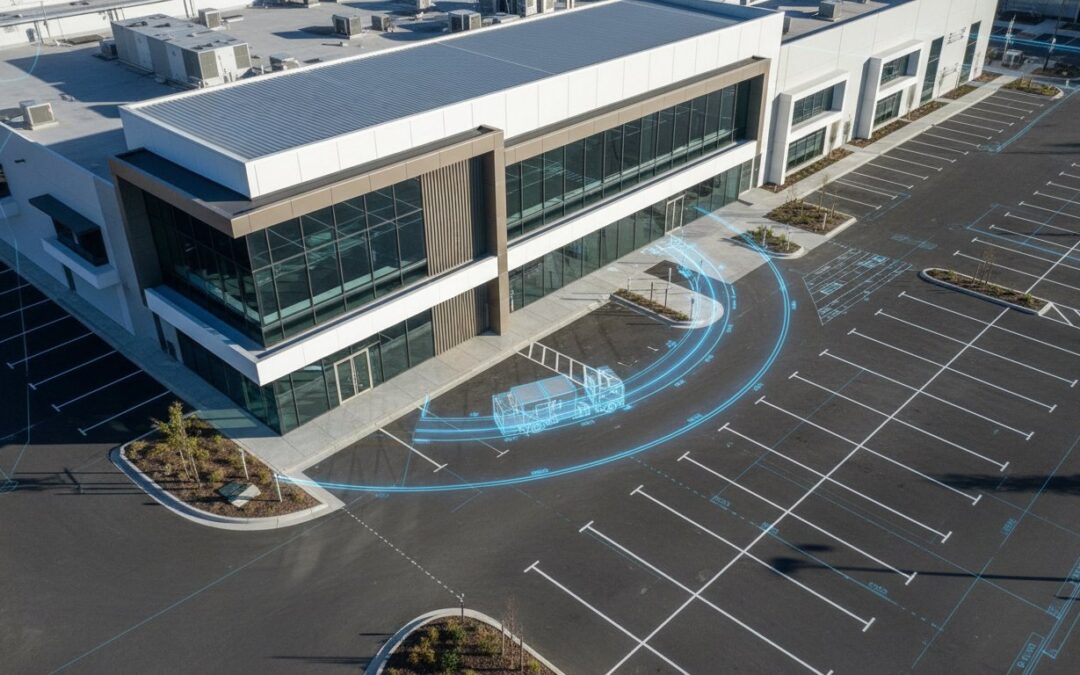
A development application that meets every local parking quota can still face immediate rejection if the Western Australian Planning Commission determines your vehicle swept paths are non-functional. It’s a common frustration for developers who find the overlap between local council policies and state-level mandates confusing, particularly with the implementation of the November 2024 WA Planning Manual. Adhering to the Western Australian Planning Commission: Vehicle Access, Site Servicing and Car Parking Layout and Requirement standards is not merely about hitting a minimum bay count; it is about providing technical engineering evidence that your site functions safely and efficiently.
You need a clear strategy to navigate these geometric demands and avoid costly technical delays. This article provides the expertise required to master WAPC-compliant vehicle access, site servicing, and car parking layouts to ensure your application succeeds. We will break down the latest non-residential parking rates for the Perth and Peel regions, explain the mandatory AS 2890.1:2004 dimensions for residential bays, and demonstrate how professional car park design and intersection analysis secure planning approval. By the end of this guide, you’ll understand how to maximize site space while maintaining full regulatory compliance.
Key Takeaways
- Understand the statutory framework under the Planning and Development Act 2005 that defines the Western Australian Planning Commission: Vehicle Access, Site Servicing and Car Parking Layout and Requirement standards.
- Differentiate between residential and non-residential geometric requirements to ensure your site servicing layout accommodates waste collection and emergency vehicles.
- Apply AS 2890.1 design principles to create a functional car park layout that maximizes space while meeting mandated minimum and maximum parking rates.
- Determine the necessity of a Traffic Impact Assessment (TIA) and how it serves as critical engineering evidence for WAPC development applications.
- Utilize technical tools like Vehicle Swept Path Analysis and Intersection Analysis to eliminate the risk of DA rejection due to non-compliant vehicle movements.
Understanding WAPC Standards for Vehicle Access and Site Servicing
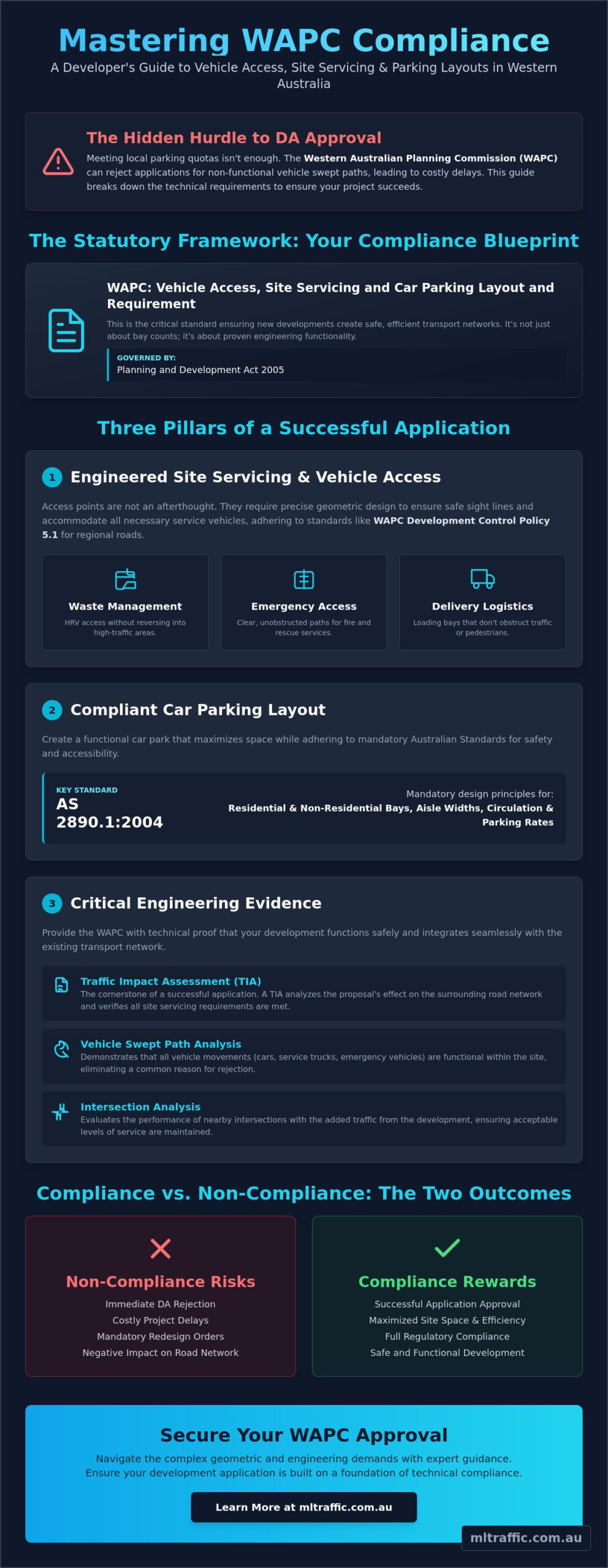
The Western Australian Planning Commission (WAPC) is the lead authority for integrated land use and transport planning across the state. Its operations are governed by the Planning and Development Act 2005, which provides the legal basis for coordinating infrastructure and urban growth. Central to this mandate is the Western Australian Planning Commission: Vehicle Access, Site Servicing and Car Parking Layout and Requirement framework. This set of standards ensures that every new development contributes to a safe and efficient transport network rather than creating localized congestion or safety hazards.
To better understand the operational context of the commission, watch this helpful video:
Vehicle access and site servicing aren’t secondary design considerations. They’re critical components of the State Planning Framework. If a proposed layout fails to demonstrate functional vehicle movements, the WAPC will likely issue a mandatory redesign order or a full DA refusal. Engineering compliance must be established during the initial concept phase to avoid these costly setbacks. This requires a meticulous approach to how vehicles enter, circulate, and exit a property without impacting the broader road hierarchy.
The Role of State Planning Policy (SPP)
State Planning Policies (SPPs) dictate the technical benchmarks for road access and safety. These policies ensure that WAPC regional schemes and local planning schemes work in unison. They provide a consistent set of rules that prevent conflicting requirements between different government tiers. Site servicing must be integrated into the earliest design stages to account for:
- Waste Management: Ensuring heavy rigid vehicles (HRV) can access collection points without reversing into high-traffic areas.
- Emergency Access: Maintaining clear paths for fire and rescue services as per regulatory standards.
- Delivery Logistics: Designing loading bays that don’t obstruct general traffic flow or pedestrian paths.
Why Compliance is Mandatory for DA Approval
The WAPC scrutinizes “significant development” applications to ensure the coordinated provision of transport infrastructure. Compliance with the WA Planning Manual guidelines is the only way to provide the engineering evidence required for approval. A successful application often hinges on a professional Traffic Impact Assessment (TIA). This report analyzes the proposal’s effect on the surrounding network and verifies that all site servicing requirements are met. Without this technical validation, a project cannot prove it meets the safety and efficiency standards demanded by the commission.
Engineering Vehicle Access and Site Servicing Layouts
Engineering a site to satisfy the Western Australian Planning Commission: Vehicle Access, Site Servicing and Car Parking Layout and Requirement involves precise geometric calculations. Design teams can’t treat access points as an afterthought. Every entry and exit must be positioned to maintain safe sight distances while minimizing disruption to existing traffic flow. This is particularly vital for developments bordering regional roads, where the WAPC Development Control Policy 5.1 strictly regulates the number and location of crossovers to preserve road capacity and safety.
A functional layout must accommodate a diverse range of vehicles beyond standard passenger cars. Site servicing plans must account for waste collection trucks, emergency services, and delivery vehicles. If a design doesn’t allow these larger vehicles to enter and exit in a forward gear, the WAPC will likely demand a revision. Engineers use technical assessments to verify that these movements are physically possible within the proposed constraints of the lot.
Geometric Layouts for Residential Developments
Residential road design follows a specific hierarchy to balance vehicle movement with neighborhood amenity. WAPC standards define clear carriageway widths based on the road’s function. Local distributors typically require 6 to 10 meters, while access ways are narrower at 5.5 to 6 meters. For smaller access places and lanes, widths can drop to 4 to 5.5 meters. Engineers must also design cul-de-sacs and T-junctions that allow service vehicles to turn safely. Pedestrian safety remains paramount; therefore, verge widths must be maintained, generally capped at 4.5 meters for access ways unless underground power allows for a reduction to 3 meters.
Site Servicing for Commercial and Industrial Projects
Commercial and industrial sites face more rigorous servicing demands. These projects must adhere to AS 2890.2 standards for off-street commercial vehicle facilities. Loading docks and service yards must be engineered to handle heavy vehicle ingress and egress without conflicting with customer parking or pedestrian paths. It’s essential to separate high-turnover car parking areas from heavy vehicle maneuvering zones. Failure to provide this separation creates operational bottlenecks and increases the risk of on-site accidents, which can lead to liability issues and planning delays.
The most effective way to prove maneuverability is through the integration of swept path analysis. This digital simulation maps the exact path a vehicle’s body and wheels take during a turn. It provides the empirical evidence needed to satisfy WAPC assessors that your site servicing layout is functional. To ensure your access points meet these technical benchmarks, consider commissioning a professional intersection analysis early in the design phase. This proactive step identifies potential conflicts before they become grounds for a development application refusal.
Car Parking Layout and Requirement Frameworks
Mastering the Western Australian Planning Commission: Vehicle Access, Site Servicing and Car Parking Layout and Requirement guidelines is essential for any modern development. The commission determines parking quotas based on land use, floor area, and the project’s specific location within the Perth and Peel regions. While local councils often have their own preferences, the WAPC manual provides a standardized range that takes precedence in many strategic locations. This approach balances the need for adequate vehicle storage with sustainable transport goals, such as the inclusion of end-of-trip facilities for cyclists and pedestrians.
Design errors cause delays. A compliant layout must adhere to the geometric design requirements of AS 2890.1 to ensure user safety and functional efficiency. It’s not enough to simply fit the required number of bays onto a site plan; the layout must prove that every vehicle can maneuver safely without obstructing traffic or pedestrians. This is where technical precision becomes the deciding factor in planning approval. Referencing WAPC Development Control Policy 5.1 is often necessary when your site interfaces with regional roads to ensure your parking and access strategy aligns with state-level safety benchmarks.
Calculating Non-Residential Car Parking Rates
The November 2024 WA Planning Manual introduced a data-driven shift toward consistent parking rates. In District, Secondary, and Strategic centres, the commission now sets a minimum of 1 space per 100m² of Floor Area (FA) and a maximum cap of 1 space per 25m² FA. This range prevents the over-provision of bitumen and encourages more efficient land use near high-frequency public transport. If your project faces constraints that make these rates difficult to achieve, you can justify a shortfall through a professional car parking demand assessment. This technical report provides the evidence needed to support a variation from the standard rates.
Designing Compliant Car Park Layouts
Physical layout design must follow the strict dimensions outlined in AS 2890.1. For standard off-street car parks, unobstructed bays must measure 2400mm x 5500mm. When obstructions like walls or columns are present, these widths must increase to 5200mm or 5600mm for double bays to maintain accessibility. Driveway ramp grades are another critical area where designs often fail; they must be engineered to prevent vehicle scraping while maintaining safe sightlines. Don’t forget that accessible parking must also meet AS 2890.6 standards to ensure your site is inclusive and legally compliant.
Navigating the Traffic Impact Assessment (TIA) Process
A Traffic Impact Assessment (TIA) is the primary engineering document used to validate a development’s compliance with the Western Australian Planning Commission: Vehicle Access, Site Servicing and Car Parking Layout and Requirement standards. This report isn’t a mere formality. It provides the technical evidence required to prove that a proposal won’t degrade the performance or safety of the surrounding road network. The commission relies on these assessments to make informed decisions on land use and infrastructure coordination. Without a TIA prepared by qualified professionals, applications for significant developments or subdivisions often face immediate technical delays or refusal.
The TIA serves as the bridge between your architectural vision and the WAPC’s regulatory expectations. It analyzes how the traffic generated by your site will distribute across nearby intersections and whether the existing infrastructure can absorb the additional load. For developers, this report is a tool to justify specific design choices, such as the location of a crossover or a variation in parking numbers. To ensure your submission meets the rigorous standards of state assessors, you should request a Traffic Impact Assessment (TIA) Report from an experienced consultancy before finalizing your design.
When is a Traffic Report Required?
WAPC guidelines distinguish between development impacts based on trip generation thresholds. Developments are generally categorized as having low, moderate, or high impact. Any project expected to generate more than 10 to 100 vehicle trips during a peak hour typically requires a formal assessment. Significant development applications managed under the Planning and Development Act 2005 almost always mandate a comprehensive TIA. Engaging a traffic engineer during the preliminary design phase allows you to identify potential network capacity issues before they become costly roadblocks in the approval process.
Key Components of a WAPC-Compliant TIA
A compliant TIA follows a structured methodology to satisfy state and local assessors. The report must provide a clear, data-driven narrative of the site’s transport functionality. Key elements include:
- Existing Conditions: A detailed analysis of current road geometry, traffic volumes, and the proximity of high-frequency public transport.
- Trip Generation and Distribution: Accurate modelling of the expected traffic volume based on specific land use categories and floor area.
- Technical Verification: Assessment of vehicle access, site servicing, and parking layouts to ensure they meet the geometric requirements discussed in previous sections.
- Impact Mitigation: Identifying any necessary upgrades to intersections or road frontages to maintain safety and flow.
Professional Traffic Engineering for WAPC Approval
ML Traffic Engineers provides specialized consultancy to meet the Western Australian Planning Commission: Vehicle Access, Site Servicing and Car Parking Layout and Requirement standards. We don’t just provide reports; we provide engineering certainty. Our team specializes in preparing Traffic Impact Assessment (TIA) Reports, Vehicle Swept Path Analysis, and detailed Car Park Design. These documents are engineered to withstand the most rigorous scrutiny from state and local planning authorities across Australia. We understand that a successful development application requires more than just meeting a quota. It requires empirical proof of functionality.
Our results-oriented approach focuses on providing the technical evidence needed to satisfy assessors that your site functions safely. We ensure that every element of your vehicle access and site servicing strategy is compliant with the latest state policies and national standards. Our experience spans a vast range of practical environments, including medical centres, industrial warehouses, mixed-use precincts, childcare facilities, and retail hubs. We identify potential network capacity issues early, allowing for design adjustments that prevent costly delays during the formal review period.
Ensuring Regulatory Compliance and Certification
With over 15 years of experience, we navigate the technicalities of the WA Planning Manual with precision. We use industry-standard software like AutoTURN to simulate vehicle movements and guarantee site maneuverability. This ensures that every driveway ramp grade assessment or site servicing plan is physically functional before it reaches an assessor’s desk. We certify car park designs to the relevant Australian Standards, including AS 2890.1, AS 2890.2, and AS 2890.6. Our technical capabilities include:
- Advanced Intersection Analysis to evaluate network capacity and safety.
- Sight Distance Assessments to ensure safe ingress and egress for all road users.
- Car Parking Demand Assessments to justify variations from standard rates.
- Driveway Ramp Grade Assessments to prevent vehicle scraping and damage.
- Traffic Guidance Schemes (TGS) for safe site operations.
Streamlining Your Development Application
A primary goal of our consultancy is reducing the risk of a Request for Further Information (RFI) from the WAPC. RFIs cause significant delays and increase project costs. We focus on securing your planning approval through meticulous technical preparation and adherence to national regulatory standards. A key signature of our service is direct access to senior principals. Clients communicate directly with our leadership, ensuring technical accountability without bureaucratic gatekeepers. Furthermore, we maintain a personnel continuity promise. The professional who initiates your project remains the primary technical lead throughout the assessment process. This hands-on philosophy distinguishes our firm from larger, more impersonal organizations. To secure the technical evidence needed for your project, Contact ML Traffic Engineers for a comprehensive technical assessment of your site.
Securing Planning Approval Through Technical Engineering Evidence
Meeting the Western Australian Planning Commission: Vehicle Access, Site Servicing and Car Parking Layout and Requirement standards is the most effective way to eliminate technical delays in your development application. Success requires more than a basic understanding of parking rates; it demands empirical evidence that every vehicle movement on your site is functional and safe. By prioritizing professional car park design and accurate swept path analysis, you ensure your project aligns with the state’s strategic transport goals and avoids the risk of mandatory redesigns.
ML Traffic Engineers provides the specialized expertise necessary to navigate these complex regulatory frameworks. With over 15 years of engineering expertise, our team specializes in high-quality TIAs and parking assessments that withstand rigorous scrutiny. We provide direct senior principal involvement on every project, ensuring technical accountability and national compliance. Our results-oriented approach removes the guesswork from your submission and provides the technical validation required for success.
Get a WAPC-Compliant Traffic Assessment for Your Project to ensure your development application proceeds without unnecessary complications. We look forward to securing your project’s planning approval.
Frequently Asked Questions
What is the Western Australian Planning Commission (WAPC)?
The Western Australian Planning Commission is the lead statutory authority responsible for state-level land use and transport infrastructure coordination. It operates under the Planning and Development Act 2005 to oversee regional planning schemes and advise the Minister for Planning. Its role includes evaluating significant development applications and ensuring that local planning aligns with broader state planning policies and frameworks.
When do I need to follow WAPC car parking rates instead of local council rates?
WAPC parking rates take precedence when a development is located within a Strategic, Secondary, or District centre as defined by the Perth and Peel regions manual. While local governments maintain their own schemes, the November 2024 WA Planning Manual provides standardized minimum and maximum rates for these priority activity centres. Developers must check the hierarchy of planning documents to determine which authority governs their specific site.
What is a Swept Path Analysis and why does the WAPC require it?
A Vehicle Swept Path Analysis is a digital simulation that maps the path of a vehicle’s body and wheels during a turn. The commission requires this to verify that service vehicles, such as waste trucks and emergency services, can maneuver safely in a forward gear. It provides the empirical evidence needed to prove that a proposed Western Australian Planning Commission: Vehicle Access, Site Servicing and Car Parking Layout and Requirement strategy is physically functional.
How much car parking is required for a non-residential development?
Requirements vary by land use and location, with the November 2024 manual setting specific ranges for the Perth and Peel regions. For example, offices in Strategic centres require a minimum of 1 space per 100m² and a maximum of 1 space per 25m² of Floor Area. Shops in Local centres typically require a minimum of 1 space per 50m² and a maximum of 1 space per 20m² of Floor Area.
Can I reduce the amount of required parking on my site?
Developers can justify a parking reduction by submitting a professional Car Parking Demand Assessment. This report analyzes factors such as proximity to high-frequency public transport, reciprocal parking opportunities, and the provision of end-of-trip facilities. The assessment must provide technical data to prove that a lower supply won’t negatively impact the local road network or result in overspill parking in the surrounding neighborhood.
What are the standard driveway widths for WAPC-compliant developments?
Standard carriageway widths for residential access ways generally range between 5.5 and 6 meters. For smaller access places or lanes, the width may be reduced to 4 to 5.5 meters, depending on the presence of underground power and verge requirements. Non-residential driveway widths are determined by the specific type of service vehicle required to access the site, often governed by AS 2890.2 standards for commercial vehicles.
How does a Traffic Impact Assessment help with WAPC approval?
A Traffic Impact Assessment (TIA) provides the technical narrative required to prove your development is safe and efficient. It evaluates trip generation, site circulation, and intersection capacity to address potential concerns from state assessors. By demonstrating compliance with the Western Australian Planning Commission: Vehicle Access, Site Servicing and Car Parking Layout and Requirement, a TIA reduces the risk of receiving a Request for Further Information (RFI) during the application process.
What Australian Standards apply to car park layouts?
The primary standard for off-street parking layout and geometric design is AS/NZS 2890. Specifically, AS 2890.1:2004 covers standard car parking facilities, while AS 2890.2 applies to commercial vehicle facilities. Accessible parking must comply with AS 2890.6 to ensure the site meets mandatory inclusivity requirements. Adherence to these standards is essential for gaining engineering certification and final planning approval for any Western Australian development.

Article by
Michael Lee
Practising traffic engineer with over 35 years experience.
Disclaimer
The content on www.mltraffic.com.au, including all technical articles, guides, and resources, is provided for general informational and educational purposes only. It is not intended to constitute professional advice in traffic engineering, transportation planning, development approvals, or any other technical or legal field.
While ML Traffic Engineers makes every reasonable effort to ensure the accuracy, completeness, and timeliness of the information published, we do not provide any warranties or representations (express or implied) regarding its reliability, suitability, or availability for any particular purpose. Any reliance you place on the content is strictly at your own risk.
In no event shall ML Traffic Engineers, its directors, employees, authors, or affiliates be liable for any direct, indirect, incidental, special, consequential, or punitive damages (including, without limitation, loss of profits, data, or business opportunities) arising out of or in connection with the use of, or inability to use, any information provided on this website.
The articles and guides on this site are not a substitute for engaging a qualified, registered professional traffic engineer (such as an NPER or RPEQ engineer) to assess your specific project requirements. For tailored advice, compliance assessments, or traffic engineering services, please contact a competent professional.
This disclaimer may be updated from time to time without notice. By accessing or using this website, you agree to be bound by the most current version of this disclaimer.
