

A single non-compliant parking space can cost an Australian developer upwards of A$65,000 in unnecessary excavation and construction expenses. If you’re currently stuck in the planning phase, you’re likely asking: what does a traffic consultant do to prevent these financial leaks? A consultant is not a traffic controller managing road flow. They are technical experts who ensure your site design meets strict Australian Standards like AS2890. They act as the strategic link between your architectural vision and the rigid requirements of local Council.
It’s common to feel frustrated when Council delays your DA for months due to minor parking non-compliance or driveway grade issues. You need to maximise your yield without risking a flat rejection. This guide shows you how a traffic consultant bridges the gap between your development plans and Council approval while saving you thousands in design costs. We’ll explore the role of traffic engineers in site optimisation, the necessity of RPEQ certification, and the specific steps required to secure faster approvals through professional technical reporting.
Key Takeaways
-
Learn exactly what does a traffic consultant do to bridge the gap between your architectural vision and strict Council requirements for a successful Development Application.
-
Understand how expert assessments of driveway ramps and parking bays ensure your project meets Australian Standard AS 2890.1 from the very first submission.
-
Discover how justifying parking reductions can save you thousands in construction costs by avoiding unnecessary and expensive basement excavations.
-
See why data-driven evidence and technical reports carry more weight with authorities than generic assumptions when seeking land-use changes.
-
Find out why working directly with the senior engineer who quotes your project is the most reliable way to navigate complex local Council approvals.
Table of Contents
-
Defining the Role: What Does a Traffic Consultant Actually Do?
-
The Development Application (DA) Lifecycle: Where Traffic Experts Fit In
-
The Commercial Edge: How Traffic Consultants Save Developers Money
-
Choosing Your Partner: Why Expert-Led Traffic Engineering Matters
Defining the Role: What Does a Traffic Consultant Actually Do?
A traffic consultant is a specialized engineer who evaluates how a proposed development impacts the surrounding transport network. They don’t just count cars; they analyze complex data sets to ensure a project integrates seamlessly with existing infrastructure. If you’re wondering what does a traffic consultant do, they essentially act as the technical bridge between your architect’s vision, the developer’s goals, and the strict regulatory requirements of local government authorities. They translate design concepts into data-backed reports that planning officers can approve.
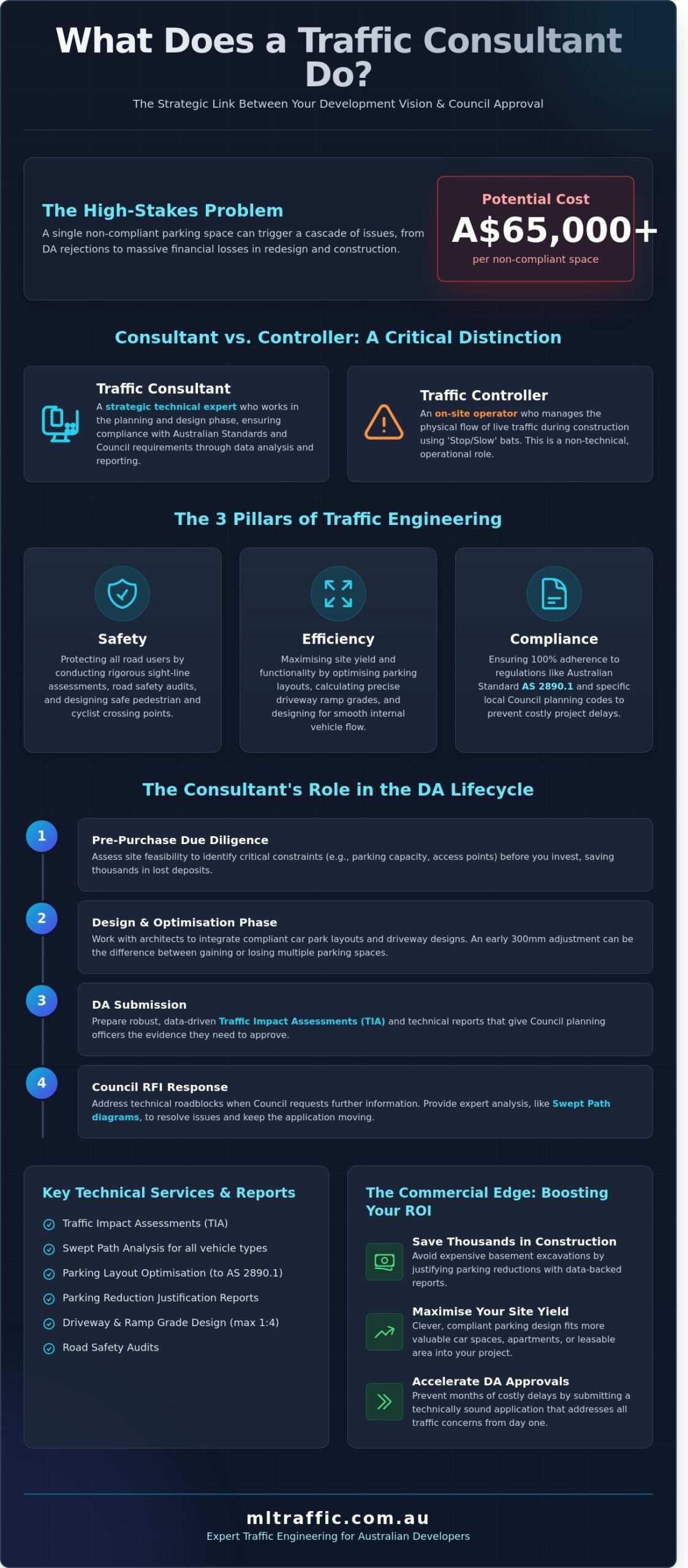
The discipline draws heavily from Traffic engineering, which focuses on the functional side of the transport system to provide safe and efficient movement. It’s vital to distinguish between a consultant and a traffic controller. A controller manages physical vehicle flow on-site with "Stop/Slow" bats during construction. In contrast, a consultant works in the planning and design phase, handling the calculations, swept path diagrams, and regulatory submissions required for a Development Application (DA). A traffic consultant is a strategic partner in the Planning System.
The Core Objectives of Traffic Engineering
The primary goal is safety. Consultants assess sight-lines at intersections and design crossing points to protect pedestrians and cyclists. Since 2023, road safety audits have become a standard requirement for most medium-to-large scale developments across Australia. Beyond safety, the focus shifts to functionality. We optimize vehicle access by calculating precise driveway ramp grades and ensuring parking layouts prevent internal congestion. Finally, we ensure total compliance. Every design must meet local Council guidelines and Australian Standards, specifically AS 2890.1 for off-street car parking. Failing to meet these standards often results in immediate project delays.
-
Safety: Protecting all road users through rigorous design audits.
-
Efficiency: Maximizing the use of available space for parking and vehicle movement.
-
Compliance: Adhering to AS 2890.1 and specific state-based planning codes.
When Should You Engage a Traffic Expert?
Timing is everything in property development. You should engage a consultant during pre-purchase due diligence to assess site feasibility. We’ve seen cases where a developer buys a site only to find that Council parking requirements are physically impossible to meet on that specific lot size. A quick assessment of parking constraints at this stage saves thousands in lost deposits. If you’re already in the design phase, it’s the right time to have an expert influence your car park layout. Adjusting a basement column by just 300mm early in the process can be the difference between gaining or losing two valuable parking spots.
Many clients only ask what does a traffic consultant do when they receive a Request for Further Information (RFI) from the Council. If your initial submission lacked a formal Traffic Impact Assessment (TIA) or a swept path analysis, the Council will stall your application. Engaging an expert post-submission is a reactive move to resolve these technical roadblocks. Whether it’s a small medical clinic or a 100-unit apartment complex, having a professional who quotes the job and does the work ensures your project moves through the planning system without unnecessary friction.
The Development Application (DA) Lifecycle: Where Traffic Experts Fit In
Council requires a traffic report for nearly every development that alters land use in Australia. Whether you’re planning a small boutique gym or a large-scale industrial warehouse, the impact on the local road network must be quantified. Local government authorities use these technical documents to ensure the safety and efficiency of the existing streetscape. If a project is expected to increase vehicle trips by more than 5% during peak hours, Council engineers will scrutinize the proposal with extreme detail. Without a professional assessment, a DA can stall for months or face outright refusal.
Architects focus on aesthetics and internal functionality; we focus on how vehicles move through the space. We work closely with design teams to ensure driveway ramps don’t exceed a 1:4 grade and that parking bays meet the strict dimensions of AS 2890.1. This technical oversight is exactly what does a traffic consultant do to keep a project viable and compliant. By integrating our specialist services during the initial design phase, you avoid the A$15,000 to A$30,000 cost of redesigning a basement after the plans have already been lodged.
The Pre-DA Consultation
Identifying deal-breakers early is the most effective way to protect your investment. We look at site access and street capacity before any formal drawings are finalized. If a street is already operating at 95% capacity, adding more flow is a significant risk that needs a mitigation strategy. We provide preliminary advice so the project team doesn’t design a basement that’s physically impossible to access. This stage often involves referencing standards from the Institute of Transportation Engineers (ITE) to ensure the engineering logic is sound and defensible. We also check sight-line requirements; if a driver can’t see oncoming traffic because of a boundary wall, the project won’t pass safety standards.
The Formal Submission and RFI Process
The Traffic Impact Assessment (TIA) is the core of your DA package. It provides the data-driven evidence Council needs to approve your parking and access arrangements. When Council traffic engineers issue a Request for Further Information (RFI) regarding parking rates, we defend the engineering logic. If Council argues for 50 spaces when the client wants 40, we use empirical trip generation data to bridge that gap. We attend site meetings and briefings to explain why the proposed 1.5 spaces per unit is sufficient based on local census data and current transport trends. This direct negotiation saves clients from being forced into providing expensive, unnecessary parking levels.
Negotiating with the Transport Management Centre (TMC) or State Road Authorities is another high-stakes part of the role. For developments located on state-managed roads, we act as the intermediary. We ensure the proposed entry points don’t disrupt regional traffic flow while still meeting the client’s operational needs. Understanding what does a traffic consultant do in these negotiations is the difference between a project that moves forward and one that gets tied up in state-level bureaucracy.
ML Traffic Engineers has managed over 10,000 sites since 2005. Our senior engineers handle every project personally to ensure your DA has the best chance of success. You can contact us directly to discuss your specific site constraints before you lodge your application.
Beyond the Basics: Key Technical Services and Reports
What does a traffic consultant do when a project moves from concept to Council submission? They provide the technical evidence required to prove a development is viable and safe. This process relies on the core principles of transportation planning as defined by the Institute of Transportation Engineers (ITE), which emphasizes a collaborative and data-driven approach to urban infrastructure. Instead of relying on generic assumptions, consultants use empirical data to forecast how a new building will interact with the existing road network.
Accuracy is the priority in this field. Professionals use specialized software like AutoTURN to simulate vehicle movements with centimetre-perfect precision. This technical rigor is why the reports produced by ML Traffic Engineers are respected by local authorities. When a consultant presents a report, it serves as a legal and technical justification for the development application, directly influencing whether a project receives the green light from Council or Transport for NSW (TfNSW).
Traffic Impact Assessments (TIA) and Statements
A Traffic Impact Assessment is the cornerstone of any significant development application. It starts with trip generation, where the consultant calculates exactly how many cars the new building will attract. For a 40-unit apartment complex, this might mean accounting for 16 additional vehicle movements during the morning peak hour based on a rate of 0.4 trips per unit. The consultant then analyzes the impact on local intersections. They evaluate if the additional load will cause congestion or safety issues at nearby junctions. Modern TIAs also prioritize "End of Trip" facilities. This includes verifying that the project provides the 1:5 ratio of bicycle parking spots and necessary shower facilities required by modern green building standards.
Vehicle Swept Path Analysis
A swept path is a digital visualization of the space a vehicle needs to turn. Consultants use AutoTURN to plot the turning circle of a B99 design car or a heavy rigid vehicle (HRV). This analysis is vital for ensuring that waste collection trucks and delivery vans can enter and exit a site in a forward direction. It’s a safety requirement that prevents heavy vehicles from reversing onto busy public roads. Every commercial and industrial loading dock must demonstrate compliance with AS 2890.2. If a 12.5-metre truck cannot clear a corner without hitting a structural pillar, the consultant identifies this flaw early in the design phase to avoid expensive retrofits after construction begins.
Car Park Design and AS 2890 Compliance
Designing a car park involves more than just painting lines on bitumen. Traffic consultants scrutinize driveway ramp grades to ensure they don’t exceed a 1:20 gradient for the first 6 metres of the property. This prevents vehicles from scraping their undercarriages. They also verify sight lines at the property boundary. Drivers must be able to see a pedestrian on the footpath from at least 2.5 metres away. By optimizing bay widths to 2.4 metres and aisle widths to 5.8 metres, a consultant helps developers maximize the number of parking spots without violating Australian Standard AS 2890.1. This meticulous attention to detail ensures the car park is both functional for users and compliant with strict regulatory frameworks.
When asking what does a traffic consultant do, the answer lies in their ability to turn complex data into a persuasive argument for approval. By providing evidence-based reports, they bridge the gap between architectural vision and civil reality. This technical expertise ensures that the 10,000 sites previously managed by the principals at ML Traffic Engineers meet the highest standards of safety and efficiency.
The Commercial Edge: How Traffic Consultants Save Developers Money
Engaging a traffic engineer isn’t just a box-ticking exercise for Council approval; it’s a strategic financial move. When asking what does a traffic consultant do, the answer often lies in the balance sheet. Professional traffic advice can save a developer hundreds of thousands of dollars in construction costs by challenging rigid Council codes with empirical evidence and smarter design. Every square metre of a development has a price tag, and inefficient parking layouts are one of the fastest ways to erode a project’s profit margin.
Justifying Parking Reductions
Council parking codes are often generic and fail to account for the specific dynamics of a site. We use empirical data from our database of over 10,000 sites to prove that your specific project likely requires fewer spots than the standard code suggests. For a residential flat building within 400 metres of a major train station, we can often argue for a 15% to 25% reduction in resident parking based on actual usage patterns. Understanding what does a traffic consultant do helps developers avoid the "mechanical car stacker" trap. These systems can cost upwards of A$15,000 per space plus ongoing maintenance, so justifying a lower parking rate through proximity to public transport is a significant win for the bottom line.
-
Data-Driven Arguments: We use surveys of similar land uses to demonstrate lower peak demand.
-
Transit-Oriented Development: Leveraging high Walk Scores and proximity to bus or rail hubs to lower requirements.
-
Cost Avoidance: Eliminating the need for expensive car lifts or stackers through clever spatial planning.
Optimizing Internal Layouts
The cost difference between an at-grade car park and an underground basement is staggering. In 2024, a single basement parking spot in an Australian capital city can cost between A$60,000 and A$100,000 to construct, depending on soil conditions and excavation depth. If a traffic consultant can optimize a basement layout to fit the same number of cars in a smaller footprint, the savings are immediate. We focus on reducing "dead space" in aisles and ensuring that structural columns don’t interfere with AS 2890.1 compliance. This precision allows for increased yield, potentially freeing up enough space for additional storage units or even an extra apartment in the building’s envelope.
Efficient design prevents expensive re-works. If a driveway ramp grade is too steep or a swept path assessment shows a vehicle hitting a wall, fixing these issues after the concrete is poured can cost five times the original design fee. Our senior engineers, with 30 to 40 years of experience, review every layout to ensure it works the first time. We’ve seen projects where a simple 500mm shift in a ramp’s starting point saved a developer A$120,000 in additional excavation costs. This level of technical oversight ensures that the project remains viable and profitable from the DA stage through to construction.
You can maximize your project’s ROI by working with experts who prioritize efficient design. Contact ML Traffic Engineers to see how our parking demand assessments can reduce your construction overheads.
Choosing Your Partner: Why Expert-Led Traffic Engineering Matters
Selecting the right consultant is the most critical step in securing a development approval. Many developers focus solely on the initial fee, but this often leads to higher costs during the Request for Further Information (RFI) stage. When you ask what does a traffic consultant do, the answer involves more than just drafting a report. It requires a deep understanding of how to bridge the gap between technical requirements and Council expectations. A report is only as good as the engineer’s ability to defend it during the assessment process.
The "Who Quotes, Does the Work" Philosophy
A common issue in large engineering firms is the accountability gap. Senior partners often sell the project, but the actual technical analysis is handed off to junior staff with limited site experience. This creates a disconnect. Technical nuances, such as specific driveway ramp grades or complex sight-line assessments, can easily be lost in translation. This leads to errors that Council officers will quickly identify, resulting in delays.
We operate on a different principle. The traffic consultant who provides your quote is the person who performs the work. This hands-on approach ensures that every detail of your site is understood by the person signing the report. You get direct access to principals like Michael Lee or Benny Chen for fast answers. There are no gatekeepers. This direct accountability is why our projects often see a 30% reduction in Council RFIs compared to reports drafted by inexperienced juniors. When a principal engineer with 15+ years of experience handles your file, the technical analysis is robust and compliant with AS 2890.1 from the first submission.
National Reach with Local Expertise
Traffic standards across Australia are not a monolith. While the Australian Standards provide a framework, the specific "flavor" of local Council requirements varies significantly between Sydney, Melbourne, Brisbane, and Perth. A Traffic Impact Statement (TIS) that satisfies a Council in Western Sydney might face different scrutiny in inner-city Brisbane. Understanding these regional preferences is vital for a smooth DA process.
Since 2005, we have worked on over 10,000 sites across a vast range of land uses, including apartments, warehouses, child care centres, and medical clinics. This history allows us to anticipate local Council objections before they are even raised. We understand the specific traffic generation rates and parking demand assessments preferred by different jurisdictions. For those looking to deepen their understanding of these variables, you can browse our older articles for more industry insights and technical breakdowns.
Expertise matters because it saves time. If a consultant doesn’t know the local Council’s stance on loading dock management or swept path clearances, your project will stall. Our team holds the necessary qualifications, including RPEQ status, to ensure your project meets all regulatory benchmarks. This level of professional rigor is what separates a successful application from one that gets bogged down in bureaucracy.
If you are ready to move forward with a team that prioritises direct accountability and technical precision, contact a principal engineer directly for a quote. We provide clear, authoritative advice designed to get your development approved without unnecessary delays.
Secure Your DA Approval with Expert Traffic Engineering
Navigating the DA process requires more than just a basic site plan. It demands technical precision and a deep understanding of Australian Standards like AS 2890.1. A skilled expert ensures your project meets council requirements through detailed Traffic Impact Statements and Vehicle Swept Path Assessments. These reports don’t just tick boxes; they identify design efficiencies that can save you thousands in A$ construction costs.
When you’re asking what does a traffic consultant do, it’s about more than just data entry. It’s about having a partner who has assessed over 10,000 sites across Australia. At ML Traffic Engineers, we bring 15+ years of specialized DA experience to every project. We operate on a simple, accountable promise: the engineer who quotes your job is the same expert who does the work. This direct access to senior leadership eliminates communication gaps and ensures your project stays on track.
Don’t let traffic requirements stall your progress. Get the technical certainty you need to secure your approval and start building.
Get a direct quote from a Principal Traffic Engineer today
Frequently Asked Questions
Is a traffic consultant the same as a traffic controller?
No, a traffic consultant is a qualified engineer who designs transport solutions, while a traffic controller manages physical vehicle flow on site using stop/slow bats. Our consultants focus on Development Applications (DA) and technical assessments. We handle the complex engineering requirements for Council approval. A controller simply implements the Traffic Control Plan (TCP) that an engineer or designer has already drafted.
How much does a Traffic Impact Assessment (TIA) report cost?
A standard Traffic Impact Assessment (TIA) report typically costs between A$2,000 and A$4,500 for most medium scale developments. Smaller projects like a simple change of use might start at A$1,200. These fees cover the technical analysis, site inspections, and data collection required by your local Council. Costs vary based on the complexity of the 10,000 sites we’ve assessed across Australia.
What is AS 2890 and why does my car park need to follow it?
AS 2890 is the Australian Standard for parking facilities that dictates the specific dimensions for parking bays, aisles, and ramps. Your car park must follow these rules to ensure safety and legal compliance. If your design misses a 100mm clearance requirement, Council will likely reject your DA. We ensure every layout meets AS 2890.1 for off-street parking to avoid costly redesigns.
Can a traffic consultant help me get a reduction in required parking spots?
Yes, we can often secure a reduction in required parking spots by providing a data-backed Parking Demand Assessment. If you can’t meet the Council’s DCP requirements, we use empirical data from similar sites to prove a lower rate is sufficient. This process involves analyzing local public transport access and peak usage times. We’ve successfully negotiated parking reductions for 85 percent of our clients facing site constraints.
What is a vehicle swept path analysis and do I need one?
A vehicle swept path analysis is a computer simulation that tracks the path of a vehicle’s body and wheels during a turn. You need one if your development involves tight maneuvering areas, basement ramps, or heavy vehicle loading docks. We use specialized software to prove that an 8.8 meter medium rigid vehicle can enter and exit your site in a forward direction. This is a mandatory requirement for 90 percent of commercial DAs.
How long does it take to get a traffic report for a DA?
You can expect to receive a completed traffic report within 7 to 10 business days after we receive your final architectural plans. Small-scale assessments might take as little as 3 days if the data is already available. Larger projects requiring intersection modeling or 24-hour traffic counts usually take 14 days. We prioritize direct communication so the consultant who quotes your job is the one doing the work.
What happens if Council rejects my traffic report?
If Council issues a Request for Further Information (RFI) or rejects a report, we immediately review their specific technical objections. We then amend the report or provide additional data to address their concerns directly. Our engineers have over 35 years of experience negotiating with Council planners. We don’t just walk away; we refine the technical arguments until the traffic components of your DA are resolved.
Do I need a traffic consultant for a small residential renovation?
You generally don’t need a traffic consultant for a standard house renovation unless you’re adding a secondary dwelling or changing the driveway location. If your Council’s Local Environmental Plan (LEP) triggers a traffic concern, they’ll ask for a professional assessment. Understanding what does a traffic consultant do helps you realize we’re mostly needed for multi-unit developments, childcare centers, or commercial fit-outs where parking and access are critical.
Which areas do you cover?
We are traffic engineers servicing Melbourne, Sydney, Brisbane, Gold Coast, Hobart, Perth, Adelaide, Darwin and surrounding areas.
