

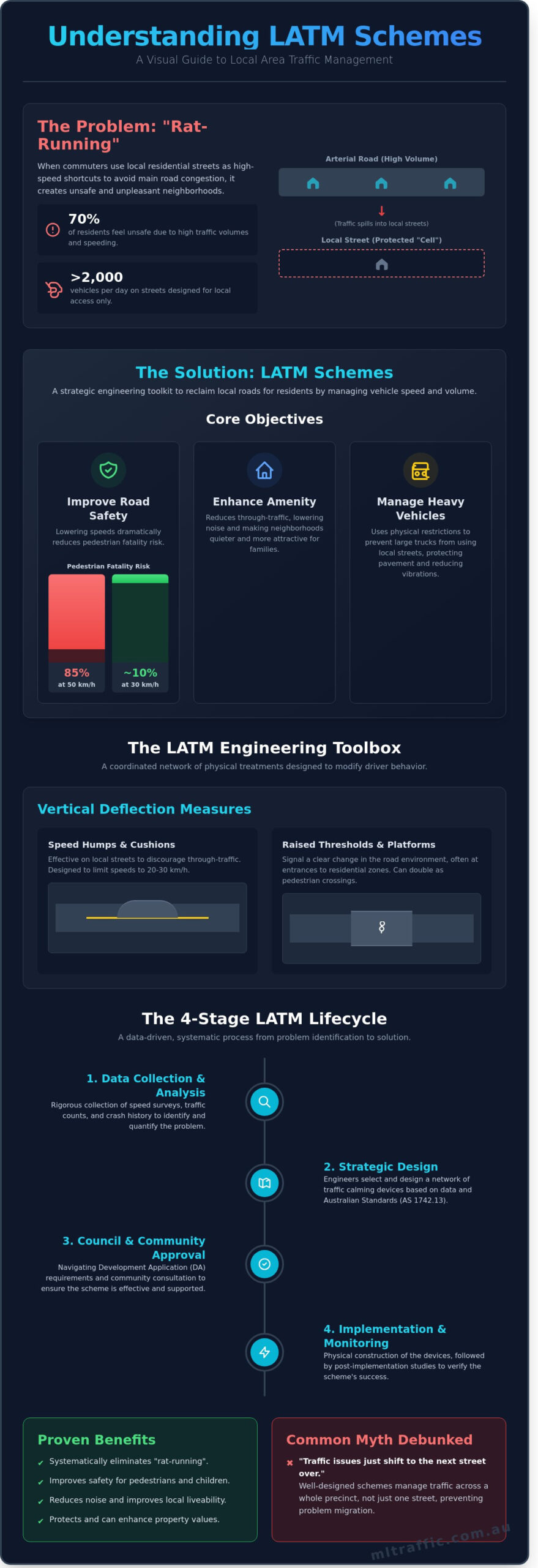
What if the road directly outside your front door was designed to prioritize children and pedestrians rather than being a shortcut for 500 speeding commuters every morning? Statistics show that 70% of residents in high-growth corridors feel unsafe due to “rat-running” and traffic volumes exceeding 2,000 vehicles per day on local streets. If you’re tired of deciphering council reports, you’ve likely asked: what is a local area traffic management (LATM) scheme and how does it actually change things? It’s a strategic engineering approach that uses physical measures to reclaim local roads for the people who live on them.
We agree that your family’s safety shouldn’t be compromised by poorly managed traffic flow or confusing technical jargon. This guide promises to strip away the complexity; we’ll show you how LATM schemes transform residential zones into quieter, safer spaces through proven traffic calming measures. You’ll learn about the core engineering components, the 4-stage council approval process, and how to access the professional engineering advice you need to get results for your specific project.
Key Takeaways
- Understand exactly what is a local area traffic management (LATM) scheme and how it systematically eliminates “rat-running” to reclaim the safety of residential streets.
- Explore the strategic engineering “toolbox” of vertical, horizontal, and psychological measures used to effectively moderate vehicle speeds and improve local liveability.
- Learn why rigorous data collection—from speed surveys to crash history—is the essential foundation for any successful and defensible traffic intervention.
- Discover how well-executed schemes protect property values and debunk the common myth that traffic issues simply shift to the next street over.
- Find out how experienced traffic consultants navigate complex Development Application (DA) requirements to ensure your project meets strict local council standards.
Understanding the Basics: What is a Local Area Traffic Management (LATM) Scheme?
A Local Area Traffic Management (LATM) scheme is a technical, strategic framework used to control vehicle behavior within residential precincts. When asking what is a local area traffic management (LATM) scheme, it’s best to view it as a toolkit for protecting “residential cells” from the negative impacts of high-speed transit. These schemes prioritize the safety of local streets by ensuring they aren’t used as high-speed bypasses for congested main roads. While arterial roads are engineered for high-volume mobility, local roads are designed for property access and community liveability.
To better understand how these plans are structured and implemented, watch this helpful video:
Engineers distinguish between a street’s physical capacity and its environmental capacity. Physical capacity refers to the maximum number of vehicles a road can physically carry. Environmental capacity, a concept introduced in the 1963 Buchanan Report, defines the limit of traffic a street can handle before noise, air quality, and safety reach unacceptable levels. Modern LATM schemes use various traffic calming measures to keep traffic volumes within these environmental thresholds.
The Core Objectives of an LATM
- Improving road safety: Reducing vehicle speeds is critical. A pedestrian hit by a car at 50km/h has an 85% chance of death, but this drops significantly if speeds are managed down to 30km/h or 40km/h.
- Enhancing neighbourhood amenity: These schemes reduce through-traffic, which lowers ambient noise levels and makes residential areas more attractive for families.
- Managing heavy vehicles: LATMs often include physical restrictions to prevent trucks over 4.5 tonnes from using local streets, protecting pavement life and reducing ground-borne vibrations.
Why Councils and Developers Need Them
Rapid urban growth creates immense pressure on existing infrastructure. A new 200-dwelling residential development can generate over 1,400 additional vehicle trips per day. If these trips aren’t managed, commuters will engage in “rat-running,” which is the practice of using local streets to avoid traffic lights on arterial routes. Councils rely on professional traffic engineering services to design schemes that address community complaints regarding 85th percentile speeds and cut-through volumes. An LATM is a strategic framework for street safety.
The Toolbox: Common Traffic Calming Devices in LATM Schemes
Understanding what is a local area traffic management (LATM) scheme requires looking at the specific physical interventions used to modify driver behavior. An LATM isn’t a single speed hump; it’s a coordinated network of treatments designed to achieve a specific safety objective. Engineers select these tools based on the 85th percentile speed data and road hierarchy. All designs must adhere to Australian Standards, specifically AS 1742.13, to ensure safety, visibility, and legal compliance. Selecting the wrong device for a specific road type can lead to increased noise or poor drainage, which is why the traffic calming planning process must be rigorous and data-led.
Vertical Deflection Measures
Vertical measures use physical height to manage velocity. Speed humps and cushions are designed to limit vehicle speeds to between 20km/h and 30km/h. These are most effective on local streets where through-traffic needs to be discouraged. Raised threshold treatments at the entrance of a residential zone signal a clear change in the road environment. Flat-top humps are highly versatile, providing speed reduction while doubling as level pedestrian crossing points for improved accessibility.
Horizontal Deflection and Obstructions
Horizontal measures change the path of travel to increase driver effort. Chicanes and curb extensions, often called outstands, narrow the driver’s visual field. This narrowing naturally encourages lower speeds without the jarring impact of a hump. Roundabouts manage intersection flow while forcing a reduction in velocity at critical conflict points. Median islands and “slow points” are effective at preventing dangerous overtaking maneuvers on long, straight residential stretches where 50km/h limits are frequently ignored.
Traffic Diversion and Access Control
Diversion tools focus on volume rather than just speed. One-way street conversions eliminate “rat runs” by making through-traffic paths less convenient. Cul-de-sacs and diagonal diverters force vehicles back toward major arterial roads, preserving the local character of the neighborhood. Entry statements use landscaping and specific signage to define the start of a low-speed precinct. If you require a detailed assessment of these measures for a development application, our traffic engineering services provide the technical data needed for council approval.
Our approach is direct. The traffic consultant who provides your quote is the same senior expert who does the work. This ensures that every device in the scheme is placed with precision and backed by decades of engineering experience.
The Lifecycle of an LATM: From Data Collection to Implementation
A successful scheme doesn’t appear overnight. It’s a technical process that often spans 6 to 12 months from the initial resident complaint to the final bolt in the asphalt. To understand what is a local area traffic management (LATM) scheme in practice, you have to look at the rigorous data that justifies every speed hump or chicane. These projects require a balance of engineering precision, community sentiment, and budget reality.
Step 1: Identifying the Problem
Traffic engineers don’t guess where the problems are; they measure them. We use Automatic Traffic Counters (ATC), often called “tube counts,” to gather 7 days of continuous data. This reveals the 85th percentile speed, which is the speed at or below which 85% of vehicles travel. If this number significantly exceeds the 50km/h local limit, intervention is likely. We also analyze origin-destination data to determine if 25% or more of peak-hour traffic consists of “rat-runners” bypassing main arterial roads. Data-driven evidence is the foundation of any council approval.
Step 2: Design and Engineering
Once the problem is quantified, the design phase begins. This is where we ensure that traffic calming devices don’t accidentally block essential services. A standard 12.5-meter Heavy Rigid Vehicle, such as a fire truck or waste collection unit, must still be able to navigate the street. Engineers apply Vehicle Swept Path Analysis to simulate these movements digitally. This stage also involves difficult trade-offs. For example, installing a new curb extension might mean losing 3 or 4 on-street parking spaces to ensure safe sight lines and vehicle clearance.
Step 3: Consultation and Approval
The technical design must pass through the Local Traffic Committee, which typically includes representatives from the Council, State Police, and local Members of Parliament. Following their review, the proposal enters a formal community consultation period, usually lasting 21 to 28 days. Resident feedback is vital; it often leads to minor tweaks in the layout to protect driveway access. Understanding what is a local area traffic management (LATM) scheme also means recognizing the role of the “Trial Period.” Many councils install temporary rubber bollards for 3 to 6 months to test the measures. This allows us to monitor real-world impacts before committing to permanent concrete construction.
- Data Collection: 7-day volume and speed surveys.
- Crash History: Reviewing 5 years of police-reported accident data.
- Compliance: Ensuring all designs meet Australian Standard AS 1742.13.
- Feedback: Adjusting designs based on emergency service and resident input.
Benefits and Common Concerns: Does LATM Actually Work?
A common myth suggests that implementing a scheme simply pushes cars to the next street over. Data proves otherwise. When you understand what is a local area traffic management (LATM) scheme, you see it’s about achieving network balance. Traffic evaporation occurs when drivers choose main arterials or alternative transport modes instead of “rat-running” through residential blocks. A 2017 study on urban traffic calming found that total network volume often decreases by 10% to 15% as through-traffic returns to designated sub-arterial roads.
Beyond flow, there’s a clear financial incentive for homeowners. Properties on calmed streets often see a value increase of 5% to 10% compared to those on high-speed through-roads. Quiet, safe streets are a premium commodity for families. The 10 second delay of a chicane or speed cushion is a small price for a 60% reduction in serious injury crashes. It’s a trade-off that prioritizes human life over a minor inconvenience.
Quantifiable Safety Improvements
Safety isn’t subjective; it’s measurable. Lowering speeds to the “survival speed” of 40km/h or less is the primary goal. If a vehicle hits a pedestrian at 50km/h, the fatality risk is approximately 85%. At 30km/h, that risk drops to 10%. A what is a local area traffic management (LATM) scheme achieves these results through physical interventions. Curb realignments at intersections also improve sight-lines by 30% or more, giving drivers more time to react to cyclists and children.
Addressing Resident Objections
- Noise levels: While older speed humps caused braking and acceleration noise, modern “speed cushions” allow buses and emergency vehicles to pass with minimal disruption while still slowing passenger cars.
- Emergency response: Engineers use vehicle swept path assessments to ensure fire trucks and ambulances maintain access. Design standards ensure response times aren’t compromised by more than a few seconds.
- Aesthetics: Modern engineering turns traffic calming into “streetscaping.” Using landscaped islands and planter boxes improves the visual appeal of the neighborhood while naturally narrowing the driving path.
The “Safety in Numbers” effect is also vital. When streets feel safer, more people walk and cycle. This increased activity further alerts drivers to be cautious. It’s a self-reinforcing cycle of neighborhood safety. If you’re planning a development or need a professional assessment, our team provides the expert data required for council approval.
Ensure your project meets all regulatory standards by viewing our traffic engineering services.
How Professional Traffic Engineers Shape Effective LATM Strategies
Developers frequently find that contributing to a local area traffic management (LATM) scheme is a mandatory condition of their Development Application (DA). Councils use these requirements to ensure that new projects don’t negatively impact the safety or amenity of existing residential streets. Successful navigation of these requirements requires a technical partner who understands both the engineering standards and the local government’s specific objectives. An experienced traffic consultant plays a critical role here, negotiating with authorities to ensure that required works remain both effective and commercially viable.
Generic, cookie-cutter solutions often fail in complex urban environments where space is at a premium and community expectations are high. A professional engineer doesn’t just apply a standard template. They analyze the specific geometry of the street, the existing traffic volumes, and the unique needs of the local neighborhood to create a custom strategy that works for everyone.
Supporting Development Applications
A Traffic Impact Assessment (TIA) is the primary tool used to determine if a project triggers the need for local traffic intervention. Engineers analyze projected trip generation rates and existing road capacities to identify potential congestion points. Understanding what is a local area traffic management (LATM) scheme in the context of your specific site is essential for avoiding costly delays during the DA process. We design site-specific solutions that satisfy council requirements while maintaining project viability, often integrating these principles into new estate layouts from the ground up to prevent future issues.
The ML Traffic Engineers Approach
Our firm operates on a model of direct accountability. You get direct access to senior principals who do the work, ensuring technical accuracy from the first draft to the final approval. We leverage over 15 years of experience across 10,000+ sites to provide reliable advice that stands up to scrutiny. Whether you are dealing with apartments, warehouses, or childcare centers, we have the specific data to support your case. If you’re ready to start your project, contact our team today for a direct quote.
Ultimately, a local area traffic management (LATM) scheme serves as the bridge between civil engineering and community wellbeing. By applying a rigorous technical lens to local street design, we create environments where new development and established residents coexist safely and efficiently.
Take Control of Your Local Traffic Infrastructure
Success in modern urban development requires more than just a basic understanding of what is a local area traffic management (LATM) scheme. You need to know how specific calming devices and data-driven lifecycles impact your site’s accessibility. Implementing the right measures can mean the difference between a rejected application and a thriving community asset. Don’t leave these technical details to chance when navigating complex council requirements.
ML Traffic Engineers offers over 15 years of specialized experience in Australian traffic engineering to guide you through the process. We’ve successfully managed over 10,000 sites, ensuring compliance and efficiency at every stage. You won’t deal with junior staff here. Senior engineers Michael Lee and Benny Chen personally handle every assessment to ensure your project meets rigorous Australian Standards. The traffic consultant who provides the quote is the expert who does the work. Let’s get your development moving forward with precision.
Get a professional Traffic Impact Assessment quote for your project today and see why experience matters.
Frequently Asked Questions
What is the difference between traffic calming and an LATM scheme?
Traffic calming refers to individual physical measures like speed humps or cushions, while a local area traffic management (LATM) scheme is a coordinated, precinct-wide strategy. Councils use these schemes to address safety across an entire residential pocket rather than fixing one isolated spot. According to Australian Standard AS 1742.13, these comprehensive plans ensure that improvements on one street don’t simply shift the traffic volume to the next parallel road.
Will an LATM scheme reduce the speed limit on my street?
An LATM scheme doesn’t automatically change the posted speed limit, though it frequently results in the implementation of new 40 km/h zones. The primary goal is to lower the 85th percentile speed, which represents the speed at or below which 85% of motorists travel. Engineering data shows that physical interventions can reduce average vehicle speeds by 10 to 15 km/h without requiring constant police enforcement or additional signage.
How do councils decide which streets get traffic calming first?
Councils prioritize streets based on a technical ranking system that weighs 5 years of crash history, daily traffic volume, and proximity to schools. Most local governments require documented evidence of safety risks before a street moves to the top of the capital works list. If a road carries more than 2,500 vehicles daily despite its status as a local access street, it’s 60% more likely to receive immediate funding.
Can an LATM scheme affect emergency vehicle access?
Emergency vehicle access is a mandatory design factor, and every device must allow for rapid transit by fire and ambulance services. Engineers design treatments like speed cushions so that wide-axle fire trucks can straddle them without slowing down. We ensure all designs meet the 12.5-meter turning radius required by local emergency services to prevent response delays. These specifications keep your neighbourhood safe without compromising critical life-saving services.
Do traffic calming devices like speed humps decrease property values?
Research indicates that traffic calming devices generally increase property values by improving street liveability and pedestrian safety. A study of residential areas showed that reducing through-traffic can boost home prices by 5% to 8% because the environment becomes quieter and safer for families. Buyers often pay a premium for homes on “slow streets” where the risk of accidents is 70% lower than on untreated local roads.
How can I request an LATM study for my local neighbourhood?
You can request a study by submitting a formal proposal to your council’s Traffic Committee, ideally supported by a petition from at least 20 households. It’s helpful to provide specific data, such as peak hour congestion times or a log of near-miss incidents. Once submitted, the council’s engineering department will conduct a 7-day traffic count to determine if the area meets the threshold for a full what is a local area traffic management (LATM) scheme.
What is rat-running and how does an LATM stop it?
Rat-running occurs when motorists use residential side streets to bypass congestion on main arterial roads during peak periods. A local area traffic management (LATM) scheme stops this by using road closures, one-way segments, or chicanes that make the shortcut less convenient for through-traffic. Data from previous projects shows these measures can reduce non-local vehicle movements by up to 30%, returning the street to its intended use for local residents.
Is a Traffic Impact Assessment required for an LATM?
A Traffic Impact Assessment (TIA) is required to ensure that proposed changes don’t create bottlenecks on adjacent roads or intersections. This assessment uses computer modeling to predict how 100% of diverted traffic will redistribute across the surrounding road network. Our engineers conduct these studies to prove that the scheme complies with state transport regulations and won’t negatively affect the level of service at nearby signalized intersections or major junctions.
Disclaimer
The content on www.mltraffic.com.au, including all technical articles, guides, and resources, is provided for general informational and educational purposes only. It is not intended to constitute professional advice in traffic engineering, transportation planning, development approvals, or any other technical or legal field.
While ML Traffic Engineers makes every reasonable effort to ensure the accuracy, completeness, and timeliness of the information published, we do not provide any warranties or representations (express or implied) regarding its reliability, suitability, or availability for any particular purpose. Any reliance you place on the content is strictly at your own risk.
In no event shall ML Traffic Engineers, its directors, employees, authors, or affiliates be liable for any direct, indirect, incidental, special, consequential, or punitive damages (including, without limitation, loss of profits, data, or business opportunities) arising out of or in connection with the use of, or inability to use, any information provided on this website.
The articles and guides on this site are not a substitute for engaging a qualified, registered professional traffic engineer (such as an NPER or RPEQ engineer) to assess your specific project requirements. For tailored advice, compliance assessments, or traffic engineering services, please contact a competent professional.
This disclaimer may be updated from time to time without notice. By accessing or using this website, you agree to be bound by the most current version of this disclaimer.
