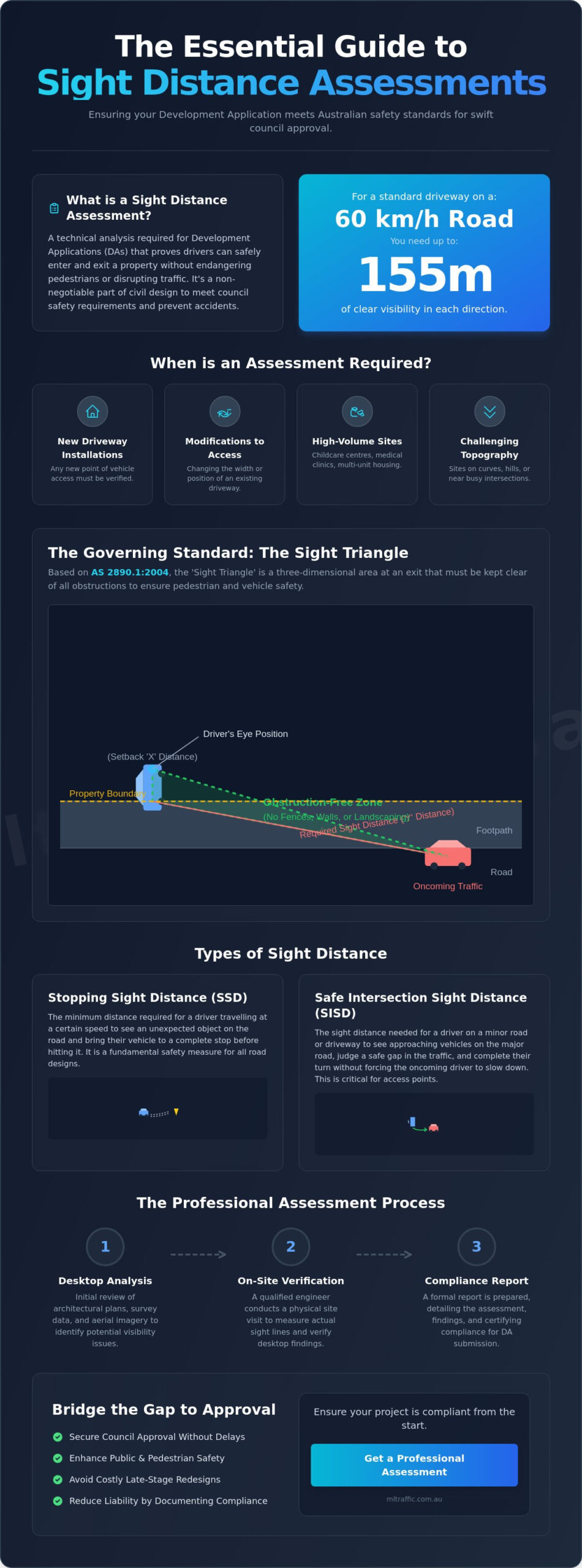
For a standard residential driveway on a 60 km/h road, you need up to 155 meters of clear visibility in each direction to meet current Australian safety standards. Most developers find the technical intersection of civil engineering and planning law to be a source of significant frustration, especially when a Council RFI demands clarity on specific visibility metrics. You might be asking, what is a sight distance assessment, and why is it a non-negotiable component of your Development Application?
It’s common to feel concerned about the potential for DA rejection or the expense of late-stage redesigns due to technical non-compliance. This guide provides a direct breakdown of the requirements, covering everything from AS/NZS 2890.1:2004 compliance to the latest March 2025 Austroads Guide updates. We’ll examine the critical calculations for driver eye height and object setback that ensure your design secures approval while maintaining the highest safety standards.
Key Takeaways
- Identify the technical requirements of AS 2890.1:2004 and learn how the ‘Sight Triangle’ ensures regulatory compliance for off-street parking.
- Understand the distinction between Stopping Sight Distance (SSD) and Safe Intersection Sight Distance (SISD) to meet specific road safety criteria.
- Determine exactly what is a sight distance assessment and how it identifies physical obstructions like landscaping or signage that risk your project’s approval.
- Gain insight into the engineering process, including desktop analysis of architectural plans and physical site verification by qualified experts.
- Ensure your development design bridges the gap between architectural vision and civil engineering safety standards to secure Council approval without delays.
What is a Sight Distance Assessment and Why is it Required?
A sight distance assessment is a technical analysis of the visibility available to drivers at property access points. It’s a critical component of the civil design process that determines if a driver can safely enter or exit a site without obstructing the traffic flow or endangering pedestrians. When clients ask, what is a sight distance assessment, they’re often looking for a way to satisfy Council requirements for their Development Application (DA). This isn’t a casual observation. It’s a rigorous engineering exercise that uses specific benchmarks, including the March 2025 Austroads Guide updates, to ensure safety.
To better understand this concept, watch this helpful video:
The Legal and Safety Mandate
Professional engineering standards exist because subjective judgment is unreliable. A developer might feel a driveway is safe, but without a technical report, there’s no legal proof of compliance. This assessment reduces liability for property owners by documenting that the design meets national safety criteria. Council planners prioritize the safety of the public road network; they won’t approve a design that risks visibility-related accidents. Poor sight distance is a documented factor in many urban collisions, making this report a vital piece of insurance for your project’s longevity.
When Does Your Project Need an Assessment?
Determining when to commission a report depends on the scale and location of your project. Most Australian Councils require a formal Sight Distance Assessment for several specific scenarios:
- New Driveway Installations: Any new point of ingress or egress must be verified against AS/NZS 2890.1:2004.
- Modifications to Access: Changing the width or position of an existing driveway often triggers a mandatory review.
- High-Volume Developments: Childcare centres, medical clinics, or multi-unit residential blocks increase the risk profile of an access point.
- Challenging Topography: Sites located on the inside of a curve, at the crest of a hill, or near a busy intersection require detailed analysis.
Understanding what is a sight distance assessment helps you anticipate these requirements early in the planning phase. This proactive approach prevents costly redesigns after you’ve already submitted your plans to the Council. It ensures your architectural vision aligns with the physical realities of road safety and current regulatory standards.
The Governing Standard: Understanding AS 2890.1 and the Sight Triangle
Australian Standard AS 2890.1:2004 is the primary document governing the design and management of off-street car parking facilities. While this standard is currently listed as pending revision, it remains the active benchmark for Council planners across the country. Compliance with this standard is not a suggestion; it’s a binary pass/fail requirement for any Development Application. If your site plan fails to demonstrate the specific visibility metrics outlined in the standard, your application will likely face immediate delays or rejection. Understanding what is a sight distance assessment requires a deep dive into how these geometric rules apply to your specific property boundary.
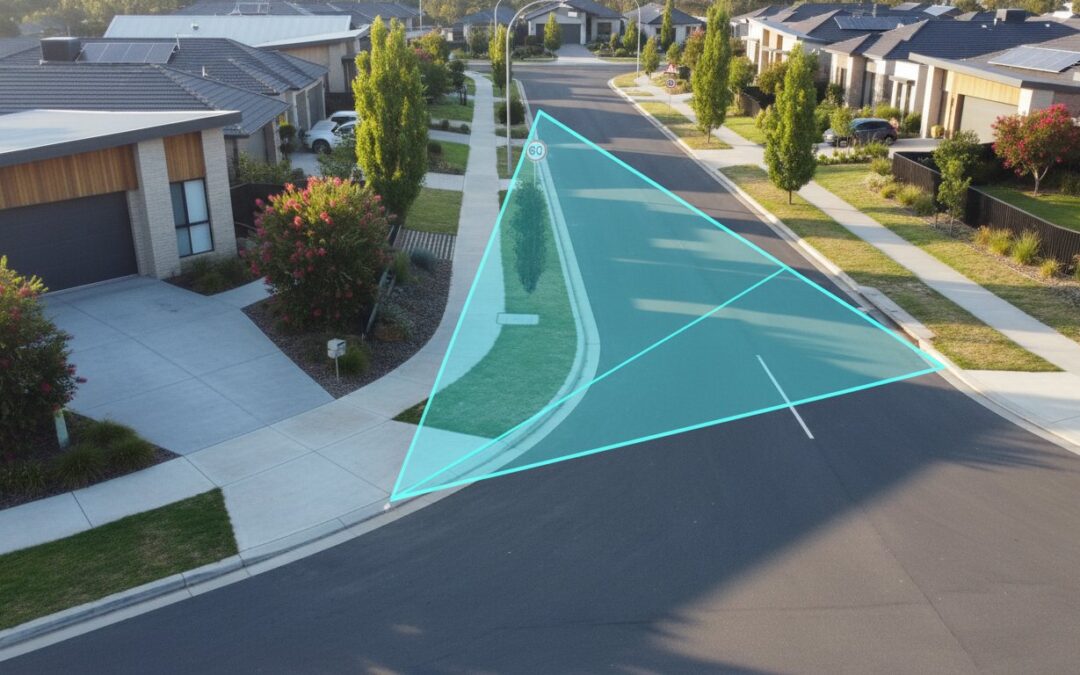
The ‘Sight Triangle’ is the most critical geometric concept within this standard. It defines a three-dimensional area that must remain entirely clear of physical obstructions. This includes boundary fences, retaining walls, dense landscaping, and even utility boxes. The most frequently cited requirement is Figure 3.3, which specifies the minimum sight lines required for pedestrian safety at the property exit. This figure ensures that a driver has a clear view of pedestrians on the footpath before the vehicle’s nose crosses the boundary. Maintaining this clear zone is essential for urban developments where foot traffic is high and the margin for error is low.
X and Y Distances Explained
Engineers use ‘X’ and ‘Y’ distances to calculate the necessary visibility for safe vehicle movements. The ‘X’ distance represents the setback of the driver’s eye from the edge of the conflict point. For most assessments, the driver is considered to be set back between 3 and 5 meters from the edge of the road carriageway. The ‘Y’ distance is the clear view required along the road or footpath. These values are not static. They scale based on the posted speed limit and the road’s classification. A 60 km/h road requires a significantly longer ‘Y’ distance than a 40 km/h local street to account for vehicle reaction times and braking distances. If you’re unsure about your site’s specific requirements, our team can provide a professional Sight Distance Assessment to verify your design.
The Pedestrian Conflict Zone
In dense urban environments, the pedestrian conflict zone is the primary focus of Council scrutiny. AS 2890.1 dictates a specific sight triangle of 2.0m along the boundary by 2.5m into the site. Within this zone, no obstruction can exist between the heights of 1.15m (standard driver eye height) and 0.2m (object height). This ensures visibility for children and individuals using mobility aids who may be obscured by standard-height fences. Failing to account for these dimensions during the architectural phase often leads to expensive late-stage redesigns. You can learn more about car park design compliance to understand how these safety triangles integrate into a total site design that satisfies both aesthetic and regulatory goals.
Types of Sight Distance: SSD vs. SISD
While the previous section focused on pedestrian safety at the property boundary, vehicle-to-vehicle visibility requires a different set of technical parameters. Understanding what is a sight distance assessment requires distinguishing between these specific technical categories. For a standard commercial or residential Development Application, engineers typically evaluate three primary types of sight distance to ensure the proposed access point doesn’t create a hazard on the public road network. These calculations shift based on whether the vehicle is stopping, turning, or entering a high-speed traffic stream.
Stopping Sight Distance (SSD) Mechanics
Stopping Sight Distance (SSD) is the minimum distance required for a driver to perceive an object and stop. This metric is the foundational safety buffer for any road design. It accounts for the driver’s reaction time, the vehicle’s braking capability, and the longitudinal grade of the road. On a steep decline, for example, the required SSD increases significantly because gravity opposes the vehicle’s braking force. In the context of a Sight Distance Assessment, we verify that approaching drivers have enough clear view to see a vehicle waiting to turn into your driveway. Ensuring adequate SSD is the most effective way to prevent high-speed rear-end collisions near site access points.
Safe Intersection Sight Distance (SISD)
Safe Intersection Sight Distance (SISD) is often considered the ‘Gold Standard’ for vehicle safety in Australia. It provides a sufficient buffer for a driver on the major road to observe a vehicle entering from a driveway and decelerate to a stop if necessary, even if the entering driver makes an error. According to the March 2025 Austroads Guide updates, the SISD for a 60 km/h road is between 145 and 155 meters. These calculations use a standard driver eye height of 1.15m and an object height of 1.25m to represent the roofline of an oncoming car. Because SISD covers more complex conflict scenarios than SSD, the role of a traffic engineer in complex assessments is vital to ensure these distances are accurately measured against physical site constraints.
Entering Sight Distance (ESD) is the final technical layer. This ensures that drivers exiting your development can see a large enough gap in the traffic to join the flow safely. While AS 2890.1:2004 provides the framework for off-street parking, we rely on Austroads Part 3: Geometric Design to manage these more complex interactions on the public road. For developments involving heavy vehicles or high-volume traffic, these two standards must be used in tandem. A design that satisfies the pedestrian requirements of AS 2890.1 might still fail a DA if it doesn’t meet the SISD requirements set by Austroads for the specific road classification.
Common Obstructions and Practical Engineering Solutions
Identifying a deficiency is only the first step in the planning process. When we conduct what is a sight distance assessment, we frequently find that architectural vision clashes with civil safety mandates. The most common physical barriers include solid boundary fences and masonry retaining walls that exceed 0.2 meters in height within the identified sight triangle. Even dense landscaping, which may look appealing on a landscape plan, can result in an automatic DA rejection if the species selected grow into the 1.15-meter driver eye height zone. Council planners don’t accept ‘trimmed hedges’ as a permanent safety solution. They require structural certainty and long-term compliance.
Street furniture and topography also present significant challenges. Power poles, bus shelters, and even legally parked cars can permanently obscure critical sight lines. Steep driveway ramps create vertical blind spots; if the ramp grade is too aggressive, the driver’s eye height drops below the line of sight to the road before the vehicle reaches the boundary. These flaws are often identified too late, leading to expensive redesigns of the entire basement or entry level.
Design Fixes for Failing Sight Lines
Splayed fences are a standard and effective engineering response. By angling the boundary wall back into the property, you expand the visible area for exiting drivers without sacrificing security. Low-height retaining walls, specifically those kept under 900mm, often resolve conflicts because they sit below the 1.15-meter eye height benchmark. Strategic landscaping is another viable fix. We recommend selecting ‘clear stem’ tree species that maintain a canopy well above the driver’s line of sight. Integrating these fixes early is easier when using swept path analysis to optimise access points, ensuring the vehicle’s turning arc doesn’t force it into a blind spot.
Technological and Structural Mitigations
Developers often ask if convex mirrors are an acceptable solution for restricted sites. Most Australian Councils view mirrors as a last resort. They are prone to vandalism, weather-related distortion, and maintenance neglect. Instead, engineers may recommend widening the driveway entry. This allows for a better approach angle, effectively opening up the view of oncoming traffic. In high-density urban environments with extreme constraints, audible signals or warning lights may be required, though these often come with strict operational conditions from the Council. If your current site plan faces visibility constraints, contact our senior engineers for a professional Sight Distance Assessment to identify compliant design alternatives.
The Professional Assessment Process: From Site Visit to Report
A professional engineering workflow ensures that the technical data presented to the Council is defensible and accurate. When developers ask what is a sight distance assessment in a practical sense, they are referring to a four-stage technical process. This begins with a comprehensive desktop review of your architectural and landscape plans. We analyze the proposed site layout against existing property boundaries and road geometry to identify potential conflict points before any physical work begins. This early stage is where we flag major design flaws, such as basement ramps that are too steep or boundary walls that obstruct the required sight triangle.
The second stage involves a physical site inspection. Desktop data cannot account for real-world variables like the exact height of a neighbor’s overgrown hedge, the position of a newly installed telecommunications pit, or the specific curvature of the road. Our engineers verify these physical constraints and document existing road conditions, including the 85th percentile traffic speeds if necessary. Following the site visit, we utilize CAD modeling to plot the required sight triangles. This precise geometric mapping ensures that every element of your design meets the binary requirements of AS 2890.1:2004 or the relevant Austroads guidelines.
The ML Traffic Advantage
Our approach is defined by senior-level accountability and deep-seated expertise. Clients gain direct access to senior principals who possess over 15 years of Australian experience in traffic engineering and urban planning. We provide a specific promise of personnel continuity; the senior expert who initiates your project and performs the site inspection is the same individual who completes the technical CAD modeling and signs the final report. This “no-gatekeepers” philosophy distinguishes our consultancy from larger firms where work is often delegated to junior staff. We have successfully delivered assessments across all land-use categories, including residential, commercial, and heavy industrial developments.
Securing Your DA Approval
A formal Sight Distance Assessment functions as a preemptive strike against Council RFIs. By providing a professionally certified report that addresses AS 2890.1, AS 2890.2, and Austroads standards, you demonstrate a commitment to public safety and regulatory compliance. This level of technical detail reduces the likelihood of project delays and prevents the need for expensive, late-stage structural modifications. Our reports provide the clear, fact-based evidence that Council planners require to approve your access design. If you need to verify the visibility metrics for your current development application, contact our senior engineers today to Request a Sight Distance Assessment.
Ensure Regulatory Compliance for Your Development Application
Success in the Australian development sector requires more than just an architectural vision. It demands a rigorous adherence to safety standards like AS 2890.1:2004 and the latest Austroads guidelines. A clear understanding of what is a sight distance assessment allows you to proactively identify visibility conflicts before they become costly redesigns. By addressing geometric requirements like the ‘Sight Triangle’ and Safe Intersection Sight Distance (SISD) early, you protect your project from avoidable Council delays and long-term liability. These technical metrics aren’t suggestions; they’re the foundation of a safe and efficient road network.
ML Traffic Engineers provides nationwide service coverage backed by over 15 years of professional experience. We offer direct access to senior principals who manage every technical detail of your report. This ensures that the same expert who evaluates your site is the one who signs off on the final certification. Don’t leave your project’s approval to chance. Secure your DA approval with a professional Sight Distance Assessment from ML Traffic Engineers. Your project’s path to approval starts with accurate, defensible engineering data.
Frequently Asked Questions
What is the minimum sight distance required for a standard driveway?
The minimum distance depends on the posted speed limit and the specific Australian Standard applied. For a residential driveway on a 60 km/h road, the Safe Intersection Sight Distance (SISD) is typically 145 to 155 meters in each direction. Off-street parking facilities must also maintain a 2.5m by 2.0m sight triangle at the property boundary to protect pedestrians as specified in AS/NZS 2890.1:2004.
Can I use a mirror if my sight distance doesn’t meet the standard?
Convex mirrors are generally considered a last resort and are frequently rejected by Australian Councils. They are vulnerable to vandalism, weather distortion, and maintenance neglect, which makes them unreliable for long-term safety. Most engineering solutions focus on structural changes like splayed fences or driveway relocation rather than relying on mirrors to achieve compliance.
Does Council check sight distance for residential renovations?
Yes, Councils require this check if your renovation involves a new driveway or significant modifications to an existing access point. Any change that alters the visibility at the property boundary will trigger a review during the Development Application (DA) process. It ensures the modification doesn’t create a new hazard for the public road network or pedestrians on the footpath.
How much does a professional sight distance assessment cost?
The cost of a professional report varies based on the complexity of the site and the level of traffic modeling required. Factors such as the number of access points, the road’s speed environment, and whether a physical site visit is necessary will influence the final fee. Developers should seek a site-specific quote from a qualified traffic engineer to understand the specific technical requirements for their project.
What happens if my sight distance assessment fails?
A failed assessment requires a redesign of the site access or the removal of physical obstructions. Common solutions include splaying boundary fences, reducing the height of retaining walls to below 0.2 meters, or relocating the driveway to a safer position on the property. Our engineers provide technical guidance to help you find a compliant design that satisfies Council planners without compromising your architectural vision.
Is sight distance the same as swept path analysis?
No, these are two distinct technical assessments used in traffic engineering. Sight distance measures the visibility available to a driver, while swept path analysis calculates the physical space a vehicle requires to turn and maneuver. Both are often required for a successful DA, but they address different safety and operational concerns regarding how vehicles interact with the site and the road.
Who is qualified to conduct a sight distance assessment in Australia?
Only qualified traffic engineering consultants with experience in Australian Standards and Austroads guidelines should perform these assessments. Professional certification is required to ensure the data is defensible during the Council review process. Understanding what is a sight distance assessment requires specialized CAD software and technical knowledge of road geometry to produce a report that meets regulatory expectations.
What height should fences be to maintain sight line compliance?
Fences within the designated sight triangle must generally be lower than 0.2 meters or higher than 1.15 meters to stay clear of the driver’s line of sight. Any structure between these heights acts as a direct obstruction to visibility. Maintaining these specific height limits is essential for ensuring that drivers can see pedestrians and oncoming vehicles clearly before crossing the property boundary.

Article by
Michael Lee
Practising traffic engineer with over 35 years experience.
Disclaimer
The content on www.mltraffic.com.au, including all technical articles, guides, and resources, is provided for general informational and educational purposes only. It is not intended to constitute professional advice in traffic engineering, transportation planning, development approvals, or any other technical or legal field.
While ML Traffic Engineers makes every reasonable effort to ensure the accuracy, completeness, and timeliness of the information published, we do not provide any warranties or representations (express or implied) regarding its reliability, suitability, or availability for any particular purpose. Any reliance you place on the content is strictly at your own risk.
In no event shall ML Traffic Engineers, its directors, employees, authors, or affiliates be liable for any direct, indirect, incidental, special, consequential, or punitive damages (including, without limitation, loss of profits, data, or business opportunities) arising out of or in connection with the use of, or inability to use, any information provided on this website.
The articles and guides on this site are not a substitute for engaging a qualified, registered professional traffic engineer (such as an NPER or RPEQ engineer) to assess your specific project requirements. For tailored advice, compliance assessments, or traffic engineering services, please contact a competent professional.
This disclaimer may be updated from time to time without notice. By accessing or using this website, you agree to be bound by the most current version of this disclaimer.
