

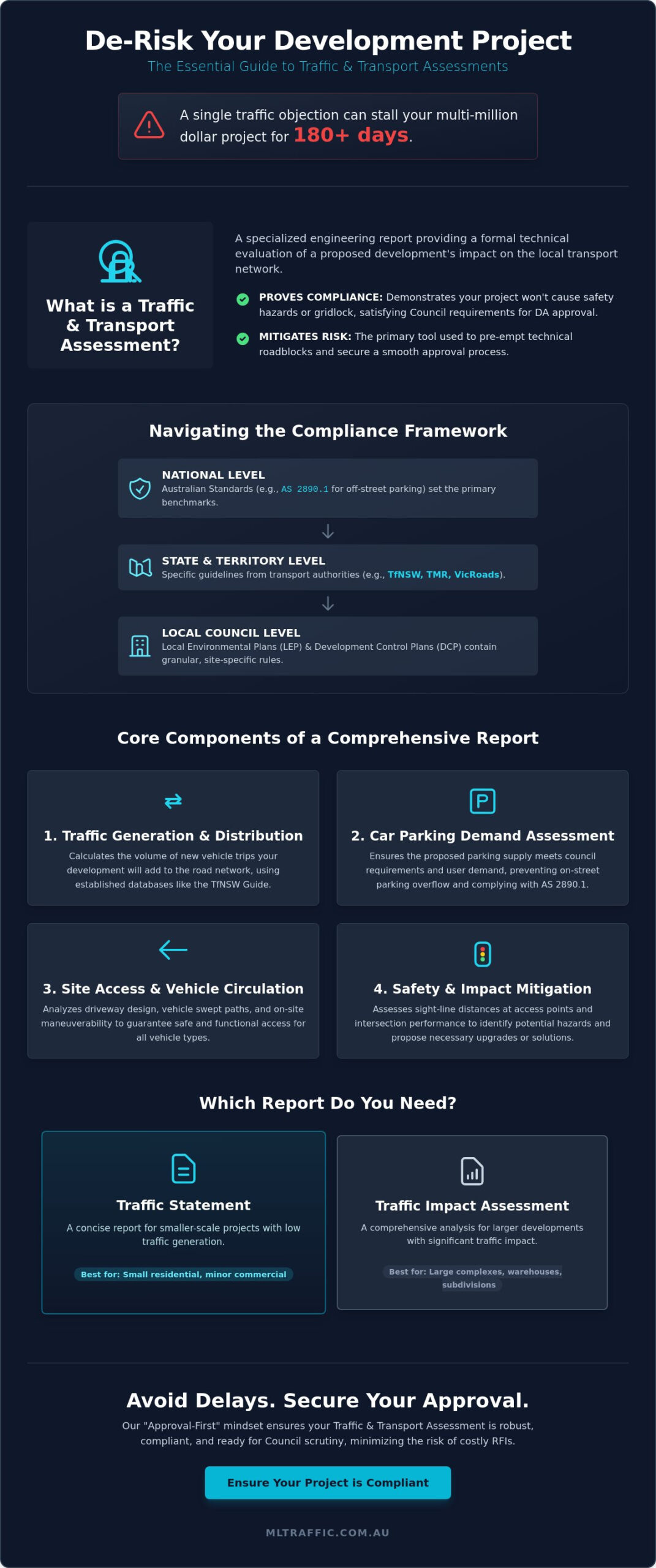
A single traffic-related objection from Council can stall a multi-million dollar development for 180 days or more. You likely already know that securing a Development Application (DA) approval is a rigorous process where technical details matter most. It’s common to feel overwhelmed by industry jargon like SIDRA modelling, TIA, or TIS. To move forward, you must understand exactly what is a traffic and transport assessment and how it demonstrates compliance with Australian Standards AS 2890.1. This specialized engineering report is the primary tool used to prove your project won’t negatively impact the local road network or create safety hazards.
We understand that you need certainty before investing in expensive engineering reports. This guide provides a direct look at the report requirements, why it’s critical for your approval, and how it mitigates development risk. We’ll cover everything from vehicle swept path assessments to sight-line requirements and parking demand analysis. By the end, you’ll have the clarity needed to ensure your site access is functional, compliant, and ready for Council scrutiny without unnecessary delays or technical roadblocks.
Key Takeaways
- Understand exactly what is a traffic and transport assessment and how this technical evaluation ensures your development meets safety and infrastructure capacity requirements for DA approval.
- Identify the core components of a professional traffic report, including traffic generation estimates and car parking demand assessments tailored to Australian Standards.
- Learn to distinguish between a Traffic Statement and a full Traffic Impact Assessment to ensure you commission the correct report for your specific project scale.
- Follow the step-by-step engineering process from initial site scoping and data collection to the final submission of a robust, evidence-based report.
- Discover how a proactive “Approval-First” mindset can pre-empt Council objections and minimize the risk of receiving costly Request for Information (RFI) letters.
Table of Contents
-
Defining the Traffic and Transport Assessment for Australian Developments
-
Traffic Statement vs. Traffic Impact Assessment: Which Do You Need?
-
Navigating Council Approvals with Expert Traffic Engineering
Defining the Traffic and Transport Assessment for Australian Developments
A Traffic and Transport Assessment is a formal technical evaluation designed to quantify the impact of a proposed land-use change on the existing transport network. It serves as a critical bridge between private development and public infrastructure. When developers ask what is a traffic and transport assessment, they’re looking at a study that ensures safety, efficiency, and infrastructure capacity are maintained once a project is completed. This process is a fundamental component of transportation planning, ensuring that new developments align with the long-term strategic goals of the region.
To better understand this concept, watch this helpful video:
Councils require these reports for Development Applications (DA) to mitigate potential risks to the road network. A proposal for a new apartment complex or a commercial warehouse can generate hundreds of additional vehicle movements daily. Without a rigorous assessment, these changes could lead to gridlock or safety hazards at nearby intersections. The report provides the evidence-based data Councils need to approve a project with confidence.
The Legal and Regulatory Framework
Every assessment must adhere to strict Australian Standards. The AS 2890 series is the primary benchmark for parking and access. Specifically, AS 2890.1:2004 covers off-street car parking, while AS 2890.2 focuses on commercial vehicle facilities. Compliance with these standards is mandatory for project approval.
State-specific transport authorities provide additional layers of regulation. In New South Wales, the TfNSW Guide to Traffic Generating Developments is the standard reference. In Queensland, developers look to TMR guidelines, while VicRoads sets the pace in Victoria. These state requirements work alongside Local Environmental Plans (LEP) and Development Control Plans (DCP). The DCP often contains granular details, such as specific parking ratios or driveway width requirements, that vary from one Council to another.
Who Conducts These Assessments?
Only qualified traffic engineers and transport planners should prepare these reports. It’s a field where industry experience and professional indemnity insurance are vital. "Off-the-shelf" or generic reports frequently fail to meet Council scrutiny. These low-quality documents often miss site-specific nuances, leading to costly delays or DA refusals.
A reliable assessment requires a hands-on approach. At ML Traffic Engineers, we believe the traffic consultant who provides the quote should be the one who does the work. This ensures that the technical complexities of your specific site are handled by a senior expert rather than a junior staff member. For more information on our approach, you can visit our about page. Professional assessments protect the developer’s investment by identifying potential access or parking issues before they become expensive construction problems.
Core Components of a Comprehensive Traffic Impact Report
A professional report provides the technical evidence required to satisfy council planners and transport authorities. Understanding what is a traffic and transport assessment requires looking at four specific technical pillars. These components ensure the development integrates safely with the existing road network and local community. Each assessment must be grounded in data, utilizing established Australian benchmarks to predict future conditions.
Analyzing Traffic Generation and Distribution
The first step involves calculating the volume of new trips the development will contribute to the road network. We use trip generation rates from established databases, primarily the Transport for NSW (TfNSW) Guide to Traffic Generating Developments. This allows us to determine the exact impact on surrounding intersections during weekday AM and PM peak hours. Trip distribution is the directional flow of traffic to and from the site. By mapping these movements, we can model intersection performance using SIDRA software to ensure the Level of Service (LoS) remains within acceptable limits for the 2024 traffic environment.
Parking Provision and Design Compliance
Parking assessments compare the proposed supply against the statutory requirements found in the local Council Development Control Plan (DCP). We analyze requirements for cars, bicycles, and motorcycles to ensure the project meets modern transport needs. All designs must comply with AS 2890.1 for user safety, covering critical details like driveway ramp grades and sight lines. If a project has a parking shortfall, we provide a detailed justification. This often involves empirical data from similar land uses or highlighting proximity to high-frequency public transport hubs. Our traffic engineering services ensure these justifications are technically sound and defensible during the RFI process.
Vehicle Maneuvering and Swept Paths
Proving that vehicles can enter and exit the site in a forward direction is a non-negotiable requirement for most Australian developments. We use AutoTURN software to simulate vehicle movements and create swept path overlays. This analysis is critical for waste collection trucks, delivery vans, and emergency vehicles. We test for 8.8m medium rigid vehicles (MRV) or 12.5m heavy rigid vehicles (HRV) depending on the site’s operational needs. Learn more about Swept Path Analysis to see how these simulations prevent costly design errors. Beyond heavy vehicles, we also evaluate pedestrian safety by checking sight distance at the property boundary to ensure drivers can see pedestrians before crossing the footpath.
By addressing these core areas, a traffic and transport assessment becomes a powerful tool for developers. It transforms complex technical data into a clear argument for a project’s viability. This meticulous approach reduces the risk of council delays and ensures the final build is functional for all end users.
Traffic Statement vs. Traffic Impact Assessment: Which Do You Need?
Determining what is a traffic and transport assessment requirement for your specific project depends on the scale of the development and the volume of traffic it’s expected to generate. Australian local councils and state road authorities use these reports to gauge how a new site affects the existing road network. While the terms are often used interchangeably by developers, they represent two distinct levels of technical rigor. A Traffic Impact Statement (TIS) is a concise document for low-impact sites, whereas a Traffic Impact Assessment (TIA) is a comprehensive technical report for major developments.
It’s vital to consult with a qualified traffic engineer before submitting your Development Application (DA). This early engagement identifies the correct reporting level, preventing costly delays or requests for further information (RFI) from Council. You can view our full range of technical reporting options at ML Traffic Engineers services to see which fits your project scope.
Thresholds for Minor Developments
A Traffic Impact Statement is generally sufficient for projects with negligible impact on the broader road network. Common triggers for a TIS include dual occupancies, small-scale residential subdivisions of fewer than 10 lots, or minor changes of use in existing commercial buildings. These reports focus on internal site logistics rather than external network modeling. Key components of a TIS include:
-
Parking Compliance: Verifying that the number of spaces meets Council’s Local Environmental Plan (LEP) or Development Control Plan (DCP) requirements.
-
Access Safety: Ensuring driveway locations provide adequate sight distances for exiting vehicles.
-
AS 2890.1 Adherence: Confirming all parking modules and ramp grades comply with Australian Standards for off-street car parking.
Because a TIS avoids complex intersection modeling, it’s a cost-effective solution that speeds up the approval process for small-scale developers.
Triggers for a Full TIA Report
Major developments require a full Traffic Impact Assessment to address complex safety and capacity issues. A TIA is mandatory when a project exceeds specific trip generation thresholds, typically 50 or more vehicle movements during peak hours. This level of reporting is standard for high-density residential towers, large shopping centers, and industrial warehouses. If your site is located near a major arterial road or a sensitive intersection, Council will insist on a TIA regardless of the project’s size.
These reports involve sophisticated technical analysis. Engineers use SIDRA software to model intersection performance, measuring metrics like Degree of Saturation and Level of Service (LoS). A TIA must also address public transport integration, pedestrian safety, and heavy vehicle swept path analysis. For sites impacting state-controlled roads, the report often requires certification by an RPEQ or an equivalent registered professional to meet state authority standards.
The Engineering Process: From Site Visit to DA Submission
A professional traffic engineering firm follows a structured four-phase process to ensure development applications meet Council requirements. Understanding what is a traffic and transport assessment involves looking at the technical workflow from initial scoping to the final report submission. We don’t guess; we measure and model based on empirical evidence. The process is designed to eliminate uncertainty for both the developer and the consent authority.
-
Phase 1: Project Scoping. We define the study area and identify key intersections. This phase often requires direct consultation with local Council or state authorities like Transport for NSW (TfNSW) to confirm their specific expectations.
-
Phase 2: Data Collection. We gather site-specific data through various survey methods. This provides the baseline for all subsequent calculations and impact predictions.
-
Phase 3: Technical Modeling. We use industry-standard software to simulate traffic flow and identify potential bottlenecks caused by the new development.
-
Phase 4: Reporting. We produce a comprehensive document that recommends specific mitigation measures. This ensures the development remains compliant with Australian Standards like AS 2890.1.
Data Collection and Site Surveys
Accurate data is the core of any assessment. We utilize manual intersection counts to capture peak hour turning movements, typically between 7:00 AM to 9:00 AM and 4:00 PM to 6:00 PM. Automated Traffic Counters (ATC) are deployed for 7-day periods to record volume and speed data. We also conduct parking occupancy surveys within a 200-metre radius of the site. These surveys help justify parking shortfalls by proving existing on-street capacity. Our engineers also inspect the site for sight-line obstructions to ensure safety at all proposed entry points.
Intersection Modeling and SIDRA Analysis
SIDRA (Signalised and unsignalised Intersection Design and Research Aid) is the industry standard for intersection analysis in Australia. It allows us to calculate the Degree of Saturation (DoS), which measures the ratio of traffic demand to the capacity of the intersection. We also evaluate the Level of Service (LoS), a qualitative measure ranging from A to F. If a development drops the LoS from B to D, we must propose infrastructure upgrades. You can learn more about how these technical metrics are applied by reading about the role of a Traffic Engineer in Developments.
Mitigation and Design Recommendations
When an assessment identifies impacts, we provide practical design solutions. This might include widening a driveway to 5.5 metres to allow simultaneous two-way flow; it might also involve adjusting ramp grades to meet the 1:20 transition requirements. For the build phase, we develop Understanding Traffic Management Plans to handle construction vehicle movements safely. These measures ensure the project is both safe for the public and acceptable to the consent authority.
For expert assistance with your development application, contact our senior traffic engineers today for a technical consultation.
Navigating Council Approvals with Expert Traffic Engineering
Securing a Development Application (DA) approval requires more than just technical data. It demands an "Approval-First" mindset where the primary goal is to minimize friction with local authorities. A robust report pre-empts Council objections before they’re even drafted. When developers ask what is a traffic and transport assessment, they should view it as a strategic tool designed to prevent RFI (Request for Information) letters. These letters often stall projects for months, adding significant costs to the development cycle.
Common mistakes in traffic reports include failing to account for driveway ramp grades or ignoring sight-line requirements specified in AS 2890.1. We adopt a Principal-led approach to ensure technical accuracy from the first draft. This accountability means every assessment is grounded in 15+ years of experience and a deep understanding of Australian regulatory frameworks. By addressing potential bottlenecks early, we ensure the project remains on schedule and within budget.
Addressing Common Council Objections
Community concerns regarding traffic congestion are a frequent hurdle for new developments. We address these by providing empirical evidence and SIDRA intersection modeling rather than relying on vague assumptions. If your project requires justifying departures from standard parking rates, we use expert evidence to demonstrate why a lower rate is sufficient for the specific land use. This evidence-based approach is far more effective than simply asking for a concession.
-
Pre-DA Meetings: Engaging with Council traffic engineers early clarifies expectations and identifies site-specific constraints.
-
Data-Driven Justification: We use traffic counts and historical data to prove that a development won’t adversely impact local road networks.
-
Compliance Checks: Every report ensures strict adherence to Australian Standards and local planning schemes to remove grounds for refusal.
The ML Traffic Advantage: Direct Expert Access
Large consultancies often fall into the "junior engineer" trap. A senior partner might sign the quote, but a graduate with limited field experience performs the actual analysis. This leads to errors that Council engineers quickly spot. At ML Traffic Engineers, the consultant who provides the quote is the one who does the work. This ensures that what is a traffic and transport assessment for your project is a high-level technical document, not a template-based report.
Our team has worked on over 10,000 sites nationwide, ranging from small residential subdivisions to complex commercial hubs. This volume of work provides us with a massive database of precedents to support your application. You get direct access to senior experts who understand the nuances of traffic flow, parking demand, and vehicle swept paths. This hands-on involvement is why we maintain a high success rate with Council approvals across Australia.
Contact ML Traffic Engineers for a quote on your assessment to ensure your next project moves through Council without unnecessary delays.
Secure Your DA Approval with Expert Traffic Engineering
Understanding what is a traffic and transport assessment is the first step in ensuring your development meets local council requirements. A robust report does more than just tick a box. It addresses AS 2890 compliance, vehicle swept paths, and parking demand to prevent costly delays during the RFI stage. Whether your project requires a simple Traffic Statement or a full Traffic Impact Assessment, technical accuracy is non-negotiable for a successful outcome.
ML Traffic Engineers has assessed over 10,000 sites across Australia. You get direct access to senior principals with over 30 years of experience. We don’t pass your project to junior staff. The traffic consultant who provides the quote, does the work. It’s the most reliable way to ensure your project stays on schedule while meeting all Australian Standards. This hands-on approach ensures your submission is meticulous and results-oriented. We look forward to streamlining your approval process and getting your project moving.
Get a professional traffic assessment for your DA approval
Frequently Asked Questions
What is the primary difference between a traffic assessment and a transport assessment?
A traffic assessment focuses specifically on vehicle movements, parking capacity, and road safety. A transport assessment is broader in scope, evaluating how a development integrates with all modes of travel, including walking, cycling, and public transport. Most Australian Councils now require the broader transport assessment to ensure projects align with integrated land use and sustainable travel goals.
When is a traffic impact assessment mandatory for an Australian development?
A traffic impact assessment is mandatory when a proposal exceeds specific triggers defined in a local Council’s Development Control Plan (DCP) or State planning policies. For example, many NSW and QLD jurisdictions require a formal report for residential developments over 20 dwellings or commercial sites exceeding 1,000 square metres of Gross Floor Area. It’s also required if the project seeks to vary standard parking rates or introduces new access points to a classified road.
How long does it take to prepare a full traffic and transport assessment report?
A professional traffic and transport assessment typically takes between 10 and 20 business days to complete. This duration allows for essential site inspections, procurement of traffic count data, and technical analysis. If your project requires complex SIDRA modeling or consultation with State agencies like Transport for NSW, the timeline can extend to 6 weeks to ensure all regulatory requirements are met.
Do I need a traffic report if my development meets all Council parking requirements?
Yes, you’ll still need a report because parking volume is only one component of the planning process. Developers must demonstrate that vehicle access is safe, sight-lines are adequate, and the generated traffic won’t negatively impact local intersection performance. A traffic report confirms that your internal layout and driveway designs comply with Australian Standard AS 2890.1, which is a common requirement for DA approval.
What is SIDRA modeling and is it always required in a TIA?
SIDRA is a specialized software tool used to model intersection capacity, delay, and level of service. It’s not required for every project, but it’s essential for high-impact developments that add significant volume to the road network. Councils generally mandate SIDRA analysis when a project contributes more than 30 vehicle trips per hour to a single intersection or affects signalized traffic lights.
Can a traffic engineer help if Council has already rejected my DA based on traffic grounds?
A traffic engineer can assist by providing a technical rebuttal or proposing design modifications to resolve Council’s concerns. We analyze the specific reasons for refusal, such as safety issues or traffic congestion, and provide evidence-based solutions. This often involves representing the developer in the Land and Environment Court or during formal Section 8.2 reviews to prove the development is manageable.
How much does a traffic impact assessment cost for a medium-density project?
The cost of a traffic impact assessment depends on the project’s scale, the number of intersections requiring analysis, and specific Council requirements. Fees are structured as a fixed lump sum tailored to the complexity of the site. For a medium-density project, the price covers site surveys, swept path analysis, and the technical report needed to satisfy planning authorities and Australian Standards.
What is a swept path analysis and why is it included in the assessment?
Swept path analysis is a computer simulation that tracks the path of a vehicle’s tires and body during a turn. It’s included in the assessment to prove that the largest expected vehicles, such as heavy rigid waste trucks or B99 cars, can navigate the site safely. We use this to ensure vehicles can enter and exit in a forward direction without striking curbs or structural columns, as required by AS 2890.2.
Which areas do you cover?
We are traffic engineers servicing Melbourne, Sydney, Brisbane, Gold Coast, Hobart, Perth, Adelaide, Darwin, Canberra and surrounding areas.

Disclaimer
The content on www.mltraffic.com.au, including all technical articles, guides, and resources, is provided for general informational and educational purposes only. It is not intended to constitute professional advice in traffic engineering, transportation planning, development approvals, or any other technical or legal field.
While ML Traffic Engineers makes every reasonable effort to ensure the accuracy, completeness, and timeliness of the information published, we do not provide any warranties or representations (express or implied) regarding its reliability, suitability, or availability for any particular purpose. Any reliance you place on the content is strictly at your own risk.
In no event shall ML Traffic Engineers, its directors, employees, authors, or affiliates be liable for any direct, indirect, incidental, special, consequential, or punitive damages (including, without limitation, loss of profits, data, or business opportunities) arising out of or in connection with the use of, or inability to use, any information provided on this website.
The articles and guides on this site are not a substitute for engaging a qualified, registered professional traffic engineer (such as an NPER or RPEQ engineer) to assess your specific project requirements. For tailored advice, compliance assessments, or traffic engineering services, please contact a competent professional.
This disclaimer may be updated from time to time without notice. By accessing or using this website, you agree to be bound by the most current version of this disclaimer.
