

A council request for a ‘traffic report’ can be a significant hurdle in any development application. The technical requirements, from a Traffic Impact Assessment (TIA) to a Swept Path Analysis, are complex, and a misstep can lead to costly delays or outright rejection. Successfully navigating these council requirements demands specialist expertise. This is the critical role of a professional traffic engineer—an expert dedicated to ensuring your project’s design is safe, compliant, and positioned for a smooth approval process.
This comprehensive guide is designed specifically for developers. We will explain the essential services a traffic engineer provides for development applications in Australia, demystify the key technical reports required by councils, and provide a clear framework for selecting the right consultant for your project. By understanding their function, you can confidently meet all authority requirements, avoid expensive redesigns, and achieve a timely and successful Development Application (DA) approval.
Defining the Traffic Engineer: More Than Just Counting Cars
A traffic engineer is a specialised professional responsible for the planning, design, and operational management of roads, highways, and parking facilities. Their primary objective is to ensure the safe and efficient movement of people and goods. While often associated with civil engineering, the role is distinct. It applies scientific principles to optimise traffic flow, enhance safety for all road users—including pedestrians and cyclists—and mitigate the transport impacts of new developments. This discipline of Traffic engineering is a critical component of any successful land development project.
To better understand this role, consider the following overview:
For a developer, the traffic engineer serves as a crucial link between their project and the local council or state road authority. While a civil engineer designs the physical infrastructure and a town planner manages land use zoning, the traffic consultant focuses specifically on access and movement. They provide the technical evidence required by authorities to prove a development will not adversely affect the existing transport network. This requires professional qualifications and often specific registration, such as being a Registered Professional Engineer of Queensland (RPEQ), to certify reports and plans.
Core Responsibilities and Objectives
The daily work of a traffic consultant is data-driven and highly technical, focused on ensuring a development is both functional and compliant with relevant Australian Standards (e.g., AS 2890.1). Key tasks include:
- Traffic Impact Assessments (TIA): Analysing the effect a new development will have on surrounding road networks and intersections.
- Functional Design: Designing compliant car parks, vehicle accessways, loading docks, and service bays that are safe and efficient.
- Safety Audits: Ensuring safe access and circulation for pedestrians, cyclists, and vehicles within and around the development site.
- Problem Solving: Using specialised software for vehicle swept path analysis and traffic modelling to resolve complex access and circulation issues.
Traffic Engineer vs. Transport Planner: What’s the Difference?
While the terms are sometimes used interchangeably, their focus is different. Traffic engineering is a micro-level discipline concerned with the design and operation of specific facilities, such as the car park and driveway for a single development site. It addresses immediate, site-specific issues.
Transport planning operates at a macro-level, focusing on strategic, long-term network planning for an entire suburb, city, or region. For a Development Application (DA), a developer almost always requires a traffic engineer to produce the detailed reports and plans that council needs to assess the site’s direct impact.
The Traffic Engineer’s Toolkit: Key Reports for DA Approval
For a development application (DA) to succeed, councils require evidence-based analysis demonstrating that the project will not adversely affect the local road network. A professional traffic engineer prepares a suite of technical reports to provide this assurance. These documents demystify a project’s impact by translating design concepts into quantifiable data, directly addressing council concerns regarding safety, efficiency, and compliance.
Each report serves a distinct purpose, providing a comprehensive overview of a development’s traffic and parking implications. Understanding these key documents is essential for any developer navigating the DA process in Australia.
Traffic Impact Assessment (TIA)
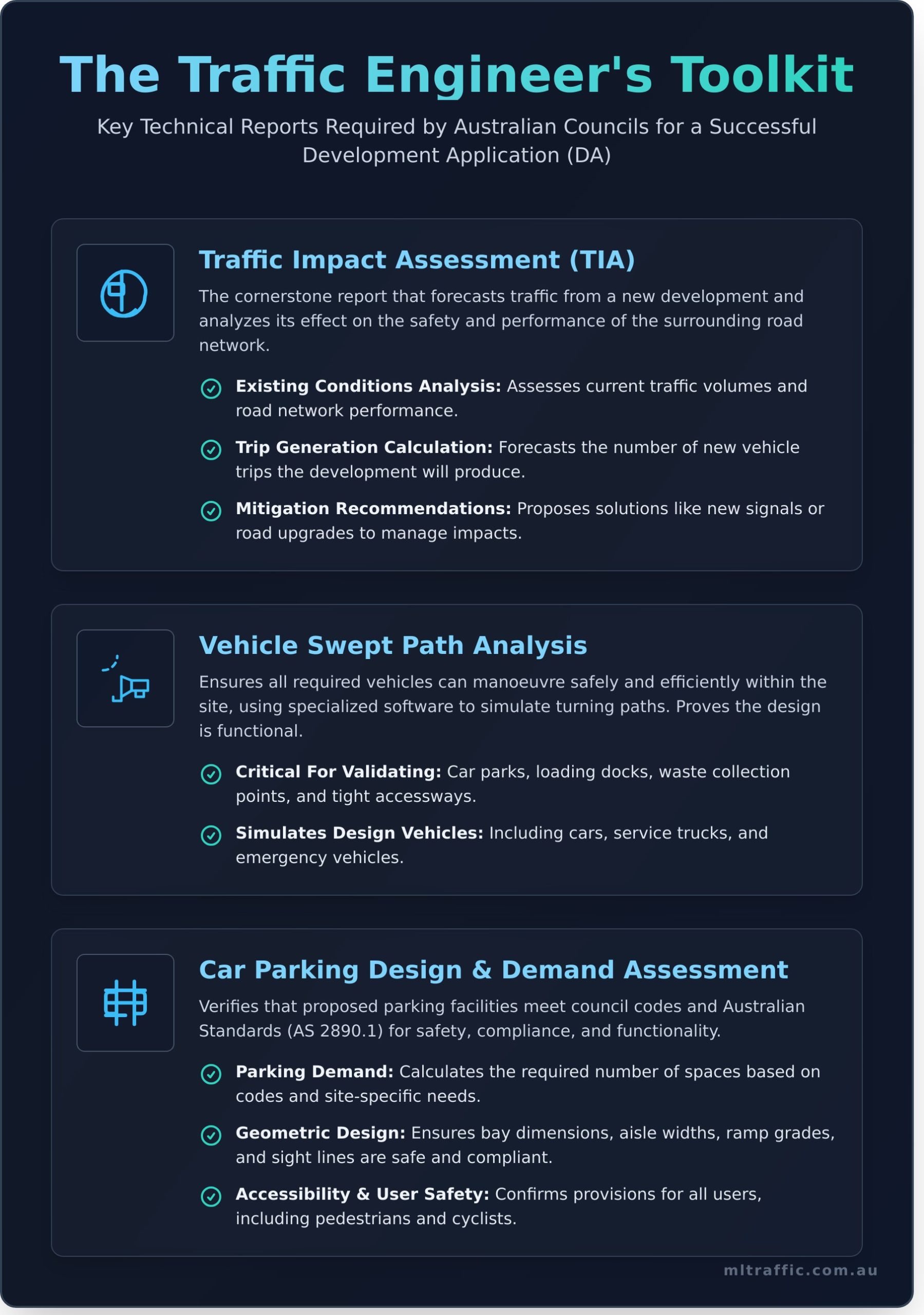
The Traffic Impact Assessment is the cornerstone report for most development applications. Its primary function is to forecast the volume of traffic a new development will generate and assess its impact on the surrounding road network’s safety and performance. This is a fundamental component of professional Traffic Engineering and Transport Planning. A TIA typically includes:
- Existing Conditions Analysis: A baseline assessment of current traffic volumes and road network performance.
- Trip Generation: Calculation of the number of new vehicle trips the development is expected to produce during peak hours.
- Recommendations: Proposed solutions to mitigate any identified impacts, such as new traffic signals, road widening, or intersection upgrades.
Vehicle Swept Path Analysis
This technical analysis ensures that vehicles—from cars to service and emergency vehicles—can manoeuvre safely and efficiently within the development site. Using specialised software like AutoTURN, engineers simulate the path of a design vehicle as it enters, navigates, and exits the property. This is critical for validating the design of car parks, loading docks, waste collection points, and tight accessways, proving to council that the layout is functional and safe for all intended vehicle types.
Car Parking Design & Demand Assessment
A compliant and functional car park is a non-negotiable requirement for most developments. This assessment ensures the proposed parking facilities meet all relevant regulations, particularly Australian Standard AS 2890.1: Parking facilities – Off-street car parking. The assessment covers two key areas: calculating the required number of parking spaces based on council codes and site-specific demand, and verifying that the geometric design—including bay dimensions, aisle widths, ramp grades, and sight lines—is safe and accessible for all users.
The Engagement Process: What to Expect When Working with a Traffic Engineer
Engaging a traffic consultant is a structured process designed to de-risk your development application (DA) and ensure compliance from the outset. A successful outcome relies on a collaborative relationship and a clear understanding of each stage. This step-by-step overview outlines what developers can expect when working with a professional traffic engineer to achieve DA approval.
Step 1: Project Briefing and Fee Proposal
The process begins with a clear project brief. To provide an accurate and comprehensive fee proposal, the engineer requires key project documents. Providing this information upfront ensures the scope of work is correctly defined.
- Architectural plans (preliminary or detailed)
- Site survey plan
- A project summary detailing the proposed land use and scale
The resulting proposal will outline the specific deliverables (e.g., Traffic Impact Statement, Car Parking Demand Assessment), timelines, and a fixed fee for the work required for your DA submission.
Step 2: Data Collection and Site Analysis
Once engaged, the engineer undertakes a thorough technical assessment. This stage involves site visits to observe existing traffic conditions, access points, and road network characteristics. Where necessary, traffic and parking surveys are conducted to gather empirical data. This phase is where the core principles of Traffic Engineering are applied, involving a detailed review of council codes, local planning schemes, and relevant Australian Standards (such as AS 2890.1 for parking facilities) to form a robust evidence base.
Step 3: Reporting and Council Submission
The culmination of the analysis is the formal traffic and parking assessment report. This document systematically addresses council’s requirements, presenting detailed findings on traffic generation, parking demand, and access design, often including vehicle swept path analysis. The report provides clear recommendations to ensure the development is compliant and functional. This document is a critical component of the overall DA package, providing council planners with the necessary technical justification to support your application.
Step 4: Post-Submission Support and Liaison
An experienced consultant’s role extends beyond the initial report submission. Should council issue a Request for Information (RFI) regarding traffic or parking matters, your engineer will prepare the formal response. We provide ongoing support to the project team, assisting with negotiations and clarifications required by council planners to facilitate a positive determination for your project.
Get a clear proposal for your project from our senior engineers.
How to Choose the Right Traffic Engineering Consultant for Your Project
Selecting the right traffic engineering consultant is a critical decision that directly impacts the viability and approval timeline of your development. The success of your Development Application (DA) often hinges on the quality, accuracy, and strategic insight of the traffic and parking assessment. To ensure you partner with the right expert, focus your evaluation on three key areas.
Verify Specialised Experience in Development Applications
Not all traffic engineering firms are structured to serve developers. Many focus on large-scale government infrastructure projects, which require a different skillset and approach than private DAs. It is essential to choose a consultant whose primary business is navigating the DA process for private clients. Ask for a portfolio of successfully completed projects that are similar in scale and land use to your own.
Confirm In-Depth Knowledge of Local Council Requirements
In Australia, each local council has its own unique set of planning controls, policies, and preferences regarding traffic, access, and parking. A consultant with extensive, hands-on experience within your project’s specific council area offers a significant advantage. This local knowledge allows a traffic engineer to anticipate potential issues, address council concerns proactively, and prepare a submission that is tailored for compliance, minimising delays and requests for further information.
Assess Their Communication and Accessibility
Effective project management requires clear communication and direct access to expertise. In larger firms, your project may be passed to a junior staff member after the initial engagement. This can lead to communication gaps and a lack of senior oversight. For optimal results, seek a consultant where you have direct access to the senior engineer responsible for your project. An experienced traffic engineer should be able to explain complex technical requirements clearly and be readily available to address your questions. This level of accountability is paramount for navigating the complexities of the approval process.
Making the right choice involves asking targeted questions to verify a consultant’s expertise aligns precisely with your project’s needs. Ensure they have a proven track record, deep local knowledge, and an accessible, accountable structure.
For professional traffic and transport planning advice focused on securing DA approval, contact the experts at ML Traffic Engineers.
Partnering with the Right Traffic Engineer for Project Success
As this guide has shown, the role of a traffic engineer extends far beyond simple vehicle counts. They are essential partners in navigating the complexities of Development Application (DA) approvals, providing the critical reports and assessments that satisfy council requirements. Understanding their process and knowing how to select a qualified consultant are fundamental steps towards a successful project outcome.
For your next development, choosing an experienced consultant is non-negotiable. ML Traffic Engineers brings over 15 years of specialised experience in preparing DA reports, with a proven track record of success with councils across Australia. We guarantee direct, hands-on involvement from our principal engineers on every project. The consultant who provides your quote is the expert who does the work.
Ensure your project has the professional backing it needs to succeed. Contact our senior engineers for a professional quote on your project. Let our expertise clear the path for your development approval.
Frequently Asked Questions
What qualifications should a traffic engineer have in Australia?
In Australia, a qualified traffic engineer typically holds a Bachelor of Engineering, usually with a specialisation in Civil Engineering. Many also possess postgraduate qualifications in traffic or transport planning. Professional accreditation is critical, such as being a Chartered Professional Engineer (CPEng) and registered on the National Engineering Register (NER). For certain states like Queensland, specific registration as a Registered Professional Engineer of Queensland (RPEQ) is a mandatory requirement for professional engineering services.
How much does a Traffic Impact Assessment report typically cost?
The cost of a Traffic Impact Assessment (TIA) report in Australia varies based on project scale and complexity. For a small-scale development, a report may cost between A$3,000 and A$8,000. Larger, more complex projects that require extensive traffic surveys, modelling, and detailed intersection analysis can cost upwards of A$20,000. The final fee is determined by the specific requirements of the local council and the intricacy of the site’s traffic challenges.
How long does it take to prepare a traffic report for a DA?
The typical timeframe for preparing a standard traffic report for a Development Application (DA) is between two to four weeks. This schedule depends on the project’s complexity, the availability of existing traffic data, and the specific assessment requirements of the council. Projects requiring new traffic counts or detailed intersection analysis may take longer. A clear project brief and prompt provision of architectural plans are essential to maintaining this timeline and avoiding delays in your DA submission.
Can a traffic engineer guarantee my development application will be approved?
No, a traffic engineer cannot guarantee DA approval. The final decision rests solely with the consent authority, such as the local council or a planning panel. The role of a professional traffic engineer is to provide a comprehensive, evidence-based assessment that demonstrates compliance with all relevant Australian Standards and planning policies. An experienced consultant maximises the likelihood of approval by identifying and resolving potential traffic-related issues before the council raises them as objections.
What are the most common traffic-related reasons a DA is rejected by council?
Development applications are commonly rejected for several traffic-related reasons. These include an inadequate supply of on-site car parking, non-compliant vehicle access design (such as unsafe sight lines or excessively steep driveway grades), and failure to meet Australian Standards (AS 2890.1). Other major issues are a lack of provision for service and delivery vehicles, unsafe interactions between vehicles and pedestrians, and a demonstrable negative impact on the safety or capacity of the local road network.
At what stage of my project should I engage a traffic engineer?
You should engage a traffic engineer as early as possible in your project, ideally during the concept or preliminary design stage. Early involvement allows the engineer to provide critical input on site layout, parking provision, and vehicle access point locations. This proactive approach helps identify and resolve potential compliance issues before they necessitate costly and time-consuming architectural redesigns, ensuring the project is viable from a traffic and transport perspective from the outset.