

We are traffic engineers servicing Perth Metropolitan Area, Wanneroo, Swan, Rockingham and Mandurah. Understand the crucial role a traffic engineer plays in your Perth development’s success, from initial design and council approval to final construction.
The Core Mission: What Does a Traffic Engineer Actually Do?
A common misconception is that traffic engineers merely count cars. In reality, their role is to solve complex movement and access problems for development projects. Their primary goal is to ensure the safe and efficient movement of all road users—drivers, cyclists, and pedestrians—while balancing the developer’s commercial objectives with the stringent requirements of local councils, Main Roads Western Australia (MRWA), and community expectations. For any developer in Perth, a traffic engineer is a critical liaison between the project team and planning authorities, providing the technical evidence needed to secure a Development Application (DA) approval.
-
Goes beyond counting cars to solve complex movement and access problems.
-
Primary goal: Ensure safe, efficient movement for all road users.
-
Balances developer needs with WA planning regulations and community safety.
-
Acts as a key liaison between the project team and Perth’s local authorities.
-
Their work is fundamental to securing a Development Application (DA) approval.
Problem Solving for Development Projects
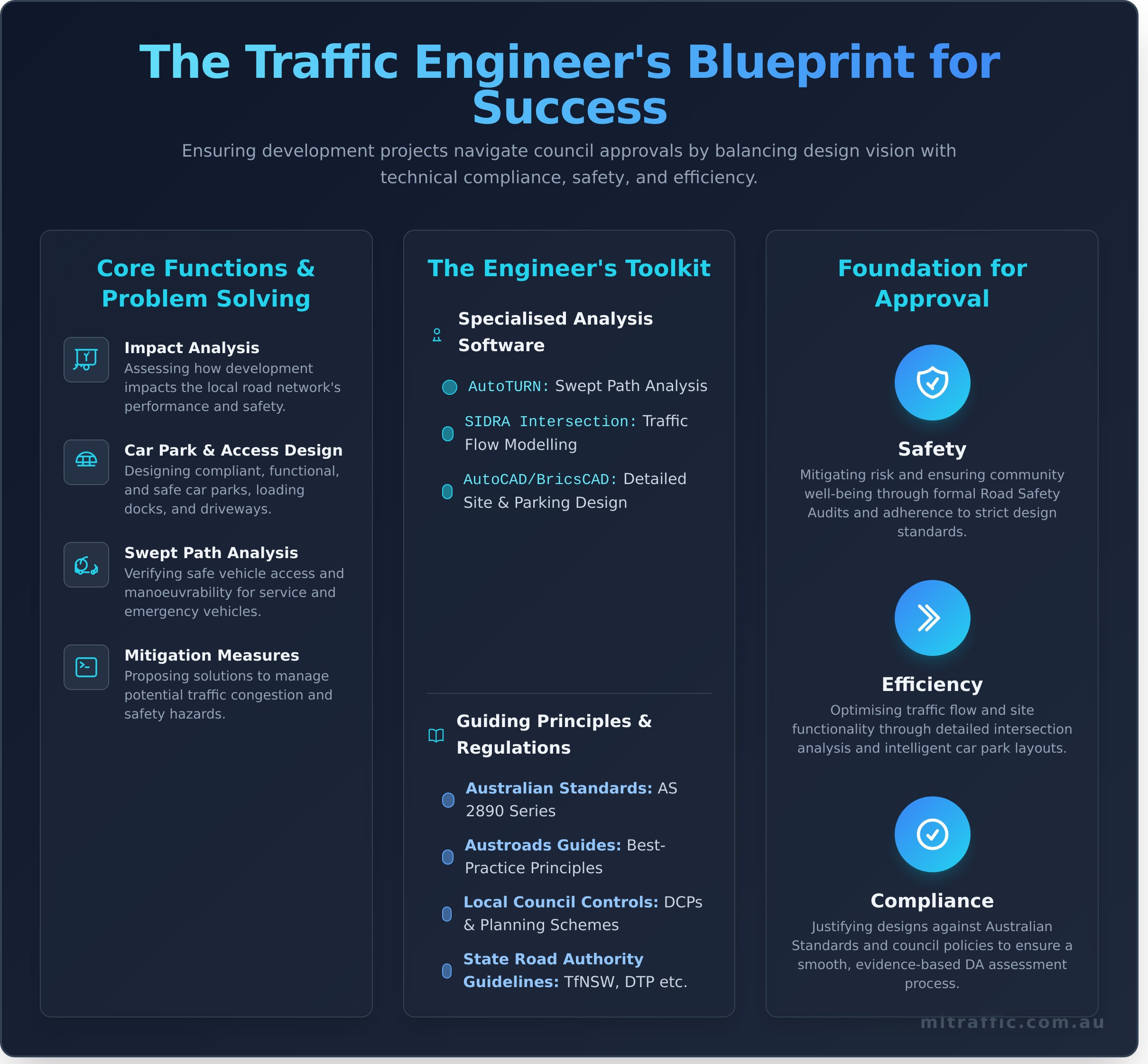
In the context of Perth’s evolving urban landscape, every new development introduces changes to the existing transport network. A traffic engineer’s job is to analyse and manage this impact. They assess how a new apartment complex, childcare centre, or warehouse will affect local street performance, design functional and compliant car parks and loading docks, and ensure emergency and service vehicles can safely access the site. Their work proactively identifies and mitigates potential traffic congestion and safety hazards before they become costly, project-derailing problems.
Safety, Efficiency, and Compliance in Western Australia
A traffic engineer provides the objective, data-driven justification for a project’s traffic and parking design. This involves the rigorous application of Australian Standards to ensure every aspect of a car park or accessway is safe and functional. They conduct road safety audits to identify risks and use sophisticated analysis to optimise traffic flow. Crucially, they provide the technical evidence to justify parking provisions, ensuring they meet the specific requirements of the relevant local government’s planning scheme and state-level policies like the R-Codes.
The Traffic Engineer’s Toolkit: From Advanced Software to Critical Standards
Traffic engineering in Western Australia relies on a combination of specialised software and a deep understanding of state and national regulations. These tools provide the verifiable data and evidence that planning authorities like the Western Australian Planning Commission (WAPC) and local councils require to assess a DA. Understanding these tools helps developers and planners appreciate the technical depth behind a Traffic Impact Assessment and recognise the value of an experienced consultant.
-
Relies on specialized tools for accurate analysis and design.
-
Provides the data and evidence needed to support a DA in WA.
-
Expert use of this software is a key differentiator for consultants.
-
Deep knowledge of WA regulations is non-negotiable.
Specialised Analysis Software
-
Swept Path Analysis (AutoTURN): This software is essential for modelling vehicle movements. It produces clear diagrams showing how a design vehicle, from a passenger car to a large delivery truck, can safely manoeuvre through a car park, loading bay, or complex intersection. This is a standard requirement to prove compliance.
-
Intersection Modelling (SIDRA): For projects with a significant impact on the road network, SIDRA Intersection is used to model traffic flow, delays, and queuing at intersections. This analysis provides a quantitative assessment of the development’s impact and helps design mitigation measures if required.
-
CAD Software (AutoCAD): All designs, from car park layouts to line-marking plans, are produced using industry-standard CAD software. This ensures precision and compatibility with architectural and civil engineering plans.
Guiding Principles and Regulations for WA
-
Australian Standards (AS 2890 series): This series of documents is the definitive guide for off-street and on-street parking facility design in Australia. Compliance with AS 2890.1, AS 2890.2, and AS 2890.6 is mandatory for almost all developments.
-
Austroads Guides: Austroads publishes best-practice guides for road design, traffic management, and road safety. A traffic engineer applies these principles to ensure a project aligns with the highest industry standards.
-
WAPC and Main Roads WA Guidelines: State-level authorities provide specific policy and guidance documents, such as the WAPC’s Transport Impact Assessment Guidelines. A competent traffic engineer must be an expert in interpreting and applying these WA-specific requirements.
-
Local Government Planning Schemes: Each council in the Perth metropolitan area (and across WA) has its own Local Planning Scheme and associated policies that dictate specific requirements for parking rates, access locations, and driveway design. Navigating these local rules is a core part of the traffic engineer’s role.
A Traffic Engineer’s Role in the Project Lifecycle
Engaging a traffic engineer early in the project lifecycle is one of the most effective ways to mitigate risk and prevent costly design changes. Their input adds value at every critical stage, from initial feasibility assessments through to construction. A proactive approach ensures that traffic and parking considerations are integrated into the design from the outset, leading to a smoother, more predictable planning approval process.
-
Engaging a traffic engineer early prevents costly redesigns.
-
Their involvement spans from concept design through to construction.
-
Their input adds quantifiable value at each critical stage.
Stage 1: Feasibility and Concept Design
During the initial stages, a traffic engineer provides high-level advice that can shape the entire project. They can identify potential ‘red flags’ related to site access, parking shortfalls, or requirements from Main Roads WA. This early input informs the architect on critical design parameters, such as the location of crossovers, the required dimensions for ramps and parking bays, and the necessary provisions for service vehicles. This helps determine the overall viability and scale of a proposed development before significant design resources are committed.
Stage 2: Development Application (DA) Submission
This is where the traffic engineer’s core deliverables are produced. The process typically involves conducting traffic surveys, analysing data, and preparing the formal Traffic Impact Assessment (TIA) report. This report is the primary document submitted to the council or JDAP to address all traffic-related matters. It is supported by technical plans, such as Swept Path diagrams and detailed car park layouts, that demonstrate full compliance with all relevant standards and policies. The engineer also plays a crucial role in responding to any council requests for information (RFIs), providing clear and authoritative answers to planner queries.
Stage 3: Construction and Post-Approval
The traffic engineer’s role can extend beyond DA approval. For larger projects, they are often required to develop a Construction Traffic Management Plan (CTMP). This plan details how vehicle movements and public safety will be managed during the construction phase. After construction, they may also be required to certify that the constructed car parks and accessways have been built in accordance with the approved plans, providing the final sign-off for the council.
Discuss your project with an experienced traffic engineer.
Key Deliverables: Understanding the Reports a Traffic Engineer Produces
The analysis and recommendations of a traffic engineer are formalised in specific technical reports. These documents are not just paperwork; they are the evidence-based arguments that give council planners the confidence to approve a project. Understanding the purpose of these key reports helps developers and planners appreciate their importance in the DA process.
-
The traffic engineer’s analysis is formalized in specific technical reports.
-
These documents provide the evidence councils in WA need to approve a project.
-
Each report serves a distinct purpose in the planning process.
Traffic Impact Assessment (TIA)
A Traffic Impact Assessment (or Traffic Impact Statement) is the most common report required for a DA in Western Australia. It provides a comprehensive analysis of the existing traffic environment and forecasts the potential impacts of the proposed development. The TIA identifies any potential issues related to capacity, safety, or access on the surrounding road network and recommends practical measures to mitigate these effects. Ultimately, it justifies the proposed traffic and parking arrangements to the planning authority.
Car Parking Demand Assessment
This report determines the appropriate number of parking spaces for a development. While local planning schemes provide standard car parking rates, a Car Parking Demand Assessment is used to justify any proposed deviation from these rates. It may involve surveys of parking supply and demand in the surrounding area, an analysis based on first principles, or reference to technical guidelines to argue for a site-specific parking provision that is both practical and compliant with planning objectives.
Vehicle Swept Path Analysis
A Swept Path Analysis is a graphical assessment that proves vehicles can safely and efficiently manoeuvre into, within, and out of a site. It is crucial for validating the design of car parks, loading docks, and tight accessways. Using software like AutoTURN, these diagrams demonstrate to the council that all vehicles, including the designated design vehicles (e.g., waste collection trucks), can enter and exit in a forward direction without conflicting with structures or other vehicles, proving compliance with Australian Standards.
How to Choose the Right Traffic Engineer for Your Project
Selecting the right traffic engineering consultant in Perth is critical for a smooth and successful approval process. The right partner will not only produce technically sound reports but will also act as a strategic advisor, helping you navigate complex negotiations with planning authorities. Look for a consultant with specific qualifications, extensive local experience, and a proven track record.
-
Not all traffic consultants offer the same level of expertise or service.
-
Selecting the right partner is critical for a smooth approval process in Perth.
-
Look for specific qualifications, local experience, and a proven track record.
Essential Qualifications and Experience
Always verify a consultant’s credentials. Check for relevant engineering degrees and professional accreditations. Most importantly, look for extensive and demonstrable experience working with your local council, the WAPC, and Main Roads WA. Ask for examples of similar projects they have successfully guided through the DA process. Finally, ensure they hold the necessary professional indemnity insurance as a baseline measure of professionalism.
Questions to Ask a Potential Consultant
-
Who will be preparing the report and be my point of contact?
-
What is your track record with the City of [e.g., Stirling, Wanneroo, Perth]?
-
How do you approach and resolve challenges or RFIs from council planners?
-
What is your process for keeping me informed of project progress?
Why Direct Access to Senior Engineers Matters
When you engage a consultancy, you are paying for experience. A firm that guarantees direct access to its senior engineers (key person has over 30 years experience) ensures accountability and a single, reliable point of contact. This model ensures that deep, practical experience is applied directly to your project, avoiding communication delays and the potential for errors that can occur when work is passed down to junior staff. It streamlines the process and delivers a more robust, defensible outcome.
At ML Traffic, the consultant who quotes the work, does the work. Contact us.
Frequently Asked Questions (FAQs)
What’s the difference between a traffic engineer and a civil engineer?
A traffic engineer is a specialist within the broader field of civil engineering. While a civil engineer designs physical infrastructure like roads, drainage, and structures, a traffic engineer focuses specifically on the operational aspect: how vehicles and people move safely and efficiently through that infrastructure. For DAs, the traffic engineer focuses on access, internal circulation, parking, and the impact on the external road network.
How early in my development project should I engage a traffic engineer?
As early as possible, ideally during the concept or feasibility stage. Early input can identify critical constraints and opportunities related to traffic and parking, preventing the need for costly and time-consuming redesigns later in the DA process.
How much does a traffic engineering report typically cost in Australia?
The cost varies significantly depending on the scale and complexity of the development, the scope of the assessment required by the council, and whether new traffic surveys are needed. A simple report for a small-scale development may cost a few thousand dollars, while a complex TIA for a major project can be substantially more. It is best to seek a tailored quote based on your specific project plans.
What happens if the council disagrees with my traffic engineer’s report?
This is a standard part of the planning process. The council’s traffic engineer will review the report and may issue a Request for Information (RFI) or challenge certain assumptions. An experienced consultant will anticipate these queries, respond with clear technical justifications, and negotiate a mutually acceptable outcome with the council on your behalf.
Can a traffic engineer help with an existing traffic problem, not just a new development?
Yes. Traffic engineers are problem-solvers for both new and existing environments. They can be engaged by businesses, strata corporations, or local governments to investigate existing issues like parking shortfalls, unsafe access points, or internal circulation conflicts and recommend practical solutions.
Are traffic engineers required for small projects like a single-family home?
Typically, a standard single home on a simple block does not require a traffic engineering report. However, it may be required in specific circumstances, such as if the property has access onto a busy Main Roads WA controlled road, involves a battle-axe lot with a long or complex driveway, or if the local council has specific policies that trigger the need for an assessment.
Which suburbs in Perth do you provide traffic engineering service?
We operate in Alexander Heights, Alfred Cove, Alkimos, Anketell, Applecross, Ardross, Armadale, Ascot, Ashby, Ashendon, Ashfield, Attadale, Atwell, Aubin Grove, Aveley, Balcatta, Baldivis, Balga, Ballajura, Banksia Grove, Bassendean, Bateman, Bayswater, Beaconsfield, Beckenham, Bedford, Beechboro, Beeliar, Beldon, Bellevue, Belmont, Bentley, Bertram, Bibra Lake, Bicton, Booragoon, Brentwood, Brigadoon, Brookdale, Bull Creek, Bullsbrook, Burns Beach, Burswood, Butler, Byford, Canning Vale, Cannington, Carine, Carlisle, Carramar, Casuarina, Caversham, Champion Lakes, Chidlow, Churchlands, City Beach, Claremont, Clarkson, Cloverdale, Cockburn Central, Connolly, Coogee, Coolbellup, Coolbinia, Cottesloe, Craigie, Crawley, Currambine, Dalkeith, Darch, Doubleview, East Perth, Edgewater, Ellenbrook, Floreat, Fremantle, Girrawheen, Greenwood, Guildford, Hamilton Hill, Heathridge, Hillarys, Inglewood, Joondalup, Kallaroo, Kingsley, Leeming, Mandurah, Maylands, Melville, Midland, Mindarie, Morley, Mosman Park, Mount Hawthorn, Mount Lawley, Mullaloo, Nedlands, North Perth, Northbridge, Ocean Reef, Osborne Park, Padbury, Perth, Piara Waters, Rockingham, Scarborough, South Perth, Subiaco, Swanbourne, Thornlie, Tuart Hill, Victoria Park, Wangara, Wanneroo, Warwick, Wembley, West Perth, Willetton, Woodvale, Yokine.
