

Navigating the requirements for worksite traffic management is a critical challenge for developers and contractors across Australia. The landscape of industry acronyms—TGS, TMP, TCP—often creates significant confusion, leading to the direct risk of project delays, council rejections, and costly worksite shutdowns. A lack of clarity on whether your project requires a simple traffic guidance scheme (formerly traffic control plan) or a full Traffic Management Plan can halt progress before it even begins. This uncertainty is a significant professional and financial liability that must be addressed with expert knowledge.
This guide delivers the required clarity and technical detail. We provide a complete breakdown of a Traffic Guidance Scheme, detailing its core purpose, essential components, and the specific legal requirements mandated by Australian standards and local councils. You will learn precisely when a TGS is mandatory for your specific worksite and understand the qualifications of the professionals authorised to prepare one. The objective is to equip you with the definitive knowledge to achieve guaranteed compliance, ensuring your project proceeds safely, on schedule, and without interruption.
Defining the Traffic Guidance Scheme (TGS): The Core Concepts
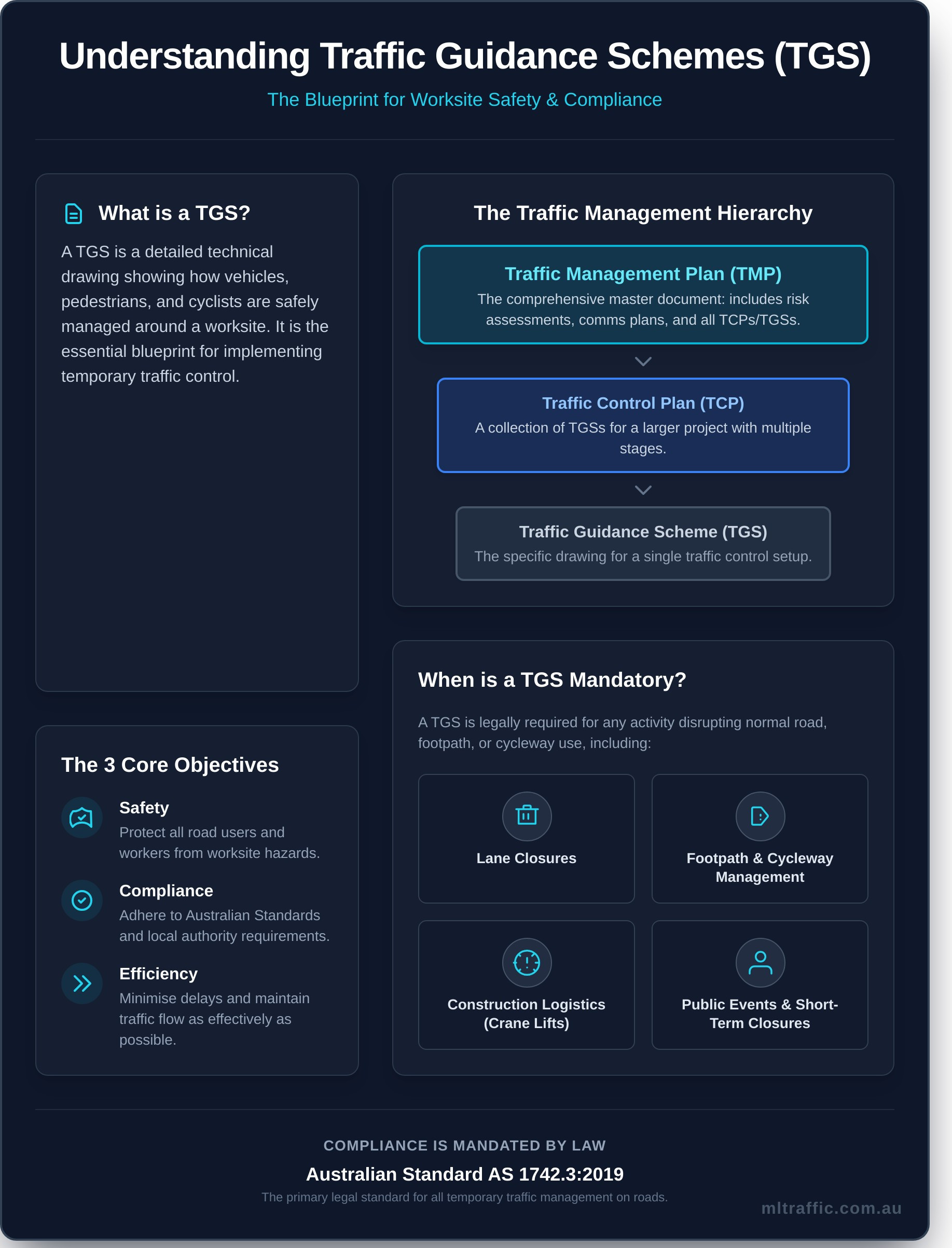
A Traffic Guidance Scheme (TGS) / formerly Traffic Control Plan (TCP) is a detailed technical drawing that dictates how road users—including vehicles, pedestrians, and cyclists—will be safely managed around a work site, event, or any other disruption to normal traffic conditions. It is the essential blueprint for road safety, providing clear, visual instructions for the implementation of temporary traffic management measures. A professionally designed TGS ensures that all on-site personnel know precisely where to place signs, barriers, and other devices to maintain a safe and efficient environment.
To better understand the practical application of these concepts, the following video provides a clear overview of on-site traffic control procedures.
What Exactly is a TGS?
A TGS is more than just a simple map. It is a legally significant document that specifies the exact placement of all temporary traffic control devices, including signs, cones, barriers, and variable message signs (VMS). The scheme also outlines the positioning of traffic controllers and any required changes to line marking. It is a mandatory requirement for any activity that impacts the normal operation of a road or path, ensuring the safety of all parties.
The Primary Goal: Safety, Compliance, and Efficiency
Every traffic guidance scheme is developed to achieve three critical, non-negotiable objectives that form the basis of all professional traffic management design.
-
Safety: The paramount objective is to protect construction workers, vehicle occupants, pedestrians, and cyclists from potential hazards created by the work site.
-
Compliance: The scheme must adhere strictly to Australian Standards (such as AS 1742.3) and the specific requirements of state and local road authorities.
-
Efficiency: While safety is the priority, a well-designed TGS also aims to minimise delays, reduce congestion, and maintain traffic flow as effectively as possible.
TGS vs. TCP vs. TMP: Understanding the Hierarchy
In the traffic management industry, several acronyms are used, which can cause confusion. It is crucial to understand their relationship:
-
Traffic Guidance Scheme (TGS): Refers to the individual drawing or diagram for a specific traffic control setup at a particular location.
-
Traffic Control Plan (TCP): Often used interchangeably with TGS. In some contexts, a TCP can refer to a collection of TGSs for a larger project with multiple stages.
-
Traffic Management Plan (TMP): The highest-level document. A TMP is a comprehensive report that contains the TGS/TCPs, along with risk assessments, project details, and communication plans.
When is a Traffic Guidance Scheme / formerly Traffic Control Plan Required?
A professional traffic guidance scheme (TGS) / formerly traffic control plan (TCP) is a mandatory requirement whenever work, construction, or an event disrupts the normal operating conditions of a road, footpath, or cycleway. Essentially, if an activity alters how vehicles, pedestrians, or cyclists use a public space, a TGS is needed to ensure safety and maintain traffic flow. This is a standard condition imposed by councils for most Development Application (DA) approvals involving construction.
The complexity of the required TGS directly correlates with the type of road and the potential impact. A simple footpath diversion on a quiet local street requires a less detailed plan than a multi-lane closure on a major arterial road managed by an authority like Transport for NSW (TfNSW).
Legal and Regulatory Triggers
The need for a TGS is dictated by strict legal and safety regulations. Compliance is not optional. The primary driver is the Australian Standard AS 1742.3:2019, Traffic control for works on roads, which sets the minimum requirements for all temporary traffic management in Australia. Furthermore, state road authorities and local councils have their own specific guidelines and submission processes. In most jurisdictions, an approved TGS is a prerequisite for obtaining a Road Occupancy Licence (ROL) or any other permit to work on or occupy the road corridor.
Common Worksite Scenarios Requiring a TGS / formerly TCP
A wide range of common activities on or near the road network legally require a professionally designed traffic guidance scheme. If your project involves any of the following, a plan is necessary to gain approval and proceed safely:
-
Lane closures: Required for utility installation or repairs (e.g., NBN, water, electrical), road maintenance, or to create a safe work buffer.
-
Footpath and cycleway management: Any closure, narrowing, or diversion of pedestrian or cyclist paths requires a plan to guide users safely around the worksite.
-
Construction logistics: Activities such as crane lifts, concrete pours, and the delivery or removal of heavy materials that occupy part of the road or footpath.
-
Short-term closures: Full or partial road closures for public events like street festivals, markets, parades, or for filming and emergency maintenance.
Key Components of a Compliant Traffic Guidance Scheme / formerly Traffic Control Plan
A compliant Traffic Guidance Scheme (TGS) / formerly Traffic Control Plan is a precise, technical document, not a general sketch. While the level of detail scales with the complexity and risk of the worksite, a set of core components is always mandatory for regulatory approval and on-site safety. These elements are non-negotiable and must adhere to Australian Standards, particularly the AS 1742.3 series, using standardised symbols and terminology to ensure universal understanding.
The TGS / formerly TCP Diagram: A Visual Blueprint
The diagram is the cornerstone of any TGS / formerly TCP, providing a clear, top-down view of the entire traffic management setup. It serves as the definitive instruction manual for site personnel. For compliance, the diagram must be drawn to scale and unambiguously detail:
-
The specific work area, safety buffer zones, and all temporary travel paths for vehicles.
-
Key dimensions, including lane widths, taper lengths, and separation distances from the work zone.
-
The exact location and type of every sign, cone, barrier, and traffic control device.
-
Existing road infrastructure, including street names, intersections, and permanent line markings.
Essential Signage and Devices
The TGS specifies the physical hardware required to implement the plan safely. These devices are categorised by their function and must be deployed exactly as shown on the diagram. Key equipment includes:
-
Advance Warning Signs: Signs such as ‘Road Work Ahead’ or ‘Workers Ahead’ must be placed at calculated distances to give motorists adequate time to react.
-
Regulatory Signs: These are legally enforceable and include temporary speed limit signs and instructions like ‘Prepare to Stop’. This also covers ‘Stop/Slow’ bats used by accredited traffic controllers.
-
Delineation Devices: Traffic cones, bollards, and barriers are used to physically guide vehicles and pedestrians, clearly separating them from the worksite and potential hazards.
Traffic Flow and Pedestrian Management
A successful traffic guidance scheme goes beyond static signs and cones; it dictates the operational flow of the site. This includes documented procedures for managing all road users. The plan must outline how risks are controlled, a principle detailed in Safe Work Australia’s traffic management guide. This includes specific instructions for temporary speed limits, clear operational procedures for traffic controllers, and, critically, the provision of safe, clearly marked routes for pedestrians and cyclists, ensuring they are protected from both worksite activities and vehicle movements.
The TGS Design Process: From Site Assessment to Final Plan
Developing a compliant and effective Traffic Guidance Scheme (TGS) / formerly Traffic Control Plan (TCP) is a technical, multi-stage process undertaken by qualified traffic engineering professionals. It is not an administrative task but a critical safety and risk mitigation exercise designed to protect workers, road users, and the public before any work commences on or near a road. The process ensures every potential hazard is identified and controlled through a professionally engineered plan.
This structured approach moves from initial analysis to a final, actionable document that meets all regulatory requirements. Each step builds upon the last, resulting in a comprehensive plan that is both safe and practical for implementation.
Step 1: Site Assessment and Risk Analysis
The process begins with a detailed on-site inspection by an experienced traffic engineer. This assessment is crucial for understanding the unique conditions of the work zone. The engineer methodically identifies all potential hazards, including intersections, private driveways, pedestrian crossings, and sight distance limitations. Key data is also collected on existing traffic conditions, such as typical vehicle volumes, posted speed limits, and the types of road users (e.g., heavy vehicles, cyclists).
Step 2: Drafting the Scheme with Specialised Software
Using the data from the site assessment, the designer drafts the plan using Computer-Aided Design (CAD) software. This technology allows for the creation of precise, to-scale diagrams that clearly illustrate the required setup. The designer selects the correct temporary signs and traffic control devices as specified by Australian road authorities. Every element, from the first "Road Work Ahead" sign to the final "End Road Work" sign, is meticulously placed to ensure clarity and safety.
Step 3: Ensuring Compliance with AS 1742.3
A draft plan is not complete until it is rigorously checked for compliance against the relevant standards, primarily the Australian Standard AS 1742.3 (Traffic control for works on roads). This verification stage is a non-negotiable part of creating a compliant traffic guidance scheme. A certified TGS designer / formerly TCP designer confirms that all technical specifications are met, including:
-
Correct sign sizing and placement distances.
-
Calculated taper lengths for lane closures.
-
Adequate safety buffer zones (lateral and longitudinal).
-
Clear delineation for vehicles and pedestrians.
Step 4: Review and Implementation
The compliant draft is submitted to the client for review, ensuring it aligns perfectly with the scope and schedule of the proposed works. If the project is on a council or state-controlled road, the TGS / formerly TCP is then submitted to the relevant road authority for formal approval. Once all approvals are secured, the plan is issued, ready for implementation by accredited traffic controllers on the ground. This final document provides them with the exact instructions needed to set up a safe work zone.
Need a compliant TGS / formerly TCP for your project? Contact our experts.
Who is Qualified to Design and Implement a TGS / formerly TCP?
A frequent point of confusion for project managers is the distinction between designing a Traffic Guidance Scheme (TGS) / formerly Traffic Control Plan (TCP) and implementing it. These are two separate, critical functions performed by professionals with different qualifications and responsibilities. Understanding this difference is essential for ensuring your project is compliant, safe, and avoids costly delays.
Designing the Plan: The Traffic Engineer’s Role
The design of a TGS / formerly TCP is a specialised engineering task. It requires a qualified traffic engineer with a deep understanding of road safety principles, vehicle dynamics, relevant Australian Standards, and specific local council requirements. The designer holds the legal and professional responsibility for the plan’s technical accuracy and its ability to safely manage traffic. This is a professional service grounded in engineering principles, not a simple template. The expert design of a compliant traffic guidance scheme is the core service provided by ML Traffic Engineers.
Implementing the Plan: The Traffic Controller’s Role
A common misconception is that the traffic controllers who manage the site are also the plan designers. This is incorrect. A certified traffic controller is responsible for the physical implementation of the TGS / formerly TCP. Their role is to set up signs, cones, and barriers exactly as specified in the engineer’s plan and to manage traffic flow on the day. While their on-site work is vital, they operate under the direction of the pre-approved engineering document; they do not create it.
Why You Can’t ‘DIY’ a Traffic Guidance Scheme
Attempting to design a plan without the correct qualifications exposes your project, your business, and the public to significant risk. The consequences are severe and costly:
-
Legal Liability: In the event of an incident, legal liability falls directly on the plan’s designer. Without the correct qualifications and professional indemnity insurance, this risk is unmanageable.
-
Council Rejection: Local authorities and road agencies will reject non-compliant or inadequate plans, leading to immediate project stoppages and expensive delays.
-
Unsafe Conditions: A lack of technical knowledge can create dangerous situations for road users, pedestrians, and site workers, exposing your project to fines and shutdowns.
For a compliant and professionally designed plan, engaging a qualified traffic engineering consultant is a non-negotiable requirement for any serious project.
Secure Your Project with a Compliant Traffic Guidance Scheme
A professionally designed traffic guidance scheme / formerly traffic control plan is not merely a suggestion—it is a critical requirement for ensuring the safety of your work site and the public, while maintaining full regulatory compliance. From the initial site assessment to the final implementation, every component must adhere to strict Australian standards. This level of technical detail and legal responsibility demands the oversight of experienced and qualified traffic engineering consultants.
With over 15 years of industry experience, ML Traffic Engineers delivers TGS plans that are fully compliant with AS 1742.3 and TfNSW standards. When you partner with us, you receive direct access to our senior traffic engineers, ensuring your project benefits from expert, hands-on management from start to finish. We eliminate the guesswork and provide the assurance your project needs.
Ensure your project proceeds safely and without costly delays. Contact our expert traffic engineers to discuss your TGS requirements.
Frequently Asked Questions About Traffic Guidance Schemes
How much does a Traffic Guidance Scheme cost?
The cost of a Traffic Guidance Scheme in Australia varies based on project complexity. A basic plan for a low-volume local road may cost between A$300 and A$600. For more complex projects on arterial roads, involving multiple stages or significant traffic disruption, the cost can range from A$1,000 to A$5,000 or more. Factors influencing the final price include the level of detail required, site inspection needs, and the extent of liaison with road authorities.
How long does it take to prepare a TGS?
A standard, site-specific TGS can typically be prepared within 2 to 5 business days, provided all necessary project details and site plans are available. This timeframe is for the design and drafting of the plan itself. It is critical to also allow for the road authority’s review and approval period, which can take anywhere from a few days to several weeks, depending on their workload and the complexity of the submission. Early engagement is essential to avoid project delays.
What happens if my worksite doesn’t comply with the approved TGS?
Non-compliance with an approved TGS is a serious breach of safety and regulatory requirements. Consequences can include immediate stop-work orders from authorities, leading to significant project delays and financial losses. Substantial fines may be issued to the principal contractor and other responsible parties. In the event of an accident, non-compliance can lead to severe legal liability, prosecution under WHS legislation, and may void insurance coverage.
Does a TGS need to be approved by the local council or road authority?
Yes, approval is mandatory. Any work that impacts the normal operation of a public road, footpath, or cycleway requires a TGS to be formally approved by the relevant road authority. For local roads, this is typically the local council. For main roads, highways, or freeways, the relevant state authority (e.g., Transport for NSW, Queensland’s Department of Transport and Main Roads, VicRoads) must provide approval. Works cannot legally commence without this formal endorsement.
Can a single TGS be used for multiple, different stages of a project?
A single TGS document can be developed to cover multiple stages of a project. Each stage of work is detailed on a separate plan within the document, outlining the specific traffic control arrangements for that phase. This is an efficient method for managing phased construction. However, if the scope of work changes unexpectedly, the TGS must be amended and resubmitted to the road authority for approval before the new works can proceed.
What is the difference between a generic and a site-specific TGS?
A generic TGS is a template for a common, low-risk work activity, such as a minor footpath closure on a quiet residential street. A site-specific TGS is a custom-designed plan that accounts for the unique conditions of a particular location, including traffic speed, volume, road geometry, and potential hazards. While generic plans have very limited use, a site-specific traffic guidance scheme is required for the vast majority of projects to ensure compliance and safety.
Who is legally responsible if an accident occurs at a work site with a TGS?
Legal responsibility following an incident is typically shared and determined by investigation. The Principal Contractor has the primary duty of care for overall site safety. The consultant who designed the TGS is responsible for the plan’s compliance and professional adequacy. The traffic control company is responsible for correct on-site implementation. All parties have a legal obligation to ensure the safety of workers and the public, and their adherence to the approved plan will be heavily scrutinised.