
A minor oversight in your traffic data can result in a costly Development Application (DA) rejection, regardless of your project’s architectural merit. Many applicants find themselves asking what is a traffic statement of environmental effects only after facing delays or requests for further information from the consent authority. Under the Environmental Planning and Assessment Regulation 2021, every development must demonstrate that its impact on the local road network is manageable and compliant with current technical standards.
It’s frustrating to manage shifting terminology and the rigorous requirements of the 2024 Guide to Transport Impact Assessment. You’ve worked hard on your design, and the last thing you need is a refusal based on inadequate car parking demand assessments or poor intersection analysis. This guide clarifies the specific role of traffic assessments within a Statement of Environmental Effects (SEE) and explains how professional documentation secures your project’s approval.
We provide a clear roadmap to DA success by detailing when a simple statement suffices and when a comprehensive Traffic Impact Assessment (TIA) is mandatory. You’ll learn how to navigate the NSW Planning Portal requirements and why engaging a qualified traffic engineer is essential for technical compliance, vehicle swept path analysis, and overall risk mitigation.
Key Takeaways
- Define what is a traffic statement of environmental effects and its role as a critical technical document within the broader Australian planning framework.
- Understand why Councils prioritize traffic and parking data, making professional validation of site access and safety essential for project approval.
- Identify the core components of a compliant report, including land use analysis and detailed assessments of existing transport infrastructure.
- Learn how to maintain compliance with Australian Standards like AS 2890.1 and local Development Control Plans to ensure development geometry is accurate.
- Discover how senior-level engineering oversight provides the technical accuracy and accountability required to navigate the complex planning process.
Table of Contents
Defining the Traffic Statement of Environmental Effects
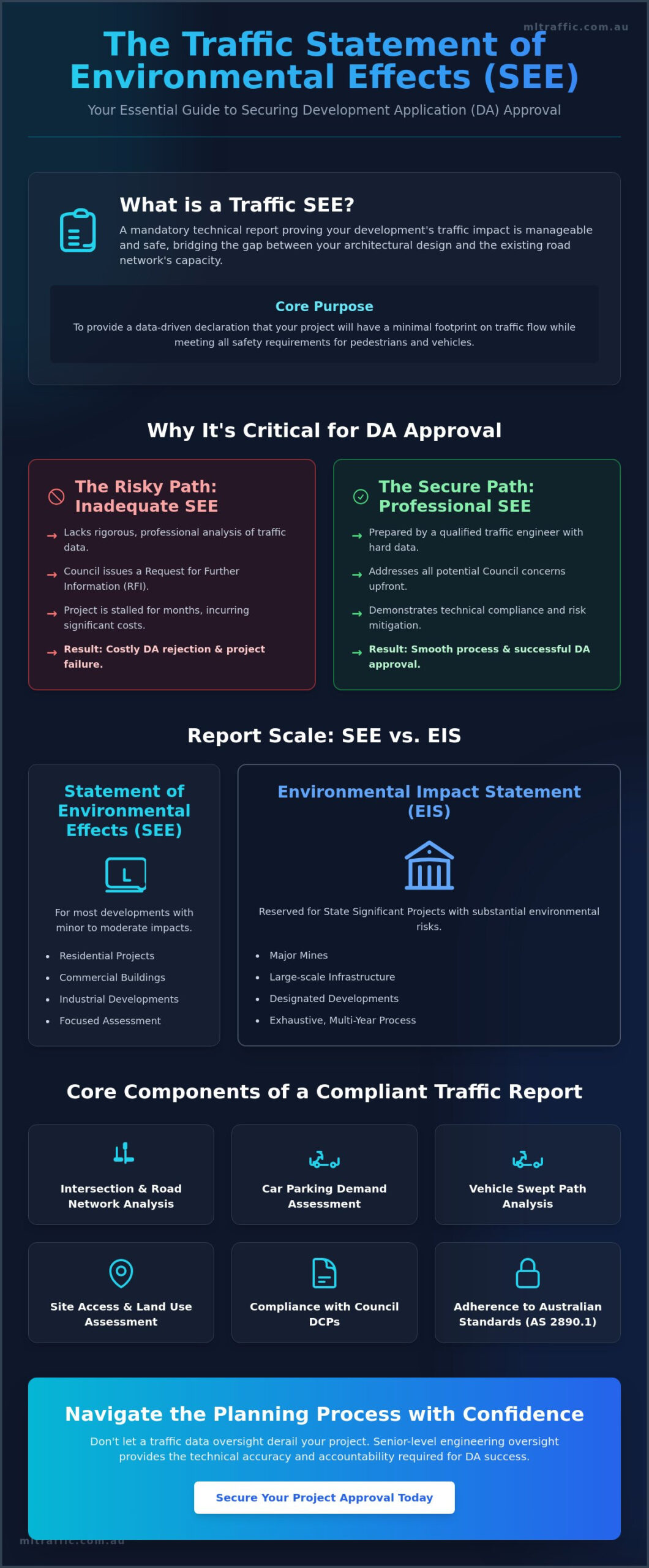
A Statement of Environmental Effects (SEE) is a mandatory technical report that accompanies the majority of Development Applications (DA) in Australia. Its primary function is to provide the consent authority with a detailed analysis of a proposal’s environmental impacts and the specific strategies used to mitigate them. While a general SEE addresses broad issues like heritage, waste management, and biodiversity, the traffic components require specialized engineering expertise to validate site accessibility and safety. The report serves as a formal declaration that the developer has considered every physical consequence of their project.
To understand what is a traffic statement of environmental effects, you must view it as a bridge between architectural intent and infrastructure capacity. It’s not a mere description of a project’s goals. It is a data-driven document that proves a development maintains the integrity of the local road network through evidence-based modeling. The core purpose is to demonstrate that the project has a minimal footprint on existing traffic flow while meeting all safety requirements for pedestrians and motorists alike.
To better understand the differences between reporting requirements, watch this helpful video:
SEE vs. EIS: Understanding the Scale
The choice between an SEE and an Environmental Impact Statement (EIS) depends entirely on the scale and potential impact of the project. Most residential, commercial, and industrial developments require an SEE because their impacts are categorized as minor or moderate. An EIS is reserved for "designated developments" or State Significant Projects, such as major mines or large-scale infrastructure, which pose substantial environmental risks. For the vast majority of urban developers, the SEE is the standard pathway for securing local council approval. It provides a focused assessment without the exhaustive, multi-year timelines often associated with an EIS.
State Variations: SEE, EES, and Traffic Reports
Terminology varies across Australian jurisdictions, which often causes confusion for developers working across state lines. In New South Wales, the term SEE is the standard regulatory requirement. In Victoria, you may encounter an Environment Effects Statement (EES) for larger projects. Despite these regional naming differences, the underlying technical requirements for traffic engineering remain consistent nationwide. Whether you’re reviewing Intersection Analysis or car parking demand, the engineering principles don’t change. Local planning instruments, such as Local Environmental Plans (LEPs) and Development Control Plans (DCPs), dictate the specific thresholds for your statement, but the reliance on Australian Standards is universal.
Why Traffic Engineering is Central to the SEE
Local Councils frequently identify traffic and parking as the most contentious elements of a Development Application. While a general town planner can describe a project’s intent, they often lack the technical tools to quantify its impact on public infrastructure. This is why a professional assessment is mandatory. When considering what is a traffic statement of environmental effects, it’s vital to recognize it as a technical validation tool. It moves beyond subjective description and provides Council with hard data regarding vehicle movements and road safety.
Inadequate traffic data is a primary cause of project delays. Councils will issue a Request for Further Information (RFI) if your submission lacks rigorous analysis. These requests can stall a project for months. A well-prepared statement by a qualified engineer addresses potential concerns before they become roadblocks. By providing precise Intersection Analysis and parking data upfront, you demonstrate a commitment to regulatory compliance. This proactive approach streamlines the approval process, especially when you consult with a specialist engineer early in the design phase.
Assessing Traffic Generation and Road Capacity
Engineers use standardized methods to estimate the volume of vehicle trips a new development will generate. This involves referencing the Transport for NSW "Guide to Transport Impact Assessment" (Version 1.1) and comparing the proposal against similar land-use categories. We evaluate the capacity of existing intersections to ensure they can handle the additional load without degrading the Level of Service (LoS). Council requires evidence that the surrounding road network can support the project’s operational needs. Without this proof, a DA is likely to be refused on the grounds of insufficient infrastructure capacity.
The Critical Role of Site Access and Safety
Site access is about more than just a driveway location. It requires ensuring safe entry and exit points for every vehicle type, from passenger cars to heavy service trucks. We perform a Sight Distance Assessment at the property boundary to verify that drivers have a clear view of oncoming traffic and pedestrians. This technical road safety metric is non-negotiable. Pedestrian safety is also integrated into the traffic statement; we ensure that footpaths and crossing points are protected from vehicle conflict zones. These details form the backbone of a compliant and safe development design.
Key Components of a Compliant Traffic Statement
A compliant traffic statement is a technical dossier that establishes the operational feasibility of your development. It moves beyond high-level descriptions to provide the consent authority with specific metrics regarding site functionality. When determining what is a traffic statement of environmental effects in a practical sense, you must include a comprehensive land-use description that details staff numbers, peak operating hours, and delivery schedules. These operational requirements form the baseline for all subsequent impact modeling.
The report must also contain a rigorous analysis of existing traffic conditions. This includes a review of the surrounding road hierarchy, local intersection performance, and available public transport infrastructure. Council assessors look for a clear understanding of how pedestrians and cyclists interact with the site. If the analysis identifies potential negative impacts, the statement must provide concrete mitigation measures. These might include updated intersection signaling, dedicated turn lanes, or specific Car Park Design modifications to improve internal circulation.
Every professional statement must address the following core elements:
-
Detailed breakdown of projected trip generation rates.
-
Audit of existing on-street parking availability and restrictions.
-
Assessment of proximity to heavy rail, light rail, and bus networks.
-
Evaluation of pedestrian desire lines and safety at site interfaces.
-
Comparison of proposed parking provisions against local Council DCP requirements.
Vehicle Swept Path Analysis
We use specialized software to simulate the movement of vehicles through your site. This process, known as Vehicle Swept Path Analysis, is essential for proving that service trucks, emergency vehicles, and standard passenger cars can maneuver safely without striking curbs or structures. It’s a non-negotiable requirement for basement car parks and loading docks where spatial constraints are tight. Providing these overlays in your submission removes any doubt regarding the physical accessibility of your design.
Parking Demand and Car Park Design
Calculating the correct parking provision requires a deep understanding of land-use specific demand. We balance the minimum requirements set by Council with the actual operational needs of the development to prevent oversupply or under-provision. All layouts must strictly adhere to national standards to ensure user safety and comfort. Our engineers ensure every bay, aisle, and ramp grade complies with the AS 2890.1 Guide for off-street car parking. This level of technical precision is what differentiates a successful DA from one that receives a refusal.
Compliance with Australian Standards and Council DCPs
Achieving DA approval requires strict adherence to a hierarchy of regulatory controls. At the top, state legislation like the Environmental Planning and Assessment Regulation 2021 sets the procedural framework. Below this, Local Environmental Plans (LEPs) and Development Control Plans (DCPs) dictate specific land-use rules. However, the physical geometry of your development is governed by Australian Standards. When people ask what is a traffic statement of environmental effects, they are essentially asking for a technical guarantee that a design complies with these multi-layered benchmarks.
AS 2890.1 (Off-street car parking) is the primary standard for passenger vehicle facilities. It dictates everything from bay widths to aisle lengths. For commercial or industrial projects, AS 2890.2 (Off-street commercial vehicle facilities) becomes critical. It ensures that heavy rigid vehicles (HRVs) and small rigid vehicles (SRVs) can navigate the site without infrastructure damage. A traffic engineer’s role is to certify that every line on your architectural plan meets these rigorous standards. Failure to provide this certification often leads to immediate rejection by Council assessors.
Navigating Local Development Control Plans (DCP)
Councils across Australia maintain unique thresholds for parking and traffic generation. A requirement in one municipality may differ significantly from its neighbor. If a project cannot meet a specific DCP requirement due to site constraints, we must justify a variation. This isn’t a simple request; it’s a technical argument supported by data. Successful variations require the technical backing of a specialized traffic engineering report to demonstrate that safety and efficiency aren’t compromised.
Driveway and Ramp Grade Certification
Driveway gradients are a frequent point of failure in DA submissions. If a ramp is too steep or lacks appropriate transitions, vehicles will scrape their undercarriages. This creates both a safety hazard and a long-term maintenance liability. We perform a detailed Driveway Ramp Grade Assessment to verify that all vertical profiles comply with AS 2890.1. We also evaluate queuing areas at site entries to ensure that entering vehicles don’t queue across public footpaths or into active traffic lanes. Providing this level of detail is a core part of what is a traffic statement of environmental effects in the eyes of a Council engineer.
Expert Traffic Engineering for Your DA Approval
Engaging a specialized consultancy like ML Traffic Engineers provides the technical certainty required for complex DA approvals. General town planners often lack the engineering depth to resolve technical objections raised by Council engineers. Our senior-level involvement ensures that every traffic statement is accurate and compliant with current Australian Standards. We reduce project risk by applying over 15 years of experience in the Australian planning system to your specific site challenges.
We maintain a strict policy of personnel continuity. The senior principal who initiates your project is the same expert who performs the technical work. This eliminates the risk of information loss between departments and ensures high-level accountability. Understanding what is a traffic statement of environmental effects is vital, but having a seasoned expert defend that statement during the Council review phase is what secures approval. Our team has a proven track record across diverse project environments, including:
-
Residential flat buildings and multi-dwelling housing.
-
Commercial office developments and retail centers.
-
Industrial warehouses and distribution hubs.
-
Childcare centers and educational facilities.
-
Medical clinics and specialized health infrastructure.
-
Mixed-use developments and urban infill projects.
Our Approach to Traffic Impact Assessments
We collaborate with architects and developers to optimize site layouts before lodgement. This proactive involvement identifies issues with driveway ramps or car park designs early in the design phase. We prioritize direct communication with Council planning departments to address specific local concerns within our reports. This hands-on approach minimizes the likelihood of a Request for Further Information (RFI) and speeds up the determination process. Explore our Traffic Engineering Services to see the breadth of our technical capabilities.
Get Started with Your Traffic Statement
To obtain a quote for your Statement of Environmental Effects, provide your current architectural plans and a description of the proposed land use. Our team reviews these documents to determine whether a concise statement or a detailed Traffic Impact Assessment is required for your specific Council. We provide direct access to our senior leadership, ensuring you have a clear line of communication with the experts handling your file. Contact our Senior Traffic Engineers today to secure an authoritative partner for your DA approval process.
Securing Your Project’s Future with Technical Compliance
A compliant development application relies on more than just architectural vision. It requires a rigorous demonstration that your project integrates safely with existing infrastructure. Understanding what is a traffic statement of environmental effects is the first step toward avoiding the common pitfalls of DA rejection. It’s essential to provide Council with the technical certainty they require through data-driven assessments like Intersection Analysis and Vehicle Swept Path Analysis. These technical reports bridge the gap between your design intent and the practical realities of the road network.
ML Traffic Engineers brings over 15 years of traffic engineering experience to every project. We ensure senior principals are directly involved in the technical work. Our firm maintains a proven track record with local Councils across Australia. This hands-on approach guarantees your submission meets the exacting requirements of AS 2890 and local DCP thresholds. By providing precise data from the start, you eliminate the risk of costly RFIs and project delays.
Secure your DA approval with a professional Traffic Impact Assessment from ML Traffic Engineers. We look forward to helping you move your development from the planning portal to successful construction.
Frequently Asked Questions
Is a Traffic Statement of Environmental Effects the same as a Traffic Impact Assessment (TIA)?
No, they serve different roles within the planning process. A Statement of Environmental Effects is the overarching document required for a Development Application, while a TIA is a specialized technical report focusing specifically on traffic and transport impacts. For small scale projects, a concise traffic statement within the SEE may suffice, but larger developments require a comprehensive TIA to satisfy technical requirements.
When is a traffic report mandatory for a Development Application?
A traffic report is mandatory whenever a proposed development changes land use or increases vehicle movements on the local road network. Local Councils specify these thresholds in their Development Control Plans (DCPs). Most commercial, industrial, and multi-unit residential applications must include a traffic assessment to prove that parking, access, and surrounding road capacity are sufficient for the new demand.
Can a town planner write the traffic section of an SEE?
A town planner can provide a high level summary, but they cannot perform the technical modeling required for most approvals. Components such as Intersection Analysis and Vehicle Swept Path Analysis require a qualified traffic engineer. Technical assessments must align with the 2024 Guide to Transport Impact Assessment, which requires specialized engineering expertise that goes beyond general planning descriptions.
What happens if my development does not meet Council parking requirements?
If your design falls short of the DCP parking rates, you must provide a formal Car Parking Demand Assessment to justify the variation. This report uses empirical data to prove that the proposed parking provision is adequate for your specific land use. When explaining what is a traffic statement of environmental effects to clients, we emphasize that a well reasoned technical justification is the only way to secure a parking variation.
How long does it take to prepare a traffic statement for an SEE?
A consultant can typically prepare a traffic statement for a standard SEE within 5 to 10 working days. This timeframe depends on the complexity of the project and the availability of architectural site plans. Projects requiring detailed intersection modeling or extensive field data collection will take longer to complete to ensure the technical accuracy required for Council submission.
Does a traffic statement need to address construction traffic?
Yes, many Councils require the traffic section of an SEE to address the impacts of heavy vehicles during the building phase. This may involve a preliminary Traffic Guidance Scheme (TGS) to manage construction site access and pedestrian safety. Proactively addressing construction traffic in your what is a traffic statement of environmental effects prevents delays when you apply for a Construction Certificate later in the project.
What is the cost of a traffic assessment for a small development?
The cost depends entirely on the specific technical requirements set by the local Council and the complexity of the site. Factors such as the number of driveway ramps, the need for sight distance assessments, and the scale of the proposed land use all influence the assessment fee. Applicants should provide detailed architectural plans to obtain a fixed quote that covers all necessary engineering deliverables.
How do Australian Standards like AS 2890 affect my Statement of Environmental Effects?
Australian Standards like AS 2890.1 and AS 2890.2 dictate the physical geometry of your parking and access facilities. Your SEE must certify that all bay dimensions, aisle widths, and ramp gradients meet these national benchmarks. Council engineers use these standards as a primary checklist for compliance; any deviation from AS 2890 without an expert engineering justification will likely result in a DA rejection.
Which areas do you cover?
We are traffic engineers servicing Melbourne, Sydney, Brisbane, Gold Coast, Hobart, Perth, Adelaide, Darwin, Canberra and surrounding areas.

Disclaimer
The content on www.mltraffic.com.au, including all technical articles, guides, and resources, is provided for general informational and educational purposes only. It is not intended to constitute professional advice in traffic engineering, transportation planning, development approvals, or any other technical or legal field.
While ML Traffic Engineers makes every reasonable effort to ensure the accuracy, completeness, and timeliness of the information published, we do not provide any warranties or representations (express or implied) regarding its reliability, suitability, or availability for any particular purpose. Any reliance you place on the content is strictly at your own risk.
In no event shall ML Traffic Engineers, its directors, employees, authors, or affiliates be liable for any direct, indirect, incidental, special, consequential, or punitive damages (including, without limitation, loss of profits, data, or business opportunities) arising out of or in connection with the use of, or inability to use, any information provided on this website.
The articles and guides on this site are not a substitute for engaging a qualified, registered professional traffic engineer (such as an NPER or RPEQ engineer) to assess your specific project requirements. For tailored advice, compliance assessments, or traffic engineering services, please contact a competent professional.
This disclaimer may be updated from time to time without notice. By accessing or using this website, you agree to be bound by the most current version of this disclaimer.
