

The success of a development application often depends on factors beyond the immediate project site. A common but frequently misunderstood hurdle is the impact on the wider, state-controlled road network. This is the direct operational domain of a transport management centre (TMC), the government body responsible for monitoring, managing, and optimising traffic flow across thousands of kilometres of arterial roads. If your project is perceived to negatively affect this network, it faces a significant risk of objection or rejection, regardless of local council support.
Understanding the function of the TMC is not optional; it is a critical component of a successful development strategy. This guide provides a direct, professional overview of Australia’s Transport Management Centres. We will explain their role, clarify how their data and objectives directly influence the traffic impact assessments required for your DA, and demonstrate how this state-level oversight affects your local project. Gaining this knowledge is essential for navigating council requirements and securing project approval.
Defining the Transport Management Centre (TMC): The Network’s Nerve Centre
A Transport Management Centre (TMC) is a centralised command-and-control facility responsible for monitoring, managing, and optimising traffic flow across a major road network in real-time. The primary mission of a transport management centre is to enhance road safety, minimise congestion, and improve journey reliability for all road users. Think of it as an air traffic control tower, but for roads, motorways, and major arterial routes.
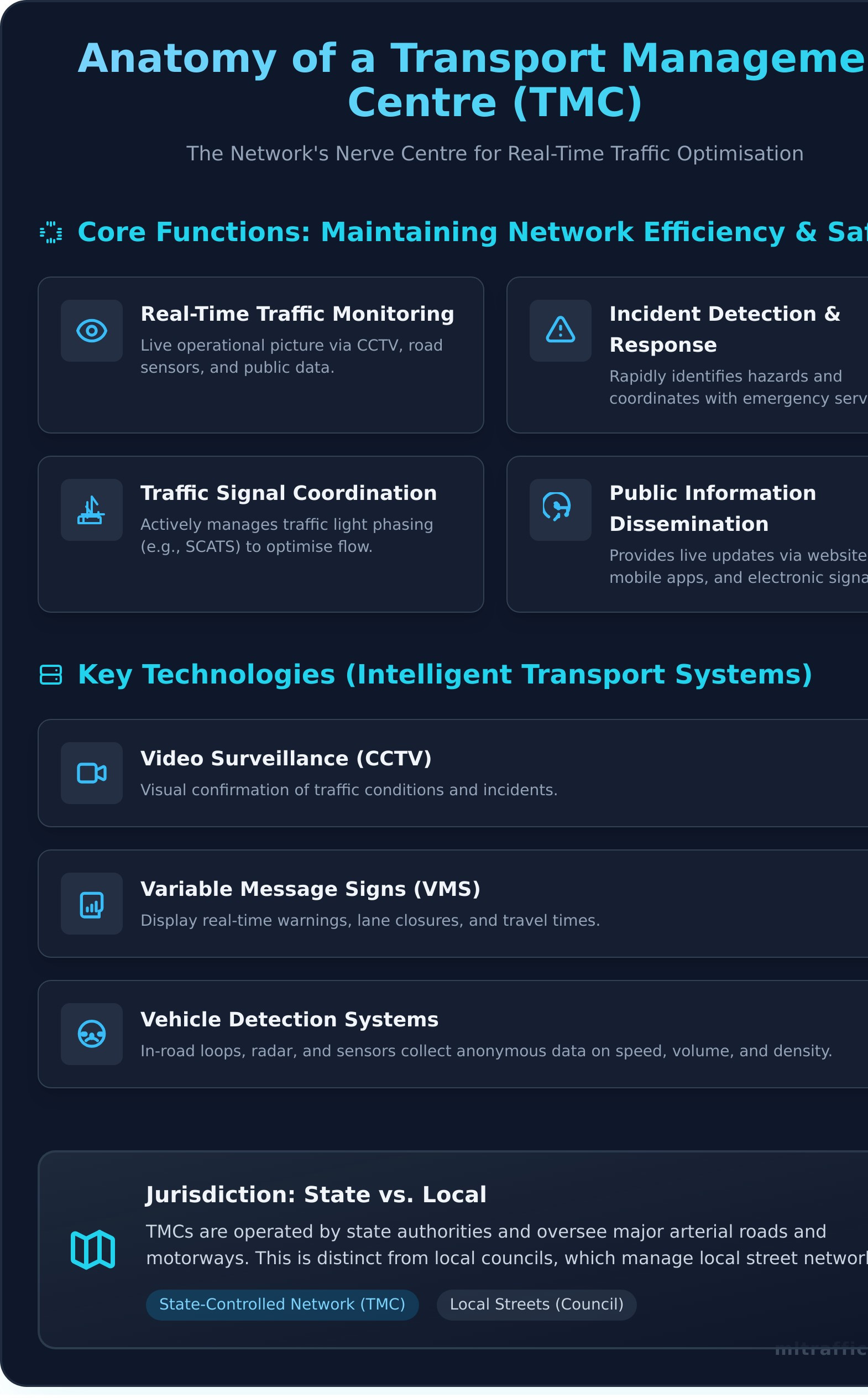
This function is distinct from local council traffic departments, which typically manage local streets. A TMC’s jurisdiction covers the state-controlled road network that forms the backbone of a city or region’s transport system.
To see how these centres operate, the following video provides a clear overview:
Core Functions of a Modern TMC
The objective of a TMC is to maintain network efficiency and safety. This is achieved through several core functions:
-
Real-Time Traffic Monitoring: Utilising a vast network of CCTV cameras, in-road sensors, and aggregated public data to maintain a live operational picture of the entire network.
-
Incident Detection and Response: Rapidly identifying accidents, breakdowns, and hazards to coordinate with emergency services and on-road response crews, clearing incidents safely and quickly.
-
Traffic Signal Coordination: Actively managing traffic light phasing, often using adaptive systems like SCATS, to optimise traffic flow and reduce delays during peak periods or special events.
-
Public Information Dissemination: Providing live updates to motorists and stakeholders via websites, mobile apps, and on-road electronic signage.
The Technology Powering Traffic Management
Modern TMCs rely on a sophisticated suite of technologies known as Intelligent Transport Systems (ITS). These systems are critical components of a broader Advanced Traffic Management System (ATMS), which uses technology to collect data and implement management strategies. Key technologies include:
-
Video Surveillance (CCTV): High-definition cameras provide operators with visual confirmation of traffic conditions and incidents.
-
Variable Message Signs (VMS): Large electronic signs display real-time warnings about congestion, lane closures, accidents, or estimated travel times.
-
Vehicle Detection Systems: In-road induction loops, radar, Bluetooth, and Wi-Fi sensors collect anonymous data on vehicle speed, volume, and density.
Who Operates Australia’s TMCs?
In Australia, TMCs are operated by state-level government transport authorities. These bodies have jurisdiction over the most critical parts of the road network. Key examples include:
-
Transport for NSW (Sydney)
-
Department of Transport and Planning, Victoria (Melbourne)
-
Queensland Department of Transport and Main Roads (Brisbane)
How TMC Operations Impact Property Development Applications
Any new property development introduces additional vehicles to the road network. From the perspective of a local council or a state road authority, your project is a new variable that will impact traffic flow, congestion, and safety. These authorities have a statutory obligation to assess and manage this impact before granting approval.
This is where the role of a transport management centre becomes critical. The TMC functions as the hub or nerve center of a freeway management system, providing the real-time and historical data that forms the baseline for any traffic assessment. Council planners and state transport bodies like Transport for NSW or Queensland’s TMR use this data to scrutinise development applications, ensuring a proposed project does not unacceptably degrade the performance of their managed network.
Network Performance and Your Traffic Impact Assessment (TIA)
A Traffic Impact Assessment (TIA) is a mandatory report for most development applications (DAs). It must quantitatively analyse the existing road network’s ‘Level of Service’ (LoS) and model the future impact of your development. The crucial data points for this analysis-such as traffic volumes, intersection delays, and peak hour performance-are often sourced directly from TMC systems. Your TIA must use this evidence to prove that any increase in traffic can be accommodated safely and efficiently, without causing significant network degradation. Need a TIA for your DA? We provide expert reports.
Site Access Design and Arterial Road Safety
A primary objective of any transport management centre is to maintain safe and consistent traffic flow, particularly on major arterial roads. A poorly designed vehicle access point for your development can directly undermine this. For example, a driveway with an inadequate queueing length or difficult turning angles can cause vehicles to bank up onto the main road, creating a serious safety hazard and a point of congestion. This is why swept path analysis and compliant driveway design are non-negotiable elements scrutinised by assessors to ensure all vehicles, from cars to service trucks, can enter and exit safely without disrupting arterial traffic.
Construction Traffic Management Plans (CTMPs)
The impact of your development begins long before it becomes operational. The construction phase can cause significant disruption to the road network, a major concern for TMC operators. A comprehensive Construction Traffic Management Plan (CTMP) is therefore required. This plan must detail every aspect of construction-related traffic, including:
-
Truck routes to and from the site
-
Management of materials delivery and spoil removal
-
Provision for worker parking
-
Traffic control measures for any required lane or footpath closures
A well-prepared CTMP demonstrates to authorities that you have a professional strategy to minimise disruption. Failure to provide an adequate plan can lead to significant project delays and financial penalties from council.
The Role of the Traffic Engineer: Your Liaison to the Network
A Transport Management Centre (TMC) operates at a macro level, focusing on the efficiency and safety of the entire road network. For a developer, these high-level objectives can seem abstract. The professional traffic engineer acts as the critical liaison, translating the TMC’s network-wide goals into the practical, micro-level requirements of your specific development site. They understand how authorities monitor and manage traffic-as demonstrated in this real-world example of TMC operations-and ensure your project aligns with these strategic priorities from day one.
Engaging an experienced traffic engineering consultant de-risks your project by ensuring every traffic-related aspect of your Development Application (DA) is robust, compliant, and defensible. This proactive approach is fundamental to securing timely approvals.
Sourcing and Interpreting Traffic Data
Council and state road authorities require decisions to be based on verifiable evidence, not assumptions. A qualified traffic engineer knows precisely where to source official traffic volume and crash data. This information forms the baseline for sophisticated traffic modelling, allowing for accurate predictions of your development’s impact on the local road network. This evidence-based methodology is non-negotiable for a successful Traffic Impact Assessment (TIA).
Designing Compliant Access and Parking
A functional and safe design is paramount for approval and long-term operational success. Our work is grounded in strict adherence to technical standards and best practices. This includes:
-
Compliance with Australian Standards: Rigorous application of the AS 2890 series for all car parking, loading, and access facility design.
-
Swept Path Analysis: Utilising industry-standard software like AutoTURN to verify that all vehicles, from cars to service trucks, can manoeuvre safely and efficiently within the site.
-
Functional Layouts: Ensuring car parks, loading docks, and access driveways are designed for optimal safety, sight lines, and functionality to prevent on-site conflicts and off-site queuing.
Negotiating with Council and State Authorities
Effective communication with authorities is a critical skill. An experienced consultant speaks the same technical language as council planners and state road agency engineers. They can articulate the rationale behind specific design choices, justifying them with robust engineering principles and compliance with relevant codes. This ability to anticipate and resolve potential objections before they become formal problems is invaluable, streamlining the approval process and preventing costly delays associated with requests for further information or redesigns.
Ultimately, the traffic engineer ensures your development integrates seamlessly with the network overseen by the transport management centre. To discuss your project’s specific requirements, contact the experts at mltraffic.com.au.
Case Studies: When TMC Considerations are Crucial
Understanding the role of a Transport Management Centre (TMC) is best illustrated through practical examples. Proactive engagement and expert traffic engineering are not just about compliance; they are about ensuring a development functions safely and efficiently within the existing road network. The following scenarios highlight common development challenges where TMC approval is critical.
Scenario 1: Childcare Centre on a Busy Arterial Road
The Challenge: A proposed 100-place childcare centre requires access from a major commuter route. The primary concern is managing the intense but short-lived traffic peaks during morning drop-off and afternoon pick-up times.
TMC Concern: The potential for vehicles queuing to enter the site to spill back onto the arterial road, obstructing a lane of traffic and causing significant delays and safety risks.
The Solution: A detailed Traffic Impact Assessment (TIA) is prepared. The assessment recommends a combination of a well-designed internal pick-up/drop-off bay that prevents queuing and a management plan that encourages staggered arrival times. This provides the TMC with the evidence needed to confirm the development will not disrupt the main road.
Scenario 2: Warehouse with Frequent Heavy Vehicle Access
The Challenge: A logistics facility is planned with an access point on a multi-lane road. The operation requires frequent movements of B-double trucks throughout the day.
TMC Concern: A slow-turning truck blocking multiple lanes or being unable to complete the turn into the site in a single, fluid manoeuvre. This can halt traffic flow and create a hazardous situation for other road users.
The Solution: A comprehensive swept path analysis is conducted using specialised software. This analysis demonstrates that the proposed driveway geometry, width, and corner splays are sufficient for the design vehicle to enter and exit the site safely and efficiently, without encroaching on adjacent lanes. This technical proof satisfies the transport management centre that network safety is maintained.
Scenario 3: Mixed-Use Development Near a Motorway On-Ramp
The Challenge: A large mixed-use development comprising retail, commercial, and residential units is proposed near a busy motorway on-ramp. The combined traffic generated by these different uses could significantly impact this critical piece of infrastructure.
TMC Concern: The additional traffic volume from the development overloading the on-ramp, causing queues to extend back onto the motorway itself-a major safety and congestion issue.
The Solution: Advanced traffic modelling is performed to simulate the network’s performance with the development traffic included. The model can test various scenarios and demonstrate that the expected traffic increase can be accommodated within the ramp’s existing capacity, or it can identify what specific upgrades (like signal timing adjustments) are required to mitigate the impact.
These scenarios represent a fraction of the complexities involved in development applications. Our team has experience with all land use types. Contact us.
Secure Your Development Approval with Expert TMC Liaison
Understanding the complex role of a transport management centre is not a minor detail; it is a critical step for any successful development application in Australia. As the nerve centre of the road network, the TMC’s primary mandate is to maintain safety and efficiency. This means any project, large or small, will face intense scrutiny regarding its potential traffic impact. Failing to adequately address these official concerns with a robust traffic engineering assessment can lead to significant project delays or outright rejection by authorities.
Protect your investment by engaging professionals who speak the language of network operators. With over 15 years of specialised experience, ML Traffic Engineers prepares expert reports for development applications across Australia, ensuring every TMC stipulation is met. Our process guarantees direct communication with senior traffic engineers who will manage your case from start to finish. Ensure your project meets all network requirements. Contact ML Traffic Engineers for a professional assessment. Let our expertise clear the way for your project’s approval.
Frequently Asked Questions
What is the difference between a Transport Management Centre and a local council’s traffic department?
A Transport Management Centre (TMC) operates at a state level, managing major arterial roads and motorways to ensure network-wide efficiency. They oversee large-scale traffic systems and respond to major incidents. In contrast, a local council’s traffic department has jurisdiction only over local roads within its specific LGA. Their responsibilities include local traffic calming, parking management, and assessing the direct site access and frontage impacts of a development application.
How can a developer get traffic data from a TMC for a planning report?
Obtaining specific data from a transport management centre requires a formal application process, often managed by a qualified traffic engineering consultant. Your consultant can request specific datasets, such as historical traffic volumes, signal phasing information, or incident data for key intersections relevant to your development. This raw data is then professionally analysed and incorporated into a comprehensive Traffic Impact Assessment (TIA) to satisfy the requirements of the consent authority.
Does my small residential development really need to consider the impact on the wider road network?
Yes. While a single small development may seem to have a negligible impact, consent authorities assess the cumulative effect of all approved projects on the road network. Even a minor increase in vehicle movements can contribute to reduced performance at nearby intersections, particularly those managed by state authorities. A professional traffic assessment is required to quantify this impact and demonstrate that the development will not unreasonably affect the safety and efficiency of the surrounding road system.
What is SCATS and how does it relate to the TMC?
SCATS, or the Sydney Coordinated Adaptive Traffic System, is an intelligent traffic signal management system used across Australia. It automatically adjusts traffic signal timings in real-time based on traffic demand detected by sensors in the road. The TMC is the operational hub that utilises SCATS as its primary tool to actively manage and optimise traffic flow across the entire arterial road network, improving efficiency and responding to incidents.
Why is a swept path analysis essential for projects on roads managed by state authorities?
A swept path analysis is a mandatory requirement for developments accessing state-managed roads to ensure safety and network integrity. These arterial roads accommodate larger design vehicles, such as buses and heavy rigid trucks. The analysis provides geometric proof, compliant with Australian Standards (AS 2890.2), that these vehicles can safely enter and exit the site without encroaching on adjacent traffic lanes or footpaths. Failure to provide a compliant assessment will result in rejection from the state road authority.
Can a traffic engineer help if council has already raised concerns about my project’s traffic impact?
Absolutely. Engaging a traffic engineer is the correct professional response when a council raises concerns. A qualified consultant will analyse the specific issues detailed in council’s correspondence, undertake the necessary technical assessments, and prepare a formal response to address each point. This can involve traffic modelling, revised access designs, or car parking assessments to demonstrate compliance and provide a technical solution that satisfies council’s requirements, facilitating a development approval.
Which areas do you service?
We are traffic engineers covering Melbourne, Sydney, Brisbane, Gold Coast, Hobart, Perth, Adelaide, Darwin and surrounding areas.
