

We are traffic management plan specialists servicing every suburb in the Sydney metropolitan area, Central Coast and South Coast.
Navigating the world of TMPs, TGSs, and TIAs for your development can feel like deciphering a foreign language. A single misstep in this process can lead to significant project delays or an outright rejection of your Development Application (DA) by the council. This complexity often leaves developers asking a critical question: do I need a traffic engineer or a traffic control company?
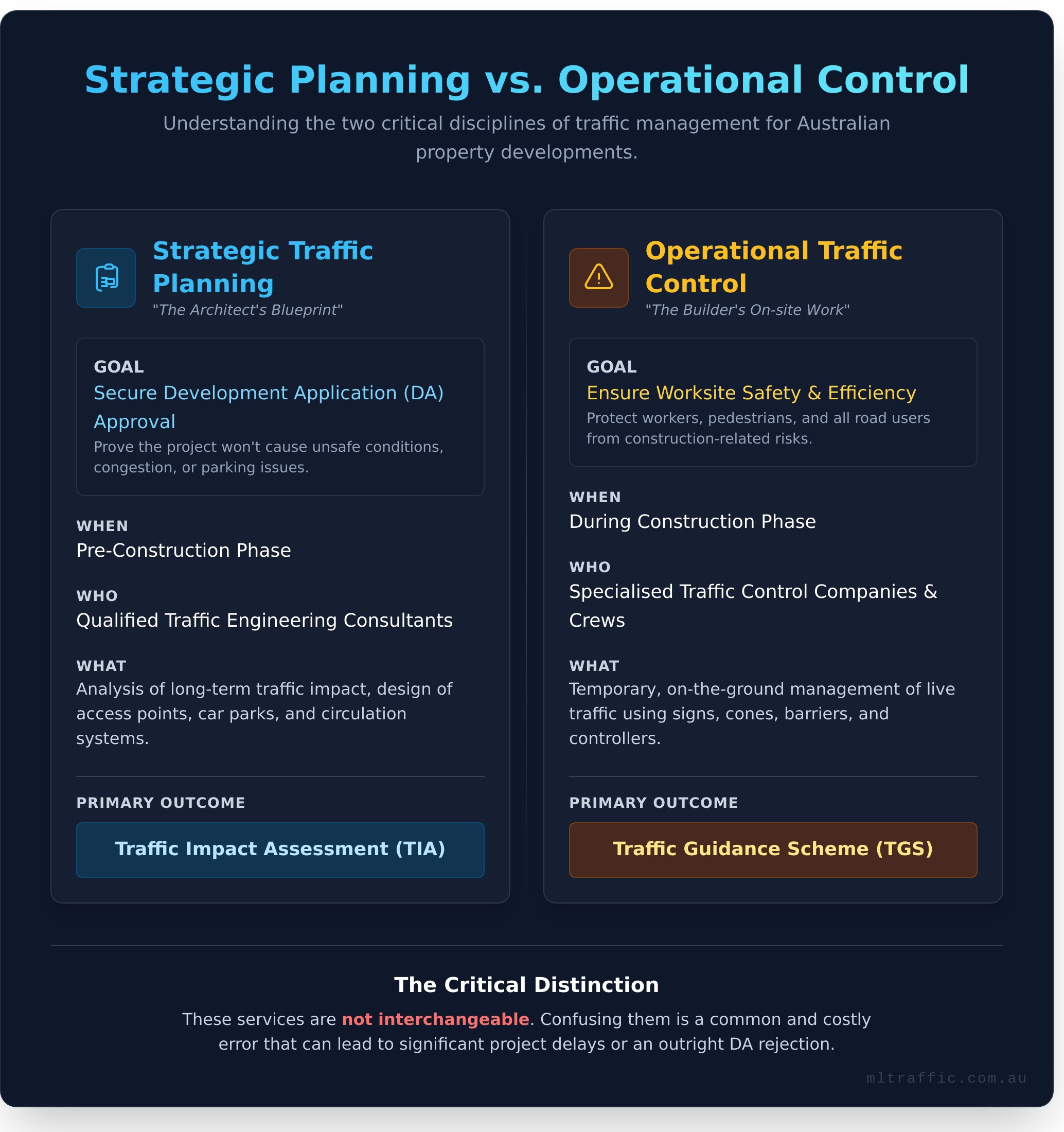
The answer lies in a crucial distinction. The term traffic management encompasses two fundamentally different disciplines: the strategic traffic engineering and transport planning required for DA approval, and the on-site, operational traffic control needed during construction. These services are not interchangeable, and confusing them is a common and costly error for Australian developments.
This guide provides the essential clarity. We will break down the critical differences between these services, explain what councils require for a successful DA submission, and equip you to confidently identify the correct professional for your project’s specific stage. Understanding this distinction is the first step to ensuring your development proceeds without avoidable, traffic-related setbacks.
The Two Sides of Traffic Management: Strategic Planning vs. Operational Control
In its broadest sense, traffic management is the professional practice of organising, guiding, and controlling the movement of both stationary and moving traffic, including pedestrians, cyclists, and vehicles. For Australian property developers, this discipline is not a single activity but is divided into two distinct and critical phases: the strategic planning that occurs before a single shovel hits the ground, and the operational control required during the construction process itself.
Understanding the requirements for each phase is fundamental for project success. The following webinar from the Toowoomba Regional Council provides a practical overview of these principles in action:
An effective way to differentiate these two functions is to use an analogy from the building industry. Strategic traffic planning is the architect’s blueprint-the detailed, forward-thinking design that ensures the final structure is functional, compliant, and approved. Operational traffic control is the builder’s on-site work-the hands-on, day-to-day execution required to build the project safely and efficiently.
What is Strategic Traffic Planning?
Strategic traffic planning is a pre-construction discipline focused on the long-term impact of a development on the surrounding road network. This process is performed by qualified traffic engineering consultants who conduct detailed analysis, forecast future traffic volumes, and design access points, car parks, and internal circulation systems. The primary outcome is a series of technical reports, such as a Traffic Impact Assessment (TIA), required to satisfy council requirements and secure a development approval.
What is Operational Traffic Control?
Operational traffic control is the temporary, on-the-ground management of live traffic around a worksite. This function is performed by specialised traffic control companies and their accredited crews. Their focus is purely on safety and efficiency during the construction phase. Using approved Traffic Guidance Schemes (TGS), they implement a system of signs, cones, barriers, and traffic controllers to protect workers, pedestrians, and all road users from the risks associated with construction activities.
Strategic Traffic Management: The Key to Development Approval
For any property developer in Australia, strategic traffic management is not an optional extra; it is the core service required to secure a Development Application (DA) approval. Before granting consent, local councils must be satisfied that a new project will integrate seamlessly into the existing road network. The primary goal is to provide objective, data-driven proof that your development will not create unsafe conditions, unacceptable congestion, or parking chaos.
A professionally prepared Traffic Impact Assessment (TIA) is your formal submission to the council. It demonstrates due diligence and compliance with crucial Australian Standards and local planning policies. Investing in a robust report at the outset is critical-it can prevent expensive redesigns, significant project delays, or an outright rejection of your application.
Why Councils Require Traffic Impact Assessments (TIAs)
A TIA provides the council’s planning and engineering departments with the technical evidence needed to assess your project’s impact. Their review is focused on ensuring public safety and maintaining the performance of community infrastructure. Key assessment criteria include:
-
Traffic Generation: Quantifying the volume of new vehicle trips the development will generate during peak hours and throughout the day.
-
Network Capacity: Analysing whether surrounding roads and intersections can absorb the additional traffic load without a significant drop in service levels.
-
Site Access and Safety: Verifying that entry and exit points are designed for safe and efficient movement for all users, including vehicles, cyclists, and pedestrians. This strategic planning lays the foundation for future operational safety, a principle detailed in Safe Work Australia’s general guide for workplace traffic management.
-
Parking Provision: Confirming that the proposed on-site parking supply meets or exceeds the requirements stipulated by local planning schemes and Australian Standard AS 2890.1.
The Role of the Traffic Engineering Consultant
A traffic engineering consultant acts as your expert advocate, translating your development vision into a technical document that satisfies council requirements. They conduct detailed analyses, including traffic surveys, capacity modelling, vehicle swept path assessments, and parking demand calculations. The consultant designs compliant and practical solutions for site access, internal circulation, and car park layouts. Their final report is a critical, non-negotiable component of a successful DA submission.
Common Projects Requiring Strategic Traffic Plans
Essentially any project that involves a change of land use or is likely to alter existing traffic patterns requires a formal traffic assessment. Our experience covers a vast range of developments, including:
-
Childcare centres, medical and allied health facilities
-
Residential flat buildings and multi-dwelling housing
-
Warehouses, distribution centres, and industrial sites
-
Service stations and car washes
-
Restaurants, cafes, pubs, and function centres
-
Places of worship and community facilities
-
Retail developments and commercial premises
Key Reports in a Strategic Traffic Management Submission
A robust Development Application (DA) is built on a foundation of clear, evidence-based technical reports. These documents provide council authorities with the necessary data to assess a project’s impact on the local road network and its compliance with statutory requirements. While the specific reports required can vary depending on the local council and the scale of the development, a strategic traffic management plan typically includes a core set of assessments. Together, these reports present a comprehensive picture of a development’s traffic and parking functions.
Traffic and Parking Impact Assessment (TIA)
The TIA is the cornerstone report for most development applications in Australia. Its primary function is to analyse the traffic implications of a proposed development. This involves:
-
Calculating the expected traffic generation and its distribution onto the surrounding road network.
-
Assessing the capacity of nearby intersections to handle the additional vehicle movements.
-
Evaluating parking demand against council codes and site-specific surveys.
-
Recommending measures to mitigate any adverse impacts, such as road upgrades or access modifications.
Vehicle Swept Path Analysis
This technical assessment uses specialised software to simulate the turning paths of design vehicles. It provides definitive proof that vehicles, from standard cars to service and delivery trucks, can safely and efficiently access and manoeuvre within the site. A swept path analysis is crucial for verifying that driveways, ramps, loading docks, and parking aisles comply with the geometric requirements of Australian Standard AS 2890.1, preventing costly design flaws.
Car Park Design and Certification
This report focuses specifically on the internal layout and functionality of the proposed parking facility. It ensures every element-from the dimensions of individual parking spaces and aisle widths to the grade of access ramps-is compliant with relevant Australian Standards. The assessment also addresses critical safety components such as sight lines for drivers and pedestrians, accessibility for persons with a disability, and the overall efficiency of the car park layout, culminating in a certification of compliance.
These reports do not operate in isolation. The TIA establishes the external impact and overall parking requirements, while the Vehicle Swept Path Analysis and Car Park Design reports confirm that the on-site infrastructure is physically capable of accommodating those needs safely and efficiently. A successful submission integrates these elements into a cohesive narrative, demonstrating a thorough and professional approach to traffic management and planning.
Operational Traffic Management: Executing the Plan During Construction
Once development approval is secured based on strategic reports, the focus shifts to the practical, on-site execution of traffic management. This operational phase is what most people picture when they hear the term ‘traffic control’: the cones, signs, and personnel managing vehicle and pedestrian flow around a live construction site. The primary objective is to implement a temporary system that ensures the safety of the public, road users, and the construction workforce while facilitating project progress.
This phase is not improvised; it is the direct implementation of meticulously prepared plans that are often a condition of council permits.
Traffic Guidance Schemes (TGS) / Traffic Control Plans (TCP)
A Traffic Guidance Scheme (TGS), also known as a Traffic Control Plan (TCP), is the fundamental document for any on-site works. These are not simple sketches but detailed technical diagrams that dictate the entire temporary traffic setup. Prepared by accredited professionals, a TGS specifies:
-
The precise placement of all temporary signs, cones, and barriers.
-
Procedures for managing vehicle flow, including lane closures or diversions.
-
Safe routes and crossings for pedestrians and cyclists.
-
The location of on-site traffic controllers.
The Role of On-Site Traffic Controllers
Traffic controllers are the accredited personnel responsible for implementing the TGS on the ground. They are the human element of the safety system, actively directing road users with stop/slow bats and two-way radios. Their role is critical in responding to real-time site conditions to protect the construction crew and the public. It is important to note that these controllers are typically employed by specialised traffic control companies, distinct from the traffic engineering consultants who undertake the strategic planning and TGS design.
How Strategic Plans Inform Operational Plans
Effective operational traffic management does not happen in a vacuum. It is directly informed by the strategic assessments, like the Traffic Impact Assessment (TIA), conducted during the planning phase. The TIA identifies key site access points and road network sensitivities, which are then used to plan efficient and safe routes for construction vehicles. This integration ensures that temporary works do not compromise the long-term functionality of the final design. For projects with complex staging, a traffic consultant’s oversight is essential to align construction activities with the strategic traffic goals. For expert guidance on integrating strategic plans with on-site requirements, you can contact a professional traffic engineer.
How to Choose the Right Traffic Management Professional
Selecting the right professional is a critical decision in any Australian development project. Effective traffic management involves two distinct phases: the strategic planning required for council approval, and the physical on-site control during construction. Understanding this distinction is key to project success.
Engaging the correct expert at the appropriate stage prevents costly delays, streamlines approvals, and ensures the safety and efficiency of your project from design through to completion. Hiring the wrong service at the wrong time leads to wasted expenditure and significant project setbacks.
When to Engage a Traffic Engineering Consultant
A traffic engineering consultant is your strategic partner during the initial design and approval stages. Their expertise is in analysis, reporting, and navigating council requirements. You should engage a consultant:
-
Early in the project design phase to identify and resolve potential issues before they become expensive problems.
-
When you are preparing a Development Application (DA) for council submission.
-
If your project involves complex vehicle access, loading dock design, or car parking assessments that must comply with Australian Standards.
-
To ensure you select a professional with a proven track record of securing approvals from your specific local council.
When to Engage a Traffic Control Company
A traffic control company provides the on-the-ground resources to physically execute an approved traffic plan. They are engaged after your DA is approved and before any work begins that impacts public roads or footpaths. You need a traffic control company:
-
After your DA is approved and a Traffic Guidance Scheme (TGS) is required for construction.
-
When you need to perform any work on or near a live road, footpath, or cycleway.
-
If your work zone requires physical staff (traffic controllers) and equipment like signage, barriers, and VMS boards.
-
To provide the accredited labour and certified gear needed to implement the approved plan safely.
Questions to Ask Your Consultant
To ensure you are hiring a qualified and experienced professional, ask direct questions before committing. Vetting your consultant is a crucial step for a successful outcome.
-
What is your direct experience with this scale and type of development?
-
How many projects have you had approved by this specific council?
-
Who will be doing the actual work on my report and managing the submission?
For direct answers to these questions from senior engineers, contact our expert traffic engineers for a quote.
Expert Traffic Management: The Key to Your Project’s Approval
As this guide has shown, effective traffic management is a critical, dual-faceted discipline. It encompasses both the high-level strategic planning required for development approval and the detailed operational control essential for safe construction. Successfully navigating the complex requirements of Australian councils demands comprehensive, technically sound reports-from Traffic Impact Assessments to Construction Traffic Management Plans. Choosing the right professional partner is not an expense, but a crucial investment in your project’s viability and timeline.
At ML Traffic Engineers, we provide the specialist expertise necessary to secure that approval. With over 15 years of experience on more than 10,000 projects, our principal engineers have a proven track record across all Australian states and council jurisdictions. When you work with us, you gain direct access to the senior experts who personally prepare your quote and complete the work, ensuring accountability and precision from start to finish.
Get a free, no-obligation quote from our senior traffic engineers today. Secure your project’s success and proceed with confidence.
Frequently Asked Questions About Traffic Management
What is the difference between a Traffic Management Plan (TMP) and a Traffic Impact Assessment (TIA)?
A Traffic Impact Assessment (TIA) is a strategic report required for a Development Application. It assesses the long-term impacts of a proposed development on the surrounding road network, including traffic generation, parking, and site access. In contrast, a Traffic Management Plan (TMP), also called a Traffic Control Plan (TCP), is an operational document. It provides specific instructions and diagrams for safely managing vehicles, pedestrians, and workers around a temporary work site or event.
How much does a traffic report for a development application typically cost?
The cost for a traffic report in Australia varies based on project complexity. A straightforward Traffic Impact Statement for a small-scale development may cost between A$2,000 and A$4,000. For larger projects requiring extensive data collection, traffic modelling (e.g., SIDRA analysis), and consultation with road authorities, the cost can exceed A$10,000. It is crucial to obtain a project-specific quote from a qualified traffic engineering consultant to understand the full scope and cost.
Do I need a formal traffic management plan for a small renovation or extension?
A formal traffic management plan is required if your renovation works impact any public area, such as the footpath, nature strip, or roadway. This includes activities like placing a skip bin on the street, using a mobile crane, or creating a works zone that obstructs public access. If all construction activity is contained entirely within your property boundary with no external disruption, a formal plan is generally not required. Always confirm specific requirements with your local council.
Who is legally responsible for implementing traffic control on a construction site?
Under Australian Work Health and Safety (WHS) legislation, the legal responsibility for implementing traffic control lies with the Person Conducting a Business or Undertaking (PCBU). For most projects, this is the principal contractor. The PCBU has a primary duty of care to ensure the safety of all workers and the public by ensuring a compliant TMP is developed, implemented, and monitored on-site by appropriately accredited personnel for the duration of the works.
How long does it take to prepare a Traffic Impact Assessment report?
The timeframe for preparing a Traffic Impact Assessment (TIA) is dictated by project scale. A report for a small development with minor traffic implications can often be completed in 1 to 2 weeks. Larger, more complex developments that require on-site traffic surveys, detailed intersection modelling, or formal consultation with state road authorities can take 4 to 6 weeks or more. Early engagement with a traffic consultant is essential to meet your project deadlines.
What are Australian Standards AS 2890.1 and AS 2890.2?
AS 2890.1, ‘Parking facilities – Off-street car parking’, is the Australian Standard that defines the design requirements for car parks. It specifies dimensions for parking spaces, ramp grades, aisle widths, and vertical clearances to ensure safety and functionality. AS 2890.2, ‘Parking facilities – Off-street commercial vehicle facilities’, provides the geometric design standards for loading docks and access ways used by service and delivery vehicles, from small vans to large semi-trailers.
Can a traffic engineer also provide on-site traffic controllers?
Typically, traffic engineering consultants and traffic control companies are separate businesses with specialised functions. A traffic engineer assesses the site and designs the compliant Traffic Management Plan (TMP). A separate traffic control company then uses that plan to provide the physical on-site implementation, including accredited traffic controllers, signage, and barriers. While we focus on the engineering and design, we can recommend reputable traffic control companies to execute the plan.
What areas do we cover?
We prepare Traffic Management Plans (TMP) and Traffic Impact Assessments (TIA) for developments in every suburb of Sydney such as Abbotsbury, Abbotsford, Acacia Gardens, Agnes Banks, Airds, Alexandria, Alfords Point, Allambie Heights, Allawah, Ambarvale, Angus, Annandale, Annangrove, Arcadia, Arncliffe, Arndell Park, Artarmon, Ashbury, Ashcroft, Ashfield, Asquith, Auburn, Austral, Avalon Beach, Badgerys Creek, Balgowlah, Balgowlah Heights, Balmain, Balmain East, Bangor, Banksia, Banksmeadow, Bankstown, Bankstown Aerodrome, Barangaroo, Barden Ridge, Bardia, Bardwell Park, Bardwell Valley, Bass Hill, Baulkham Hills, Bayview, Beacon Hill, Beaconsfield, Beaumont Hills, Beecroft, Belfield, Bella Vista, Bellevue Hill, Belmore, Belrose, Berala, Berkshire Park, Berowra, Berowra Heights, Berowra Waters, Berrilee, Beverley Park, Beverly Hills, Bexley, Bexley North, Bidwill, Bilgola Beach, Bilgola Plateau, Birchgrove, Birrong, Blackett, Blacktown, Blair Athol, Blairmount, Blakehurst, Bligh Park, Bondi, Bondi Beach, Bondi Junction, Bonnet Bay, Bonnyrigg, Bonnyrigg Heights, Bossley Park, Botany, Bow Bowing, Box Hill, Bradbury, Bradfield, Breakfast Point, Brighton-Le-Sands, Bringelly, Bronte, Brooklyn, Brookvale, Bundeena, Bungarribee, Burraneer, Burwood, Burwood Heights, Busby, Cabarita, Cabramatta, Cabramatta West, Caddens, Cambridge Gardens, Cambridge Park, Camellia, Cammeray, Campbelltown, Camperdown, Campsie, Canada Bay, Canley Heights, Canley Vale, Canoelands, Canterbury, Caringbah, Caringbah South, Carlingford, Carlton, Carnes Hill, Carramar, Carss Park, Cartwright, Castle Cove, Castle Hill, Castlecrag, Castlereagh, Casula, Catherine Field, Cattai, Cecil Hills, Cecil Park, Centennial Park, Chatswood, Chatswood West, Cheltenham, Cherrybrook, Chester Hill, Chifley, Chippendale, Chipping Norton, Chiswick, Chullora, Church Point, Claremont Meadows, Clarendon, Clareville, Claymore, Clemton Park, Clontarf, Clovelly, Clyde, Coasters Retreat, Cobbitty, Colebee, Collaroy, Collaroy Plateau, Colyton, Como, Concord, Concord West, Condell Park, Connells Point, Constitution Hill, Coogee, Cottage Point, Cowan, Cranebrook, Cremorne, Cremorne Point, Cromer, Cronulla, Crows Nest, Croydon, Croydon Park, Curl Curl, Currans Hill, Currawong Beach, Daceyville, Dangar Island, Darling Point, Darlinghurst, Darlington, Davidson, Dawes Point, Dean Park, Dee Why, Denham Court, Denistone, Denistone East, Denistone West, Dharruk, Dolans Bay, Dolls Point, Doonside, Double Bay, Dover Heights, Drummoyne, Duffys Forest, Dulwich Hill, Dundas, Dundas Valley, Dural, Eagle Vale, Earlwood, East Hills, East Killara, East Lindfield, East Ryde, Eastern Creek, Eastgardens, Eastlakes, Eastwood, Edensor Park, Edgecliff, Edmondson Park, Elanora Heights, Elderslie, Elizabeth Bay, Elizabeth Hills, Elvina Bay, Emerton, Enfield, Engadine, Englorie Park, Enmore, Epping, Ermington, Erskine Park, Erskineville, Eschol Park, Eveleigh, Fairfield, Fairfield East, Fairfield Heights, Fairfield West, Fairlight, Fiddletown, Five Dock, Forest Glen, Forest Lodge, Forestville, Frenchs Forest, Freshwater, Gables, Galston, Georges Hall, Gilead, Girraween, Gladesville, Glebe, Gledswood Hills, Glen Alpine, Glendenning, Glenfield, Glenhaven, Glenmore Park, Glenorie, Glenwood, Gordon, Grantham Farm, Granville, Grays Point, Great Mackerel Beach, Green Valley, Greenacre, Greendale, Greenfield Park, Greenhills Beach, Greenwich, Gregory Hills, Greystanes, Guildford, Guildford West, Gymea, Gymea Bay, Haberfield, Hammondville, Harrington Park, Harris Park, Hassall Grove, Haymarket, Heathcote, Hebersham, Heckenberg, Henley, Hillsdale, Hinchinbrook, Hobartville, Holroyd, Holsworthy, Homebush, Homebush West, Horningsea Park, Hornsby, Hornsby Heights, Horsley Park, Hoxton Park, Hunters Hill, Huntingwood, Huntleys Cove, Huntleys Point, Hurlstone Park, Hurstville, Hurstville Grove, Illawong, Ingleburn, Ingleside, Jamisontown, Jannali, Jordan Springs, Kangaroo Point, Kareela, Kearns, Kellyville, Kellyville Ridge, Kemps Creek, Kensington, Kenthurst, Kentlyn, Killara, Killarney Heights, Kings Langley, Kings Park, Kingsford, Kingsgrove, Kingswood, Kirkham, Kirrawee, Kirribilli, Kogarah, Kogarah Bay, Ku-ring-gai Chase, Kurnell, Kurraba Point, Kyeemagh, Kyle Bay, La Perouse, Lakemba, Lalor Park, Lane Cove, Lane Cove North, Lane Cove West, Lansdowne, Lansvale, Laughtondale, Lavender Bay, Leets Vale, Leichhardt, Len Waters Estate, Leppington, Lethbridge Park, Leumeah, Lewisham, Liberty Grove, Lidcombe, Lilli Pilli, Lilyfield, Lindfield, Linley Point, Little Bay, Liverpool, Llandilo, Loftus, Londonderry, Long Point, Longueville, Lovett Bay, Lower Portland, Lucas Heights, Luddenham, Lugarno, Lurnea, Macquarie Fields, Macquarie Links, Macquarie Park, Maianbar, Malabar, Manly, Manly Vale, Maraylya, Marayong, Maroota, Maroubra, Marrickville, Marsden Park, Marsfield, Mascot, Matraville, Mays Hill, McCarrs Creek, McGraths Hill, McMahons Point, Meadowbank, Melonba, Melrose Park, Menai, Menangle Park, Merrylands, Merrylands West, Middle Cove, Middle Dural, Middleton Grange, Miller, Millers Point, Milperra, Milsons Passage, Milsons Point, Minchinbury, Minto, Minto Heights, Miranda, Mona Vale, Monterey, Moore Park, Moorebank, Morning Bay, Mortdale, Mortlake, Mosman, Mount Annan, Mount Colah, Mount Druitt, Mount Kuring-Gai, Mount Lewis, Mount Pritchard, Mount Vernon, Mulgoa, Mulgrave, Narellan, Narellan Vale, Naremburn, Narrabeen, Narraweena, Narwee, Nelson, Neutral Bay, Newington, Newport, Newtown, Nirimba Fields, Normanhurst, North Balgowlah, North Bondi, North Curl Curl, North Epping, North Kellyville, North Manly, North Narrabeen, North Parramatta, North Rocks, North Ryde, North St Marys, North Strathfield, North Sydney, North Turramurra, North Wahroonga, North Willoughby, Northbridge, Northmead, Northwood, Norwest, Oakhurst, Oakville, Oatlands, Oatley, Old Guildford, Old Toongabbie, Oran Park, Orchard Hills, Oxford Falls, Oxley Park, Oyster Bay, Paddington, Padstow, Padstow Heights, Pagewood, Palm Beach, Panania, Parklea, Parramatta, Peakhurst, Peakhurst Heights, Pemulwuy, Pendle Hill, Pennant Hills, Penrith, Penshurst, Petersham, Phillip Bay, Picnic Point, Pitt Town, Pleasure Point, Plumpton, Point Piper, Port Botany, Port Hacking, Potts Hill, Potts Point, Prairiewood, Prestons, Prospect, Punchbowl, Putney, Pymble, Pyrmont, Quakers Hill, Queens Park, Queenscliff, Raby, Ramsgate, Ramsgate Beach, Randwick, Redfern, Regents Park, Regentville, Revesby, Revesby Heights, Rhodes, Richards, Richmond, Riverstone, Riverview, Riverwood, Rockdale, Rodd Point, Rookwood, Rooty Hill, Ropes Crossing, Rose Bay, Rosebery, Rosehill, Roselands, Rosemeadow, Roseville, Roseville Chase, Rossmore, Rouse Hill, Rozelle, Ruse, Rushcutters Bay, Russell Lea, Rydalmere, Ryde, Sackville North, Sadleir, Sandringham, Sandy Point, Sans Souci, Schofields, Scotland Island, Seaforth, Sefton, Seven Hills, Shalvey, Shanes Park, Silverwater, Singletons Mill, Smeaton Grange, Smithfield, South Coogee, South Granville, South Hurstville, South Maroota, South Penrith, South Turramurra, South Wentworthville, South Windsor, Spring Farm, St Andrews, St Clair, St Helens Park, St Ives, St Ives Chase, St Johns Park, St Leonards, St Marys, St Peters, Stanhope Gardens, Stanmore, Strathfield, Strathfield South, Summer Hill, Surry Hills, Sutherland, Sydenham, Sydney, Sydney Olympic Park, Sylvania, Sylvania Waters, Tallawong, Tamarama, Taren Point, Telopea, Tempe, Tennyson Point, Terrey Hills, The Ponds, The Rocks, Thornleigh, Toongabbie, Tregear, Turramurra, Turrella, Ultimo, Varroville, Vaucluse, Villawood, Vineyard, Voyager Point, Wahroonga, Waitara, Wakeley, Wareemba, Warrawee, Warriewood, Warwick Farm, Waterfall, Waterloo, Watsons Bay, Wattle Grove, Waverley, Waverton, Wedderburn, Wentworth Point, Wentworthville, Werrington, Werrington County, Werrington Downs, West Hoxton, West Pennant Hills, West Pymble, West Ryde, Westleigh, Westmead, Wetherill Park, Whalan, Whale Beach, Wheeler Heights, Wiley Park, Willmot, Willoughby, Willoughby East, Windsor, Windsor Downs, Winston Hills, Wisemans Ferry, Wolli Creek, Wollstonecraft, Woodbine, Woodcroft, Woodpark, Woollahra, Woolloomooloo, Woolooware, Woolwich, Woronora, Woronora Heights, Yagoona, Yarrawarrah, Yennora, Yowie Bay, Zetland.
