

A university degree in civil engineering is not enough to guarantee your development application will pass a Council assessment. Many developers only ask when do you need a traffic report for council without verifying if their consultant holds the legal authority to sign it off. It’s a costly mistake to assume any general engineer can provide a compliant Traffic Impact Assessment (TIA). In states like Queensland, providing engineering services without being a Registered Professional Engineer of Queensland (RPEQ) is a breach of statutory requirements that leads to immediate report rejection.
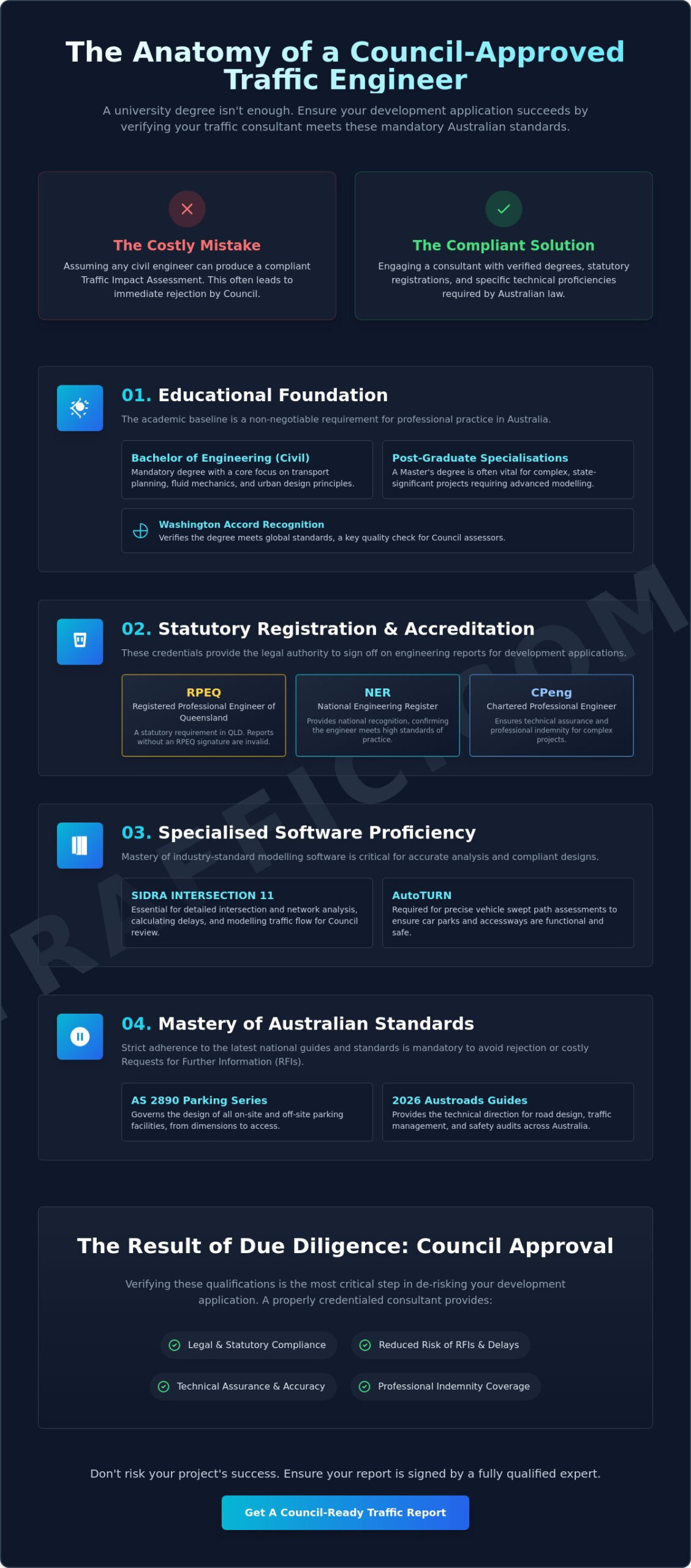
You need a consultant who understands the technicalities of the 2026 Austroads updates and the latest SIDRA INTERSECTION 11 modelling software. This article identifies the essential degrees, professional registrations, and technical certifications required for a traffic engineer to secure Council approval for your project. We’ll detail why specific professional credentials like National Engineering Register (NER) status are vital, the importance of Washington Accord-recognised degrees, and the technical software proficiencies needed to ensure your project complies with current Australian Standards.
Key Takeaways
- A Bachelor of Engineering (Civil) with a core focus on transport planning is the mandatory educational baseline for professional traffic consultants in Australia.
- Determining when do you need a traffic report for council is only the first step; the report must be signed by an RPEQ or NER-registered specialist to be legally valid.
- Mastery of specialised modelling tools, specifically SIDRA INTERSECTION 11 and AutoTURN, is essential for accurate intersection analysis and vehicle swept path assessments.
- Strict adherence to the AS 2890 parking series and the latest 2026 Austroads Guides is required to eliminate the risk of Council rejection or costly Requests for Further Information.
- Verification of Chartered Professional Engineer (CPeng) status provides the technical assurance and professional indemnity necessary for complex development approvals.
The Educational Foundation: Essential Degrees for Traffic Engineering
A Bachelor of Engineering (Civil) is the non-negotiable industry standard for professional traffic engineers across Australia. This degree provides the rigorous mathematical and physical foundation required to manage complex infrastructure projects. When determining when do you need a traffic report for council, you must first ensure your consultant possesses this specific academic background. A general civil background ensures the consultant understands how road geometry, drainage, and pavement design intersect with traffic flow. Core curriculum subjects must include transport planning, fluid mechanics, and urban design principles to ensure the engineer can address the multi-faceted nature of urban development.
To better understand the implications of traffic reporting and infrastructure safety, watch this video:
Undergraduate Engineering Pathways
Choosing a Civil Engineering major is the most effective technical pathway for mastering Traffic Engineering Principles. This curriculum covers essential topics including advanced mathematics and physics, which are necessary for calculating intersection capacity and vehicle delay. Professional engineers use these skills to interpret complex data sets that technicians might overlook. It’s critical to distinguish between a technician with an Associate Degree and a professional engineer with a full Bachelor degree. While technicians handle basic data collection, only a professional engineer has the training to sign off on high-stakes traffic engineering outcomes for major developments.
Post-graduate Specialisations
Senior consultants often pursue post-graduate qualifications, such as a Master of Transport Engineering, to manage high-density residential or commercial developments. These programs offer specialised study in advanced transport modelling and sustainable urban mobility strategies. Advanced degrees significantly improve traffic engineering outcomes through deeper analytical modelling and more accurate predictive forecasting for future traffic demand. This level of expertise is often required for state-significant projects or complex mixed-use precincts where standard modelling isn’t sufficient for Council approval.
Verification of these degrees by Engineers Australia under the Washington Accord serves as a vital quality marker. This international agreement ensures that the engineering education meets global standards for professional practice. For developers, this means the consultant’s qualifications are recognised and vetted, reducing the risk of Council rejecting a report due to insufficient technical standing. Council assessors look for these credentials to confirm the author understands the regulatory frameworks governing Australian roads. This verification process is a primary step in confirming when do you need a traffic report for council and who is qualified to write it.
Professional Accreditations and Statutory Registrations in Australia
Professional registration is the mechanism that converts academic knowledge into legal authority. In Australia, a traffic consultant without the appropriate professional “letters” after their name cannot provide the certifications required for a successful development application. Knowing when do you need a traffic report for council is only half the battle; you must also ensure the author is legally permitted to sign it. Reports submitted without the signature of a registered professional are frequently rejected by assessors, leading to costly project delays and unnecessary rework.
Engineers Australia and CPeng Status
Chartered Professional Engineer (CPeng) status represents the highest tier of professional competence in the Australian engineering landscape. This credential is not granted simply upon graduation. It requires a rigorous peer-assessment process where an engineer must demonstrate proficiency across 16 distinct competencies, including ethical conduct, risk management, and technical mastery. To maintain this status, engineers must complete 150 hours of Continuing Professional Development (CPD) every three years. This commitment ensures they remain updated on the latest 2026 Austroads standards and state-specific regulatory changes. National recognition through the National Engineering Register (NER) within the Civil or ITEE colleges provides further assurance that the engineer holds professional indemnity insurance and adheres to a strict code of ethics.
State-Level Mandatory Registrations
While national recognition is prestigious, certain states have strict statutory requirements that carry the force of law. In Queensland, the Professional Engineers Act 2002 mandates that any professional engineering service must be performed or supervised by a Registered Professional Engineer of Queensland (RPEQ). As of June 2026, RPEQ eligibility typically requires a Washington Accord-recognised degree and a minimum of five years of relevant experience. If your project is based in Queensland, a report signed by a non-RPEQ engineer is legally invalid and will be dismissed by the local authority.
This requirement ensures that the person certifying your swept path analysis or car park design is personally accountable to a state regulatory board. Before engaging a consultant, you should verify their registration status on the BPEQ or NER databases to prevent a flat refusal from Council. For complex projects requiring high-level technical sign-off, you can speak directly with our senior principals to ensure your submission meets all statutory obligations. Councils rely on these registrations to outsource the risk of technical failure. If the engineer lacks these credentials, the Council cannot legally accept their recommendations, regardless of the technical quality of the report.
Technical Skills and Specialised Software Proficiency
Professional engineering requires more than theoretical knowledge. Mastery of specialised software is what enables a consultant to produce a defensible Traffic Impact Assessment (TIA). When you need a traffic report for council, the assessor will look specifically for data outputs generated by industry-standard modelling tools. These tools provide the empirical evidence required to prove that a development will not cause an “adverse impact” on the existing road network. A report that relies on qualitative descriptions rather than quantitative data will fail to meet the technical requirements of modern planning schemes.
Intersection and Network Modelling
SIDRA INTERSECTION is the primary tool used by traffic engineers to evaluate the performance of individual intersections and small networks. It calculates critical metrics such as Level of Service (LoS), Degree of Saturation (DoS), and average delay in seconds per vehicle. Council engineers rely on these outputs to determine if a proposed development requires intersection upgrades or signal timing adjustments. Without SIDRA modelling, a report lacks the technical depth necessary for Council sign-off. As of June 2026, SIDRA INTERSECTION 11 is the definitive industry standard for Australian intersection analysis because it provides the most accurate capacity and delay algorithms for complex urban environments.
Manoeuvrability and Design Software
Proving that a site is accessible for all intended vehicle types is a mandatory requirement for most development applications. AutoTURN software allows engineers to perform vehicle swept path analysis, simulating the turning movements of everything from a standard passenger car to a 12.5-metre heavy rigid vehicle (HRV) for waste collection. This ensures that driveway widths, internal circulation roads, and loading docks are functional and safe. AutoCAD is used alongside these tools to draft precise car park layouts and driveway ramp grades. This software ensures that every design element adheres to the strict geometric requirements of the AS 2890 series.
Specialised technical capabilities include:
- Mastery of SIDRA INTERSECTION 11 for intersection capacity and level of service analysis.
- Proficiency in AutoTURN for simulating vehicle swept paths and ensuring safe site access.
- Expertise in AutoCAD for detailed car park design and driveway ramp grade assessments.
- Utilisation of LinSig 3.3 for complex signalised network modelling where required.
- Application of modern traffic counting technology to gather baseline data for modelling.
Mastery of Australian Standards and Regulatory Frameworks
Technical software proficiency is only effective when guided by a comprehensive understanding of Australian Standards. A traffic engineer’s primary value lies in their ability to interpret and apply complex regulatory frameworks to a specific site. This expertise is a critical factor in determining when do you need a traffic report for council. Simple compliance checks against local codes often trigger the requirement for a formal assessment, especially when a development seeks to vary from standard parking rates or access requirements. Without a deep grasp of these benchmarks, a project risks immediate rejection during the initial lodgement phase.
The AS 2890 Series Expertise
The AS 2890 (Parking Facilities) series is the technical backbone of every car park and access design in Australia. A qualified consultant must possess a detailed understanding of AS 2890.1 to ensure off-street car parking compliance for residential and visitor spaces. This includes precise calculations for bay dimensions, aisle widths, and blind aisle extensions. Compliance with AS 2890.2 is equally vital for commercial vehicle facilities, where loading dock clearances and heavy vehicle turn circles are non-negotiable. Qualified engineers apply these standards meticulously to prevent Council refusals and eliminate the need for costly structural redesigns after a DA has been lodged. They ensure that every ramp grade and head-height clearance meets the minimum safety and functional requirements before the report reaches the assessor’s desk.
Local Government and Austroads Guidelines
National standards provide the foundation, but local planning laws introduce a layer of site-specific complexity. An expert traffic engineer must be proficient in “Council-speak” to successfully navigate the nuances of Development Control Plans (DCP) and Local Environmental Plans (LEP). They must also stay current with the latest national updates, such as the May 2026 Austroads Guide to Temporary Traffic Management and the new technical specifications for road signs. Interpreting these guides is essential for large-scale urban development projects where the intersection of engineering standards and planning law is most pronounced. This includes understanding state-specific supplements from bodies like Transport for NSW (TfNSW) or the Queensland Department of Transport and Main Roads (TMR).
Local authorities rely on the engineer to act as a technical translator. The consultant must prove that the proposed infrastructure aligns with both the broad objectives of Austroads and the specific setbacks or landscaping requirements of the local Council. Failure to account for these local variations is a primary reason why reports are flagged for further information. To ensure your project meets every regulatory benchmark from the outset, you can review our full range of traffic engineering services. Mastery of these frameworks ensures that the technical data produced by modelling software is applied in a way that satisfies the legal and safety requirements of the Australian development landscape.
Why Verified Qualifications Are Critical for Council Approval
A professional signature on a technical report is more than a formality; it’s a legal certification of safety and compliance. When you engage a consultant, you’re purchasing their professional accountability and the protection of their professional indemnity insurance. Councils are inherently risk-averse. They require an authoritative signature on a Traffic Impact Assessment to ensure the proposed development meets statutory safety requirements. If a report is signed by someone lacking the necessary RPEQ or NER credentials, the Council assessor cannot legally accept the findings, regardless of the report’s technical quality.
Developers often prioritise the logistical question of when do you need a traffic report for council, but the author’s qualifications are what determine the speed of the approval. An unqualified or generalist sign-off is the most common trigger for a Request for Further Information (RFI) or a flat refusal. These delays are expensive. They stall construction timelines and can force a complete redesign of site access or parking layouts late in the planning cycle. Ensuring that your report is authored by a registered professional is what prevents project stagnation and unnecessary rework.
Mitigating Development Risk
Verified qualifications act as a technical shield against planning disputes and Land and Environment Court cases. A specialist traffic engineer understands the specific evidentiary requirements needed to defend a design under cross-examination. General civil engineers often struggle with the niche requirements of modern traffic modelling and the subtle nuances of parking demand assessments. By hiring a specialist early in the design phase, you ensure the site layout is functionally sound before significant capital is committed. This proactive approach reduces the likelihood of technical issues being identified by Council engineers during the formal assessment period.
The ML Traffic Engineers Australia Advantage
Our firm operates on a principle of direct accountability. We provide direct access to senior expertise, ensuring the same principal engineer who initiates your project is the one performing the technical work and signing the final report. This personnel continuity promise distinguishes ML Traffic Engineers Australia from larger, impersonal firms where work is often delegated to junior staff without adequate oversight. We bring over 15 years of experience applying Australian Standards to secure successful DA approvals for a vast range of project environments nationwide.
We dislike unnecessary bureaucracy and focus on delivering results-oriented assessments that meet the strict criteria of local authorities. Our senior leadership is involved in every single project to maintain the highest standards of technical accuracy. To ensure your submission is compliant and defensible, you can contact our principals directly for a qualified assessment of your next development project. Professional sign-off is the final safeguard for your development’s success; don’t leave it to chance with unverified credentials.
Securing Your Development Approval with Qualified Expertise
Professional qualifications in traffic engineering provide the legal and technical certainty required for a successful development application. An academic degree establishes the foundation, but statutory registrations like RPEQ and NER are the mandatory credentials for signing off on a compliant Traffic Impact Assessment. Determining exactly when do you need a traffic report for council is a strategic first step that must be followed by engaging a verified specialist who understands the 2026 Austroads updates and AS 2890 parking series. Relying on generalist civil engineers increases the risk of costly Council rejections and technical delays.
ML Traffic Engineers Australia offers over 15 years of specialised Australian consultancy experience across diverse project environments. We ensure direct access to senior principals on every project, providing a personnel continuity promise that guarantees accountability. Our expertise in AS 2890 compliance and national Council approvals ensures your project meets all regulatory benchmarks from the initial submission. Consult with our qualified principals at ML Traffic Engineers Australia today to secure an authoritative assessment for your next development. We look forward to helping you navigate the complexities of the Australian planning system with technical precision.
Frequently Asked Questions
Do traffic engineers in Australia need to be registered?
Yes, professional registration is mandatory for legal sign-off in several jurisdictions. In Queensland, you must be a Registered Professional Engineer of Queensland (RPEQ) to provide engineering services. Nationally, registration on the National Engineering Register (NER) or holding Chartered (CPeng) status provides the technical assurance councils require. These credentials confirm the engineer holds professional indemnity insurance and meets strict competency standards.
Can a general civil engineer sign off on a traffic report for Council?
A general civil engineer usually lacks the specialised modelling skills and professional indemnity coverage required for a Traffic Impact Assessment. While they understand basic infrastructure, they don’t typically possess mastery of SIDRA or AutoTURN software. Councils often reject reports signed by generalists because they cannot verify the technical accuracy of niche traffic flow calculations or parking demand assessments.
What is the difference between a traffic engineer and a transport planner?
Traffic engineers focus on the technical design and physical movement of vehicles, while transport planners handle broad policy and strategy. Engineers use software to calculate intersection capacity and design car park layouts according to Australian Standards. Planners look at land-use patterns, public transport networks, and long-term urban growth. For a DA, you specifically need an engineer’s technical sign-off on the physical site access.
Is a Master’s degree necessary to work as a professional traffic consultant?
A Master’s degree isn’t mandatory, but it’s a common qualification for senior consultants. The industry standard is a Bachelor of Engineering (Civil) recognised under the Washington Accord. Advanced degrees are usually pursued by those specialising in complex network modelling or multi-modal transport strategy. Most standard Council reports only require a qualified Bachelor-level professional with relevant registration.
What software should a qualified traffic engineer be able to use?
A qualified consultant must be proficient in SIDRA INTERSECTION 11, AutoTURN, and AutoCAD. These tools are the industry standards for calculating intersection delays and performing vehicle swept path analysis. If your consultant doesn’t use these specific programs, their data may not meet the technical requirements of the Australian Standards or local planning codes.
How do I verify if a traffic engineer is Chartered or on the NER?
You can verify an engineer’s status through the National Engineering Register (NER) search tool on the Engineers Australia website. For Queensland projects, use the Board of Professional Engineers of Queensland (BPEQ) online register. These public databases allow you to confirm that the individual holds current registration and has the legal authority to provide engineering services.
What qualifications are needed for a Traffic Guidance Scheme (TGS) in NSW?
Preparing a Traffic Guidance Scheme in NSW requires a specific “Prepare a Work Zone Traffic Management Plan” (PWZTMP) certification from Transport for NSW. This is a vocational qualification distinct from a university engineering degree. While a traffic engineer can hold this, it’s specifically for managing traffic during construction rather than assessing the long-term impact of a new development.
Does a traffic engineer need local Council experience to get a DA approved?
Local experience is highly beneficial because it helps a consultant understand when do you need a traffic report for council based on specific local triggers. Every Council has unique nuances within their Development Control Plan (DCP). An engineer familiar with these local requirements can tailor the report to address known Council concerns, significantly reducing the risk of a Request for Further Information (RFI).

Disclaimer
The content on www.mltraffic.com.au, including all technical articles, guides, and resources, is provided for general informational and educational purposes only. It is not intended to constitute professional advice in traffic engineering, transportation planning, development approvals, or any other technical or legal field. While ML Traffic Engineers makes every reasonable effort to ensure the accuracy, completeness, and timeliness of the information published, we do not provide any warranties or representations (express or implied) regarding its reliability, suitability, or availability for any particular purpose. Any reliance you place on the content is strictly at your own risk. In no event shall ML Traffic Engineers, its directors, employees, authors, or affiliates be liable for any direct, indirect, incidental, special, consequential, or punitive damages (including, without limitation, loss of profits, data, or business opportunities) arising out of or in connection with the use of, or inability to use, any information provided on this website. The articles and guides on this site are not a substitute for engaging a qualified, registered professional traffic engineer (such as an NPER or RPEQ engineer) to assess your specific project requirements. For tailored advice, compliance assessments, or traffic engineering services, please contact a competent professional. This disclaimer may be updated from time to time without notice. By accessing or using this website, you agree to be bound by the most current version of this disclaimer.
