

Imagine opening a formal council letter on a Tuesday morning to find your $2.5 million development proposal stalled because of a single traffic objection. It’s a scenario we’ve seen many times in our 19 years of consultancy. You’re likely feeling the pressure of mounting interest and wondering exactly what to do if DA is rejected on traffic grounds before your budget disappears. It’s completely normal to feel overwhelmed by technical terms like sight-line assessments or driveway ramp grades that seem designed to block your progress.
We understand that a rejection feels like a total project loss, but it’s usually just a hurdle that requires a professional, technical response. This guide will teach you how to decode council objections and follow the exact steps to turn a DA refusal into a stamped approval. We’ll preview the recovery process, including how to implement cost-effective technical fixes and secure your permit without a $50,000 court battle. By applying the same logic we’ve used across 10,000 successful sites, you can get your project back on track immediately.
Key Takeaways
- Understand that a traffic-based refusal is typically a technical disagreement over road safety or flow benchmarks rather than a personal rejection of your development.
- Learn exactly what to do if DA is rejected on traffic grounds by evaluating whether to negotiate with the council, amend your plans, or pursue a formal appeal.
- Discover how to overhaul a weak Traffic Impact Assessment by replacing generic estimates with real-world data and ensuring full compliance with Australian Standards.
- See how direct involvement from senior traffic engineers can identify subtle design solutions and technical fixes that junior consultants often overlook.
Table of Contents
- Don’t Panic: Understanding Why Traffic Grounds Lead to DA Refusals
- Decoding the Refusal: Identifying the Specific Traffic Pain Points
- Your Three Main Paths Forward: Review, Amend, or Appeal
- The Technical Fix: How to Overhaul Your Traffic Impact Assessment
- Turning a “No” into a “Yes” with Expert Traffic Engineering
Don’t Panic: Understanding Why Traffic Grounds Lead to DA Refusals
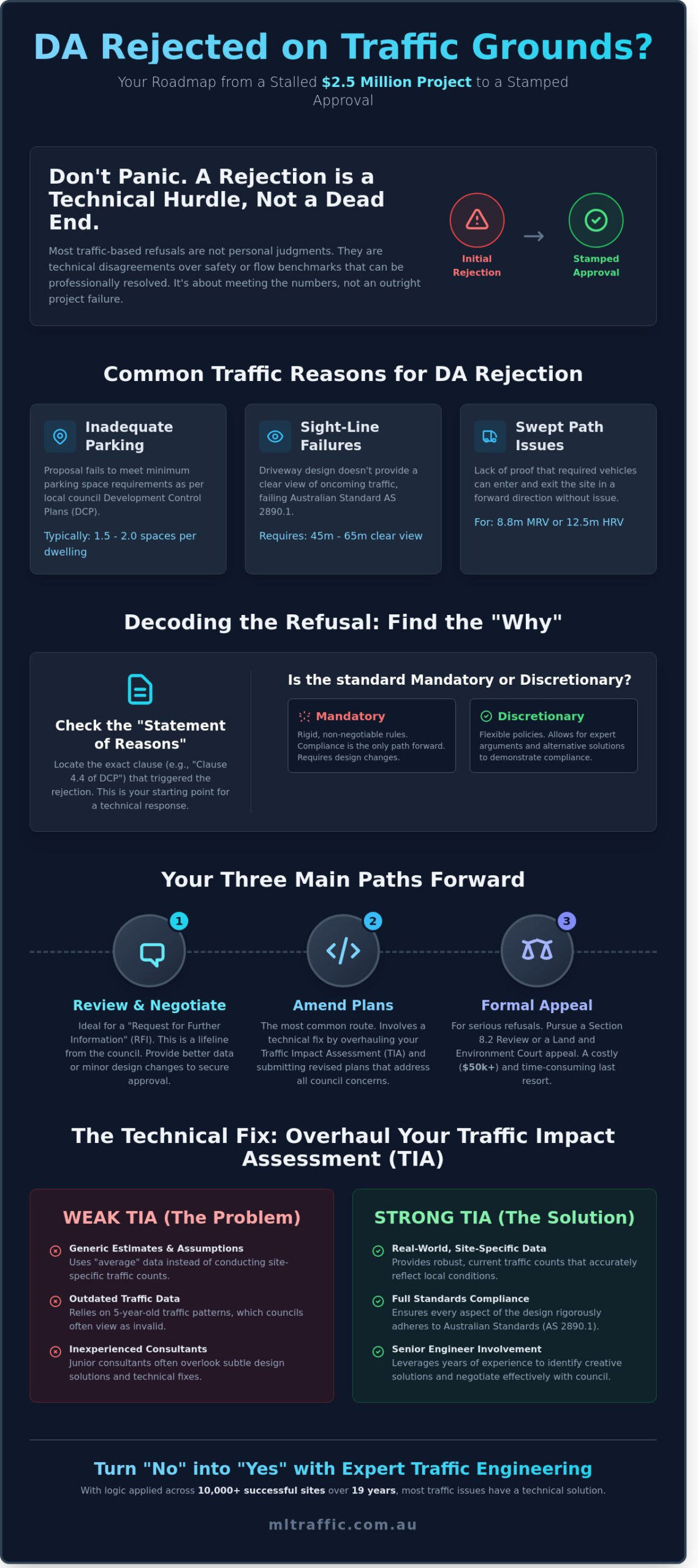
Receiving a formal “No” from the council on your Development Application (DA) feels like a total roadblock. It isn’t. Most traffic-based refusals occur because a council assessing officer believes your project will negatively impact road safety or local traffic flow. This is rarely a personal judgment on your project. Instead, it is a technical assessment that your proposal failed to meet specific benchmarks, such as those found in Australian Standards (AS 2890.1) or local Development Control Plans (DCP).
The reality is that traffic engineering is a science of numbers. If a driveway fails a sight-line test, it is usually because the initial data was conservative or the design didn’t account for specific site topography. These numbers can be recalculated, and impacts can be mitigated with professional intervention. Understanding Understanding Land-Use Planning is the first step in realizing that your site must function within a broader, regulated infrastructure network. If the council rejects your plans, they are simply stating that the current version of your project doesn’t fit that network’s safety parameters.
To better understand this concept, watch this helpful video:
Before deciding what to do if DA is rejected on traffic grounds, you must identify if you have a “Hard Refusal” or a “Request for Further Information” (RFI). An RFI is a lifeline; it means the council is willing to approve the project if you provide better data or minor design changes. A formal refusal is more serious, but it still allows for a Section 8.2 Review or a Land and Environment Court appeal. At ML Traffic Engineers, we have seen over 10,000 sites and know that most “unworkable” traffic issues have a technical solution.
Common Traffic Reasons for Rejection
- Inadequate Parking: Your proposal fails to meet the minimum 1.5 or 2.0 spaces per dwelling required by the local LEP.
- Sight-Line Failures: The proposed driveway doesn’t provide the 45-metre or 65-metre clear view of oncoming traffic required for the speed environment.
- Swept Path Issues: You haven’t proven that a 12.5m Heavy Rigid Vehicle (HRV) or an 8.8m Medium Rigid Vehicle (MRV) can enter and exit the site in a forward direction.
The Role of the “Statement of Reasons”
Every refusal comes with a “Statement of Reasons” or a “Delegate’s Report.” You must find the specific clause, such as Clause 4.4 of a specific DCP, that triggered the rejection. Identifying whether the objection is based on a mandatory standard or a discretionary policy is vital. Mandatory standards are rigid. Discretionary policies allow for expert arguments. Often, a generic traffic report that uses “average” data instead of site-specific counts leads to these objections. You can view our specialized traffic services to see how detailed assessments overcome these specific council hurdles.
Decoding the Refusal: Identifying the Specific Traffic Pain Points
When you receive a refusal, the first step is to isolate the technical failure. Most rejections stem from non-compliance with Australian Standards, specifically AS 2890.1 for off-street car parking. You need to know exactly what to do if DA is rejected on traffic grounds by scrutinizing the council’s “Reasons for Refusal” document. Is the issue the sheer volume of cars entering the street, or is it the physical design of the driveway? Identifying this distinction is the difference between a simple redesign and a complex legal appeal.
Determine who issued the objection. A local council traffic officer focuses on local amenity and neighborhood impact. However, a referral to a state road authority, such as Transport for NSW, involves much stricter arterial road safety protocols. We often find that an original Traffic Impact Assessment (TIA) fails because it relies on 5-year-old traffic counts or outdated assumptions. If your TIA hasn’t been updated to reflect 2024 traffic patterns, the council will likely view the data as invalid.
Reviewing your initial submission is critical. If your consultant didn’t provide a site-specific analysis, you’re fighting an uphill battle. You can view our full range of traffic services to see how a professional audit of your existing TIA can pinpoint these gaps before you resubmit.
Parking Demand vs. Council Rates
Council codes often apply a “one size fits all” rate that doesn’t account for modern transport shifts. If your 500-square-meter development is near a major transit hub, the code might still demand 25 spaces when 15 are sufficient. We use empirical data from similar land-use types to prove your project’s specific needs. A Car Parking Demand Assessment provides a site-specific technical justification to override generic council parking requirements based on actual peak usage patterns and local demographics.
Access and Safety Compliance
Precision is non-negotiable in traffic engineering. A 1% error in a driveway ramp grade can cause a vehicle to scrape its undercarriage, leading to an immediate safety refusal. We use B85 and B99 vehicle templates to perform a Vehicle Swept Path Assessment. This technical simulation proves that an 8.8-meter medium rigid vehicle can enter, turn, and exit in a forward direction without mounting a curb. We also verify sight distances; if a driver cannot see a pedestrian 2.5 meters from the property boundary, the DA will not meet safety standards. Knowing what to do if DA is rejected on traffic grounds starts with correcting these geometric errors.
Your Three Main Paths Forward: Review, Amend, or Appeal
Deciding what to do if DA is rejected on traffic grounds depends on three specific factors: your project budget, your construction timeline, and the technical strength of the council’s objection. You don’t always need to head straight to a courtroom to get a “Yes”. In many cases, strategic negotiation or a minor design pivot is the most efficient way to secure an approval. Since 2005, our firm has seen that a well-timed traffic statement can often resolve issues that initially seemed like deal-breakers to a local council officer.
Each path requires a different level of technical engineering support. Choosing the wrong route can lead to unnecessary delays or wasted legal fees. Most Australian developers find success by matching the response to the severity of the refusal. If the objection is based on a simple misinterpretation of a driveway ramp grade, a review is sufficient. If the objection challenges the fundamental density of the project, a more formal appeal is usually necessary.
The Section 8.2 Review (The “Second Look”)
A Section 8.2 review allows you to request that a different council officer evaluates your proposal. This is a cost-effective route if the refusal stemmed from a misunderstanding of the original Traffic Impact Statement (TIS). You’ll need a persuasive, updated traffic report that addresses the specific reasons for refusal with fresh data. This path is best for projects where minor tweaks to parking layouts or sight-line assessments can satisfy the original objections without a full redesign. It avoids the high costs of the legal system while still providing a fresh set of eyes on your application.
The Merits Appeal (Land and Environment Court)
If the council remains firm, a merits appeal takes the decision out of their hands and places it before an independent commissioner. This process relies heavily on expert witness testimony. A senior traffic engineer with over 30 years of experience becomes your strongest asset here. They provide evidence based on engineering facts and Australian Standards, such as AS 2890.1, rather than local planning politics. Approximately 80% of these traffic-related cases are settled during the conciliation phase. This is a Section 34 conference where engineers from both sides meet to find a technical middle ground, often avoiding a full court hearing and saving the developer significant capital.
- Review: Fast and lower cost; requires a fresh technical perspective to clear up misunderstandings.
- Amend: Moderate cost; involves changing the physical design to meet specific council requirements or swept path constraints.
- Appeal: Higher initial cost; offers the highest success rate for complex sites with significant traffic generation concerns.
The Technical Fix: How to Overhaul Your Traffic Impact Assessment
A rejection doesn’t always mean your project is flawed. Often, the Council refused the application because the initial Traffic Impact Assessment (TIA) lacked the technical depth required to satisfy their engineering department. When you’re figuring out what to do if DA is rejected on traffic grounds, the first step is a rigorous technical audit of your previous submission. We often find that reports rely on outdated templates rather than site-specific reality.
Generic traffic generation rates from the RTA Guide or TfNSW often overestimate impact. We replace these estimates with real-world data. By conducting 7-day pneumatic tube counts or manual intersection turn counts at the specific site, we often find that actual traffic volumes are 12% to 18% lower than theoretical models suggest. This data-driven accuracy provides the Council with a factual basis for approval that generic estimates cannot match.
Sometimes, small architectural adjustments solve the biggest “pinch points.” Our comprehensive traffic services focus on identifying these bottlenecks early. We look at driveway gradients, sight-line obstructions, and entry widths. A 400mm shift in a structural column or a minor regrading of a ramp can often resolve a non-compliance issue that previously blocked the entire DA. At ML Traffic Engineers, the consultant who provides your quote is the one who does this technical work, ensuring no detail is lost in a corporate hierarchy.
Advanced Swept Path Analysis
We use AutoTURN software to provide definitive proof that vehicles can navigate your site safely. Council officers often reject plans based on visual “estimates” of turning circles. We provide color-coded diagrams for B99 cars and heavy rigid vehicles (HRVs) that demonstrate exact clearances. Our designs ensure compliance with AS 2890.1 standards without sacrificing 10% of your net lettable floor area. We show the Council exactly how the vehicle moves, leaving no room for subjective interpretation.
Mitigation Strategies
Knowing what to do if DA is rejected on traffic grounds often involves proposing physical or operational offsets. We implement formal mitigation, such as a robust Traffic Management Plan (TMP) to shift heavy vehicle movements outside of the 8:00 AM to 9:00 AM peak. We also design Green Travel Plans that incorporate car-share pods or increased bicycle parking to justify a parking shortfall. Occasionally, we negotiate specific road upgrades, such as a dedicated right-turn bay, as a condition of consent to satisfy RPEQ requirements.
Need a technical overhaul of your refused application? Contact our senior engineers today for a direct assessment of your site.
Turning a “No” into a “Yes” with Expert Traffic Engineering
A council refusal isn’t a dead end. It’s a signal that your application requires a more sophisticated technical approach. Senior engineers see the solutions that junior consultants often miss because they’ve handled these specific roadblocks thousands of times before. At ML Traffic Engineers, we bring between 30 and 40 years of experience to every project. This level of seniority allows us to negotiate directly with council traffic departments from a position of technical authority, ensuring your project isn’t sidelined by avoidable errors.
Why Senior Involvement is Critical for Refusals
Technical precision is the only way to overturn a rejection. We focus on the granular details that council officers scrutinize most. This includes meticulous sight-line assessments and calculating driveway ramp grades to ensure 100% compliance with Australian Standards like AS 2890.1. When you’re wondering what to do if DA is rejected on traffic grounds, the answer lies in professional advocacy. Our principals have managed over 10,000 sites across Australia since 2005, giving them the insight to find the path of least resistance to approval.
Our firm operates on a simple but rare principle: the traffic consultant who provides your quote is the person who actually does the work. There’s no hand-off to a junior staffer who lacks the experience to defend a complex design. You get direct access to experts like Michael Lee and Benny Chen. They know how to speak the council’s language and can provide the technical weight needed for a successful resubmission.
Next Steps for Your Development
To get your project moving again, you need a clear strategy. Start by organizing your documentation to give your engineer the best possible starting point. Follow these steps to prepare for your recovery:
- Gather every piece of council correspondence and your original traffic reports.
- Book a technical review to pinpoint exactly where the previous submission failed.
- Brief your consultant with a full history of the site to ensure the next submission is bulletproof.
Don’t let a refusal stall your progress. A “no” is often just the beginning of a negotiation if you have the right data on your side. If you’re ready to get your project back on track, contact our principals today for a direct consultation. We’ll help you navigate what to do if DA is rejected on traffic grounds and provide the expert engineering required to secure your approval.
Turn Your Traffic Refusal Into a Project Approval
A DA refusal feels like a major roadblock, but it’s really a roadmap for your next technical move. You now understand that decoding council feedback is the first step toward a successful resubmission. Whether you need to adjust a driveway ramp grade or overhaul your Swept Path Analysis, the solution lies in data that meets strict Australian Standards. Knowing what to do if DA is rejected on traffic grounds is simply about replacing uncertainty with engineering precision.
At ML Traffic Engineers, we have assessed over 10,000 sites across Australia. You won’t be passed off to a junior staff member. Instead, you get direct access to principals who bring between 30 and 40 years of experience to every project. We’re specialists in AS 2890 compliance and technical traffic engineering. We’ve spent decades turning complex refusals into project approvals by providing the exact technical evidence councils demand. Don’t let a temporary setback stop your development. We’re ready to help you navigate the path to a “yes.”
Get a Professional Traffic Review for Your Rejected DA
Your project is too important to leave to chance. Let’s get it approved together.
Frequently Asked Questions
What are the most common traffic reasons for a DA refusal in Australia?
About 40% of traffic-related refusals stem from non-compliance with Australian Standard AS 2890.1 or inadequate parking provisions. Councils frequently reject applications based on “unsafe” vehicle swept paths or poor sight-line distances that don’t meet the 5-second visibility rule for oncoming traffic. These technical failures often suggest a project will create congestion or safety hazards for local residents.
Can I appeal a DA refusal if the council says my driveway is unsafe?
You can definitely appeal by providing a professional Sight-Line Assessment that uses actual field measurements rather than generic plans. If our engineers prove the driveway design complies with AS 2890.1 safety requirements, the Council’s objection loses its technical basis. We’ve used this data-driven approach to overturn refusals for over 10,000 sites since 2005.
How long do I have to lodge an appeal after a DA is rejected?
You have exactly 6 months, or 182 days, from the date of the refusal notice to lodge an appeal in the NSW Land and Environment Court. If you’re seeking a Section 8.2 Review, you must submit the application early enough for Council to finish their assessment within that same 6-month window. Missing these deadlines usually means you’ll have to start the entire application process from scratch.
Will a new Traffic Impact Assessment guarantee my DA approval?
No consultant can guarantee an approval, but a new Traffic Impact Assessment (TIA) provides the data needed to address Council’s specific concerns. When you’re deciding what to do if DA is rejected on traffic grounds, a TIA focused on the 2002 RTA Guide to Traffic Generating Developments is your best tool. It replaces Council’s assumptions with hard facts about trip generation and parking demand.
How much does it cost to fix a traffic-based DA objection?
Fixing a traffic objection typically costs between $2,500 and $7,500 depending on the complexity of the required reports. This investment covers a new Traffic Impact Statement or a Car Parking Demand Assessment designed to prove your project won’t cause local congestion. These professional fees are a small fraction of the total project value and are necessary to move past a deadlock.
What is the difference between a Section 8.2 Review and a Court Appeal?
A Section 8.2 Review is an internal reassessment by a different Council officer, while a Court Appeal is a formal legal process. Section 8.2 reviews are often 70% cheaper than litigation and serve as a faster first step for resolving technical disputes. If the internal review fails, the Land and Environment Court remains the final path for an independent decision.
Do I need a lawyer or a traffic engineer first after a refusal?
You should contact a traffic engineer first to determine if the Council’s objections have technical merit. Since 2005, we’ve found that a solid engineering report can often resolve issues during a Section 8.2 Review without needing a legal team. This approach can save you upwards of $15,000 in legal fees by solving the problem through technical compliance instead of litigation.
Can I reduce my parking requirements to satisfy council objections?
You can reduce parking requirements by submitting a Car Parking Demand Assessment that proves actual usage will be lower than standard DCP rates. By citing the 2002 RTA Guide or nearby 85th percentile occupancy data, we can justify a parking reduction that satisfies Council planners. This is a common strategy for sites near public transport where standard parking minimums don’t reflect real-world needs.
Which areas do you cover?
We are traffic engineers servicing Melbourne, Sydney, Brisbane, Gold Coast, Hobart, Perth, Adelaide, Darwin, Canberra and surrounding areas.
Disclaimer
The content on www.mltraffic.com.au, including all technical articles, guides, and resources, is provided for general informational and educational purposes only. It is not intended to constitute professional advice in traffic engineering, transportation planning, development approvals, or any other technical or legal field.
While ML Traffic Engineers makes every reasonable effort to ensure the accuracy, completeness, and timeliness of the information published, we do not provide any warranties or representations (express or implied) regarding its reliability, suitability, or availability for any particular purpose. Any reliance you place on the content is strictly at your own risk.
In no event shall ML Traffic Engineers, its directors, employees, authors, or affiliates be liable for any direct, indirect, incidental, special, consequential, or punitive damages (including, without limitation, loss of profits, data, or business opportunities) arising out of or in connection with the use of, or inability to use, any information provided on this website.
The articles and guides on this site are not a substitute for engaging a qualified, registered professional traffic engineer (such as an NPER or RPEQ engineer) to assess your specific project requirements. For tailored advice, compliance assessments, or traffic engineering services, please contact a competent professional.
This disclaimer may be updated from time to time without notice. By accessing or using this website, you agree to be bound by the most current version of this disclaimer.
