

A single missing document can stall a multi-million dollar development for months, and frequently, that document is a traffic report. Determining exactly when is a traffic impact assessment required for a DA is the difference between a seamless lodgement and receiving a frustrating Request for Further Information (RFI) from council. You likely already recognise that traffic flow and parking are primary concerns for planning authorities, yet the specific technical thresholds often feel like a moving target. This uncertainty leads to budget concerns and project stagnation.
This guide provides the technical clarity needed to identify mandatory triggers for traffic reports across Australian jurisdictions. You’ll find a definitive checklist of development scales that necessitate professional input, ensuring you don’t overspend on unnecessary consultancy or undershoot council requirements. We’ll examine the critical distinctions between a basic Transport Impact Statement and a comprehensive assessment, while referencing national standards such as AS 2890.1 and AS 2890.2. This ensures you approach your next lodgement with technical confidence and a clear path to approval.
Key Takeaways
- Identify the specific trip generation thresholds and road access triggers that determine exactly when is a traffic impact assessment required for a DA.
- Understand the technical distinctions between a simplified Traffic Impact Statement (TIS) and a comprehensive Traffic Impact Assessment (TIA) to avoid over-scoping your project.
- Ensure your development meets national compliance by adhering to Australian Standards AS 2890.1 and AS 2890.2 for parking and access design.
- Recognise when statutory referrals to state road authorities are mandatory based on your project’s proximity to classified or state-controlled roads.
- Discover how direct engagement with senior principals and consistent personnel continuity can prevent costly council objections and technical delays.
Understanding Traffic Impact Assessments in the DA Process
A Traffic Impact Assessment (TIA) is a formal technical report that evaluates how a proposed development will affect the local road network, public transport, and pedestrian safety. It is a fundamental component of transportation planning, ensuring that new land uses don’t compromise the efficiency or safety of the surrounding infrastructure. For developers, determining exactly when is a traffic impact assessment required for a DA is vital because councils use these reports to establish conditions of consent and calculate infrastructure contributions. Without this data, planning authorities cannot accurately assess the external costs of your project.
Adherence to national standards is non-negotiable throughout the design phase. Designing a site without considering AS 2890.1 for off-street car parking or AS 2890.2 for commercial vehicle facilities often leads to fundamental layout failures. A TIA report validates that your design meets these benchmarks before the council’s engineering team reviews the submission. This proactive approach ensures the development remains functional and compliant from the first day of operation.
The Core Objectives of a Traffic Report
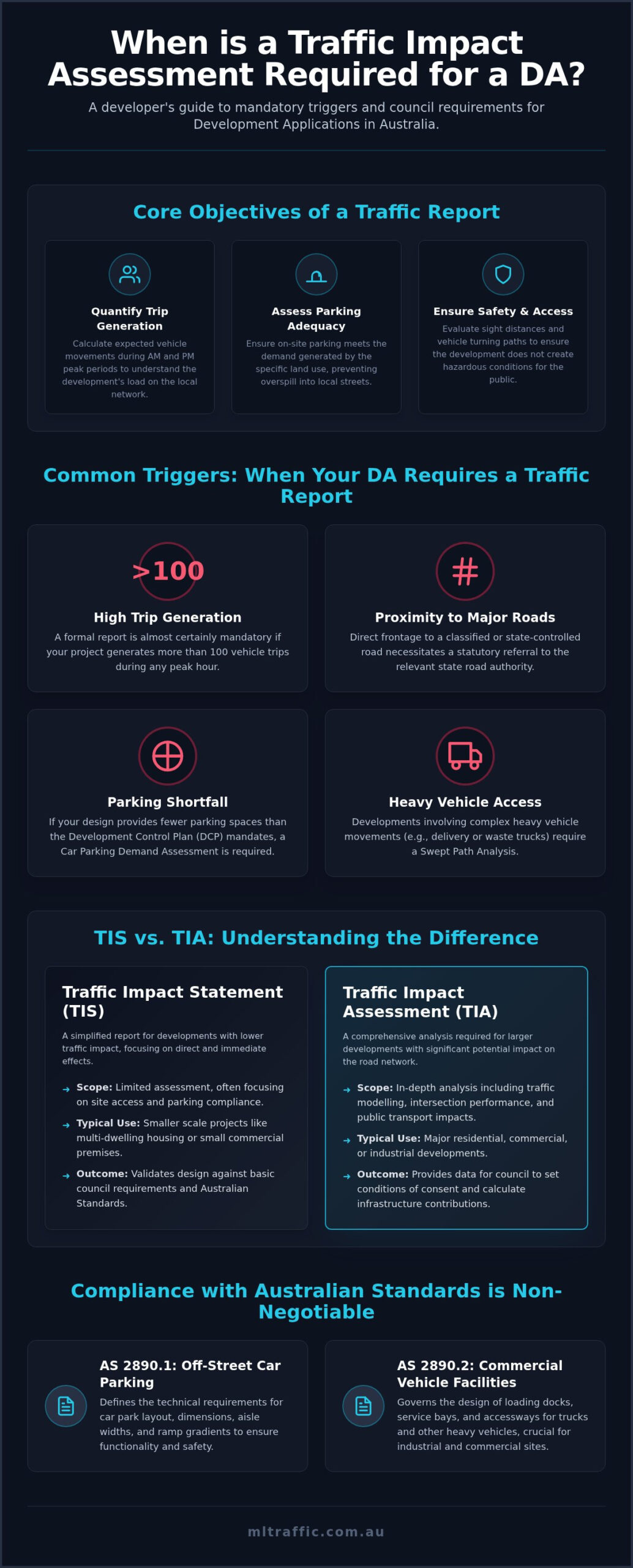
The primary goal of a traffic report is to provide a fact-based justification for the development’s transport arrangements. The technical work performed by ML Traffic Engineers Australia focuses on several critical metrics:
- Quantifying Trip Generation: We calculate the expected number of vehicle movements during AM and PM peak periods using state-specific rates and historical data.
- Assessing Parking Adequacy: We determine if the proposed on-site parking meets the demand generated by the specific land use, preventing overspill into local streets.
- Safety and Access: We evaluate sight distances at entry points and ensure vehicle movements don’t create hazardous conditions for the public.
Why Early Assessment Saves Development Costs
Engaging a consultant early prevents “project-killer” issues from appearing after architectural plans are locked in. If a driveway gradient is too steep or a swept path analysis shows a delivery truck can’t turn around, the entire ground floor layout might require a redesign. This leads to expensive revisions and missed deadlines. By identifying these constraints during the feasibility stage, you protect your project’s timeline.
Securing a Traffic Impact Assessment (TIA) Report from ML Traffic Engineers Australia during the initial design phase reduces the risk of receiving a Request for Further Information (RFI). Councils often use RFIs to stall applications when technical data is missing or insufficient. By providing a compliant report from the outset, you maintain control over the DA programme. Professional oversight also helps in optimising car park layouts, allowing you to maximise site yield while remaining strictly compliant with Australian Standards.
Common Triggers: When Your DA Requires a Traffic Report
Determining exactly when is a traffic impact assessment required for a DA involves reviewing both local Development Control Plans (DCP) and state-level guidelines. While specific numbers change between jurisdictions, the core triggers remain consistent. If your project generates more than 100 vehicle trips during any peak hour, a formal report is almost certainly mandatory. Similarly, if your site has direct frontage to a classified or state-controlled road, the council must refer the application to the relevant state authority. For projects in the north, Queensland’s Guide to Traffic Impact Assessment provides a clear framework for these state-level referrals.
Deviating from statutory parking requirements is another major trigger. If your design provides fewer spaces than the DCP mandates, you must provide a Car Parking Demand Assessment to justify the shortfall. Additionally, any development involving complex heavy vehicle movements requires a Swept Path Analysis to prove that trucks or waste vehicles can enter and exit in a forward direction without hitting curbs or structures. Understanding when is a traffic impact assessment required for a DA allows you to budget for these specialist costs early in the project lifecycle.
Residential Development Triggers
Small dual occupancies rarely require a full TIA. However, once a project scales to multi-dwelling housing or residential flat buildings, the requirements change. In many areas, a development of 10 or more dwellings triggers a mandatory traffic statement. If the project includes new road infrastructure or significant driveway upgrades, councils will demand technical proof of safety and capacity. Projects relying on on-street visitor parking also face higher scrutiny during the assessment process.
Commercial and Industrial Triggers
Retail developments often trigger a TIA based on Gross Leasable Area (GLA). Large supermarkets or shopping centres create high trip volumes that can overwhelm local intersections. Industrial warehouses present different challenges. They require proof of adequate loading dock facilities and heavy vehicle access. Service stations and drive-through facilities are high-turnover land uses. These projects must demonstrate that queuing vehicles won’t spill back onto public roads.
Special Interest Land Uses
Certain land uses are sensitive due to their operational patterns. Childcare centres are a prime example. The concentrated nature of “drop-off” and “pick-up” periods creates localised congestion and pedestrian safety risks. Medical centres and places of public worship also experience concentrated peak arrivals that don’t always align with standard commuter peaks. Schools and educational facilities require rigorous assessment of bus routes and pedestrian crossings. If you’re unsure if your specific land use triggers a report, contact our senior principals for a preliminary review of your site.
Thresholds and Regulatory Frameworks Across Australia
Planning frameworks in Australia operate on a multi-tiered hierarchy. While the AS 2890 series provides the technical foundation for car park design and access, the specific triggers for when is a traffic impact assessment required for a DA are dictated by state legislation and local planning schemes. This dual-layered approach means a development might satisfy local council requirements but still trigger a mandatory referral to a state road authority based on its scale or proximity to a classified road. Technical compliance with national standards is the baseline, but regulatory triggers often depend on the intensity of the proposed land use.
State Road Authorities, such as Transport for NSW (TfNSW), the Department of Transport and Main Roads (TMR) in Queensland, and VicRoads, act as concurrence or referral bodies. They focus on protecting the efficiency of the state-controlled road network. If a development is classified as a “Traffic Generating Development,” councils are legally bound to seek input from these agencies. This often involves a rigorous review of how new vehicle volumes will impact regional intersections or public transport corridors. Failure to identify these state-level triggers early can lead to significant delays in the DA process.
State-Specific Referral Thresholds
Referral triggers vary significantly between states. In some jurisdictions, a development generating 50 or more peak-hour trips requires state-level review. In others, the threshold is 100 trips. Proximity is also a factor. A project within 90 metres of a classified road often mandates referral regardless of its size. Understanding these thresholds is essential for accurate project scheduling. State agency turnaround times can extend the DA assessment period by several weeks, so early identification of these “traffic generating” statuses is critical for your programme.
Local Council Discretionary Requirements
Local Environmental Plans (LEP) and Development Control Plans (DCP) provide the granular detail for local assessments. Councils retain significant discretionary power. Even if a project falls below a state trip threshold, a council officer may request a traffic report if they identify safety risks or sight distance issues. This request often stems from the initial review of the Statement of Environmental Effects. If the council believes the local street network cannot absorb the additional volume, they will demand a technical justification.
Pre-lodgement meetings are the most effective way to confirm the required scope of work. These sessions allow developers to clarify if a full TIA is necessary or if a simplified statement will suffice. Engaging a specialist early to attend these meetings ensures that the technical requirements are clearly defined before you commit to final architectural designs. This prevents unexpected RFIs regarding when is a traffic impact assessment required for a DA during the formal assessment phase.
Traffic Impact Statement (TIS) vs. Traffic Impact Assessment (TIA)
While the terms are occasionally used interchangeably in project meetings, a Traffic Impact Statement (TIS) and a Traffic Impact Assessment (TIA) are distinct technical documents with different regulatory weights. It’s essential to recognise that a TIS is a simplified report designed for low-impact developments where the primary concerns are limited to on-site parking and safe access. Conversely, a TIA is a comprehensive study required for major projects that could potentially alter the performance of the broader road network. Both reports must be prepared and signed off by a qualified Traffic Engineer to satisfy council submission requirements.
The technical scope is the primary differentiator. A TIS typically focuses on “within the boundary” issues, such as driveway sight distances and compliance with AS 2890.1. A TIA extends its analysis to external intersections, often requiring sophisticated computer modelling to predict delays and level of service changes. Understanding these differences helps developers identify when is a traffic impact assessment required for a DA versus a more cost-effective statement. Providing the wrong level of detail can lead to immediate council rejection or unnecessary consultancy fees.
When a Traffic Impact Statement is Sufficient
Minor developments usually don’t trigger the need for regional intersection analysis. A Traffic Impact Statement is typically sufficient for small-scale residential infill, such as dual occupancies or small townhouse clusters, and minor commercial fit-outs. If your project’s proposed parking supply meets or exceeds the local Development Control Plan (DCP) requirements and there is no significant change to existing traffic patterns, a TIS is the appropriate level of reporting. It provides the council with technical assurance that the development is self-contained in its traffic impact.
When a Full Traffic Impact Assessment is Mandatory
Major development applications necessitate the deeper analysis provided by a TIA. This is mandatory for large-scale subdivisions, high-rise residential towers, and significant retail centres. If your project generates enough volume to require intersection upgrades, new traffic signals, or changes to existing road geometry, a full assessment is required. This report is also essential for any project where a “No-Objection” or concurrence from state road authorities is a condition of the planning process. If you are unsure which report your project needs, you can request a technical TIA report quote from our senior principals to confirm the necessary scope.
Navigating Council Requirements with Expert Consultancy
Managing the technical complexities of a development application requires more than just a checklist. While determining when is a traffic impact assessment required for a DA is a critical first step, the quality of the subsequent report determines the project’s success. At ML Traffic Engineers Australia, we remove the bureaucratic layers found in larger firms. Clients receive direct access to senior principals who perform the technical work personally. This ensures that the expert who understands your site’s constraints is the same person defending the report during council negotiations. We don’t delegate your project to junior staff; the person who initiates the relationship is the one who delivers the final submission.
Technical accuracy is maintained through the use of specialist software such as AutoTURN. This industry-standard tool is essential for performing precise Vehicle Swept Path Analysis and ensuring that driveway ramp grades comply with AS 2890.1. By simulating vehicle movements during the initial design phase, we identify potential layout failures before they become grounds for a council refusal. This meticulous approach provides a robust technical foundation that stands up to the scrutiny of both local councils and state road authorities.
The ML Traffic Engineers Australia Approach
Our methodology focuses on early intervention and clear communication. We don’t just react to council requests; we anticipate them. Our approach includes:
- Proactive Identification: We spot parking and access issues during the design phase, allowing for architectural adjustments before plans are finalised.
- Regulatory Alignment: Every report is tailored to address the specific Local Environmental Plan (LEP) requirements and state-level triggers discussed in previous sections.
- Direct Resolution: We maintain direct lines of communication with council officers to resolve technical objections quickly, preventing the need for multiple RFI rounds.
Securing Your DA Approval
A professionally prepared traffic report is the most effective insurance against project delays. It transforms a potential “project-killer” into a manageable engineering solution. With over 15 years of industry experience, ML Traffic Engineers Australia understands the nuances of navigating complex planning approvals across diverse project environments. Determining when is a traffic impact assessment required for a DA becomes a straightforward process when you have senior-level expertise guiding the submission.
The value of personnel continuity cannot be overstated. It ensures that no technical detail is lost between the quoting stage and the final council hearing. If you’re preparing a new development application, the next step is to secure a project-specific review. Contact ML Traffic Engineers Australia to discuss your site requirements and ensure your traffic documentation is compliant from day one.
Securing Your Project Timeline with Technical Compliance
Understanding when is a traffic impact assessment required for a DA allows developers to navigate the complex planning process without the risk of unexpected council delays. Identifying mandatory triggers early ensures that your project budget accounts for the necessary technical reporting, whether that involves a simplified statement or a comprehensive assessment. By aligning your site design with Australian Standards from the outset, you establish a clear path to approval and avoid the frustration of repetitive Requests for Information.
ML Traffic Engineers Australia provide the technical assurance needed for successful lodgements across the country. With over 15 years of industry experience, our senior principals perform all technical work personally. This personnel continuity guarantee means the expert who understands your site’s specific constraints remains your primary contact until the application is determined. You benefit from direct access to leadership and a meticulous approach to compliance that protects your project’s yield. Request a Traffic Assessment Quote for Your DA to secure the expertise your development requires. Taking a proactive approach to traffic engineering is the most reliable way to maintain your project’s momentum.
Frequently Asked Questions
Is a traffic impact assessment required for all Development Applications?
A traffic impact assessment is not required for all Development Applications. Small-scale projects like minor home renovations or internal fit-outs with no change in floor area typically bypass this requirement. However, determining when is a traffic impact assessment required for a DA depends on whether the proposal alters trip generation, parking demand, or vehicle access. If a project increases the intensity of land use, councils will mandate at least a basic statement to ensure local safety.
What is the difference between a Traffic Management Plan and a Traffic Impact Assessment?
A Traffic Impact Assessment (TIA) is a planning document used to secure DA approval by predicting long-term infrastructure impacts. In contrast, a Traffic Management Plan (TMP) or Traffic Guidance Scheme (TGS) outlines the short-term safety measures required during the physical construction phase or for specific events. While a TIA justifies the development’s existence, a TMP manages the day-to-day safety of road users and workers while the project is being built on-site.
How long does it take to prepare a traffic report for a DA?
Preparation times vary significantly based on the project’s scale and the level of modelling required. A standard Traffic Impact Statement for a small development can often be completed within one to two weeks. More complex assessments involving intersection modelling or state road referrals typically require three to four weeks of technical work. Engaging an expert early prevents these timelines from clashing with your planned lodgement date, ensuring all technical documentation is ready for council.
Can I prepare my own traffic statement for a small development?
Councils generally don’t accept traffic statements prepared by non-professionals. Most planning authorities require these documents to be signed off by a qualified traffic engineer with relevant tertiary qualifications and professional indemnity insurance. Professional oversight ensures that the data adheres to Australian Standards AS 2890.1 and AS 2890.2. Submitting an uncertified report often results in an immediate Request for Further Information (RFI), causing unnecessary delays to your application’s assessment period.
What happens if my development application does not meet council parking requirements?
If your project fails to meet the parking rates specified in the Development Control Plan, you must provide a Car Parking Demand Assessment. This report uses empirical data and peak-hour analysis to justify why a lower parking provision is sufficient for the specific land use. Councils may approve a shortfall if the engineer demonstrates that the development won’t create overspill into local streets or if the site has high accessibility to public transport.
Do I need a swept path analysis as part of my traffic report?
A swept path analysis is mandatory for any development where vehicle manoeuvrability is a concern. This includes industrial warehouses requiring heavy vehicle access, service stations, or residential flat buildings with basement parking. Using specialist software like AutoTURN, we prove that the largest expected vehicle can enter and exit the site in a forward direction. This analysis is a core component in determining when is a traffic impact assessment required for a DA for complex sites.
How much does a traffic impact assessment typically cost for a DA?
The cost of a traffic report is determined by the complexity of the site and the specific requirements of the local council. Factors influencing the fee include the number of intersections requiring modelling, the need for on-site traffic counts, and whether a state road referral is triggered. While smaller statements have lower technical requirements, comprehensive assessments for major subdivisions involve significant engineering hours. We recommend requesting a site-specific quote to ensure the scope matches your project’s needs.
Does a traffic engineer need to attend council meetings for my DA?
Attendance at council meetings or regional planning panel hearings is often necessary for contentious or large-scale projects. A traffic engineer provides technical testimony to address objections from council officers or the public regarding road safety and congestion. Having the senior principal who performed the technical work present ensures that engineering queries are answered with authority. This direct representation is a vital part of defending the project’s technical merits during the final determination phase.

Disclaimer
The content on www.mltraffic.com.au, including all technical articles, guides, and resources, is provided for general informational and educational purposes only. It is not intended to constitute professional advice in traffic engineering, transportation planning, development approvals, or any other technical or legal field.
While ML Traffic Engineers makes every reasonable effort to ensure the accuracy, completeness, and timeliness of the information published, we do not provide any warranties or representations (express or implied) regarding its reliability, suitability, or availability for any particular purpose. Any reliance you place on the content is strictly at your own risk.
In no event shall ML Traffic Engineers, its directors, employees, authors, or affiliates be liable for any direct, indirect, incidental, special, consequential, or punitive damages (including, without limitation, loss of profits, data, or business opportunities) arising out of or in connection with the use of, or inability to use, any information provided on this website.
The articles and guides on this site are not a substitute for engaging a qualified, registered professional traffic engineer (such as an NPER or RPEQ engineer) to assess your specific project requirements. For tailored advice, compliance assessments, or traffic engineering services, please contact a competent professional.
This disclaimer may be updated from time to time without notice. By accessing or using this website, you agree to be bound by the most current version of this disclaimer.
