

The success of a Development Application (DA) often hinges on its completeness. A common point of failure, and a frequent cause of costly delays, is the uncertainty around when is a traffic report required for a DA. Submitting an application without a necessary Traffic Impact Assessment can trigger an immediate Request for Information (RFI) from the council, halting your project’s progress and disrupting your timeline. This ambiguity can lead to significant frustration and unforeseen expenses.
This guide provides a direct, professional breakdown of the specific triggers that mandate a traffic report. We will outline the key criteria used by councils across Australia, from changes in land use to increases in traffic generation. By understanding these technical requirements, you will gain the confidence to prepare a compliant DA, avoid preventable RFIs, and budget for your project with greater accuracy. The objective is to provide you with the clarity needed to ensure a smoother, more efficient approval process.
Understanding the Traffic Report: Why Councils Require It for a DA
A traffic report, formally known as a Traffic and Parking Assessment, is a specialised technical document prepared by a qualified traffic engineer. Its fundamental purpose within a Development Application (DA) is to identify, assess, and propose mitigation measures for the traffic-related impacts of a proposed development on the surrounding road network. This report provides the local council with the essential data needed to make an informed and responsible planning decision.
For a direct explanation of the key considerations, the following video provides a clear overview.
Submitting a traffic report demonstrates due diligence and confirms that your project complies with relevant Australian Standards and local planning policies. Councils mandate these assessments to ensure any new development integrates safely and efficiently into the existing transport system. The core of this analysis involves quantifying the expected increase in vehicle movements, a process that starts with estimating trip generation based on the proposed land use. This data allows the council to verify that the development will not unduly compromise community safety or amenity.
The Council’s Perspective on Traffic Impact
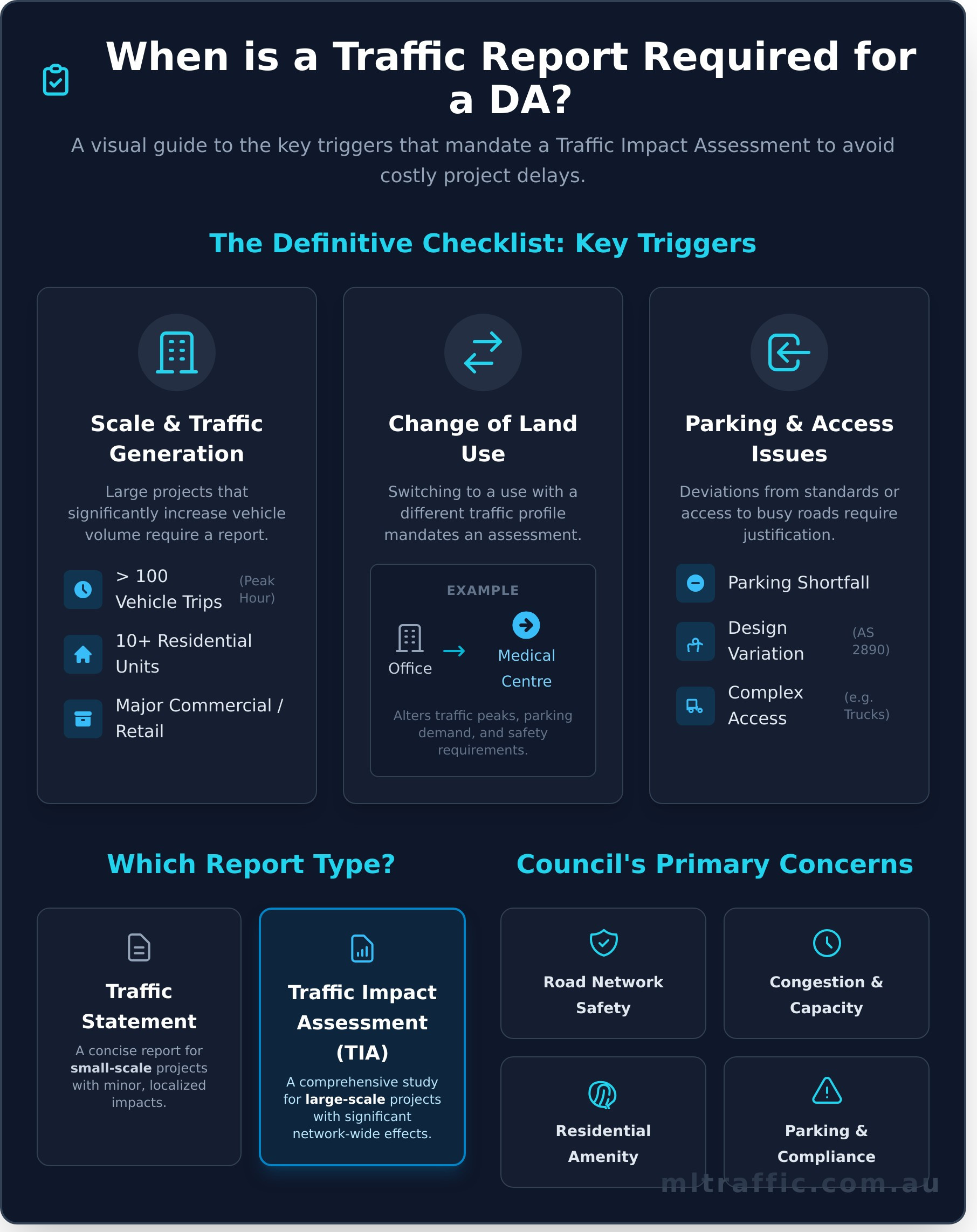
From a council’s standpoint, a traffic report is a non-negotiable tool for risk management. It must adequately address their primary concerns, which include:
-
Road Network Safety: Ensuring safe vehicle and pedestrian access to the site and maintaining safety standards on adjacent roads.
-
Congestion and Capacity: Managing traffic flow to prevent unacceptable delays or congestion on the local street network.
-
Parking Provision: Verifying that sufficient, compliant on-site parking is provided to meet demand and prevent overflow onto public streets.
-
Residential Amenity: Protecting nearby residents from negative impacts such as excessive traffic noise, light spill, or intrusive on-street parking.
Traffic Statement vs. Traffic Impact Assessment (TIA)
A key factor in determining when is a traffic report required for a DA is understanding the two main types of reports. A Traffic Statement (or Traffic Impact Statement) is a concise report suitable for smaller-scale developments with minor, localised impacts. In contrast, a full Traffic Impact Assessment (TIA) is a far more comprehensive study required for larger projects expected to have a significant effect on the wider road network. The scale, location, and nature of your proposed development will directly determine which report the council mandates.
The Definitive Checklist: Key Triggers Requiring a Traffic Report
To determine when is a traffic report required for a DA, developers and architects should use this checklist as a preliminary self-assessment tool. The following triggers are based on common requirements across Australian local councils. If your development application (DA) meets one or more of these criteria, a professional Traffic Impact Assessment is almost certainly mandatory. Failure to provide a required report is a frequent cause of significant DA delays or outright rejection by council planners.
Trigger 1: Scale of Development & Traffic Generation
The sheer volume of traffic a new development is expected to generate is the most common trigger. Councils need assurance that the existing road network can handle the additional load, particularly during peak periods. While specific thresholds vary between councils, many authorities reference state-level guidelines, such as the NSW Guide to Transport Impact Assessment, to define their requirements. A report is typically needed for:
-
Developments generating a significant number of vehicle trips (e.g., over 100 trips in the AM or PM peak hour).
-
Large-scale residential buildings, often with a threshold as low as 10 or more units.
-
Major commercial, industrial, or retail developments involving substantial new gross floor area (GFA).
Trigger 2: Change of Land Use
A change in how a property is used, even with no new construction, can fundamentally alter its traffic impact and parking demand. Converting a low-traffic office space into a high-turnover use like a childcare centre or medical facility will almost always require assessment. These land uses have unique traffic profiles with concentrated drop-off and pick-up times that demand specific analysis to ensure the safety and efficiency of the surrounding road network.
Trigger 3: Parking & Access Issues
Any proposal that deviates from standard council or Australian Standard requirements for vehicle parking and access will trigger the need for a traffic report. The purpose of the report is to justify the proposed design and demonstrate that it will operate safely and efficiently. Key triggers in this category include:
-
Proposing a shortfall in the number of on-site parking spaces required by the council’s Development Control Plan (DCP).
-
Requesting a variation from the geometric design standards for parking layouts, as defined in the Australian Standards (AS 2890 series).
-
Developments that require complex vehicle access for trucks, service vehicles, or loading docks.
-
Any new or modified vehicle access point (driveway) onto a state-classified or otherwise busy road.
Location-Specific Factors: When Your Site’s Position Matters
The decision on when is a traffic report required for a DA extends beyond the scale of the development itself. A site’s location and the sensitivity of the surrounding road network are often the primary triggers for a formal assessment. Proximity to critical infrastructure or areas with existing traffic issues prompts immediate scrutiny from councils and state authorities. A professional traffic engineer is essential for identifying these location-based risks early in the planning process.
Proximity to Classified Roads
If your property has direct access to or is located near a classified road—such as a main road, arterial road, or state-managed highway—a traffic report is almost always mandatory. State road authorities like Transport for NSW (TfNSW) or Victoria’s Department of Transport and Planning have stringent requirements to protect the function of their networks. A Traffic Impact Assessment (TIA) is required to rigorously assess the development’s impact on traffic flow, intersection performance, and road safety along these critical corridors.
Proximity to Intersections and Public Transport
Developments situated near key transport infrastructure will attract significant council attention. This includes sites adjacent to:
-
Signalised intersections or busy roundabouts
-
Train stations or light rail stops
-
Major bus interchanges
In these locations, councils require a detailed analysis of the interaction between vehicles generated by the development, public transport users, pedestrians, and cyclists. The report must demonstrate that the proposal will not compromise the safety or operational efficiency of these vital transport nodes.
Local Area with Known Issues
Even a small-scale development can trigger the need for a traffic report if it is located in an area with pre-existing problems. If the local street network already suffers from significant traffic congestion, a lack of on-street parking, or has a documented history of accidents, the council will require justification that your project will not worsen the situation. The assessment must align with established best practices, such as those detailed in the Austroads Guide to Traffic Management, to provide a credible analysis. This demonstrates why location is a critical factor for when is a traffic report required for a DA, even in cases of minor development.
Understanding these location-specific triggers is fundamental. An incorrect assessment of these external factors can lead to significant project delays or refusal of your DA. For a definitive evaluation of your site’s specific requirements, contact the experienced consultants at ML Traffic Engineers.
What’s Inside a Traffic Report? Key Components Explained
A professional Traffic Impact Assessment is a structured, evidence-based document, not a simple form. Each section is meticulously prepared to answer the specific questions a council’s traffic engineer will have about your development. The objective is to provide a clear, defensible analysis that demonstrates the proposed development is acceptable from a traffic, parking, and access perspective. Understanding these components is vital for any applicant facing the question of when is a traffic report required for a DA.
A comprehensive report typically includes the following key sections:
Analysis of Existing Conditions
This section establishes the baseline. It involves a detailed review of the surrounding road network, including its classification, current performance, and any existing safety issues. We conduct traffic surveys to measure current vehicle, pedestrian, and cyclist volumes at peak times. The assessment also documents the availability and proximity of public transport services, providing a complete picture of the site’s current transport environment.
Traffic Generation & Parking Demand
Here, we forecast the future impact. Using established and council-accepted rates, such as those from the TfNSW Guide to Traffic Generating Developments, we calculate the number of vehicle trips the new development is expected to generate. This data is then used to assess the car parking demand. The proposed car parking supply is rigorously compared against the requirements stipulated in the local council’s Development Control Plan (DCP).
Access, Internal Layout & Swept Path Analysis
This component focuses on the site’s functionality and safety. We review the proposed driveway design to ensure it provides safe sight lines and complies with all relevant standards. Critically, this includes swept path analysis, using specialised software to create diagrams that prove vehicles—from standard cars to the largest expected service vehicle—can manoeuvre safely into, through, and out of the site without conflict. The internal car park layout is also assessed for compliance with Australian Standards (AS 2890.1).
Recommendations & Conclusion
The report culminates in a clear conclusion. If any potential traffic impacts are identified, this section provides specific recommendations to mitigate them. These may include measures such as upgrading a driveway, installing new signage, or making a financial contribution to local road network upgrades. The report concludes with a definitive professional statement on the overall traffic-related suitability of the Development Application, giving the council the assurance it needs for approval.
Need a comprehensive traffic report for your DA? Contact our experts.
Secure Your DA Approval with Expert Traffic Assessment
Understanding when is a traffic report required for a DA is crucial for a smooth and successful application process. The need for a professional traffic assessment is determined by key triggers, including the scale of your development, changes in land use, and specific council requirements. A compliant, thorough report is not just a formality; it is a critical tool that demonstrates due diligence and addresses potential traffic and parking impacts before they become obstacles to approval.
Navigating these requirements demands specialised expertise. At ML Traffic Engineers, we bring over 15 years of dedicated experience to every project, having completed more than 10,000 traffic assessments across Australia. We provide direct access to our principal engineers, ensuring your project receives the senior oversight it deserves from start to finish.
Don’t let traffic compliance delay your project. Ensure your DA is compliant. Contact ML Traffic Engineers for a quote today. Partner with us to secure a clear path forward for your development.
Frequently Asked Questions
Can I prepare a traffic report for my DA myself?
No. Councils require traffic and parking reports to be prepared by a qualified and experienced traffic engineering consultant. These reports must demonstrate a thorough understanding of local council controls, Australian Standards (such as AS 2890.1), and relevant transport authority guidelines. A submission from an unqualified individual will be rejected by the assessing authority, leading to significant delays and additional costs. Engaging a professional consultant ensures compliance and credibility for your Development Application.
What is the difference between a Traffic Impact Assessment (TIA) and a Statement of Environmental Effects (SEE)?
A Traffic Impact Assessment (TIA) is a specialist technical report focusing exclusively on the traffic and parking implications of a development. It analyses traffic generation, parking supply and demand, access design, and road network safety. In contrast, a Statement of Environmental Effects (SEE) is a much broader document that addresses all potential environmental impacts, including acoustics, waste, and visual amenity. The TIA is typically submitted as a technical appendix that informs the traffic section of the SEE.
How much does a traffic and parking report for a DA typically cost?
The cost of a traffic report is determined by the scale and complexity of the proposed development. A straightforward report for a small-scale project, such as a dual occupancy or a change of use for a small commercial tenancy, typically ranges from A$1,500 to A$3,000. Larger, more complex developments that require detailed traffic modelling or intersection analysis will incur higher fees. We provide a fixed-fee proposal based on your specific project to ensure complete cost certainty.
How long does it take to get a traffic report completed?
The timeframe depends on the project’s complexity and data collection requirements. A standard Traffic Impact Statement for a small to medium-sized development can usually be completed within 1 to 2 weeks of engagement. More complex assessments that require on-site traffic and parking surveys or detailed intersection modelling may take 3 to 4 weeks to finalise. We provide a clear delivery schedule in our proposal to ensure you can meet your DA submission deadlines without delay.
What happens if the traffic report identifies significant negative impacts?
If a report identifies potential negative impacts, our role as experienced consultants is to recommend practical and effective mitigation measures. This is a standard part of the assessment process. Solutions may include modifying site access points, recommending local road upgrades, redesigning parking layouts, or implementing a Travel Demand Management plan. The objective is to demonstrate to council that any adverse impacts are manageable, allowing the development to proceed towards approval.
Is a traffic report still required for a small extension or renovation?
Generally, a minor extension that does not change the land use or parking demand will not trigger the need for a report. However, understanding when is a traffic report required for a DA is crucial as rules vary between councils. A report may become necessary if the work alters vehicle access, reduces the number of on-site parking spaces, or adds a secondary dwelling. Consulting the local Development Control Plan (DCP) or a traffic engineer provides certainty and prevents delays.