

Is your project being delayed by a Council request for “more robust evidence” that your current traffic report simply can’t provide? Many developers assume a standard SIDRA analysis is sufficient for every site, only to face unexpected costs when authorities demand a microsimulation model late in the planning process. Identifying the specific traffic impact assessment triggers for intersection analysis early is the only way to avoid these expensive bottlenecks.
We understand the frustration of navigating technical requirements that seem to shift with every new regulation. This article explains exactly when your development requires the advanced capabilities of PTV Vissim 2026 or Aimsun Next 26 to secure approval. You’ll learn the clear criteria for choosing between static and dynamic models, ensuring your traffic evidence is both compliant and cost-effective. We’ll break down the latest 2026 software standards and provide a roadmap for a modelling strategy that satisfies Council requirements while protecting your project’s bottom line.
Key Takeaways
- Distinguish between PTV Vissim and Aimsun Next to select the appropriate modelling tool for your specific project requirements.
- Identify the traffic impact assessment triggers for intersection analysis that necessitate microsimulation, such as interacting signals and queue spillback.
- Evaluate the limitations of standard SIDRA models for complex geometries such as multi-lane roundabouts and tram networks.
- Expedite Council approval by providing high-fidelity evidence for Future Year scenario testing and capacity assessments.
- Maximise accountability by partnering with consultants who perform technical modelling personally to ensure data integrity.
Defining Microsimulation: What are Vissim and Aimsun Models?
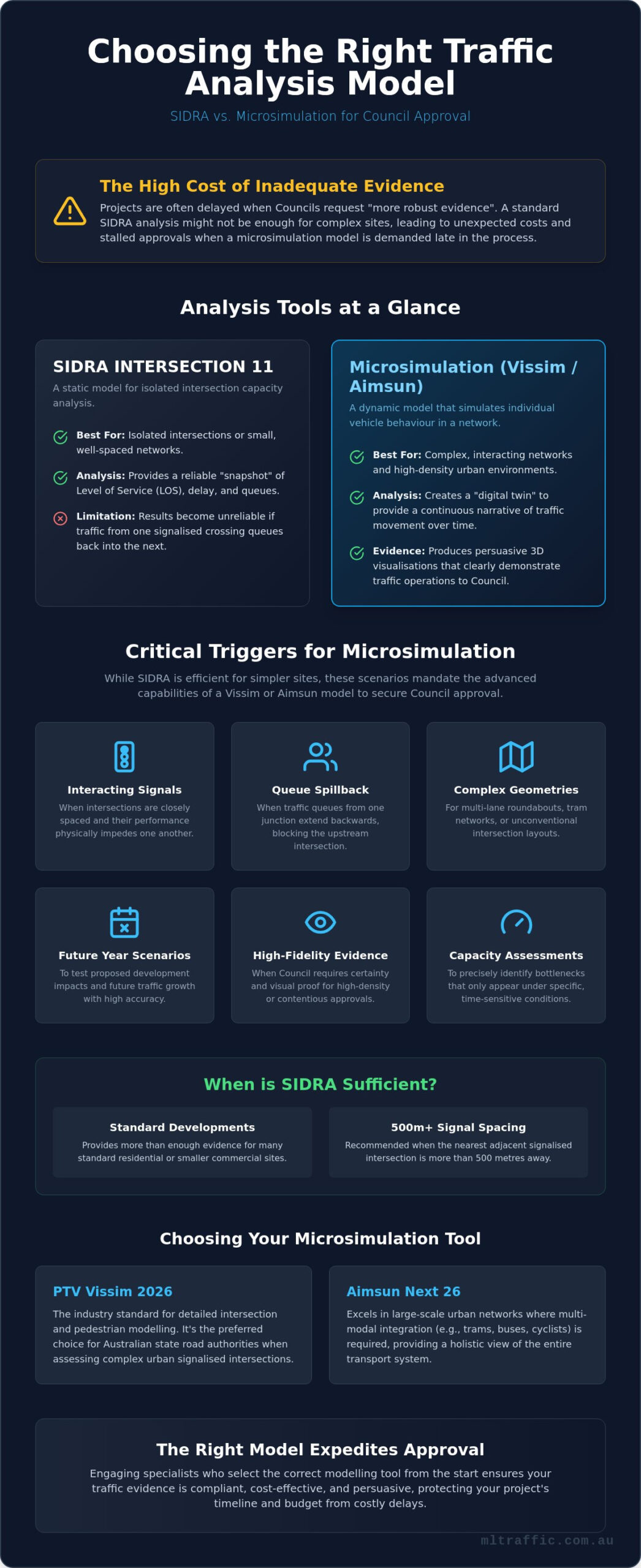
Microsimulation represents a technical shift from static calculations to dynamic reality. Unlike traditional analytical methods that rely on averages, these models track every individual vehicle, cyclist, and pedestrian within a defined network. This high-fidelity approach is often one of the main traffic impact assessment triggers for intersection analysis when standard models fail to capture complex vehicle interactions. Professionals use Microscopic traffic flow models to create a digital twin of the existing road environment. This allows for precise testing of proposed development impacts before a single brick is laid.
To better understand how these models function within a broader study, watch this helpful video:
These tools are preferred for time-sensitive analysis because they account for how traffic builds and dissipates over a peak period. While a static model provides a snapshot of capacity, Vissim and Aimsun provide a continuous narrative of movement. This allows engineers to identify specific bottlenecks that only appear when certain conditions align, such as a bus blocking a lane or a pedestrian crossing disrupting a left-turn slip lane. It’s a level of detail that provides Council with the certainty they require for high-density approvals.
The Core Technology Behind the Models
The underlying logic relies on car-following and lane-changing algorithms. Every virtual driver is assigned specific characteristics, such as aggressiveness or patience, which dictates how they react to the vehicle in front. We incorporate stochasticity, or programmed randomness, to ensure the model reflects real-world variability rather than a perfect, unrealistic flow. This technology produces 3D visualisations that allow Council officers to see exactly how a site operates. This visual evidence is often more persuasive than a standard spreadsheet in resolving disputes during the DA process.
Vissim vs. Aimsun: Key Differences for Developers
PTV Vissim 2026 remains the industry standard for detailed intersection and pedestrian modelling. It’s frequently the preferred choice for Australian state road authorities when assessing complex urban signalised intersections. Aimsun Next 26, however, excels in large-scale urban networks where multi-modal integration is required. While both packages provide robust data, the choice often depends on the specific RFI requirements issued by the relevant authority. Engaging a specialist who understands these traffic engineering services ensures you don’t over-invest in a model that exceeds your project’s specific needs.
Microsimulation vs. SIDRA: Choosing the Right Analysis Tool
Selecting the correct analytical tool is a commercial decision as much as a technical one. SIDRA INTERSECTION 11, released in March 2026, remains the benchmark for isolated capacity analysis across Australia. It provides a reliable snapshot of Level of Service (LOS), delay, and queue lengths for single intersections or small, well-spaced networks. However, its mathematical foundations assume that the performance of one intersection does not physically impede another. When intersections are closely spaced, these static assumptions often fail to reflect reality.
Identifying specific traffic impact assessment triggers for intersection analysis allows developers to avoid the trap of providing inadequate data to Council. While SIDRA is significantly faster to set up and run, the results become unreliable if traffic from one signalised crossing queues back into the next. In these high-stakes urban environments, a failure to transition to microsimulation can lead to a Request for Further Information (RFI) that stalls a project for months. The cost of a Vissim model is often offset by the speed of approval it facilitates through robust evidence.
When SIDRA is Sufficient
For many standard residential developments or smaller commercial sites, SIDRA provides more than enough evidence for a successful DA. We typically recommend this analytical approach for isolated intersections where the nearest adjacent signal is more than 500 metres away. It is also the ideal tool for preliminary feasibility studies where you need to understand potential land-use yields before committing to a full design. If the site has low traffic generation and doesn’t significantly alter the existing degree of saturation, a standard intersection analysis is usually the most cost-effective path forward.
The Tipping Point for Advanced Modelling
The transition to Vissim or Aimsun occurs when the physical reality of the road network becomes too complex for simplified formulas. According to the FHWA guidelines on microsimulation, dynamic models are essential when you need to account for time-varying traffic demands or complex geometric configurations that static models cannot process.
The most common tipping point is queue spillback. If your project is located in a saturated urban centre where queues frequently overlap, SIDRA cannot accurately predict the resulting gridlock. Microsimulation handles these peak-hour surges by simulating every vehicle’s movement over time. This provides a realistic view of how congestion builds and clears. Determining if your project has reached the limit of analytical modelling requires a senior engineer to assess the interaction between your site access and the broader municipal network.
Critical Scenarios Where a Vissim or Aimsun Model is Mandatory
Regulatory authorities across Australia, such as state transport departments and local councils, mandate microsimulation for projects that exceed specific complexity thresholds. While SIDRA handles isolated intersections, Vissim or Aimsun models are required when a development’s footprint extends into the broader network logic. These traffic impact assessment triggers for intersection analysis ensure that infrastructure can handle real-world variability, not just theoretical averages. Failing to identify these triggers early often results in costly redesigns after a DA has already been lodged.
State agencies and local Councils typically demand advanced microsimulation in the following scenarios:
- Multi-lane roundabouts: Where circulating flow and gap acceptance behaviour are too complex for standard analytical formulas.
- Closely spaced signals: Intersections located within 300 metres of each other where queue spillback is a high risk.
- Signal modifications: Any project requiring changes to SCATS signal timings or the introduction of new phases to the existing network.
- Cumulative impact zones: Large-scale precinct plans where multiple concurrent developments affect the same road corridor.
- High-conflict pedestrian zones: Environments where vehicle-pedestrian interactions must be quantified to ensure safety and throughput.
Complex Network Interactions
Dynamic models are the only way to accurately assess platooning effects. When vehicles leave a signalised intersection in a “platoon”, their arrival at the next intersection is not random. Analytical models often fail to account for this, leading to underestimated delays and queue lengths. Microsimulation is also essential for weaving sections on motorways or high-speed interchanges, where lane-changing behaviour significantly dictates capacity. We use these tools to prove that new mid-block crossings or site accesses won’t cause upstream gridlock on arterial routes.
Public Transport and Multi-Modal Integration
State agencies prioritise transit reliability. If your development impacts a bus priority lane or a tram network, you must demonstrate that transit times remain unaffected. Aimsun Next 26 is particularly effective for this multi-modal integration. It allows us to quantify the Green Time required for pedestrian safety at major transport hubs while ensuring vehicle-pedestrian conflicts are minimised. Providing this level of evidence is critical for securing approval in high-density urban centres where Intersection Analysis is a core component of the planning permit.
Securing a project’s future requires more than just meeting the minimum requirements. It involves providing robust, defensible evidence that stands up to the scrutiny of senior transport planners. By identifying the necessary triggers early, we help developers avoid the RFI cycle and move straight to construction.
Navigating Council Requirements and the Approval Process
Interpreting a Request for Further Information (RFI) requires a technical understanding of why the Council or State authority has flagged your submission. Often, an RFI isn’t a request for more volume, but a demand for higher precision. If your initial report relied on static averages in a saturated network, the reviewing engineer has likely identified that your data doesn’t account for dynamic interactions. Understanding the specific traffic impact assessment triggers for intersection analysis early in the scoping phase prevents these delays. We recommend a formal scoping meeting with authorities before modelling begins to agree on the study area and methodology.
Future Year scenario testing is a standard requirement for major developments. Authorities typically demand 10-year forecasts to ensure that the proposed infrastructure can accommodate both development traffic and regional growth. Microsimulation is the only defensible way to model these long-term impacts in complex corridors. While it’s sometimes possible to negotiate a simpler analytical model for low-impact sites, projects in high-density areas almost always require the robust evidence provided by PTV Vissim 2026 or Aimsun Next 26.
Meeting State Authority Standards
Compliance with Transport for NSW or other state-specific guidelines is essential for a successful Traffic Impact Assessment (TIA) Report. A model is only as reliable as its calibration. We validate every microsimulation against real-world data, ensuring that virtual travel times and queue lengths match observed conditions. Per 2026 regulatory standards, traffic counts used for this process must not be older than two years. An uncalibrated model lacks credibility and will be rejected by reviewing engineers, leading to significant project setbacks and additional costs.
The Strategic Value of Visualisation
Technical reports are often reviewed by non-technical stakeholders, including local councillors and community groups. Vissim and Aimsun provide 3D visualisations that function as a powerful proof of concept. These simulations show exactly how a new site access or signal modification will operate during peak hours. Using video evidence reduces friction during public exhibitions for controversial developments by providing a clear, visual response to community concerns about congestion. This transparency builds trust and demonstrates that the proposed traffic solution is grounded in rigorous technical analysis.
If you have received an RFI or need to discuss a modelling strategy for your DA, contact our senior principals directly for expert guidance.
Professional Traffic Modelling Services for Your Development
Securing a Development Application (DA) approval in a complex urban environment requires more than just high-end software. It demands a senior level of professional accountability. We ensure that the expert who initiates your project is the same specialist performing the technical modelling. This personnel continuity promise distinguishes ML Traffic Engineers Australia from larger firms where work is often delegated to junior staff. Identifying the precise traffic impact assessment triggers for intersection analysis requires seasoned judgement to avoid unnecessary modelling costs while meeting every regulatory requirement.
ML Traffic Engineers Australia integrates PTV Vissim 2026 and Aimsun Next 26 outputs directly into comprehensive Traffic Impact Assessment (TIA) Reports. Every model we produce adheres strictly to Australian Standards and specific state authority guidelines. Senior principal involvement is mandatory for all microsimulation projects to ensure that the data is defensible during Council negotiations or at planning tribunals. We provide a meticulous, results-oriented service that focuses on clearing technical hurdles and securing your approval without unnecessary bureaucratic delays.
Our Approach to Traffic Impact Assessments
We do not treat modelling as an isolated task. Our strategy involves a holistic review of your site’s physical and operational constraints to ensure the model reflects the practicalities of the built environment. This includes:
- Linking microsimulation results to Vehicle Swept Path Analysis to ensure total site compliance and functional driveway design.
- Evaluating the most cost-effective modelling path by determining if a standard SIDRA analysis or a dynamic Vissim model is the most appropriate for your specific RFI.
- Ensuring seamless Traffic Engineering integration from the initial feasibility stage to final submission.
- Providing direct access to senior leadership to discuss technical parameters and project timelines without administrative gatekeepers.
Contact Our Senior Principals Today
Expertise in microsimulation is a specialised skill that requires decades of practical experience. Our principals understand the technicalities of SCATS signal timings, car-following logic, and the specific bureaucratic requirements of Australian transport authorities. We provide direct names, professional qualifications, and direct contact lines to ensure you have a transparent experience. Whether you’re managing a high-density residential tower or a major retail precinct, we provide the robust evidence required to move your project forward.
Request a technical review or a detailed quote for your project’s traffic modelling needs by reaching out to our experts. Contact ML Traffic Engineers Australia for a tailored modelling strategy that meets Council standards and protects your project’s bottom line. We are committed to providing the technical certainty your development requires for a successful outcome.
Securing Project Approval with Robust Traffic Evidence
Navigating the transition from standard analytical reports to advanced microsimulation is a critical step in the planning process. While SIDRA remains the benchmark for isolated capacity, complex network interactions and high-density urban environments demand the dynamic precision of Vissim or Aimsun. Identifying the specific traffic impact assessment triggers for intersection analysis early ensures your project avoids costly RFIs and technical bottlenecks during Council review.
ML Traffic Engineers Australia provides over 15 years of Australian traffic engineering experience, ensuring that every model is compliant with current 2026 standards. We guarantee direct principal involvement in all technical modelling, providing the high-level accountability required for complex approvals. Our expertise in both SIDRA and advanced microsimulation ensures your project is supported by defensible, high-fidelity evidence from day one.
Discuss your traffic modelling requirements with our senior experts to establish a cost-effective strategy for your development. We look forward to assisting you in securing a streamlined approval for your next project through meticulous data and professional assurance.
Frequently Asked Questions
What is the main difference between Vissim and SIDRA?
SIDRA INTERSECTION 11 is an analytical tool that uses mathematical formulas to calculate capacity and delay for isolated intersections. PTV Vissim 2026 is a microsimulation tool that tracks individual vehicle movements using car-following logic. While SIDRA provides a static snapshot of performance, Vissim simulates the dynamic interaction of vehicles across a network over time. This makes Vissim essential for capturing complex queuing behaviour that static models cannot process.
How much does a Vissim traffic model cost for a standard DA?
The cost of microsimulation is determined by the size of the study area and the complexity of the signalised intersections involved. These models require significantly more investment than SIDRA due to the intensive data collection, calibration, and validation phases required by Australian road authorities. We provide tailored quotes based on the specific RFI requirements issued by your local Council or state transport department to ensure a cost-effective modelling strategy.
Is Aimsun better than Vissim for large-scale urban planning?
Aimsun Next 26 is often preferred for large-scale urban networks because it handles hybrid modelling across macro, meso, and microscopic levels efficiently. Vissim remains the industry benchmark for high-fidelity intersection analysis and detailed pedestrian simulation. The choice between the two often depends on which software is specifically mandated by the relevant state authority or the specific multi-modal requirements of your development’s traffic impact assessment.
How long does it take to build a calibrated microsimulation model?
Developing a fully calibrated and validated model typically takes between two to four weeks depending on network complexity. This timeframe includes the procurement of traffic counts, network coding, and the iterative process of matching virtual queue lengths to observed real-world conditions. Identifying the traffic impact assessment triggers for intersection analysis early allows us to streamline this process and meet strict project deadlines for DA submissions.
Can I use a Vissim model to prove my car park design works?
Vissim is an excellent tool for verifying that complex car park designs and internal circulation systems function as intended. It allows us to simulate vehicle conflict points, ramp queuing, and the interaction between entering and exiting traffic in a 3D environment. This provides Council with visual and data-driven proof that your site access won’t cause external traffic blockages, which is often a major concern for high-density developments.
What data do I need to provide for a traffic microsimulation?
We require detailed site survey plans, existing signal phasing data, and recent traffic counts that are no older than two years. To ensure the model is accurately calibrated, we also collect observed queue lengths and travel time data from the surrounding road network. Providing high-quality input data is the most effective way to ensure your model is accepted by reviewing engineers at Transport for NSW or other state bodies.
Do all Councils require Vissim for medium-density developments?
Most medium-density projects are adequately served by a standard SIDRA analysis. However, Council may mandate microsimulation if your site is located near a saturated arterial road, a tram network, or a major transport interchange. We assess the traffic impact assessment triggers for intersection analysis for every project to determine if advanced modelling is necessary, helping you avoid the cost of unnecessary technical work while ensuring compliance.
Can Vissim model pedestrian movements and bicycle lanes?
Vissim features advanced modules specifically designed to simulate pedestrian and cyclist behaviour within the road network. This allows us to quantify vehicle-pedestrian conflict at major crossings and demonstrate the safety of proposed bicycle lane integrations. Modelling these multi-modal interactions is often a requirement for developments in major Australian CBDs where pedestrian throughput is prioritised alongside vehicle flow to ensure urban safety and efficiency.

Disclaimer
The content on www.mltraffic.com.au, including all technical articles, guides, and resources, is provided for general informational and educational purposes only. It is not intended to constitute professional advice in traffic engineering, transportation planning, development approvals, or any other technical or legal field.While ML Traffic Engineers makes every reasonable effort to ensure the accuracy, completeness, and timeliness of the information published, we do not provide any warranties or representations (express or implied) regarding its reliability, suitability, or availability for any particular purpose. Any reliance you place on the content is strictly at your own risk.In no event shall ML Traffic Engineers, its directors, employees, authors, or affiliates be liable for any direct, indirect, incidental, special, consequential, or punitive damages (including, without limitation, loss of profits, data, or business opportunities) arising out of or in connection with the use of, or inability to use, any information provided on this website.The articles and guides on this site are not a substitute for engaging a qualified, registered professional traffic engineer (such as an NPER or RPEQ engineer) to assess your specific project requirements. For tailored advice, compliance assessments, or traffic engineering services, please contact a competent professional.This disclaimer may be updated from time to time without notice. By accessing or using this website, you agree to be bound by the most current version of this disclaimer.
