

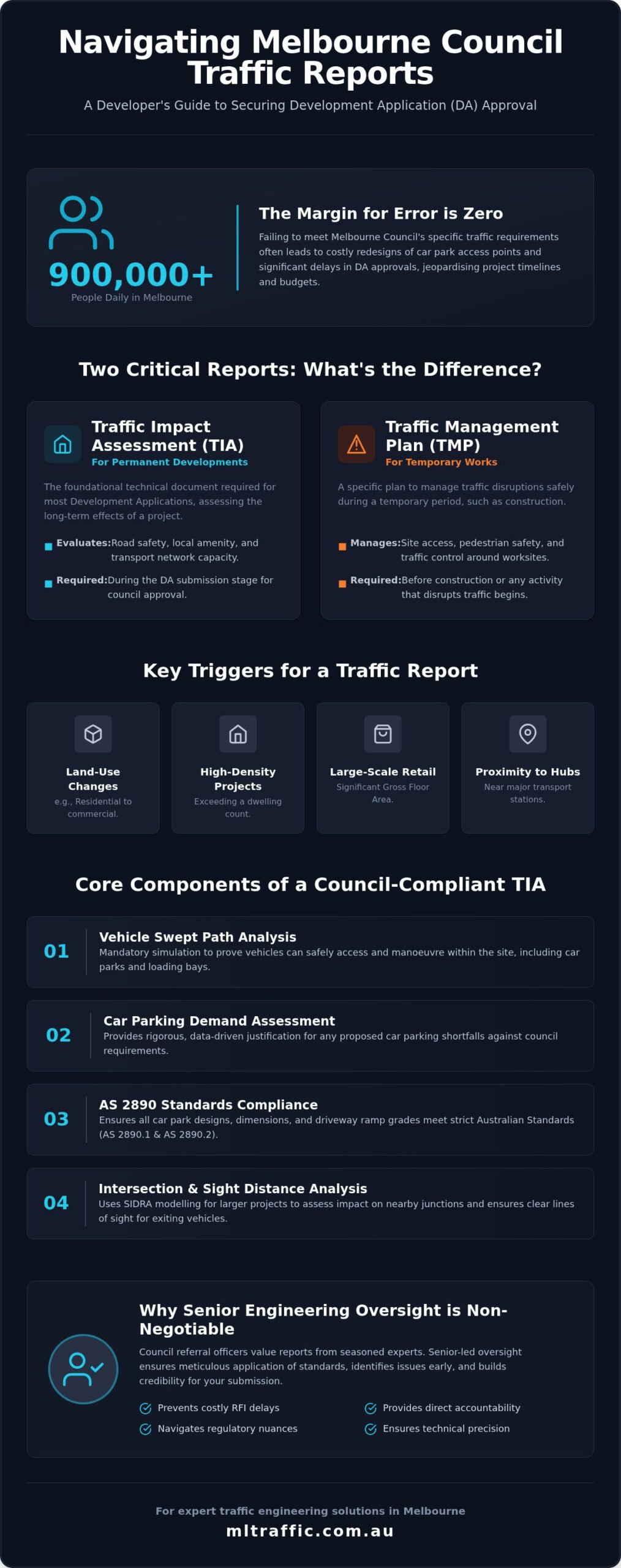
With over 900,000 people moving through the municipality of Melbourne every single day, the margin for error in your development’s traffic planning is effectively zero. Failing to meet the specific melbourne council traffic report requirements often leads to costly redesigns of car park access points and prolonged delays in DA approvals. Most developers recognise that unclear guidelines and the high cost of post-submission revisions are significant risks to project timelines and budgets.
Securing a permit requires a precise application of Australian Standards and a thorough understanding of the Activities Local Law 2024. This guide provides the technical framework and compliance benchmarks necessary to secure council approval for your project’s traffic and parking assessments. You will gain a clear understanding of the differences between a Traffic Impact Assessment (TIA) and a Traffic Management Plan (TMP). We also provide a breakdown of the essential criteria for AS 2890.1 and AS 2890.2 compliance to ensure your submission is technically sound from the outset.
Key Takeaways
- Learn to distinguish between permanent Traffic Impact Assessments (TIA) and temporary Traffic Management Plans (TMP) to ensure correct lodgement at each project stage.
- Master the technical melbourne council traffic report requirements, including the mandatory inclusion of Vehicle Swept Path Analysis for all new developments.
- Discover how to justify car parking shortfalls through professional Car Parking Demand Assessments and rigorous site-specific data collection.
- Ensure your development remains compliant with AS 2890 standards for car park design and driveway ramp grades to prevent costly post-submission redesigns.
- Understand the importance of senior-led engineering oversight in managing the transition from architectural plans to council-approved traffic documentation.
Understanding Council Traffic Report Requirements and TIA Mandates
A Traffic Impact Assessment (TIA) Report serves as the foundational technical document required for most Development Applications (DA). Australian local government authorities (LGAs) mandate these assessments to evaluate how a proposed project affects road safety, local amenity, and the existing capacity of the transport network. By Understanding Traffic Engineering principles, developers can better appreciate why councils prioritise the mitigation of congestion and the preservation of pedestrian safety.
Fulfilling melbourne council traffic report requirements is not merely a box-ticking exercise; it’s a statutory necessity. Under the Road Management Act 2004 and the Planning and Environment Act 1987, councils possess the legal authority to demand comprehensive data on vehicle movements. These reports ensure that new developments don’t compromise the functionality of public infrastructure or create hazardous conditions at nearby intersections. It’s vital to identify whether your site impacts local roads managed by the City of Melbourne or arterial roads under the jurisdiction of the Department of Transport and Planning (VicRoads).
To better understand the importance of intersection safety in urban planning, watch this video regarding Melbourne’s road conditions:
When is a Traffic Report Triggered?
Councils typically trigger the requirement for a formal report when a development meets specific thresholds. These include land-use changes that increase trip generation, such as converting a residential site into a commercial precinct. High-density residential projects exceeding a specific number of dwellings or large-scale retail spaces with significant Gross Floor Area (GFA) also require assessment. Meeting melbourne council traffic report requirements often hinges on these triggers. If your site is located near a central city rail station where 290,000 people converge daily, the level of scrutiny increases. Precise data collection, including traffic counts and parking surveys, becomes essential to satisfy these triggers.
The Role of the Traffic Engineer in DA Approval
The credibility of your submission depends heavily on the tenure and qualification of the authoring engineer. Council referral officers prefer reports signed off by senior principals who demonstrate a meticulous understanding of regulatory standards. Early involvement from a seasoned expert helps identify potential access issues or parking shortfalls before they become ‘Request for Further Information’ (RFI) delays. At ML Traffic Engineers, we ensure the same senior expert manages your project from initial audit to final submission. This provides a direct line of accountability that larger, more impersonal firms often lack. This hands-on approach is vital for navigating the technicalities of Traffic Impact Assessment (TIA) Reports and ensuring successful DA outcomes.
Technical Components of a Compliant Traffic Impact Assessment
A compliant TIA is a technical bridge between architectural vision and operational reality. While council checklists identify what to submit, the engineering precision within those documents determines if a project survives the referral process. Adhering to the Guide to Traffic Impact Assessment methodology ensures that your data stands up to rigorous scrutiny. To satisfy melbourne council traffic report requirements, every vehicle movement must be proven through empirical data and specialist software simulations rather than simple assumptions.
Beyond basic access, larger developments must provide an Intersection Analysis using SIDRA modelling. This software evaluates the degree of saturation, delays, and queue lengths at nearby junctions. Councils also require a Sight Distance Assessment to ensure that exiting drivers have a clear line of sight to pedestrians and oncoming traffic. This is particularly critical for sites located on curved roads or near heavy vegetation. Engaging a consultant for a Car Park Design review early in the process prevents costly architectural revisions after the DA has been lodged.
Swept Path Analysis and Vehicle Access
Swept Path Analysis is the simulation of a vehicle’s turning envelope to ensure it can navigate the site without striking curbs or structures. We use AutoTURN software to model the movements of the largest expected vehicles, typically an 8.8m Small Rigid Vehicle (SRV) or a 12.5m Heavy Rigid Vehicle (HRV) for waste collection. Compliance with B85 and B99 vehicle templates is essential for both entry and internal circulation. For a deeper look at these requirements, refer to our Swept Path Analysis Guide.
Car Parking Demand and Justification
When a development cannot meet the statutory parking rates set by the local planning scheme, a Car Parking Demand Assessment is required. This report justifies a parking shortfall by analysing local demographics, proximity to public transport, and existing on-street parking availability. We conduct parking surveys to provide the empirical evidence councils need to grant a waiver. Demonstrating that the peak demand of the development does not exceed the available supply is the only way to secure approval for reduced parking provisions.
AS 2890 Compliance: The Gold Standard
Adherence to the Australian Standard AS 2890 series is mandatory for all off-street parking facilities. AS 2890.1 governs residential and public car parks, while AS 2890.2 focuses on commercial and industrial vehicle facilities. Common design errors that trigger council rejections include excessive driveway ramp grades, insufficient headroom clearances for service vehicles, and narrow aisle widths that prevent two-way flow. You can find more detail on these technical specifications in our AS 2890.1 Design Guide. Ensuring these metrics are correct in the initial plans is the most effective way to avoid RFI delays.
Distinguishing Between TIAs, TMPs, and Traffic Guidance Schemes
Confusion between operational and construction-phase documentation is a primary cause of project delays. To satisfy melbourne council traffic report requirements, developers must provide distinct sets of data for the permit application and the subsequent building phase. A Traffic Impact Assessment (TIA) deals with the permanent operational state of the development. It evaluates how the completed project will affect the road network over its lifespan. Conversely, a Traffic Management Plan (TMP) addresses the temporary disruptions caused during the construction process.
A Traffic Guidance Scheme (TGS) is a specific technical diagram showing the placement of signs and devices. It is a subset of the TMP used by traffic controllers on-site. For significant projects, councils may also request a Construction Traffic Impact Assessment (CTIA). This is typically required if works last four weeks or longer and forms part of a broader Construction Management Plan (CMP). These documents are reviewed by different stakeholders. Council planners assess the TIA for long-term land-use viability, while council engineers and asset managers review TMPs to protect public infrastructure under the Activities Local Law 2024.
Operational vs. Construction Traffic Plans
The TIA focuses on how the finished building interacts with the road network. It justifies parking rates and ensures safe access for residents and visitors. The TMP focuses on temporary road closures, pedestrian detours, and the safe delivery of materials to the site. It is a live document that changes as the build progresses. For a detailed breakdown of construction-phase requirements and compliance with the Austroads Guide to Temporary Traffic Management, see our Traffic Management Plan Definitive Guide.
Waste Management and Loading Requirements
Local councils now frequently mandate a Waste Management Plan (WMP) as a condition of the TIA or DA approval. This ensures that garbage collection occurs on-site rather than obstructing public roads. We design loading areas that accommodate the specific turning circles of collection vehicles, ensuring they can enter and exit in a forward direction. This integrated approach prevents the need for redesigns when the waste contractor refuses to service a non-compliant facility. Our senior engineers perform these assessments simultaneously to ensure the TIA and WMP are technically aligned before submission.
Steps to Organise and Submit Your Traffic Report for Council Approval
Navigating the referral process requires a structured engineering workflow that prioritises data accuracy and regulatory alignment. To meet the melbourne council traffic report requirements, the process begins with a comprehensive site audit. This is a technical data collection phase where we establish the baseline conditions of the local road network and identify any physical constraints that might impact vehicle access or pedestrian safety.
Once the baseline data is established, we draft the report by overlaying your proposed architectural plans with our traffic models. We perform a rigorous internal review against the specific LGA planning scheme and the AS 2890 series. This ensures that every car park design element, from aisle widths to headroom clearances, is compliant before the document is lodged. The final report is then certified by a senior Traffic Engineer, providing the professional authority required for a successful DA submission.
Data Collection and Site Surveys
Accurate empirical data is the only way to defend a development’s impact against council scrutiny. We conduct 7-day traffic counts to understand daily fluctuations, though councils primarily focus on the morning and afternoon peak periods. For projects requiring a parking waiver, we perform parking occupancy surveys within a 200-metre radius of the site. It is a strict requirement that these surveys occur during neutral weeks. This means avoiding school holidays, public holidays, or major local events that would skew the data and lead to an immediate council rejection. Accurate data collection ensures your Traffic Impact Assessment (TIA) Report is based on realistic operating conditions.
Addressing Council RFI Letters
Even robust submissions may receive a ‘Request for Further Information’ (RFI). Council referral officers often raise objections based on perceived safety risks or specific interpretations of local design codes. Interpreting these engineering objections requires a seasoned expert who understands the nuances of council feedback. The objective is to amend the design to satisfy access requirements without compromising the project’s yield or architectural intent.
This often involves technical negotiations regarding driveway ramp grades or sight distance assessments. Direct communication between your engineer and the council officer is critical at this stage. It allows for a technical resolution that can prevent months of delays. If you are currently managing an RFI or need to discuss your development’s specific needs, you can contact our senior principals for direct engineering support.
Navigating Regulatory Hurdles with Expert Traffic Engineering
Fulfilling melbourne council traffic report requirements demands a strategic approach to technical negotiation. ML Traffic Engineers serves as the primary bridge between your development objectives and the strict compliance standards of local government. Our 15+ years of consultancy experience enables us to anticipate council objections before they are formalised in an RFI. This foresight is critical for maintaining project momentum and avoiding the high costs associated with late-stage design changes.
We operate with a strict personnel continuity promise. The senior expert who initiates your project is the same professional who performs the technical work and signs the final report. This no-gatekeepers approach ensures accountability and technical consistency. Direct communication with our leadership allows for rapid resolution of complex engineering hurdles. We provide the technical authority needed to satisfy referral officers and asset managers alike.
Maintaining such high standards of professional delivery often requires a strong support structure; many Australian firms partner with Tarino to hire specialised offshore staff that complement their local expertise.
Just as expert engineering secures your development’s physical assets, professional advice from Financial Mentors Wealth Management can help you manage the financial rewards and wealth generated from successful property ventures.
Additionally, for tradies and contractors looking to scale their business alongside these developments, you can discover Cloud Tech Digital and their specialised lead generation services.
National Expertise, Local Results
We apply national regulatory standards, including the Austroads guides, to satisfy specific metropolitan council demands. Our experience encompasses a vast range of practical project environments. We have successfully managed assessments for residential units, medical centres, child care facilities, and major industrial hubs. For more information on our professional tenure and project history, read About ML Traffic Engineers. This diverse project background ensures that we can handle any land-use category with precision and reliability.
Streamlining the Approval Process
Robust engineering is the most effective way to reduce the likelihood of VCAT or planning tribunal appeals. We focus on ensuring car park designs are functional for the end-user, not just compliant on paper. A design that meets the minimum standard but proves difficult for a B99 vehicle to navigate will likely trigger a council rejection. Our goal is to secure a successful DA approval with minimal revisions by addressing these operational realities early.
Meticulous attention to detail in the initial Traffic Impact Assessment (TIA) Report prevents the need for redesigning access points after submission. If your project involves complex site constraints or a significant parking shortfall, expert intervention is essential. You can Contact our Senior Principals directly to discuss your specific development needs and ensure your submission meets all regulatory benchmarks.
Securing Your Development’s Technical Approval
Successfully navigating the DA process requires a meticulous approach to technical documentation. You’ve now gained a clear understanding of the critical distinction between operational TIAs and construction-phase TMPs, alongside the mandatory nature of AS 2890 compliance for all off-street parking. Adhering to the specific melbourne council traffic report requirements ensures your project avoids the common pitfalls of RFI delays and expensive design revisions. By prioritising senior-led engineering from the initial site audit, you establish the professional credibility required by council referral officers.
ML Traffic Engineers provides a comprehensive national consultancy service backed by over 15 years of traffic engineering experience. We guarantee direct senior engineer involvement on every project to maintain accountability and technical precision. This hands-on expertise is the most reliable way to bridge the gap between your architectural plans and final council sign-off. Secure your DA approval with a compliant Traffic Report from ML Traffic Engineers. We look forward to supporting your next successful development.
Frequently Asked Questions
Is a traffic report mandatory for all development applications?
A formal traffic report is not required for every development application. The necessity depends on project scale, land-use intensity, and the potential impact on the local road network. Small-scale internal renovations often bypass this, but most new commercial or multi-dwelling residential projects must address melbourne council traffic report requirements through a formal TIA submission.
How much does a Traffic Impact Assessment (TIA) cost?
The cost of a TIA depends on the complexity of the development and the specific data collection required by the council. Variables include the number of intersections requiring SIDRA modelling and the duration of parking occupancy surveys. Because each project has unique site constraints, engineering consultants provide quotes based on the specific scope of work defined by the local planning scheme.
What is the difference between a TMP and a TGS?
A Traffic Management Plan (TMP) is a strategic document outlining the safety and coordination of traffic during the construction phase. A Traffic Guidance Scheme (TGS) is a technical diagram within the TMP that illustrates the precise placement of signs and barriers. While the TMP explains the strategic approach to traffic control, the TGS provides the visual instructions for on-site implementation.
How long does it take for a traffic engineer to prepare a report?
Preparation time for a professional traffic report usually ranges from two to four weeks. This timeline accounts for the mandatory data collection period, such as 7-day traffic counts or peak period parking surveys. Reports cannot be finalised until neutral-week data is collected, as surveys must avoid school holidays to ensure the results are accurate and acceptable to council referral officers.
Do I need a separate parking assessment if I meet the minimum council requirements?
If your project meets the minimum parking rates specified in the planning scheme, a separate Car Parking Demand Assessment is generally unnecessary. However, you must still demonstrate that the physical layout complies with AS 2890.1 standards. This proof is typically integrated into the broader TIA to confirm that aisle widths, ramp grades, and turning circles are technically sound.
Can a traffic engineer help if my DA has already been rejected by council?
A traffic engineer can assist after a DA rejection by analysing the specific engineering objections raised in the council’s refusal. This process involves technical negotiations and design amendments to resolve safety or capacity concerns without losing development yield. Professional intervention at this stage is often the only way to avoid a lengthy and expensive planning tribunal appeal.
What software is used for swept path analysis in Australia?
AutoTURN is the primary software used by Australian traffic engineers for Vehicle Swept Path Analysis. This industry-standard tool allows for the simulation of vehicle turning envelopes using B85 and B99 templates. These simulations are essential to prove that service vehicles, such as 8.8m Small Rigid Vehicles, can safely enter and exit the site in a forward direction.
How often are Australian parking standards (AS 2890) updated?
Australian Standards are reviewed and updated periodically by Standards Australia to reflect changes in vehicle dimensions and safety protocols. Developers must ensure their consultants use the most current versions, such as AS 2890.1:2004 for off-street parking and AS 2890.2:2018 for commercial facilities, to satisfy melbourne council traffic report requirements and ensure design compliance.

Disclaimer
The content on www.mltraffic.com.au, including all technical articles, guides, and resources, is provided for general informational and educational purposes only. It is not intended to constitute professional advice in traffic engineering, transportation planning, development approvals, or any other technical or legal field.
While ML Traffic Engineers makes every reasonable effort to ensure the accuracy, completeness, and timeliness of the information published, we do not provide any warranties or representations (express or implied) regarding its reliability, suitability, or availability for any particular purpose. Any reliance you place on the content is strictly at your own risk.
In no event shall ML Traffic Engineers, its directors, employees, authors, or affiliates be liable for any direct, indirect, incidental, special, consequential, or punitive damages (including, without limitation, loss of profits, data, or business opportunities) arising out of or in connection with the use of, or inability to use, any information provided on this website.
The articles and guides on this site are not a substitute for engaging a qualified, registered professional traffic engineer (such as an NPER or RPEQ engineer) to assess your specific project requirements. For tailored advice, compliance assessments, or traffic engineering services, please contact a competent professional.
This disclaimer may be updated from time to time without notice. By accessing or using this website, you agree to be bound by the most current version of this disclaimer.
