
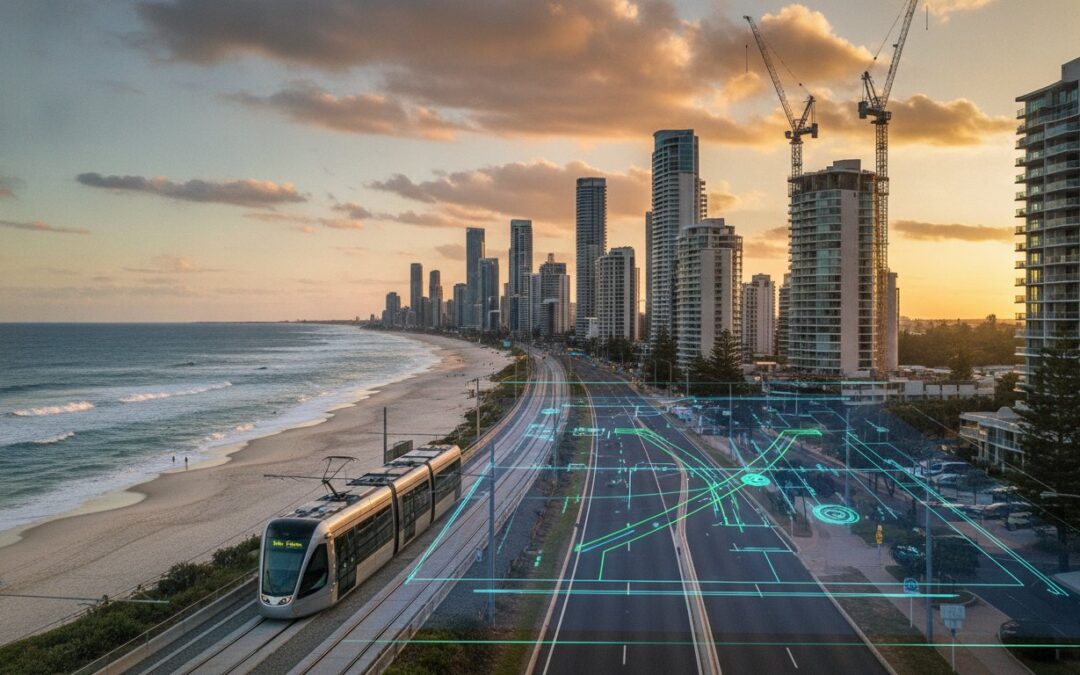
The $1.549 billion investment in the Gold Coast Light Rail Stage 3 Broadbeach South to Burleigh Heads extension represents a fundamental shift in the city’s urban planning framework. With passenger services expected to begin in mid-2026, the 6.7 km of dual track and eight new stations directly impact every development site along the Gold Coast Highway. You’re likely facing increased complexity in securing planning approvals as the City of Gold Coast adjusts its expectations for Traffic Impact Assessments (TIAs) and site access protocols.
Securing successful development outcomes requires more than just acknowledging the new infrastructure; it demands precise technical execution. This article provides a comprehensive technical overview of the GCLR Stage 3 extension and its critical implications for traffic engineering, site access, and development approvals. We will examine the specific engineering challenges of this corridor, from performing compliant swept path analysis on constrained sites to utilizing data-driven car parking demand assessments to optimize project feasibility.
Key Takeaways
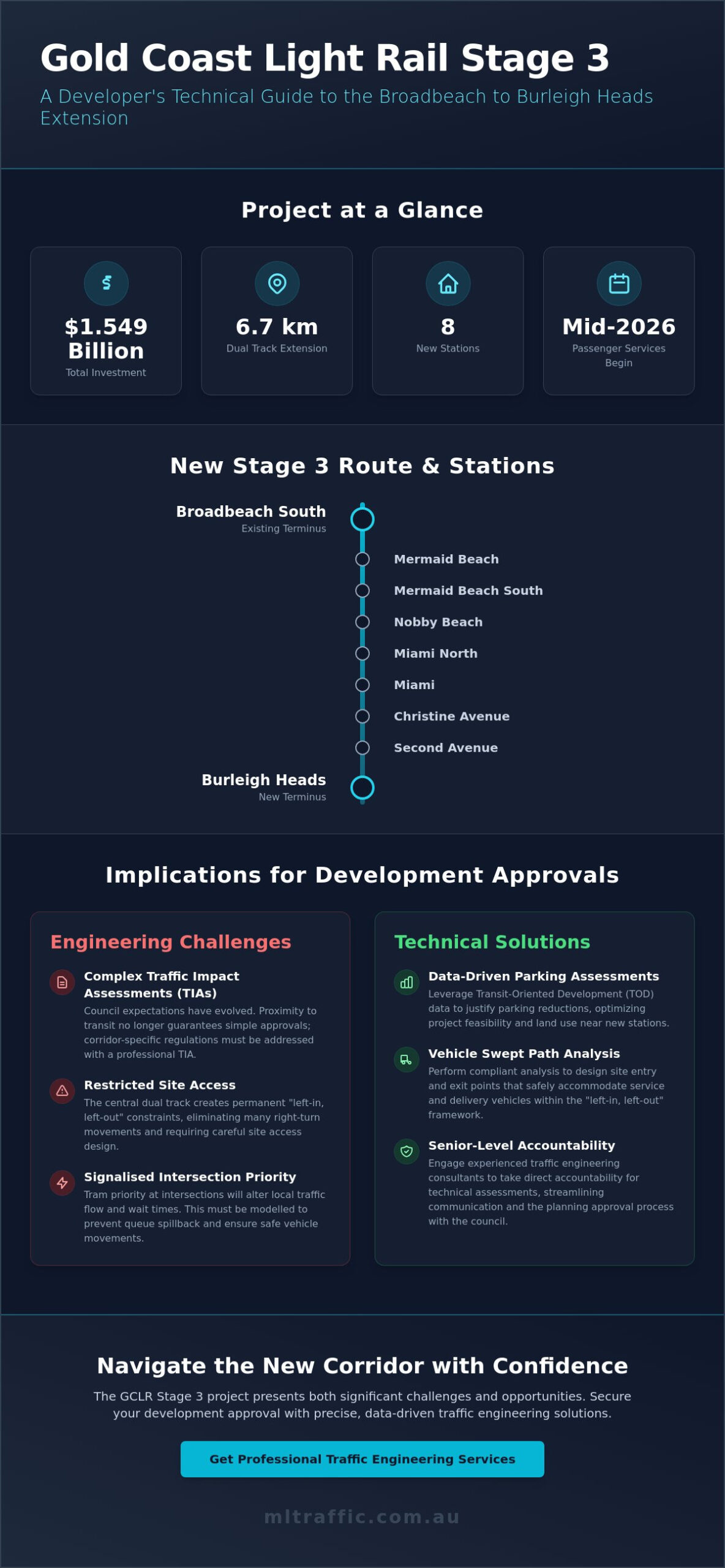
- Understand the technical scope of the Gold Coast Light Rail Stage 3 Broadbeach South to Burleigh Heads extension, including the 6.7km dual-track alignment and the locations of the eight new stations.
- Learn why proximity to high-frequency transit does not negate the requirement for a professional Traffic Impact Assessment (TIA) Report to address corridor-specific council regulations.
- Identify strategies for managing “left-in, left-out” access constraints using Vehicle Swept Path Analysis to ensure compliant site entry and exit for service vehicles.
- Discover how to leverage transit-oriented development data to optimize Car Parking Demand Assessments and justify parking reductions for projects near the new light rail stations.
- Recognize the importance of direct senior-level accountability in technical assessments to streamline the planning approval process for developments along the new corridor.
Gold Coast Light Rail Stage 3: Broadbeach South to Burleigh Heads Overview
The Gold Coast Light Rail Stage 3 Broadbeach South to Burleigh Heads extension is a 6.7km dual-track infrastructure project that connects the existing terminus at Broadbeach South to the southern hub of Burleigh Heads. Major construction commenced in July 2022; passenger services are scheduled to begin in mid-2026. This timeline is critical for developers currently in the design or application phase. Projects being planned today will open into a significantly different transport environment. The Gold Coast Highway is transitioning from a traditional arterial road into a complex multi-modal transit corridor.
The extension introduces eight new stations strategically placed to serve key coastal communities:
- Mermaid Beach
- Mermaid Beach South
- Nobby Beach
- Miami North
- Miami
- Christine Avenue
- Second Avenue
- Burleigh Heads
Project Scope and Strategic Importance
The total project investment is $1.549 billion. This represents a major partnership between the Australian Government, which contributed $395.6 million, the Queensland Government, providing $1.043 billion, and the City of Gold Coast. Once this stage is operational, the Gold Coast Light Rail (G:link) network will span 27km from Helensvale to Burleigh Heads, featuring 27 stations in total. The project adds five new light rail vehicles to the fleet to maintain high-frequency service intervals across the 23-tram system. This infrastructure is a response to forecast population growth; it aims to manage regional road demand by shifting commuters from private vehicles to high-capacity transit. Since opening in 2014, the network has facilitated over 60 million paid passenger trips, proving the technical and commercial viability of integrated transport solutions.
Station Locations and Transit-Oriented Hubs
The placement of stations at Christine Avenue and Miami North serves as a catalyst for high-density residential and commercial growth. These stations are designed as transit-oriented hubs that encourage urban consolidation and active transport. To support the expanded fleet, the project includes an upgrade to the existing depot and significantly expanded stabling facilities. For developers, these hubs present opportunities for optimized car parking demand assessments and potentially reduced parking requirements based on high transit accessibility. However, the engineering reality of a dual track in the center of the Gold Coast Highway creates permanent physical constraints. Site access must now account for the removal of certain right-turn movements. This makes vehicle swept path analysis and detailed intersection analysis essential for any development application within the corridor to ensure compliance with changed traffic flow patterns.
Technical Infrastructure and Multi-Modal Transport Integration in 2026
The Gold Coast Light Rail Stage 3 Broadbeach South to Burleigh Heads project is a complete reconfiguration of the Gold Coast Highway’s technical infrastructure. It moves beyond simple track installation to create a high-capacity, multi-modal corridor. According to the City of Gold Coast’s light rail information, this integration is a key component of the Transport Strategy 2031. It necessitates a shift from traditional car-centric traffic modelling to sophisticated Transit-Oriented Development (TOD) assessments that prioritize public transport efficiency and pedestrian safety.
Signalised Intersection Upgrades
Retrofitting the existing Gold Coast Highway requires precise engineering of signalised traffic intersections along the 6.7km corridor. Signalised priority is the mechanism that ensures tram reliability without crippling side-street access. These systems use real-time data to adjust light timings, allowing trams to maintain their schedule. For developers, this means local traffic flow and wait times on side streets will be dictated by tram frequency. The civil engineering challenge involves balancing these priority phases while maintaining safe sight distances and preventing vehicle queues from spilling back into the dual-track light rail area.
Bus and Rail Interchange Engineering
The project includes new light rail-bus interchanges at Miami and Burleigh Heads. These hubs are designed for seamless passenger transfers to reduce private vehicle reliance. Engineering these interchanges requires rigorous Intersection Analysis to manage high-volume bus movements alongside light rail vehicles. The Burleigh Heads interchange must accommodate high-capacity buses within a constrained footprint. Designers use vehicle swept path analysis to verify that these buses can maneuver safely without encroaching on pedestrian zones or light rail infrastructure. This technical precision is essential for maintaining the operational integrity of the entire 27km network.
Safety for active transport users is a core requirement of the 2026 operational plan. The corridor features upgraded signalised pedestrian crossings near every station, integrated into the wider traffic signal network. These crossings ensure safe access to the center-running tracks. Additionally, the project provides improved bicycle facilities and active transport links. These facilities connect the new stations to existing coastal paths, creating a continuous network for cyclists. By integrating these modes, the project aims to manage the Gold Coast’s growth while providing a sustainable alternative to the private motor vehicle.
Impact on Traffic Impact Assessment (TIA) and Development Applications
Projects along the Gold Coast Light Rail Stage 3 Broadbeach South to Burleigh Heads corridor face a specific set of regulatory hurdles. A Traffic Impact Assessment (TIA) is a critical requirement for any development application (DA) in this precinct. Some stakeholders assume that proximity to high-frequency light rail removes the need for detailed traffic reporting. This is incorrect. While the light rail provides a sustainable transport alternative, the physical presence of the tracks and changed intersection configurations necessitates a rigorous analysis of how a development interacts with the new road environment. Council and State authorities require proof that your project won’t compromise the safety or efficiency of the Gold Coast Highway.
Redefining Parking Demand Near Light Rail
Transit-Oriented Development (TOD) status fundamentally changes how car parking demand is calculated. Council planning schemes often permit parking rate reductions for sites within 400m to 800m of a light rail station. To secure these reductions, developers must provide a professional Car Parking Demand Assessment. This report must demonstrate that the proposed parking supply is sufficient for the specific land-use, taking into account the increased modal shift toward public transport. Crucially, any parking provided must still achieve full AS 2890.1 compliance. This standard governs the internal geometry of the car park, including bay dimensions and aisle widths, ensuring that the facility remains functional even with a reduced footprint.
Regulatory Compliance and TMR Referral
The Gold Coast Highway is a State Controlled Road. This status means that development applications near the Gold Coast Light Rail Stage 3 Broadbeach South to Burleigh Heads extension are subject to Department of Transport and Main Roads (TMR) referral. Engaging a Traffic Engineer early in the process is vital for addressing TMR’s specific safety and efficiency criteria. The light rail alignment is designated as a “protected corridor.” Any proposed land-use change must prove it won’t interfere with the G:link’s operational integrity. A Statement of Environmental Effects for these projects must include detailed traffic and transport components. These components must address:
- Vehicle access and egress safety within the constrained corridor.
- Impact on existing and future traffic volumes at modified intersections.
- Pedestrian and cyclist connectivity to station hubs.
- Compliance with the State Development Assessment Provisions (SDAP) for transport infrastructure.
Failure to provide these technical details often leads to lengthy Information Requests (IRs) or outright refusal. A professional TIA report provides the evidence needed to satisfy both local Council and State Government requirements, ensuring the project moves through the planning phase without unnecessary delays.
Optimising Site Access and Swept Path Analysis for Transit-Oriented Developments
The Gold Coast Light Rail Stage 3 Broadbeach South to Burleigh Heads extension introduces permanent physical barriers in the center of the Gold Coast Highway. This configuration limits many adjacent sites to “left-in, left-out” access. Engineers must solve the challenge of how heavy vehicles, including refuse trucks and delivery vans, maneuver within these restricted envelopes without crossing into the light rail’s path or blocking through-traffic. Maintaining operational efficiency requires a precise understanding of the new road geometry and the specific constraints imposed by the dual-track alignment.
Swept Path Analysis for Constrained Sites
Ensuring operational efficiency on these sites requires Swept Path Analysis. Swept Path Analysis is the technical simulation of a vehicle’s widest turning arc to ensure zero-collision access. Using AutoTURN software, we model the specific movements of garbage trucks and delivery vehicles to verify they can enter and exit in a forward direction. Compliance with AS 2890.2 is mandatory for heavy vehicle access in high-density coastal areas. This standard ensures that loading bays and service areas are functional and safe. Beyond horizontal clearance, we perform a Driveway Ramp Grade Assessment to prevent vehicle scraping on steep or complex entries. Sight distance requirements are equally critical. New light rail infrastructure, such as station furniture or signaling boxes, must not obstruct a driver’s view of oncoming traffic when exiting a private driveway. We analyze these sight lines to ensure they meet national safety standards before submitting any application to Council.
Managing Construction Traffic and TGS
The construction phase of a private development near the Gold Coast Light Rail Stage 3 Broadbeach South to Burleigh Heads corridor requires meticulous planning. You must coordinate private site traffic with the ongoing $1.549 billion public works. A Traffic Guidance Scheme (TGS) is a prerequisite for any work impacting the road reserve. This scheme works in tandem with a comprehensive Traffic Management Plan (TMP) to ensure the safety of workers, motorists, and pedestrians. Managing these overlapping construction timelines prevents site bottlenecks and avoids costly work stoppages. A well-designed TGS accounts for reduced lane widths and temporary changes to traffic flow, ensuring that construction vehicles can access your site without disrupting the broader transport network.
If you need a compliant access design for a site along the new corridor, contact our principals for a Vehicle Swept Path Analysis today.
Securing Planning Approval with Professional Traffic Engineering Services
The Gold Coast Light Rail Stage 3 Broadbeach South to Burleigh Heads extension creates a high-stakes environment for development approvals. Navigating the intersection of light rail operations and private site access requires senior-level technical proficiency. ML Traffic Engineers Australia provides a no-gatekeepers approach to traffic engineering. This means the senior principal who initiates your project is the one performing the technical work. This direct access to leadership ensures that complex engineering challenges are addressed with the precision required to satisfy both the City of Gold Coast and the Department of Transport and Main Roads (TMR).
A comprehensive traffic report serves as a defensive document against Council RFI (Request for Information) delays. By anticipating regulatory concerns regarding site access, parking reductions, and corridor safety, we streamline the approval process. Our reports are designed to be authoritative and compliant, providing the technical evidence needed to support your project’s feasibility. Developers don’t have to manage the bureaucracy of junior staff or impersonal firms; they deal directly with the experts responsible for the technical output.
The ML Traffic Engineers Australia Advantage for National Developers
We bring over 15 years of experience in supporting complex planning approvals across Australia. Our firm manages a diverse range of project environments and land-use categories, including:
- High-density residential towers and mixed-use precincts.
- Commercial office developments and retail hubs.
- Industrial warehouses and logistics centers.
- Childcare centers and medical facilities.
- Educational institutions and community infrastructure.
Our commitment to technical excellence ensures that every report meets both Australian Standards and specific local requirements. We understand the nuances of state-controlled road regulations and the specific constraints of the Gold Coast Light Rail Stage 3 Broadbeach South to Burleigh Heads corridor. This national experience allows us to apply proven strategies from other major transit projects to your local development application.
Next Steps for Your Development Application
Early engagement with a traffic consultant is essential during the feasibility stage of any project. Identifying access constraints or parking demand issues early prevents costly design revisions later in the planning cycle. Our process for obtaining a quote for a Traffic Impact Assessment or Vehicle Swept Path Analysis is direct and transparent. We provide clear statements of purpose and a structured breakdown of technical services. This results-oriented approach focuses on securing your planning approval without unnecessary narrative or delay.
If you require an authoritative assessment for a project near the new light rail corridor, consult with our experienced Traffic Engineers. We are ready to provide the technical expertise needed for your national projects. Contact ML Traffic Engineers Australia for a professional traffic assessment for your next development application.
Securing Your Development’s Future in the Transit Corridor
The Gold Coast Light Rail Stage 3 Broadbeach South to Burleigh Heads extension fundamentally redefines the Gold Coast Highway’s operational environment. Success for developers along this 6.7km corridor depends on technical precision and early engagement with transport authorities. You’ve seen how left-in, left-out constraints and reduced parking rates require sophisticated modelling to satisfy Council and TMR requirements. Securing your development’s future in this transit corridor demands more than just basic reporting; it requires a deep understanding of multi-modal integration.
ML Traffic Engineers Australia offers 15+ years of expert traffic engineering consultancy. We ensure direct principal-level involvement in every report, providing the accountability needed for complex planning approvals. Our national experience with Australian Standards (AS 2890) compliance ensures your site design is functional, safe, and ready for regulatory scrutiny. Don’t let RFI delays or access constraints compromise your project’s feasibility.
Request a Professional Traffic Assessment for Your Development to ensure your application meets the rigorous standards of this evolving transit precinct. We’re ready to help you navigate the complexities of the new transport landscape and achieve a successful outcome for your project.
Frequently Asked Questions
Will the Gold Coast Light Rail Stage 3 reduce the amount of parking I need to provide in my development?
Yes, Council planning schemes often permit reduced parking rates for sites located within 400m to 800m of a new station. To secure these reductions, you must provide a professional Car Parking Demand Assessment. This report justifies lower ratios by analyzing the modal shift toward public transport while ensuring the remaining supply meets the specific needs of your land-use type.
How does the light rail corridor affect my property’s driveway access?
The installation of the dual-track center alignment typically restricts property access to left-in and left-out movements only. Right turns across the light rail tracks are generally prohibited for safety reasons. You’ll need to demonstrate that your site’s access and egress points can operate safely within these new constraints, often requiring detailed intersection analysis to satisfy TMR and Council requirements.
Is a Traffic Impact Assessment (TIA) mandatory for all developments near the new stations?
A Traffic Impact Assessment is a standard requirement for most developments within the Gold Coast Light Rail Stage 3 Broadbeach South to Burleigh Heads corridor. Because the Gold Coast Highway is a State Controlled Road, TMR must verify that your project doesn’t compromise the safety or efficiency of the light rail. A TIA provides the technical evidence needed to move through the referral process without delays.
Can a swept path analysis help me get council approval for a small commercial site?
Vehicle Swept Path Analysis is essential for demonstrating that delivery and refuse vehicles can safely access constrained commercial sites. By using AutoTURN software to simulate vehicle movements, we prove that your site can accommodate heavy vehicle turns without encroaching on pedestrian zones or the light rail corridor. This technical proof is often a decisive factor in securing approval for sites with limited footprints.
What happens if my development construction overlaps with the Light Rail Stage 3 works?
Developers must coordinate their site activities with the ongoing GCLR Stage 3 construction schedule to avoid logistical conflicts. You’ll need a Traffic Guidance Scheme (TGS) and a comprehensive Traffic Management Plan (TMP) to manage site access. These documents ensure that construction vehicles can enter and exit your property safely without disrupting the broader public infrastructure works or local traffic flow.
Do I need a separate report for TMR if my site is on the Gold Coast Highway?
You don’t need a separate report, but your TIA must specifically address the State Development Assessment Provisions (SDAP). Since the Gold Coast Highway is a State Controlled Road, TMR acts as a referral agency. Your traffic report must provide data on how your development interacts with the Gold Coast Light Rail Stage 3 Broadbeach South to Burleigh Heads infrastructure to satisfy state safety criteria.
What are the specific parking standards for developments near high-frequency transit?
Parking standards are dictated by the local planning scheme’s Transit-Oriented Development (TOD) overlays and national standards like AS 2890.1. While TOD overlays may allow for fewer spaces, the internal geometry of the car park must still comply with Australian Standards. This includes bay dimensions, aisle widths, and ramp grades, ensuring that even a reduced parking facility remains fully functional and safe for users.
How long does it take to prepare a Traffic Impact Assessment report for a DA?
Preparation times for a professional TIA report generally range from two to four weeks. This timeline depends on the complexity of the site and the availability of current traffic data. Engaging a consultant during the feasibility stage allows for the early identification of access issues, ensuring the final report is ready for submission alongside your initial development application to avoid unnecessary Information Requests.

Disclaimer
The content on www.mltraffic.com.au, including all technical articles, guides, and resources, is provided for general informational and educational purposes only. It is not intended to constitute professional advice in traffic engineering, transportation planning, development approvals, or any other technical or legal field.
While ML Traffic Engineers makes every reasonable effort to ensure the accuracy, completeness, and timeliness of the information published, we do not provide any warranties or representations (express or implied) regarding its reliability, suitability, or availability for any particular purpose. Any reliance you place on the content is strictly at your own risk.
In no event shall ML Traffic Engineers, its directors, employees, authors, or affiliates be liable for any direct, indirect, incidental, special, consequential, or punitive damages (including, without limitation, loss of profits, data, or business opportunities) arising out of or in connection with the use of, or inability to use, any information provided on this website.
The articles and guides on this site are not a substitute for engaging a qualified, registered professional traffic engineer (such as an NPER or RPEQ engineer) to assess your specific project requirements. For tailored advice, compliance assessments, or traffic engineering services, please contact a competent professional.
This disclaimer may be updated from time to time without notice. By accessing or using this website, you agree to be bound by the most current version of this disclaimer.
