

A single oversight in your traffic management strategy can result in an immediate site shutdown and fines exceeding A$10,000 under the Work Health and Safety Act 2011. For developers, the technical complexity of AS 1742.3 often leads to costly delays and bureaucratic friction. You likely find that the distinction between a Traffic Guidance Scheme (TGS) and a full Traffic Management Plan (TMP) causes confusion during the council approval process. As professional traffic engineering consultants in Gold Coast, we know that technical errors in site setup compromise both safety and project timelines.
It’s vital to resolve these compliance issues before the first vehicle enters the site. This guide outlines the exact steps required to execute a compliant, safe, and efficient traffic management plan on your Australian construction site. You’ll gain a clear roadmap for site setup that ensures 100% compliance with AS 1742.3 and targets zero traffic-related incidents. We’ll examine the critical differences between TGS and TMP documents and provide a technical checklist for seamless implementation from day one.
Key Takeaways
- Understand why successful implementation requires treating the Traffic Management Plan as a dynamic safety priority rather than a mere administrative requirement.
- Learn the sequential five-step process for physical site setup, including critical pre-start verification to ensure signage matches real-time conditions.
- Discover how traffic engineering consultants in Gold Coast apply swept path analysis to ensure heavy vehicles navigate your site without causing property damage.
- Identify the necessary frequency for site audits and protocol adjustments as your project transitions from excavation through to the final fit-out phase.
- Mitigate professional liability by utilizing RPEQ-certified engineering oversight instead of relying on generic, high-risk traffic plan templates.
Table of Contents
-
The Fundamentals of Implementing a Traffic Management Plan on Site
-
5 Steps to Successfully Executing Your Site Traffic Controls
The Fundamentals of Implementing a Traffic Management Plan on Site
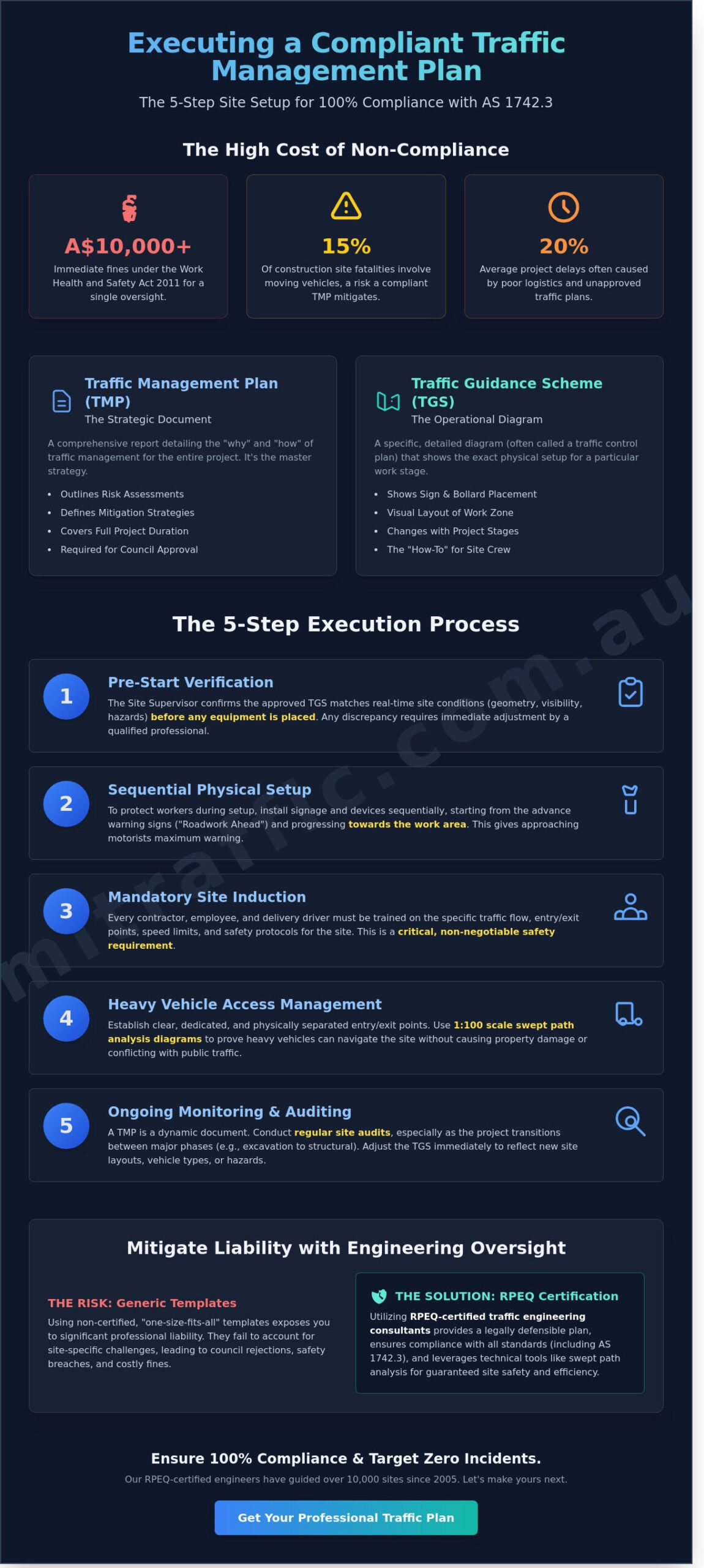
Implementing a Traffic Management Plan (TMP) is the technical process of translating a strategic traffic report into physical controls and operational protocols. It isn’t just a document for Council approval; it’s the operational framework that ensures site safety and legal compliance. Many developers fail because they treat the TMP as a "tick-box" exercise. This approach ignores the reality that roughly 15% of construction site fatalities involve moving vehicles. Engaging experienced traffic engineering consultants in Gold Coast ensures your site maintains legal access while meeting strict local government criteria.
To better understand the professional roles involved in this process, watch this helpful video:
Successful implementation requires a clear distinction between high-level strategy and daily operational requirements. The strategy dictates the overall approach to road traffic control principles. Daily operations involve the actual deployment of accredited personnel and physical hardware. Without this distinction, site managers often find themselves with a plan that looks good on paper but fails to account for heavy vehicle swept paths or peak-hour congestion. A well-executed plan prevents the 20% project delays often caused by poor logistics management.
TMP vs. TGS: Knowing the Difference
A TMP is the strategic document. It outlines the "why" and "how" of traffic flow, detailing risk assessments and mitigation strategies for the entire project duration. In contrast, the Traffic Guidance Scheme (TGS) is the specific visual diagram showing the exact placement of signs, bollards, and arrow boards for a specific work stage. You cannot implement a TGS effectively without the strategic context of a TMP to justify the specific control measures used.
Regulatory Standards and Compliance
All site traffic controls in Australia must adhere to AS 1742.3 (Traffic control for works on roads). This standard serves as the primary benchmark for safety and uniform signage across all states. Beyond national standards, developers must navigate state-specific guidelines and local council requirements, which vary significantly between jurisdictions. For a detailed professional assessment of your site’s specific regulatory needs, you can review the professional services provided by traffic engineering consultants in Gold Coast to ensure full compliance and avoid costly work-stop orders.
5 Steps to Successfully Executing Your Site Traffic Controls
Executing a Traffic Management Plan (TMP) requires technical precision. Since 2005, ML Traffic Engineers has provided expert guidance for over 10,000 sites, ensuring that theoretical plans translate into safe work zones. Developers must follow a disciplined five-step process to maintain compliance and protect site personnel. Professional traffic engineering services can help ensure these steps are integrated into your project from day one.
-
Pre-start verification: The Site Supervisor must verify that the current site conditions match the Traffic Guidance Scheme (TGS) before any signs are placed. If site geometry or visibility has changed since the plan’s inception, the TGS needs immediate adjustment by a qualified professional.
-
Physical setup: Signage and delineation must be placed sequentially, starting from the "Roadwork Ahead" sign and moving toward the work area. This protects workers during the setup phase by providing an early warning to approaching motorists.
-
Site induction: Every contractor and delivery driver must be trained on the specific traffic movements allowed on-site. This isn’t just a recommendation; it’s a critical safety requirement.
-
Access management: Establish clear, dedicated entry and exit points for heavy vehicles. Using 1:100 scale swept path analysis ensures that trucks can maneuver without striking infrastructure or encroaching on pedestrian zones.
-
Pedestrian separation: Create physical barriers between foot traffic and plant machinery. Relying on paint or tape is insufficient for high-risk zones where heavy machinery operates.
Effective Work Zone Traffic Management involves constant monitoring to ensure controls remain effective throughout the project lifecycle. Many developers work with traffic engineering consultants in Gold Coast to audit these setups regularly, ensuring they meet the stringent requirements of AS 1742.3 and local council regulations.
Signage and Delineation Setup
Correct placement of "Roadwork Ahead" and speed reduction signs is vital for driver reaction times. Signs must be placed at specific intervals defined by the speed environment. Use T-top bollards for short-term delineation and water-filled barriers for high-impact zones to create effective lane tapers. All signage must be clean, visible, and meet the reflectivity standards of AS 1906.1. If a sign is damaged or dirty, it loses its legal standing and safety efficacy, potentially exposing the developer to liability.
Site Induction and Communication
Incorporate the TMP into the daily pre-start toolbox talk. Each morning, the site supervisor should review the day’s expected heavy vehicle arrivals and any changes to site access. Clear radio communication protocols are essential. Drivers should announce their arrival 500 metres from the gate to ensure the entry is clear. Traffic controllers manage the interface with public roads, while site supervisors control internal movements. If you need assistance with site-specific planning, you can contact our senior engineers directly for professional advice. Our traffic engineering consultants in Gold Coast ensure your site communication is as robust as your physical controls.
Addressing Technical Challenges: Swept Paths and Parking
Theoretical plans frequently fail the moment a 19-metre semi-trailer arrives at the site gate. While a site layout might look functional on a 2D drawing, it often neglects the physical realities of vehicle articulation and overhang. This oversight leads to property damage, blocked intersections, and costly project delays. Professional traffic engineering consultants in Gold Coast prevent these issues by applying rigorous technical modeling to the temporary works phase.
A common objection is that a formal plan adds "red tape" that slows down the job. In reality, a site with clear, pre-calculated movements operates faster. When drivers know exactly where to turn and how much clearance they have, you eliminate the 20-minute bottlenecks caused by multi-point turns in tight spaces. Logistics efficiency is a direct result of technical precision; it’s about moving vehicles through the gate without hesitation.
Utilising Swept Path Analysis on Site
A swept path is the actual envelope a vehicle requires to manoeuvre safely. We use AutoTURN software to generate these diagrams, ensuring that every delivery vehicle, from a 6.4-metre SRV to a 19-metre AV, can access the site without incident. For more technical context, refer to our Swept Path Analysis Guide.
-
Fencing Placement: Use AutoTURN diagrams to dictate exactly where temporary site fencing and hoarding are installed. Don’t guess the clearance; use the software to set the boundary.
-
Live Site Integration: Overlay swept paths onto specific construction stages. As the building footprint grows, the available turning space shrinks. Your plan must account for this reduction in real-time.
-
Conflict Point Identification: Identify where vehicle paths cross pedestrian walkways or plant operating zones to implement physical separation or spotter protocols.
Managing On-Site Parking and Access
Contractor parking is a major friction point for local councils and residents. Failing to manage this demand results in heavy fines and strained community relations. Our approach involves a data-driven car parking demand assessment during peak construction phases to ensure the surrounding road network remains functional and clear of overflow vehicles.
-
AS 2890.1 Compliance: All temporary parking layouts must adhere to Australian Standards for bay dimensions and aisle widths to prevent site gridlock.
-
Ramp Grades: Maintain appropriate driveway ramp grades during temporary works. Low-clearance vehicles and fully loaded trucks risk bottoming out or losing traction if transitions are too steep.
-
Clearance Verification: Ensure overhead gantries and temporary structures accommodate the maximum height of arriving plant and machinery.
By engaging qualified traffic engineering consultants in Gold Coast, developers ensure their site logistics are grounded in physics rather than optimism. This technical rigour protects the project’s timeline and the developer’s bottom line.
Monitoring, Auditing, and Adapting the Plan
A Traffic Management Plan (TMP) is a living document. It doesn’t remain static once council grants approval. As a project transitions through its lifecycle, the physical environment and risk profile change. Safety isn’t static; it requires constant vigilance and adjustment. Engaging traffic engineering consultants in Gold Coast ensures your site remains compliant from the first day of excavation to the final fit-out.
The "competent person" on site, typically a supervisor with relevant traffic management qualifications, must conduct daily inspections. These checks confirm that the Traffic Guidance Scheme (TGS) is implemented exactly as designed. If site conditions change, such as a new trench opening or a change in site access points, the plan must be updated. Minor adjustments can often be noted in a site diary, but significant deviations require a revised TGS to ensure your council permit remains valid.
Conducting Daily Site Audits
Daily audits are the primary defense against site accidents. Site managers should use a structured checklist every morning before work begins. This includes verifying that signs are stable, visible, and haven’t been knocked over by wind or machinery. You must also check for "near-miss" trends. If drivers are consistently braking hard at a specific merge point, the taper length likely needs adjustment. Maintaining a detailed site diary is mandatory. It provides a legal record that you’ve met your duty of care, which is vital if an incident occurs on or near your perimeter.
-
Check all signage for cleanliness and reflectivity.
-
Ensure traffic cones and bollards follow the spacing specified in the TGS.
-
Verify that pedestrian walkways are clear of debris and trip hazards.
-
Document any unauthorized vehicle entries or safety breaches.
Adapting to Project Stages
Traffic flow requirements shift dramatically between project phases. During bulk earthworks, the focus is on heavy plant movement and spoil removal. Once you move into the structural phase, the priority shifts to concrete pours and crane placements. These activities often require temporary road closures or lane diversions for utility connections. You can learn more about managing these transitions in our Pillar Guide on TMPs.
When transitioning between stages, our traffic engineering consultants in Gold Coast recommend a formal review of the TMP. This ensures that the original assumptions about vehicle volumes and types still hold true. If your project timeline shifts, you may also need to account for seasonal traffic changes or local events that weren’t present during the initial planning phase.
Ensure your project remains compliant and safe through every stage of construction. Contact ML Traffic Engineers for expert site auditing and plan adaptations.
Ensuring Success with Professional Engineering Oversight
Generic traffic plans are a liability for complex Australian developments. Using "copy-paste" templates often results in immediate rejection by local authorities or, worse, safety incidents that halt production. Qualified traffic engineering consultants in Gold Coast provide the technical rigour needed to navigate these risks effectively. Certification from a Registered Professional Engineer of Queensland (RPEQ) isn’t just a bureaucratic hurdle; it’s essential liability protection. It shifts the professional responsibility for the design onto the engineer, ensuring the plan complies with AS 2890.1 and local council requirements.
Professional oversight significantly reduces the likelihood of council-imposed work stoppages. These delays are expensive. In the Australian construction industry, a forced shutdown can cost a developer between A$5,000 and A$20,000 per day in lost productivity and equipment hire. At ML Traffic Engineers, we provide direct access to the principals who design your plan. You won’t be handed off to junior staff. This direct line of communication ensures that the engineer who understands your site’s specific constraints is the one answering council queries.
-
Compliance: Every plan meets current Australian Standards and local government guidelines.
-
Accountability: RPEQ certification provides a legal safety net for developers.
-
Efficiency: Accurate plans lead to faster approvals and fewer on-site revisions.
-
Cost Control: Avoiding work stoppages protects your project’s bottom line.
The Value of Expert Consultation
Our firm operates on a transparent philosophy: the consultant who provides the quote, does the work. This ensures that senior expertise is applied to every Traffic Impact Assessment (TIA) and Traffic Guidance Scheme. In a 2022 project involving a high-density residential development, our detailed TIA identified a critical conflict between heavy vehicle swept paths and pedestrian zones. By identifying this during the design phase, the developer avoided a 6-month delay that would’ve occurred if the issue was discovered during the construction audit. This technical accuracy is what sets professional traffic engineering consultants in Gold Coast apart from low-cost, template-based providers.
Next Steps for Your Development
Timing is critical in project management. You should engage a traffic engineer during the initial design phase or as soon as you receive a Request for Further Information (RFI) from the council. We’ve been trading since 2005 and have completed over 10,000 sites, giving us the experience to handle everything from simple driveway assessments to complex multi-stage construction traffic plans. It’s best to secure a site-specific Traffic Guidance Scheme before any boots hit the ground.
Don’t risk your project timeline with substandard documentation. For immediate assistance with your development application or site management requirements, Contact ML Traffic Engineers to speak directly with our senior consultants.
Secure Compliance and Site Safety with Expert Traffic Oversight
Effective site traffic management relies on technical precision and rigorous auditing. You must address complex variables like vehicle swept paths and parking demand to maintain safety and operational flow. Relying on professional engineering oversight isn’t just a regulatory requirement; it’s a strategy to mitigate risk and prevent project delays. ML Traffic Engineers provides this certainty through over 15 years of dedicated traffic engineering experience. We’ve successfully assessed 10,000+ sites across Australia, ensuring every development meets stringent Australian Standards. You’ll work directly with senior RPEQ qualified engineers who handle your project personally from the first quote to the final assessment.
As experienced traffic engineering consultants in Gold Coast, we provide the technical expertise needed to navigate local council requirements and complex site constraints. Our hands-on approach means the consultant who quotes your job is the one who completes the work. This direct accountability ensures your Traffic Management Plan is accurate, compliant, and ready for implementation. Get a Professional Traffic Management Plan for Your Site. We look forward to helping you deliver a safe and successful project.
Frequently Asked Questions
How often should a site traffic management plan be reviewed?
A site traffic management plan requires review every 6 months or immediately when site conditions change. If a project phase shifts or a new hazard appears, the document must be updated to reflect current risks. Regular audits ensure compliance with AS 1742.3. Our traffic engineering consultants in Gold Coast recommend monthly internal checks to verify that all physical controls match the approved documentation.
Who is legally responsible for implementing a TMP on an Australian construction site?
The Person Conducting a Business or Undertaking (PCBU), typically the principal contractor, holds legal responsibility for implementing the TMP under the Work Health and Safety Act 2011. They must ensure the plan’s followed and that all workers are trained. Failure to maintain a safe site can result in Category 1 penalties exceeding A$3,000,000 for corporations or individual imprisonment for serious breaches.
What is the difference between a Traffic Management Plan and a Traffic Guidance Scheme?
A Traffic Management Plan (TMP) is a comprehensive document outlining the project’s broad strategy, risk assessments, and stakeholder requirements. In contrast, a Traffic Guidance Scheme (TGS), previously called a Traffic Control Plan (TCP), is a technical diagram showing the exact placement of signs and cones. While the TMP explains the strategy and logic, the TGS provides the visual map for on-site execution.
Do I need a new TMP for every stage of my construction project?
You need a revised TMP or a new TGS for every stage that significantly alters vehicle or pedestrian flow. A project with 4 distinct phases, such as excavation, structural framing, fit-out, and landscaping, usually requires separate traffic assessments. Each stage introduces different vehicle types and access points. Traffic engineering consultants in Gold Coast ensure each phase meets local council requirements and Australian Standards to avoid project delays.
What happens if our site traffic plan does not meet Australian Standards?
Non-compliance with AS 1742.3 or AS 2890.1 leads to immediate WorkSafe improvement notices or site shutdowns. If an accident occurs, a non-compliant plan often voids insurance coverage and exposes the developer to massive civil liability. Regulatory fines for safety breaches in Queensland can reach A$50,000 for individuals and significantly more for businesses. It’s safer to ensure all plans are RPEQ certified from the start.
Can a developer create their own traffic management plan?
Developers can technically draft a plan, but most Australian councils and road authorities require TMPs to be signed off by a qualified person with Level 2 or Level 3 Traffic Management Accreditation. In Queensland, complex designs often require an RPEQ (Registered Professional Engineer of Queensland) certification. Without these credentials, the plan will likely be rejected during the Development Application (DA) process by the assessing authority.
What specific signage is required for a standard site entrance?
A standard site entrance requires "Work Site Ahead" (T1-1) and "Trucks Entering" (T2-25) signs as per AS 1742.3. You must also display clear "Entry" and "Exit" signage, along with a 10 km/h or 20 km/h speed limit within the site boundary. All signs must be retroreflective for visibility. If the entrance crosses a footpath, "Pedestrians Watch Your Step" or "Watch for Vehicles" signs are mandatory for public safety.
How do I manage pedestrian safety when the site borders a public footpath?
Manage pedestrian safety by installing physical barriers like 1.8-meter-high hoarding or Class A/B gantries for overhead protection. You must maintain a minimum clear width of 1.2 meters for accessible paths of travel according to disability standards. If vehicles cross the footpath, use a qualified traffic controller to act as a spotter. This ensures a zero-harm interface between heavy machinery and the pedestrians passing the site.
Which areas do you cover?
We are traffic engineers servicing Advancetown, Alberton, Arundel, Ashmore, Austinville, Beechmont, Benobble, Benowa, Biddaddaba, Biggera Waters, Bilinga, Birnam, Bonogin, Broadbeach, Broadbeach Waters, Bundall, Burleigh Heads, Burleigh Waters, Carrara, Cedar Creek, Clagiraba, Clear Island Waters, Coolangatta, Coombabah, Coomera, Currumbin, Currumbin Valley, Currumbin Waters, Elanora, Gaven, Gilberton, Gilston, Guanaba, Helensvale, Highland Park, Hollywell, Hope Island, Jacobs Well, Kingsholme, Labrador, Lower Beechmont, Luscombe, Main Beach, Maudsland, Mermaid Beach, Mermaid Waters, Merrimac, Miami, Molendinar, Mount Nathan, Mudgeeraba, Natural Bridge, Nerang, Neranwood, Norwell, Numinbah Valley, Ormeau, Ormeau Hills, Oxenford, Pacific Pines, Palm Beach, Paradise Point, Parkwood, Pimpama, Reedy Creek, Robina, Runaway Bay, South Stradbroke, Southport, Southern Moreton Bay Islands, Springbrook, Stapylton, Steiglitz, Surfers Paradise, Tallai, Tallebudgera, Tallebudgera Valley, Tugun, Upper Coomera, Varsity Lakes, Willow Vale, Wongawallan, Woongoolba, Worongary, Yatala

Disclaimer
The content on www.mltraffic.com.au, including all technical articles, guides, and resources, is provided for general informational and educational purposes only. It is not intended to constitute professional advice in traffic engineering, transportation planning, development approvals, or any other technical or legal field.
While ML Traffic Engineers makes every reasonable effort to ensure the accuracy, completeness, and timeliness of the information published, we do not provide any warranties or representations (express or implied) regarding its reliability, suitability, or availability for any particular purpose. Any reliance you place on the content is strictly at your own risk.
In no event shall ML Traffic Engineers, its directors, employees, authors, or affiliates be liable for any direct, indirect, incidental, special, consequential, or punitive damages (including, without limitation, loss of profits, data, or business opportunities) arising out of or in connection with the use of, or inability to use, any information provided on this website.
The articles and guides on this site are not a substitute for engaging a qualified, registered professional traffic engineer (such as an NPER or RPEQ engineer) to assess your specific project requirements. For tailored advice, compliance assessments, or traffic engineering services, please contact a competent professional.
This disclaimer may be updated from time to time without notice. By accessing or using this website, you agree to be bound by the most current version of this disclaimer.
