

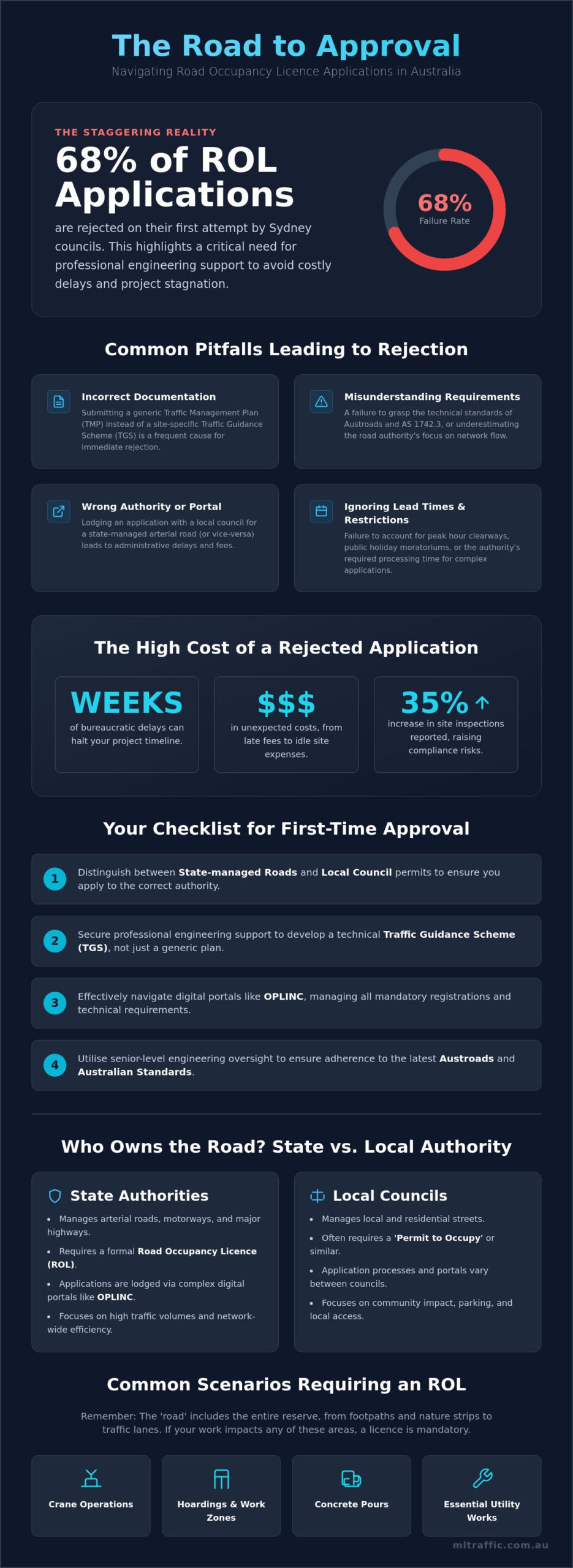
Did you know that approximately 68% of road occupancy licence applications submitted to Sydney councils are rejected on their first attempt? This staggering failure rate highlights why professional road occupancy license application support is no longer a luxury but a project necessity. When your construction timeline depends on occupying a public road, a single administrative error or an underspecified Traffic Guidance Scheme can trigger weeks of bureaucratic delays and unexpected costs. These setbacks often stem from a misunderstanding of the technical requirements demanded by Transport for NSW or local government authorities.
It is frustrating to watch your site stand idle while you wait for OPLINC approvals or struggle with portal errors. We recognise that the confusion between a general Traffic Management Plan and a site-specific TGS often leads to late application fees and project stagnation. This guide provides professional engineering insights to help you manage these complexities and secure fast, compliant approvals. We will outline how to handle road authority queries, ensure your documentation meets the latest Austroads Guide to Temporary Traffic Management standards, and keep your project on track while avoiding the 35% increase in site inspections reported this year.
Key Takeaways
- Distinguish between State-managed Road Occupancy Licences and local council permits to ensure your application is lodged with the correct road authority.
- Secure professional road occupancy license application support to integrate technical Traffic Guidance Schemes (TGS) with your broader construction traffic management requirements.
- Navigate the complexities of digital portals like OPLINC effectively, including managing multi-factor authentication and mandatory organisational registrations.
- Minimise project delays by accounting for critical lead times and restricted periods, such as peak hour clearways and public holiday moratoriums.
- Utilise senior-level engineering oversight to maintain technical continuity and ensure your project adheres to the latest Austroads and Australian Standards.
Understanding Road Occupancy Licence (ROL) Requirements in Australia
A Road Occupancy Licence (ROL) is a formal approval that allows you to occupy a public road for a set period. It’s a legal mandate under Australian road laws. Most developers don’t realise that ‘road’ covers the entire reserve, including footpaths and nature strips. If your work impacts any of these areas, you must have a licence. Occupying these spaces without approval isn’t just a site safety issue; it’s a criminal offence in many jurisdictions that carries heavy financial penalties. Your site can be shut down immediately if you’re found operating without the correct paperwork.
Road authorities prioritise network flow above all else. They won’t compromise the efficiency of the transport network just to meet your construction schedule. Effective road occupancy license application support involves demonstrating that your project can function while maintaining safe road traffic control. This often requires complex engineering data to satisfy the road manager that your presence won’t cause excessive congestion or safety hazards for the public.
To better understand this concept, watch this helpful video:
Common Scenarios Requiring an ROL
Construction projects often spill over into public space. You’ll need an ROL for:
- Crane operations and heavy plant mobilisation, especially when outriggers or slewing arcs extend over the road.
- Long-term hoarding placements or work zone establishments that take up parking or pedestrian space.
- Major concrete pours or deliveries that require temporary lane closures to accommodate heavy vehicles.
- Essential utility works like water, gas, and electrical connections that require trenching within the road reserve.
The Role of Road Authorities (State vs. Local)
The application pathway is determined by the road’s hierarchy. State authorities, such as Transport for NSW or VicRoads, manage arterial roads that carry high traffic volumes. Local councils act as the road manager for local and residential streets. This distinction is critical because the application requirements and portals differ between the two.
The difference is significant. A state road application usually requires a formal ROL via a digital portal like OPLINC. A local road might only require a ‘Permit to Occupy’ or a ‘Works within Road Reserve’ permit. While the Austroads Guide to Temporary Traffic Management offers a national framework, state-specific nuances still apply. Understanding who actually ‘owns’ the road is the first step in our technical assessment process. We act as the bridge between your site requirements and the road authority’s strict compliance expectations.
Technical Requirements for Road Occupancy License Application Support
Professional engineering input is the deciding factor between an approved application and a costly rejection. Road authorities don’t just review a form; they scrutinise the technical integrity of your proposed occupation. Generic traffic control templates often fail because they don’t account for site-specific constraints like existing bus zones, signalised intersections, or narrow lane widths. This is why expert road occupancy license application support is essential. We provide the technical evidence that your project won’t compromise public safety or network efficiency.
Your ROL must integrate seamlessly with your broader Construction Traffic Management Plan (CTMP). Every design we produce complies with AS 1742.3 (Traffic control for works on roads) and the latest Austroads guidelines. When you Apply for a Road Occupancy Licence, the road manager expects to see site-specific data that addresses real-world conditions. Using professional engineering software ensures that every taper length and sign placement is mathematically correct and legally compliant.
Traffic Guidance Schemes (TGS) and Compliance
A Traffic Guidance Scheme must be more than a basic sketch. It needs to accurately reflect the unique geometry of the site. We focus on critical details that authorities often flag, such as pedestrian safety and disability access. If your road occupancy impacts a footpath, the TGS must show how pram and wheelchair access is maintained. Our schemes include precise signage and line marking requirements, ensuring that temporary road occupancy doesn’t lead to driver confusion or accidents. Our team can help you develop these traffic engineering services to meet strict council and state requirements.
Swept Path Analysis for Heavy Plant
Heavy plant mobilisation requires technical certainty. We use AutoTURN software to prove that heavy vehicles can safely enter and exit your site without striking public infrastructure. These calculations define ‘clearance zones’ that are vital for protecting kerbs, power poles, and street furniture.
Swept paths are also critical for crane placement. If your outrigger stability depends on occupying a specific portion of the road reserve, the authority will demand proof that the remaining traffic lanes stay functional. You can Learn more about our Swept Path Analysis services to see how we use engineering data to secure approvals for even the most constrained urban sites. By providing these detailed technical drawings, we eliminate the guesswork for road managers and accelerate the approval process for your project.
Navigating Digital Portals: OPLINC and Council Systems
Australia’s road occupancy management has transitioned almost entirely to digital platforms. Whether you’re dealing with Transport for NSW’s OPLINC system or the Northern Territory’s Road Agency Approval System, the days of paper-based submissions are over. This digital shift aims for greater efficiency but introduces a layer of technical complexity for applicants. You can no longer simply email a plan to a council officer; you must now manage your project through sophisticated, state-specific portals that demand precise data entry and technical documentation.
As of early 2026, portals like OPLINC have introduced multi-factor authentication (MFA) to enhance security. You can’t access these systems without a verified organisational profile. This setup process is often a hurdle for developers who haven’t established their digital credentials. Professional road occupancy license application support ensures your organisation is correctly registered from the start, preventing administrative delays before your technical plans are even reviewed.
Monitoring these portals is a daily requirement once an application is live. Authorities frequently issue a ‘Request for Further Information’ (RFI) when a Traffic Guidance Scheme or swept path analysis requires clarification. Failing to respond within the portal’s strict timeframe can lead to an automatic rejection. We track these applications on your behalf, providing the engineering data required to clear RFI blocks and keep the approval process moving. If your project timeline shifts, we manage the extension process within the portal. Most systems don’t allow for retrospective approvals, so renewing a licence before it expires is critical for maintaining legal site operations.
Mastering the OPLINC System
The OPLINC system treats every roadwork application as a ‘Planned Incident’. This perspective is why authorities demand such high levels of detail regarding traffic impact. The portal features interactive maps that identify potential conflicts with other approved works in the area. If another project has already secured the road space, OPLINC will flag a conflict. We use these mapping tools during the design phase to anticipate clashes and adjust your schedule, significantly reducing the 68% first-submission rejection rate common in major urban centres.
Local Council Application Pathways
Local roads require a different approach through council-specific portals. Most councils manage ‘Section 138’ approvals under the Roads Act for any work that impacts their local street network. If your site sits on a boundary between two councils, or between a state-managed arterial road and a local street, you’ll need to coordinate between multiple authorities. This is a common source of confusion and delay. We provide integrated road occupancy license application support to manage these overlapping jurisdictions, ensuring all permits are synchronised and compliant with local government requirements.
Avoiding Common Pitfalls and Application Delays
The primary reason for application rejection is failing to provide adequate notice. Road authorities operate on strict statutory timeframes. If you submit a request late, it will be refused regardless of your project’s urgency. Professional road occupancy license application support helps you map these deadlines into your construction schedule. You must also account for Restricted Periods. These include peak hour clearways, school zones, and public holiday moratoriums where road occupancy is strictly prohibited. Attempting to occupy a clearway during peak hours without an exceptional reason is a guaranteed path to rejection.
Insurance is another common stumbling block. Your public liability insurance must explicitly meet the indemnity requirements of the specific road authority. Most councils require a minimum of $20 million in coverage, with the road authority specifically named as an interested party on the policy. If your certificate of currency is expired or lacks the necessary indemnity clauses, your application won’t proceed. We review your documentation early to ensure it meets the specific legal standards of the road manager before the submission goes live.
Critical Lead Times and Planning
A standard application typically requires a minimum of 7 business days for processing. Complex projects involving full road closures or major arterial roads often require 12 or more business days. You must remember that the day of application doesn’t count toward this notice period. If you lodge at 4:50 PM on a Friday, your notice period begins on Monday morning. Planning for seasonal moratoriums is also vital. Many urban centres halt all non-essential roadworks during the December to January period to accommodate holiday traffic. We ensure your road occupancy strategy accounts for these blackout dates months in advance.
Communication with Stakeholders
Approval is often contingent on effective stakeholder engagement. Authorities require a detailed distribution map showing which residents and businesses will receive notification letters. These letters must be distributed within a specific timeframe, usually 5 to 7 days before work commences. If a local business proves that your lane closure will block their delivery access without prior notice, your licence can be revoked on the spot. Integrating these requirements into your Professional guidance on Traffic Management Plans is the best way to ensure compliance. Managing Conflicting Works is the final piece of the puzzle. If two developers apply for the same lane, the authority typically grants access to the first compliant applicant. We monitor portal activity to identify these conflicts early and negotiate alternative windows for your site.
Professional Support for Your ROL Application
ML Traffic Engineers Australia acts as the technical intermediary between your operational requirements and the road authority’s regulatory mandates. We leverage more than 15 years of consultancy experience to ensure your documentation aligns with the latest Australian Standards and Austroads guidelines. Our approach focuses on delivering results-oriented solutions that mitigate project risk and prevent the financial consequences of site closures. While previous sections detailed the administrative hurdles of portals and lead times, our role is to resolve the underlying engineering challenges. We bridge the gap by providing the technical certainty that road managers require to approve your occupancy. We understand that construction reality often conflicts with bureaucratic expectations; our senior leadership remains hands-on with every project to ensure that technical assessments are meticulous and accurate.
Our Comprehensive Approach to Road Occupancy
We provide a full-service technical suite rather than simple permit administration. Our process begins with a rigorous site assessment to identify physical constraints that generic templates often overlook. We then coordinate your Traffic Impact Assessment (TIA) with a site-specific Traffic Guidance Scheme and Swept Path Analysis. This integrated method ensures that every aspect of your road occupancy license application support is technically consistent. Our ‘one-stop’ solution eliminates the need for multiple consultants, reducing the potential for technical discrepancies that cause application rejections. You can Explore our full range of traffic engineering services to see how we manage the complex intersection of design, safety, and compliance for Australian developers.
Why Experience Matters in Transport Planning
Success in transport planning requires deep-seated expertise and established professional relationships with road authorities. ML Traffic Engineers Australia offers a ‘No Gatekeepers’ promise, meaning you have direct contact with the senior principals actually performing the technical work. This ensures personnel continuity and a high level of accountability that larger, impersonal firms often lack. We utilise specialised software like AutoTURN to provide the mathematical evidence needed for complex heavy vehicle movements. Our 15-year tenure in the industry has allowed us to develop a meticulous understanding of how authorities evaluate risk. This experience is applied to every project, ensuring that the same expert who initiates the relationship is the one performing the calculations. Contact us today for road occupancy license application support to ensure your project remains compliant and on schedule.
Secure Your Site Access with Engineering Precision
Securing road occupancy is a technical challenge that requires a detailed understanding of network priorities and regulatory standards. Successful project delivery depends on providing authorities with mathematically sound data and compliant Traffic Guidance Schemes. By addressing critical lead times and ensuring your technical documentation meets national requirements, you remove the administrative barriers that frequently stall construction timelines. High-quality engineering oversight ensures that your site operations remain safe and legally protected.
ML Traffic Engineers Australia provides the specialist road occupancy license application support needed to manage these complex approvals. Our senior principals remain personally accountable for every technical assessment, ensuring that your TGS and Swept Path Analysis meet the strictest road authority criteria. With over 15 years of transport planning experience, we act as a dependable bridge between your construction requirements and the road manager’s expectations.
Secure your Road Occupancy Licence with expert support from ML Traffic Engineers Australia.
We look forward to helping you achieve a seamless approval process and maintaining the momentum of your construction project.
Frequently Asked Questions
What is the difference between a Road Occupancy Licence and a Traffic Control Plan?
A Road Occupancy Licence (ROL) is the legal authorisation to occupy a specific road space; a Traffic Control Plan (now often called a TGS) is the technical diagram showing how you’ll manage traffic. You need both to operate legally. The authority grants the ROL only after they approve the engineering details in your TGS. This ensures the occupation doesn’t compromise public safety or network efficiency.
How much notice do I need to give for a standard ROL application?
Standard lead times for OPLINC applications are 10 business days. For complex projects involving full closures or arterial roads, allow at least 12 business days. It’s critical to remember that the day of submission isn’t included in this count. Early planning is the only way to avoid late application fees or project delays that can stall your construction site.
Can I apply for an ROL if my work is entirely off-road but affects a footpath?
Yes, you require a licence because the road reserve extends from property boundary to property boundary. This includes the nature strip and the footpath. If your construction activity, crane outriggers, or site hoarding restricts pedestrian movement, you’re legally occupying the road reserve. You must secure the relevant council or state permit to maintain compliance and public safety.
What happens if my road occupancy licence expires before the work is finished?
You must apply for an extension before the current licence expires. Most digital portals don’t allow for retrospective approvals. If you continue work with an expired licence, you’re operating illegally. This can result in immediate prohibition notices from SafeWork NSW or heavy financial penalties from the road authority. We manage these timelines to ensure your site remains legally operational.
Why was my road occupancy application rejected by the authority?
Applications are often rejected due to inadequate lead times or technical errors in the Traffic Guidance Scheme. Authorities also flag ‘Conflicting Works’ if another developer has already booked that road space. Expert road occupancy license application support identifies these risks early, helping you adjust your schedule and technical designs to satisfy road authority requirements and avoid the 68% first-submission rejection rate common in urban centres.
Do I need a separate ROL for every street if my project is on a corner?
Yes, each street usually requires its own specific approval in the application. If your project is on a corner, you must detail the impact on both frontages. If one street is a state road and the other is local, you’ll need to coordinate between two different authorities. This ensure your entire work zone is legally protected and compliant with all local government requirements.
What insurance cover is required for a road occupancy licence in Australia?
Most Australian jurisdictions require a minimum of $20 million in public liability insurance. The road authority must be specifically named as an interested party on the certificate of currency for the duration of the works. If your insurance doesn’t meet these specific indemnity requirements, the road manager will reject your application during the initial administrative check before reviewing your technical plans.
Can an ROL be granted for emergency road repairs?
Yes, an ROL can be granted for emergencies under ‘Unplanned Incident’ protocols. These allow for immediate occupation to address dangerous situations, such as burst water mains or collapsed structures. You must notify the Traffic Management Centre immediately and follow up with a formal application to regularise the occupation once the site is safe. This ensures the emergency work is documented and compliant with road safety standards.

Disclaimer
The content on www.mltraffic.com.au, including all technical articles, guides, and resources, is provided for general informational and educational purposes only. It is not intended to constitute professional advice in traffic engineering, transport planning, development approvals, or any other technical or legal field.While ML Traffic Engineers makes every reasonable effort to ensure the accuracy, completeness, and timeliness of the information published, we do not provide any warranties or representations (express or implied) regarding its reliability, suitability, or availability for any particular purpose. Any reliance you place on the content is strictly at your own risk.In no event shall ML Traffic Engineers, its directors, employees, authors, or affiliates be liable for any direct, indirect, incidental, special, consequential, or punitive damages (including, without limitation, loss of profits, data, or business opportunities) arising out of or in connection with the use of, or inability to use, any information provided on this website.The articles and guides on this site are not a substitute for engaging a qualified, registered professional traffic engineer (such as an NPER or RPEQ engineer) to assess your specific project requirements. For tailored advice, compliance assessments, or traffic engineering services, please contact a competent professional.This disclaimer may be updated from time to time without notice. By accessing or using this website, you agree to be bound by the most current version of this disclaimer.
