

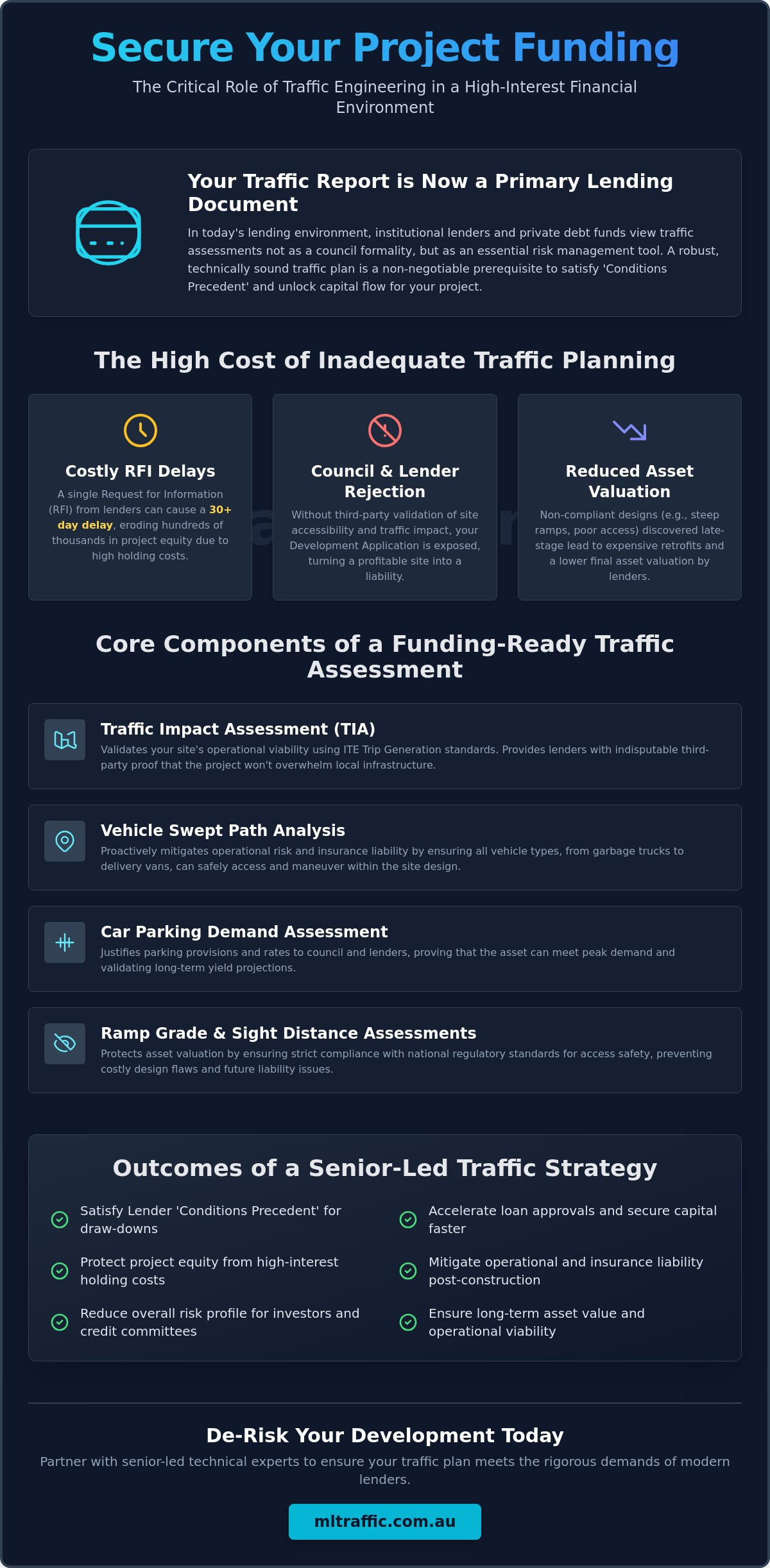
Your traffic report is no longer just a box to tick for council approval; it’s a primary document for your lender’s credit committee. With the U.S. Federal Reserve target rate holding at 3.75% and private debt funds demanding disciplined financial structures, the margin for error on project delays is non-existent. Securing project funding with a robust traffic plan is now the most effective way to preempt the lender-issued RFIs that stall capital flow. When technical data is indisputable, you reduce the risk profile of your development and protect equity from the high costs of holding land during bureaucratic disputes.
You’ve likely seen how unexpected council rejections can gut project yield and turn a profitable site into a liability. This guide demonstrates how technically precise assessments, including Vehicle Swept Path Analysis and Car Parking Demand Assessments, validate your site’s operational viability. You’ll learn how to satisfy rigorous lender due diligence and use intersection analysis to prove your project’s longevity. We’ll outline the specific technical documentation required to accelerate loan approvals and secure your project’s financial future in a high-interest environment.
Key Takeaways
- Understand why securing project funding with a robust traffic plan is a prerequisite for satisfying lender ‘Conditions Precedent’ and ensuring consistent construction draw-downs.
- Identify the technical benchmarks for a Traffic Impact Assessment (TIA) that validate your site’s long-term operational viability to credit committees.
- Learn how precise Driveway Ramp Grade Assessments and Car Park Design protect your asset’s valuation by ensuring strict compliance with national regulatory standards.
- Mitigate operational risk and insurance liability through the application of Vehicle Swept Path Analysis and Sight Distance Assessments during the initial design phase.
- Recognize how senior-led technical expertise and personnel continuity reduce the risk profile of your project for potential investors and institutional lenders.
The Link Between Traffic Engineering and Project Financing
In the 2026 lending environment, technical due diligence is the primary filter for capital allocation. Institutional lenders no longer view traffic reports as secondary permits; they see them as essential risk management tools. Securing project funding with a robust traffic plan is now a mandatory step in satisfying the ‘Conditions Precedent’ (CPs) required for construction draw-downs. Without a validated plan, a project’s operational viability remains speculative. This creates a risk profile that most modern credit committees will not accept. Lenders demand discipline. They require proof that a site can function under peak loads before committing capital.
Traffic engineering serves as the bridge between architectural intent and financial reality. By applying established traffic engineering principles, developers can identify critical design flaws before they become costly site-works. Issues like non-compliant driveway ramps or inadequate loading zones are often identified too late, leading to expensive retrofits. A technically sound plan defines operational viability by ensuring that transport access is safe, efficient, and compliant with national regulatory standards.
To better understand how technical due diligence integrates with project finance, watch this helpful video:
De-risking the Asset for Institutional Lenders
Lenders face significant exposure if a local council refuses a Development Application (DA) based on traffic impact. A professional Traffic Impact Assessment (TIA) mitigates this by providing third-party validation of site accessibility. These reports utilize ITE Trip Generation standards to forecast realistic site impacts. This ensures the project’s traffic load won’t overwhelm local infrastructure. This level of technical precision satisfies the rigorous due diligence required by private debt funds, which currently hold approximately $1.7 trillion in global assets. It provides the assurance that the asset is viable for its intended use throughout the loan term.
Protecting Project Equity from RFI Delays
In the current high-interest environment, where the Federal Reserve target rate remains at 3.75%, project delays are financially catastrophic. A 30-day delay caused by a Request for Information (RFI) can erode hundreds of thousands of dollars in project equity. Securing project funding with a robust traffic plan involves pre-empting these queries by addressing potential bottlenecks in the initial submission. It’s vital that the traffic strategy aligns perfectly with the Statement of Environmental Effects to ensure a seamless approval process. Developers who prioritize senior-led traffic engineering early in the cycle see faster loan approvals. They avoid the staccato rhythm of bureaucratic back-and-forth that kills project momentum.
Core Components of a Funding-Ready Traffic Assessment
A funding-ready traffic assessment is a comprehensive technical suite. It must address two distinct phases: the immediate construction period and the long-term operational life of the asset. Lenders evaluate both. They require assurance that the build process won’t be halted by regulatory breaches and that the completed project will meet its projected yield. Securing project funding with a robust traffic plan requires a precise combination of reports that satisfy these specific risk parameters. With the Infrastructure Investment and Jobs Act (IIJA) set to expire on September 30, 2026, and the proposed BUILD America 250 Act shifting focus toward formula-based funding, developers must ensure their technical documentation aligns with the latest federal and state requirements.
The transition from construction to operation is where many projects face financial friction. A high-quality submission includes Car Parking Demand Assessments to justify parking rates. This is critical for maximizing floor area and project yield. By proving that parking supply meets actual demand rather than just generic council minimums, developers can reclaim valuable square meters for leasable space. For projects seeking federal support, referencing eligibility within transportation grant programs can further strengthen the financial case for large-scale infrastructure components.
Traffic Impact Assessments vs. Statements
The scale of your development determines whether you need a full Traffic Impact Assessment (TIA) or a simpler Traffic Impact Statement. For institutional funding, a TIA is almost always mandatory. It provides a granular analysis of how the development interacts with the broader road network. It validates the site’s ability to handle projected vehicle volumes without degrading existing service levels. For a deeper dive into these requirements, consult our Traffic Impact Assessment Guide. This document is the primary evidence used to de-risk the asset for credit committees.
Construction Phase Risk Management
Lenders view construction as the highest-risk phase. A site shutdown due to poor traffic management can lead to immediate loan defaults. You must have a Traffic Guidance Scheme (TGS) and a Construction Traffic Impact Assessment (CTIA) in place to manage contractor access and public safety. These plans must meet strict Australian Standards to secure necessary permits for road or footpath occupation. Our experts provide The Ultimate Guide to Traffic Management Plans to help you navigate these regulatory hurdles. Ensuring your detailed traffic assessment services are handled by senior engineers prevents the bureaucratic delays that threaten project liquidity.
Protecting Yield and Asset Value via Compliant Design
Asset valuation is inextricably linked to technical functionality. For commercial and multi-residential developments, a car park that fails to meet regulatory standards isn’t just a design flaw; it’s a financial liability. Lenders scrutinize parking layouts because non-compliant spaces cannot be legally counted toward a project’s yield. Securing project funding with a robust traffic plan requires meticulous attention to these details during the design phase. If your parking aisles are too narrow or your turning circles don’t accommodate the required design vehicle, you risk a downward revision of your project’s Gross Realization Value (GRV).
Professional Car Park Design optimizes internal circulation to ensure every square meter contributes to the project’s bottom line. In the current economic environment, where global private debt funds hold approximately $1.7 trillion in assets and demand disciplined financial structures, technical precision is your best defense against de-valuation. Lenders look for “clean” designs that won’t require post-construction retrofitting. A single non-compliant ramp can trigger a refusal of the occupation certificate, stalling the transition from construction finance to long-term investment debt.
AS 2890.1: The Benchmark for Parking Compliance
Compliance with AS 2890.1 is the non-negotiable standard for off-street parking in Australia. This standard dictates the minimum dimensions for parking bays, access aisles, and clearance heights. When these metrics are ignored, the resulting “dead zones” reduce the total number of functional spaces. Our experts provide a detailed breakdown in AS 2890.1 Explained to help developers avoid these common pitfalls. Ensuring your project meets these benchmarks prevents the catastrophic cost of tearing out concrete to fix a 100mm shortfall in aisle width.
Beyond simple bay dimensions, Driveway Ramp Grade Assessments are critical for site accessibility. A ramp that is too steep or lacks appropriate transitions will scrape the undercarriage of standard vehicles. This leads to long-term maintenance issues and potential legal claims from tenants. Lenders view these technical failures as operational risks that threaten the stability of the asset’s income stream.
Maximising Yield through Demand Assessment
Securing project funding with a robust traffic plan often involves challenging generic council parking rates. By commissioning a Car Parking Demand Assessment, you can provide evidence-based justifications for lower parking requirements. This is particularly effective for sites with high public transport accessibility or mixed-use profiles. Reducing the required parking footprint provides several financial advantages:
- Increased Leasable Area: Freeing up site area allows for additional residential units or commercial floor space.
- Reduced Construction Costs: Minimizing basement excavation significantly lowers the capital expenditure required for the build.
- Enhanced GRV: A higher ratio of leasable space to “service” space directly improves the project’s overall valuation.
Lenders are increasingly receptive to these data-driven arguments when they are backed by senior-led traffic engineering. It demonstrates a sophisticated approach to risk management and yield optimization that generic submissions lack.
Mitigating Operational Risk: Swept Paths and Access Safety
Operational failure is a direct threat to capital stability. Securing project funding with a robust traffic plan hinges on proving the site works in practice. Lenders demand a “proof of concept” for heavy vehicle movements. If a 12.5m Heavy Rigid Vehicle (HRV) cannot clear a loading dock without multiple corrections, the site’s commercial efficiency is compromised. This impacts the ability to attract high-tier tenants. It threatens the stability of projected revenue streams. Technical validation ensures that these operational bottlenecks are eliminated during the design phase.
Vehicle Swept Path Analysis for Commercial Assets
Vehicle Swept Path Analysis uses specialized AutoTURN software to simulate the exact movement of vehicles through a site. This is critical for commercial assets where loading dock functionality is a primary driver of value. These diagrams provide the visual certainty that investors and lenders require. They prove that waste management vehicles and delivery trucks can enter and exit in a forward direction. This prevents “dead-end” scenarios that compromise site safety and efficiency. Without this validation, you risk operational failures that lead to tenant disputes and reduced asset liquidity. For a technical breakdown of these simulations, see our Swept Path Analysis Guide.
Safety as a Financial Safeguard
Site safety is a financial safeguard against future litigation. Lenders scrutinize access points to ensure they don’t introduce unacceptable risk to the road network. Intersection Analysis and Sight Distance Assessments are the primary tools used to prove safe egress. These assessments confirm that drivers exiting the site have a clear line of sight to oncoming traffic. They must adhere to the strict requirements of AS 2890.1. Failing to meet these standards doesn’t just invite accidents. It increases insurance premiums and creates a permanent liability for the property owner.
Technical precision in Driveway Ramp Grade Assessments ensures the B99 design vehicle navigates transitions without bottoming out. This level of detail protects the developer from the reputational and financial damage of a poorly designed entry. By demonstrating a meticulous approach to safety, you lower the project’s overall risk profile. This makes the development a more attractive proposition for institutional debt. If you need to validate your site’s operational safety, request a professional Sight Distance Assessment to secure your technical compliance and protect your asset value.
Partnering for Financial De-risking and Approval
Transitioning a project from a design concept to a funded reality requires a technical partner who understands the nuances of credit risk. Securing project funding with a robust traffic plan isn’t just about the data; it’s about the credibility of the entity standing behind that data. When a lender reviews your submission, they evaluate the professional reputation and the specific qualifications of your consultant. ML Traffic Engineers Australia provides this essential layer of technical authority. We ensure that your traffic strategy isn’t just compliant but is also defensible under the most aggressive scrutiny from institutional investment committees.
The choice of consultant can be the difference between a rapid construction draw-down and a stalled project. Lenders require assurance that the traffic strategy won’t be picked apart by regulatory bodies mid-build. ML Traffic Engineers Australia bridges the gap between engineering theory and the pragmatic requirements of project finance. We deliver tailored assessments that address the specific risk profile of your asset, ensuring that your financial modeling remains stable throughout the development lifecycle.
Direct Access to Senior Expertise
Technical accountability is the cornerstone of our consultancy. Unlike larger firms where junior staff may handle the bulk of the analysis, ML Traffic Engineers Australia ensures that a Principal Engineer is directly involved in every assessment. This senior-led approach is vital when navigating the complex ‘Conditions Precedent’ typical of multi-year development loans. Having direct access to leadership means that when a lender or Council officer has a technical query, it’s answered by the same expert who performed the work. This personnel continuity maintains the integrity of the report from the initial DA submission through to the final Occupation Certificate. Review our full range of Traffic Engineering Services to understand how this senior sign-off adds value to your finance application.
Securing Your Project’s Future
The most successful developers engage technical expertise long before the first shovel hits the ground. Early involvement allows ML Traffic Engineers Australia to identify potential traffic constraints during the site acquisition phase. This proactive strategy prevents the purchase of land with unresolvable access issues that could later kill a funding deal. We provide the technical precision required for large-scale national civil projects, ensuring that every driveway ramp and intersection design is optimized for both safety and financial yield. By aligning your project with a seasoned partner, you reduce the risk of unforeseen technical hurdles. Contact ML Traffic Engineers Australia for a project-specific consultation to ensure your next development is backed by a finance-ready traffic strategy.
Standardize Your Technical Due Diligence for 2026
The 2026 lending landscape requires a transition from basic regulatory checkboxes to sophisticated, proactive risk management. Securing project funding with a robust traffic plan is the most reliable method to prove a site’s operational viability and safeguard investor equity against high holding costs. By prioritizing technically precise documentation early in the cycle, developers can preempt the credit committee queries that often result in financially catastrophic construction delays. This approach ensures that every design element is validated before capital is committed.
ML Traffic Engineers Australia provides the specialized expertise needed to navigate these technical and financial requirements. With over 15 years of experience and a commitment to direct senior-led accountability, we ensure your projects meet the rigorous demands of AS 2890.1 and AS 2890.2. Our meticulous assessments provide the technical foundation for successful funding negotiations and long-term asset stability. Technical excellence is the primary driver of development certainty in an increasingly selective market.
Secure your project funding with a professional traffic assessment from ML Traffic Engineers Australia. Your project’s financial viability starts with expert-led engineering.
Frequently Asked Questions
Is a traffic report mandatory for all development finance applications?
Institutional lenders and private debt funds require a traffic report for most commercial and multi-residential construction finance applications. While smaller projects might bypass this at the initial assessment stage, institutional credit committees view traffic documentation as a non-negotiable part of technical due diligence. It serves as proof that the project can meet its operational requirements without triggering regulatory intervention.
What is the difference between a standard TIA and a finance-ready traffic report?
A standard TIA focuses primarily on meeting Council’s minimum regulatory requirements for a planning permit. In contrast, securing project funding with a robust traffic plan requires a report that addresses lender-specific risks like asset valuation, long-term operational viability, and insurance liability. Finance-ready reports provide the technical certainty that a site’s yield is protected from future design-related litigation.
How long does it typically take to prepare a robust traffic plan for funding?
Preparation of a comprehensive assessment generally requires two to four weeks depending on the complexity of the site and the volume of traffic data required. This timeframe allows for detailed intersection analysis and vehicle swept path simulations. Starting this process early prevents the staccato delays that occur when lenders issue last-minute requests for information during the final credit approval phase.
Can a well-designed traffic plan actually increase my project’s yield?
Yes, a professional Car Parking Demand Assessment can justify a reduction in the number of required parking spaces based on empirical data. By proving that a site requires fewer bays than the generic council minimum, you can reclaim basement or ground-level area for additional residential units or commercial floor space. This optimization directly increases the project’s Gross Realization Value (GRV).
What happens if my project doesn’t meet AS 2890.1 parking standards?
Non-compliance with AS 2890.1 standards often results in a refusal of the Occupation Certificate, which prevents the transition from construction finance to long-term investment debt. Lenders view non-compliant parking as a significant structural risk. If vehicles cannot safely navigate the car park, the asset’s marketability and valuation are negatively impacted, potentially triggering a breach of loan covenants.
Why do lenders care about swept path analysis for commercial developments?
Lenders prioritize swept path analysis because it proves the site can physically accommodate the heavy vehicles required for its commercial operation. If a loading dock is inaccessible to the design vehicle, the project’s income stability is at risk. Technical validation via AutoTURN simulations ensures that waste collection and delivery functions won’t fail once the asset is operational.
How does a traffic engineer help with Council RFIs regarding site access?
A traffic engineer provides authoritative data, such as Sight Distance Assessments and Intersection Analysis, to resolve technical disputes with Council. This expert intervention shifts the conversation from subjective opinion to fact-based engineering. By providing indisputable proof of safety and compliance, the engineer reduces the RFI cycles that increase holding costs and threaten project liquidity.
Does a traffic plan include construction phase management for funding draw-downs?
Securing project funding with a robust traffic plan involves providing a Construction Traffic Impact Assessment (CTIA) to manage risks during the build. Lenders often make construction draw-downs conditional on having approved Traffic Guidance Schemes (TGS) in place. These documents ensure that road or footpath occupations are permitted, preventing site shutdowns that would otherwise disrupt the funding schedule.

Disclaimer
The content on www.mltraffic.com.au, including all technical articles, guides, and resources, is provided for general informational and educational purposes only. It is not intended to constitute professional advice in traffic engineering, transportation planning, development approvals, or any other technical or legal field.
While ML Traffic Engineers makes every reasonable effort to ensure the accuracy, completeness, and timeliness of the information published, we do not provide any warranties or representations (express or implied) regarding its reliability, suitability, or availability for any particular purpose. Any reliance you place on the content is strictly at your own risk.
In no event shall ML Traffic Engineers, its directors, employees, authors, or affiliates be liable for any direct, indirect, incidental, special, consequential, or punitive damages (including, without limitation, loss of profits, data, or business opportunities) arising out of or in connection with the use of, or inability to use, any information provided on this website.
The articles and guides on this site are not a substitute for engaging a qualified, registered professional traffic engineer (such as an NPER or RPEQ engineer) to assess your specific project requirements. For tailored advice, compliance assessments, or traffic engineering services, please contact a competent professional.
This disclaimer may be updated from time to time without notice. By accessing or using this website, you agree to be bound by the most current version of this disclaimer.
