

A single Request for Information (RFI) from a transport department can stall a multi-million dollar development for months, eroding profit margins through mounting holding costs. Failing to meet state road authority submission requirements on the first attempt often results in expensive design revisions that could have been avoided with technical foresight. In Victoria, where developer contributions can represent up to 11% of total project costs, there is no room for administrative error or non-compliant engineering plans.
You already know that aligning local council expectations with the rigid standards of state road authorities is one of the most complex stages of the planning process. We understand that you need a reliable path to approval that bypasses bureaucratic delays. This article provides the technical clarity required to master the submission process and protect your project timeline. We will outline the essential technical reports needed for compliance, clarify the differences between classified and unclassified road requirements, and provide a definitive checklist to ensure your application is professional, complete, and ready for immediate assessment.
Key Takeaways
- Identify the essential technical documentation, such as Traffic Impact Assessment (TIA) Reports and Vehicle Swept Path Analysis, required to meet state road authority submission requirements and avoid project delays.
- Understand the regulatory landscape and the legal necessity for state-level consent under national legislative frameworks like the Roads Act.
- Ensure all infrastructure designs adhere to national standards, including Austroads Guides and the AS 2890 series for off-street parking and access.
- Eliminate the risk of “Request for Information” (RFI) traps by conducting pre-lodgement meetings and submitting comprehensive, compliant engineering plans from the outset.
- Leverage professional traffic engineering expertise to navigate authority negotiations and protect your development from costly redesigns and legal liabilities.
Understanding the Regulatory Landscape for Road Reserve Works
The road reserve represents the entire corridor between private property boundaries. It encompasses more than just the asphalt; it includes footpaths, nature strips, drainage systems, and utility easements. A Highway Authority holds statutory responsibility for these assets to ensure public safety and network efficiency. For developers, understanding state road authority submission requirements is critical because any physical connection to this reserve requires formal legal consent. This regulatory oversight prevents unauthorized modifications that could compromise pavement integrity or traffic flow.
To better understand the distinction between different levels of authority, watch this helpful video:
Classified vs. Unclassified Roads: Who Has the Final Say?
Identifying road status is the first step in determining site feasibility. Classified roads are primary arterial routes managed directly by state agencies such as Transport for NSW, Victoria’s Department of Transport and Planning, or Queensland’s Department of Transport and Main Roads. Unclassified roads usually fall under local council jurisdiction. However, the hierarchy is not always simple. If a development borders a local road that intersects a classified road nearby, the state authority often retains concurrence power. They have the legal right to veto a local council’s approval if the proposed access point threatens the performance of the broader state network. This referral process adds weeks to a project timeline if the initial submission is not met with precision.
The Legal Framework for Submission Consent
Legislative instruments dictate the submission and approval process for all works within the road reserve. In New South Wales, Section 138 of the Roads Act 1993 is the primary mechanism; other states utilize similar frameworks like the Road Management Act in Victoria. These laws make it illegal to dig up, erect a structure, or drive a vehicle across a footway without a permit. The consequences of non-compliance are severe. They include immediate stop-work orders from regulatory officers and significant financial penalties for the developer and contractor. Refusal of the Occupation Certificate (OC) often follows until the works are rectified to state standards.
State authorities use the submission process to protect multi-billion dollar infrastructure assets. They review technical specifications for pavement depth, drainage calculations, and sight distance to ensure new developments don’t degrade existing road quality. Professional traffic engineering ensures these technical criteria are met during the initial specialized assessment phase, reducing the risk of costly redesigns.
The Technical Submission Checklist: Essential Traffic Engineering Reports
Securing approval for works within a road reserve requires more than a simple site plan. State road authorities demand a suite of technical reports that prove your development won’t degrade the safety or efficiency of the existing network. These documents form the core of state road authority submission requirements; they provide the data-driven evidence needed to satisfy regulatory assessors. If these reports lack technical depth or fail to reference current standards, the application will likely trigger an RFI, causing avoidable delays.
Traffic Impact Assessment (TIA) Requirements
A Traffic Impact Assessment (TIA) is a non-negotiable requirement for developments that meet specific trip-generation thresholds. This report must analyze existing traffic volumes and incorporate projected growth using the latest Austroads Guide to Traffic Management. We use this data to perform a detailed Intersection Analysis, measuring the Level of Service (LoS) and degree of saturation. If the development reduces an intersection’s performance below acceptable limits, the TIA must propose specific mitigation strategies. These might include dedicated turn lanes or signal timing adjustments to maintain network stability.
Swept Path Analysis and Access Design
Access design must be validated through Vehicle Swept Path Analysis. We utilize AutoTURN software to simulate the movements of the largest expected vehicle class, such as an 8.8m medium rigid vehicle or a 19m articulated truck. This analysis proves that heavy vehicles can enter and exit the site without mounting curbs or encroaching on opposing traffic lanes. Compliance with AS 2890.2 is essential for all commercial loading and service areas. Much like the technical standards required for Oregon DOT Encroachment Permits, Australian authorities demand precise engineering drawings that demonstrate safe driveway grades and widths to prevent vehicle scraping or sightline obstructions.
Construction Traffic Management Plans (TMP)
The submission process doesn’t end with the permanent site design. You must also account for the construction phase. A Construction Traffic Management Plan (TMP) outlines how you’ll manage pedestrian safety and traffic diversions while works are underway. A specific Traffic Guidance Scheme (TGS) is required for any activity that physically impacts the road reserve, including utility connections or driveway construction. You can learn more about Traffic Management Plans to understand how these documents protect your project from liability and regulatory fines.
Every development has unique constraints that require a tailored approach to compliance. If you’re unsure which reports your project needs, it’s best to consult with a traffic engineer early in the design phase to avoid expensive revisions later.
Sight Distance and Parking Assessments
Safety at the property boundary is a primary concern for state assessors. A Sight Distance Assessment must confirm that drivers exiting the site have a clear view of approaching traffic, adhering to the SISD (Safe Intersection Sight Distance) requirements set by Austroads. Furthermore, if your proposal deviates from standard parking rates, a Car Parking Demand Assessment is necessary. This justifies your parking provisions through empirical data, ensuring that overflow vehicles don’t congest the state road network and create safety hazards.
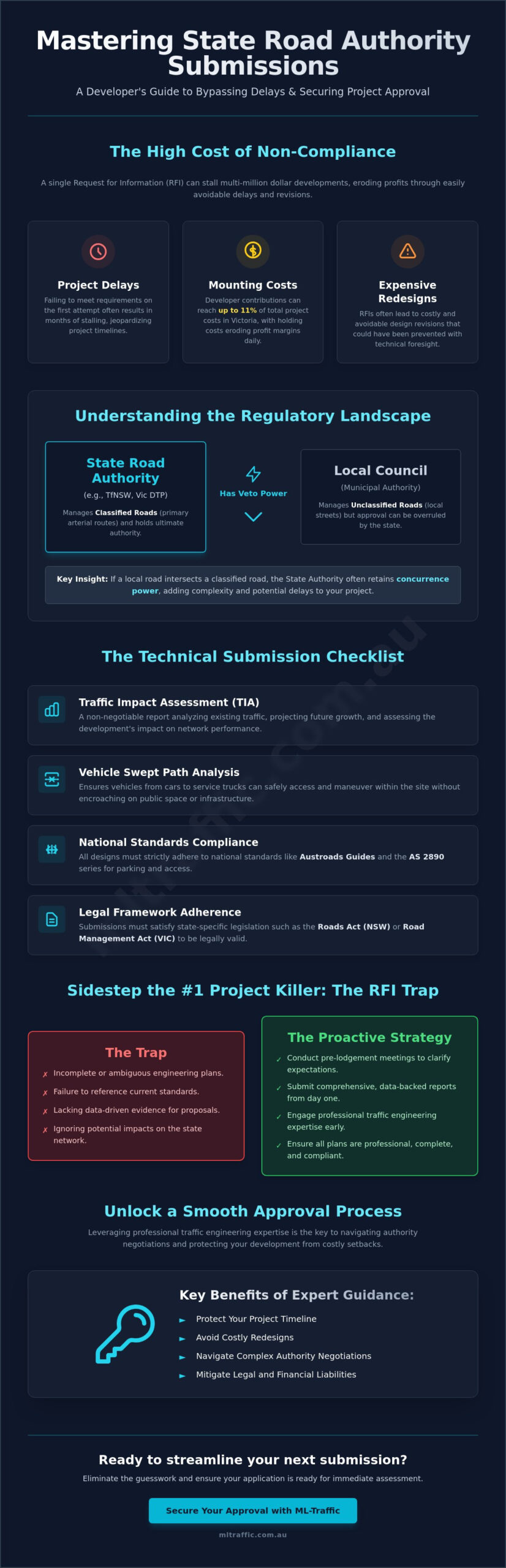
National Standards vs. State Authority Specifics: Navigating Compliance
Compliance in traffic engineering relies on a strict hierarchy of documentation. While national standards provide a uniform framework, state road authority submission requirements frequently mandate adherence to state-specific supplements. These supplements often introduce more stringent sight distance requirements or different intersection saturation thresholds than the national baseline. Developers must recognize that satisfying a local council’s requirements does not guarantee state-level approval, especially when a project impacts a classified road network.
Austroads and the Uniformity of Road Design
Austroads Guides serve as the primary reference for road design and traffic management across Australia. Specifically, the Guide to Traffic Management Part 2: Traffic Theory Concepts, updated on February 25, 2026, provides the essential theoretical background for analyzing traffic behavior. Authorities use these guidelines to evaluate road geometry and intersection performance during the assessment phase. Correct application of these concepts is a core component of the role of a traffic engineer in developments. Assessors look for strict alignment with these national benchmarks to ensure network safety and longevity.
AS 2890 Compliance for Developers
The AS 2890 series is the definitive standard for off-street parking and access. For most residential and commercial projects, AS 2890.1 dictates the minimum dimensions for parking spaces based on User Classes 1, 2, and 3. Common failures that lead to immediate submission rejection include inadequate aisle widths, poorly positioned structural columns, and non-compliant driveway gradients. Detailed technical knowledge is required to navigate these rules, as seen in our guide on AS 2890.1 explained. Proactive compliance during the design phase eliminates the need for expensive structural changes once the building footprint is established.
State authorities often have the final word through their own technical directions and supplements. For instance, the Department of Transport and Main Roads in Queensland will increase various fees and charges by 3.4% on July 1, 2026, reflecting the administrative complexity of these detailed technical reviews. In addition to standard reports, a Road Safety Audit (RSA) may be required for complex intersections or high-volume access points. This independent review identifies latent safety risks before a project moves to the construction phase, ensuring the final design is both efficient and legally defensible.
Navigating the interplay between national standards and state-specific overrides requires a meticulous approach. Authorities prioritize the protection of their assets and the safety of the motoring public. Any deviation from established standards must be justified with robust engineering data and site-specific analysis to avoid the “Request for Information” (RFI) trap that stalls many development applications.
Managing the Submission Process: Common Pitfalls and Strategic Advice
The submission process is rarely a linear path. While the local council acts as the primary consent authority, state road authorities function as a powerful secondary gatekeeper through the concurrence process. This means the state department must formally agree with the council’s decision before a permit is issued. If your proposal impacts a classified road, the state’s technical requirements take precedence. Managing this intersection between local and state expectations requires a proactive strategy that begins long before the formal lodgement date.
Avoiding the Request for Information (RFI)
An RFI is the most common cause of project stagnation. Incomplete or amateur documentation forces assessors to stop their review, often pushing your application back to the end of the queue. In the Australian Capital Territory, for example, a third submission for a residential or commercial development costs $1,647.85 as of July 1, 2025. This financial penalty is minor compared to the holding costs incurred during months of delay. To ensure prompt processing, your submission must include:
- Scaled engineering drawings rather than conceptual sketches.
- A comprehensive Traffic Impact Assessment (TIA) that uses current traffic data.
- Electronic copies of modeling files (such as SIDRA) for intersection analysis.
- Specific evidence of compliance with state-specific supplements to Austroads.
- Clear documentation of any pre-lodgement advice received.
State authorities prioritize applications that provide professional, high-quality data. We find that submissions lacking technical rigor are often viewed as high-risk, leading to more intensive scrutiny and more frequent RFI triggers.
Strategic Engagement with Road Authorities
Engaging with state departments early in the design phase is essential. Pre-lodgement meetings allow you to identify potential “deal breakers” regarding access points or required road upgrades before you finalize your site layout. This is where a traffic engineer’s role becomes critical. We act as a technical liaison, interpreting authority feedback and negotiating developer contributions or infrastructure upgrades. For instance, if an authority demands a new turn lane, we provide the data to determine if that requirement is proportional to the development’s actual impact.
Coordinating between your architect, civil engineer, and traffic consultant ensures that site designs remain functional while meeting state road authority submission requirements. When community objections arise regarding traffic flow, having a robust, data-backed report allows you to address concerns with evidence rather than speculation. If you need to secure approval for a complex site, you should contact our senior principals to discuss a streamlined submission strategy.
Negotiating road upgrades requires a deep understanding of state-specific legislative frameworks. Authorities use the submission process to ensure that new developments contribute fairly to the broader network. By presenting a compliant, well-researched application, you position your project as a low-risk addition to the infrastructure network, significantly increasing the likelihood of a first-round approval.
Why Professional Traffic Engineering is the Key to Road Authority Approval
DIY submissions frequently fail because they lack the technical rigor required to satisfy state assessors. A project bordering a state-controlled road network requires more than basic site plans. It demands a sophisticated understanding of state road authority submission requirements. Errors in initial documentation lead to denied access points or mandatory redesigns that can cost tens of thousands of dollars. We leverage over 15 years of experience in state and local government negotiations to prevent these outcomes. Our firm provides direct access to senior principals who perform the technical work personally. This ensures every project benefits from deep-seated expertise and a results-oriented approach.
Meticulous Documentation for Seamless Approvals
ML Traffic Engineers prioritizes meticulous documentation to ensure seamless approvals. We provide a senior-led approach from the initial site assessment to the final concurrence phase. High-quality Traffic Impact Assessment (TIA) reports fast-track complex Development Applications (DAs) by addressing potential network impacts before they become RFI triggers. Our personnel continuity promise means the expert who initiates the relationship performs the technical work. You can explore our specialized Traffic Engineering Services to see the full range of our technical capabilities. We ensure your project meets national Austroads standards while accounting for state-specific supplements that often override general guidelines. We have managed submissions for diverse project environments, including residential subdivisions, commercial retail centers, industrial warehouses, medical facilities, and mixed-use developments.
Take the Next Step in Your Development Approval
Early involvement of a traffic consultant is the most effective way to protect your project timeline. Identifying access constraints during the feasibility stage saves thousands in holding costs and redesign fees. With the infrastructure investment pipeline in Tasmania reaching almost $40 billion and Western Australia investing $1.1 billion in Anketell Road upgrades, professional compliance is a financial necessity in a competitive market. Authorities are increasingly data-driven; they require precise Intersection Analysis and Vehicle Swept Path Analysis to approve new access points. Don’t risk your project’s success on administrative guesswork. Contact our senior principals today for a comprehensive site assessment and a streamlined path to road authority approval. We provide a no-gatekeepers approach, giving you a direct line to the experts responsible for your project’s success.
Secure Your Development Approval with Technical Precision
Mastering state road authority submission requirements is a technical challenge that demands more than simple administrative compliance. It requires a strategic alignment of site design with national Austroads standards and specific state-level supplements. By prioritizing high-quality data in your Traffic Impact Assessment and Vehicle Swept Path Analysis, you eliminate the RFI traps that stall project timelines and increase holding costs. Professional engineering is the only way to navigate the concurrence process between local councils and state departments effectively.
ML Traffic Engineers provides over 15 years of traffic engineering excellence with comprehensive national coverage for all Australian state authorities. We ensure your application is technically sound by providing direct access to senior principals for every project. This senior-led approach guarantees that the expert who initiates your site assessment is the same one performing the technical work. Don’t let bureaucratic delays erode your project’s feasibility or lead to costly redesigns.
Get a Professional Traffic Assessment for Your Road Authority Submission today. Our meticulous approach ensures your development meets the highest standards of safety and efficiency while securing a streamlined path to approval.
Frequently Asked Questions
What is the difference between a Traffic Impact Assessment and a Traffic Management Plan?
A Traffic Impact Assessment (TIA) evaluates the long-term, permanent impact of a development on the surrounding road network and intersection performance. Conversely, a Traffic Management Plan (TMP) or Traffic Guidance Scheme (TGS) manages short-term safety and vehicle flow specifically during the construction phase. While the TIA is required for the initial planning approval, the TMP is essential for obtaining work permits within the road reserve.
Does every development application require a state road authority submission?
No, state-level submission is only mandatory for developments bordering classified roads or those exceeding specific trip-generation thresholds. If your site access is via a local, unclassified road, the local council typically remains the sole consent authority. However, any project impacting the safety or efficiency of an arterial route must strictly meet state road authority submission requirements to obtain concurrence.
How long does the road authority approval process typically take?
Approval timelines vary by state but generally range from 21 to 40 days for standard referrals. This statutory period often restarts if the authority issues a Request for Information (RFI) due to incomplete documentation. Complex applications involving major intersection upgrades or significant network modifications can take several months to reach a final determination.
Can I use a local council traffic report for a state-controlled road submission?
Local council reports are rarely sufficient for state-controlled road assessments. State authorities demand a higher level of technical rigor, including detailed SIDRA modeling and adherence to state-specific supplements to the Austroads guides. A report designed for local road standards often fails to address the arterial network performance metrics that state assessors prioritize.
What happens if the state road authority refuses concurrence for my project?
If a state road authority refuses concurrence, the local council is legally barred from granting development consent. You must then renegotiate the site access design or the scope of proposed road upgrades with the state department. If a resolution isn’t reached, the developer may need to appeal the decision through the relevant state planning tribunal or land and environment court.
What specific vehicle types must be included in a Swept Path Analysis for commercial sites?
Swept Path Analysis must simulate the movements of the largest vehicle expected to service the facility. For standard commercial sites, this is often an 8.8m Medium Rigid Vehicle (MRV), while large-scale logistics hubs require simulations for 19.0m Articulated Vehicles (AV). All simulations must prove the vehicle can maneuver without mounting curbs or encroaching on opposing traffic lanes in accordance with AS 2890.2.
Are there specific submission requirements for works impacting pedestrian or cycle paths?
Yes, any works impacting active transport infrastructure require dedicated safety and design assessments. You must demonstrate that driveway crossings maintain Safe Intersection Sight Distance (SISD) and that any temporary diversions during construction adhere to national accessibility standards. State authorities prioritize the protection of vulnerable road users and will reject submissions that compromise existing pedestrian or cycle networks.
How much does a professional Traffic Impact Assessment report cost for a standard DA?
Pricing for a professional TIA report depends on project complexity, the number of intersections analyzed, and the depth of traffic modeling required. Small-scale residential developments require less intensive data collection than major industrial or retail precincts. Developers should view professional fees as a strategic investment to avoid the high holding costs and administrative penalties associated with state road authority submission requirements and RFI delays.

Disclaimer
The content on www.mltraffic.com.au, including all technical articles, guides, and resources, is provided for general informational and educational purposes only. It is not intended to constitute professional advice in traffic engineering, transportation planning, development approvals, or any other technical or legal field.
While ML Traffic Engineers makes every reasonable effort to ensure the accuracy, completeness, and timeliness of the information published, we do not provide any warranties or representations (express or implied) regarding its reliability, suitability, or availability for any particular purpose. Any reliance you place on the content is strictly at your own risk.
In no event shall ML Traffic Engineers, its directors, employees, authors, or affiliates be liable for any direct, indirect, incidental, special, consequential, or punitive damages (including, without limitation, loss of profits, data, or business opportunities) arising out of or in connection with the use of, or inability to use, any information provided on this website.
The articles and guides on this site are not a substitute for engaging a qualified, registered professional traffic engineer (such as an NPER or RPEQ engineer) to assess your specific project requirements. For tailored advice, compliance assessments, or traffic engineering services, please contact a competent professional.
This disclaimer may be updated from time to time without notice. By accessing or using this website, you agree to be bound by the most current version of this disclaimer.
