

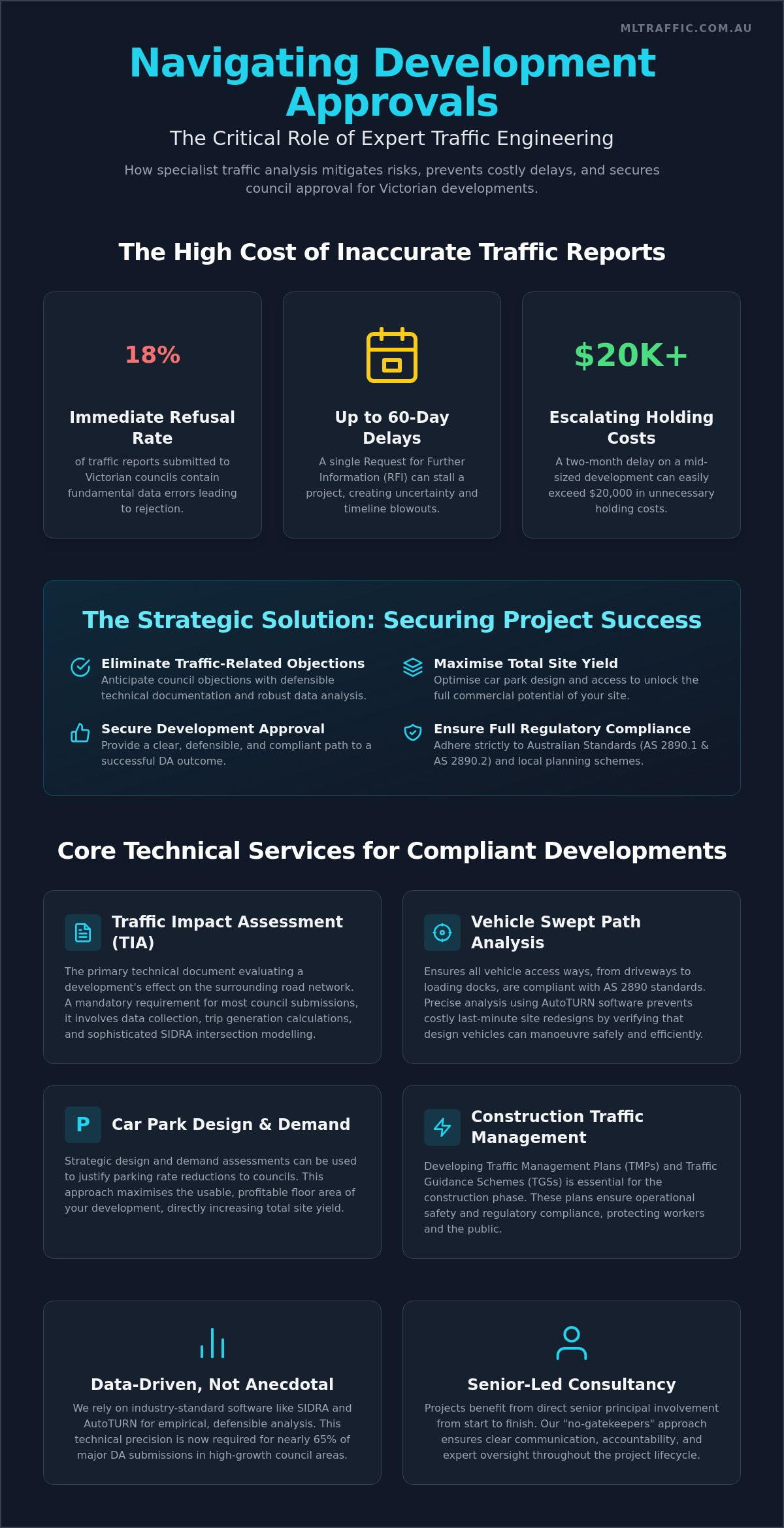
Eighteen per cent of traffic reports submitted to Victorian councils contain fundamental data errors that lead to immediate refusal. For a developer, a single Request for Further Information (RFI) regarding traffic can stall a project for up to 60 days, creating significant project uncertainty and mounting holding costs. You understand that traffic planning is not merely a regulatory hurdle; it’s a high-stakes technical requirement where inaccuracies in swept path analysis or driveway grades can force expensive, last-minute site redesigns.
By engaging experienced traffic engineering consultants melbourne, you secure the technical precision required to bypass these bureaucratic bottlenecks. We ensure your project adheres strictly to AS 2890.1 and AS 2890.2 standards through senior-led consultancy and meticulous technical documentation. This article outlines how authoritative engineering expertise can maximise your site yield, eliminate traffic-related objections, and provide a clear, defensible path to successful DA approval.
Key Takeaways
- Understand why a Traffic Impact Assessment (TIA) is the critical document for evaluating a development’s road network impact and securing council approval.
- Learn how precise vehicle swept path analysis using AutoTURN software ensures compliance with AS 2890 standards and prevents costly last-minute site redesigns.
- Discover how car park design and parking demand assessments can be used to justify parking rate reductions and maximise your total site yield.
- Identify why traffic engineering consultants melbourne provide a technical advantage through direct senior principal involvement and a “no-gatekeepers” approach to project communication.
- Clarify the requirements for Traffic Management Plans and Traffic Guidance Schemes to ensure operational safety and regulatory compliance during the construction phase.
The Critical Function of Traffic Engineering Consultants for Development Success
Traffic engineering is a technical discipline that applies scientific principles to the safe and efficient movement of people and goods. For a developer, this is the bridge between a conceptual site plan and a council-approved reality. The primary role of traffic engineering consultants melbourne is to interpret a developer’s vision through the lens of local planning schemes and state-wide transport policies. Without this technical filter, even the most innovative site designs can fail at the first stage of council review.
To better understand the specific complexities of the local road network, watch this video on the engineering that sets Melbourne apart:
Site viability is inextricably linked to traffic and parking access. If a site cannot accommodate the required vehicle movements or parking demand, its commercial yield drops significantly. Engaging an expert during the “sketch” phase identifies deal-breakers like non-compliant driveway grades or insufficient sight lines before significant costs are sunk into architectural drawings. Early-stage advice prevents expensive redesigns during the DA process, ensuring the site layout is functional and compliant from the outset.
Navigating Regulatory Frameworks and Planning Approvals
Professional reports are a mandatory component of most Development Applications (DA). Consultants must navigate the Victoria Planning Provisions (VPP) and specific municipal overlays. Non-compliance leads to immediate project delays. A single Request for Further Information (RFI) from a council regarding traffic issues can stall a project for 45 to 60 days. For a mid-sized development, a two-month delay can result in holding costs exceeding $20,000. Expert consultants anticipate council objections and provide defensible technical documentation to mitigate these risks.
Why Technical Expertise is Non-Negotiable
Generalist engineering firms often lack the specialised tools required for precise transport planning. Specialised traffic engineering consultants melbourne rely on data-driven analysis rather than anecdotal observations. This involves using industry-standard software like SIDRA for intersection modelling and AutoTURN for swept path analysis. Councils in high-growth areas now require independent verification of traffic data for nearly 65% of major DA submissions. All technical services must be performed by certified engineers to satisfy regulatory requirements and ensure personnel continuity throughout the project life cycle.
Technical Assessments: TIA Reports and Swept Path Analysis
The Traffic Impact Assessment (TIA) serves as the primary technical document for evaluating a development’s effect on the surrounding road network. It is a mandatory requirement for most Victorian council submissions. As traffic engineering consultants melbourne, we use a rigorous methodology to ensure every report is defensible during the peer review process. This involves detailed data collection, trip generation calculations, and sophisticated intersection modelling to predict post-development traffic flow accurately.
Precision is paramount. We rely on industry-standard SIDRA software to analyse intersection performance and identify potential capacity issues before they become grounds for council refusal. For a comprehensive look at the regulatory framework governing these reports, the Guide to Traffic Impact Assessment provides the essential principles used to maintain infrastructure standards across Australia.
The Anatomy of a Traffic Impact Assessment (TIA) Report
A compliant TIA report must address several core components to satisfy council requirements. We begin by reviewing existing traffic conditions and the capacity of the surrounding road infrastructure. Following this, we estimate trip generation based on specific land-use types, such as residential, commercial, or industrial. The final phase involves analysing intersection performance to determine if the development necessitates physical upgrades or signal timing adjustments. Explore our full range of traffic services to understand how these technical assessments support your DA approval.
Swept Path Analysis: Ensuring Functional Site Access
Vehicle Swept Path Analysis is a critical tool for refining a site’s internal layout. We define a “swept path” as the geometric envelope cleared by a vehicle’s body and wheels during a turning manoeuvre. Using AutoTURN software, we produce precision diagrams that simulate the movement of various vehicles, including waste collection trucks and delivery vans. This ensures your site can actually accommodate the vehicles it’s designed for.
This analysis is vital for verifying compliance with AS 2890 standards. It confirms that driveway ramp grades and access widths are sufficient for safe operation. Errors in these calculations often lead to site redesigns that can cost tens of thousands in architectural fees. For more information, see our Swept Path Analysis: A Complete Guide for Australian Developments. If you have concerns about your current site plan, you should consult a senior engineer early in the process to avoid these pitfalls.
Car Park Design and Parking Demand Management
Efficiency in car park design is a primary driver of project profitability. A poorly designed layout wastes valuable space, directly reducing the total number of dwellings or the available commercial floor area. Expert traffic engineering consultants melbourne ensure that every square metre is utilised according to strict technical requirements. This involves a precise balance between maximising bay numbers and maintaining safe, functional vehicle circulation. Engaging traffic engineering consultants melbourne during the initial design phase allows for the early identification of spatial constraints that could otherwise compromise the site’s commercial potential.
Adhering to Australian Standards (AS 2890.1 & AS 2890.2)
Compliance with the AS 2890 series is a non-negotiable baseline for council approval. AS 2890.1 governs off-street car parking for light vehicles, while AS 2890.2 sets the requirements for commercial vehicle facilities. Designers must account for standardised aisle widths, bay dimensions, and the critical placement of structural columns to avoid obstruction. We provide formal certification of car park designs to verify that these technical thresholds are met. For a deeper technical breakdown, see our article on AS 2890.1 Explained: The Ultimate Guide to Compliant Car Park Design. Modern developments also require strict adherence to AS 2890.6 to ensure accessible parking design meets current disability access legislation.
Parking Demand Assessments: Justifying Your Site Layout
Standard parking rates found in local planning schemes don’t always reflect the actual needs of a specific development. A Car Parking Demand Assessment allows developers to justify a reduction in the number of required spaces to council. This assessment relies on empirical data and local surveys to prove that the proposed parking supply meets the actual demand generated by the site. We use data-driven evidence to support variations to standard parking rates, which can significantly increase a project’s site yield.
The impact of sustainable transport initiatives cannot be overlooked. Integrating a Green Travel Plan strengthens a parking reduction case by demonstrating how bicycle facilities, end-of-trip provisions, and proximity to public transport hubs reduce the reliance on private vehicles. These assessments provide a clear, defensible technical argument that bridges the gap between regulatory requirements and commercial reality. By focusing on data rather than anecdotal observations, we help developers secure approvals that might otherwise be refused based on generic parking clauses.
Managing Construction Traffic and Operational Safety
Managing the transition from approved architectural plans to active construction requires a rigorous focus on operational safety. Councils and road authorities mandate a Traffic Management Plan (TMP) to ensure that works don’t compromise the safety of road users or the efficiency of the surrounding network. As traffic engineering consultants melbourne, we provide the technical documentation needed to secure these critical permits. It’s essential to distinguish between a strategic TMP and a Traffic Guidance Scheme (TGS). While the TMP outlines the broad approach to vehicle movements and safety protocols, the TGS is the specific technical diagram used to implement on-road traffic control measures.
Construction Traffic Management Plans (CTMP)
A Construction Traffic Management Plan (CTMP) is a specific requirement for most urban developments in Victoria. The primary objective is to organise construction vehicle access while maintaining pedestrian safety. We focus on minimising disruption to the surrounding community by designing efficient delivery routes and site entry points. Securing permits from authorities like VicRoads or local councils requires a plan that demonstrates a deep understanding of local traffic volumes and peak periods. For more detail, read The Ultimate Guide to Traffic Management Plans for Australian Developers.
Safety Audits and Sight Distance Assessments
Operational safety extends beyond the construction phase into the permanent use of the site. A Sight Distance Assessment is a fundamental requirement to ensure drivers have adequate visibility when entering or exiting a property. We evaluate intersection geometry and potential obstructions to identify safety hazards before they lead to accidents. Our role as a traffic engineer is to provide a certified assessment of safe sight lines, which is a non-negotiable component of council review. This ensures your site access points meet the required safety thresholds for all road users.
Intersection Analysis also plays a vital role in maintaining road network efficiency. By simulating how a development’s traffic interacts with existing junctions, we can determine if physical modifications or signal adjustments are necessary. This data-driven approach ensures that your project doesn’t create bottlenecks that could lead to community backlash or council objections. If you need a compliant Traffic Guidance Scheme or safety assessment, our senior engineers are available to provide technical guidance and certification for your next project.
Partnering with Expert Traffic Engineers for National Compliance
Selecting traffic engineering consultants melbourne is a strategic decision that determines the speed and success of your development application. A consultancy must offer more than just local knowledge; it requires a deep understanding of the national regulatory landscape and a commitment to technical precision. We position ourselves as a technical partner, providing authoritative guidance from the initial site assessment through to final council sign-off. This partnership ensures that every aspect of your project, from driveway ramp grades to parking demand, aligns with the rigorous expectations of statutory authorities.
The Value of Principal-Led Project Continuity
A significant risk in larger engineering firms is the delegation of technical work to junior staff. This often leads to communication gaps and errors in complex modelling that only surface during council review. The advantage of a principal-led model is direct access to senior leadership without the interference of gatekeepers. We promise personnel continuity; the senior engineer who initiates the project is the same expert who performs the technical work, including SIDRA modelling and AutoTURN analysis. This approach provides a single point of contact for accountability and clarity. Learn about our 15-year history and expertise in delivering compliant outcomes for diverse project environments.
Achieving Compliance Across Diverse Jurisdictions
Navigating the nuances of different state and local council requirements requires seasoned expertise and meticulous attention to detail. Whether addressing Clause 52.06 of the Victoria Planning Provisions or national standards like AS 2890, our reports are designed to be defensible. This level of technical rigour is essential if a project proceeds to a planning tribunal or requires expert witness testimony. We provide clear, evidence-based documentation that withstands intense scrutiny from council engineers and peer reviewers. Our 15 years of experience allows us to anticipate potential objections and address them proactively in the initial submission.
This meticulous attention to detail is just as important when managing the internal operations of specialised facilities; for instance, you can explore Tattoo Aftercare and professional studio equipment guides from Tatt Lab to ensure your project meets the highest industry standards.
Our project experience is comprehensive, covering a vast range of land-use categories and environments. This includes high-density residential developments, major retail shopping centres, industrial and logistics hubs, medical centres, childcare facilities, and specialised rural infrastructure. Successful DA approval depends on authoritative engineering and direct accountability. Contact ML Traffic Engineers Australia today for a consultation on your next project and ensure your development is backed by senior-led expertise and a proven track record of compliance.
Securing Your Development Approval with Technical Precision
Navigating the complexities of council compliance requires more than just a standard report. It demands a rigorous, data-driven approach that addresses every technical requirement from car park design to construction traffic management. By prioritising adherence to AS 2890 standards and leveraging precise swept path analysis, you eliminate the technical inaccuracies that lead to immediate refusal or costly project delays. The involvement of experienced traffic engineering consultants melbourne ensures your site’s internal layout is both functional and defensible during the peer review process.
ML Traffic Engineers Australia provides over 15 years of specialist experience and national coverage across Australia. We maintain a strict policy of direct principal involvement on all projects; the senior engineer who starts your project is the one performing the technical work. This level of accountability and personnel continuity is essential for navigating diverse jurisdictions and securing successful DA outcomes without unnecessary bureaucracy. Prepare your next development for success with authoritative engineering expertise.
Get a Professional Traffic Engineering Quote for Your Development and move forward with confidence.
Frequently Asked Questions
What is a Traffic Impact Assessment (TIA) report and why do I need one?
A Traffic Impact Assessment (TIA) is a formal technical report that evaluates the potential impact of a proposed development on the surrounding road and transport network. You need one to prove to council that your project won’t compromise road safety or network efficiency. It provides a data-driven justification for the development, ensuring that all vehicle movements and infrastructure requirements align with statutory planning requirements.
When is a traffic report required for a Development Application (DA)?
A traffic report is required when a development triggers specific thresholds within the Victoria Planning Provisions or local municipal overlays. This often occurs for projects with high trip generation, such as multi-deck apartments or commercial centres. Expert traffic engineering consultants melbourne identify these triggers early to prevent project delays. Even small-scale developments may require a report if they seek a variation to standard parking rates.
How does AS 2890.1 affect my car park design?
AS 2890.1 is the Australian Standard for off-street car parking. It dictates mandatory minimums for bay dimensions, aisle widths, and the placement of structural columns. If your car park design doesn’t meet these technical thresholds, council will likely refuse the application. Adhering to these standards ensures that your site is safe for light vehicle movements and functional for all users, including those with specific accessibility requirements.
What is the difference between a Traffic Management Plan and a Traffic Guidance Scheme?
A Traffic Management Plan (TMP) is a strategic document that outlines the overall safety protocols and vehicle access strategies for a construction site. A Traffic Guidance Scheme (TGS) is the specific, detailed diagram that shows the exact placement of signs and barriers on the road. While the TMP focuses on the broad management of the site, the TGS provides the technical instructions for physical traffic control implementation during works.
How long does it typically take to prepare a professional traffic report?
A standard TIA report typically takes between 7 and 14 business days to prepare. This timeframe includes the necessary data collection, site inspections, and technical modelling required for a defensible submission. Engaging a consultant early in the design phase is critical; a single Request for Further Information (RFI) from council regarding traffic issues can stall a project for an additional 45 to 60 days.
Can a traffic engineer help me reduce the number of required car spaces on my site?
Yes, a traffic engineer can justify a reduction in parking spaces through a formal Car Parking Demand Assessment. We use empirical data, local surveys, and proximity to public transport to prove that the actual demand is lower than the standard planning scheme requirements. This technical justification can significantly increase your site yield by repurposing space that would otherwise be wasted on unnecessary parking bays.
What is a Vehicle Swept Path Analysis and why is council asking for one?
Vehicle Swept Path Analysis is a computer-simulated diagram that shows the path a vehicle’s body and wheels take while turning. Councils require this to ensure that large vehicles, such as waste collection trucks and delivery vans, can safely enter and exit your site without hitting kerbs or structures. We use specialised AutoTURN software to provide the precision diagrams required to satisfy these specific council and regulatory requirements.
Why is direct access to a senior traffic engineer important for my project?
Direct access ensures that the technical modelling and reporting are performed by a seasoned expert rather than delegated to junior staff. This “no-gatekeepers” approach provides a higher level of accountability and ensures that the technical documentation is defensible during council reviews. Traffic engineering consultants melbourne who offer personnel continuity provide a single point of contact, ensuring the engineer who starts your project is the one performing the work.

Disclaimer
The content on www.mltraffic.com.au, including all technical articles, guides, and resources, is provided for general informational and educational purposes only. It is not intended to constitute professional advice in traffic engineering, transport planning, development approvals, or any other technical or legal field.While ML Traffic Engineers makes every reasonable effort to ensure the accuracy, completeness, and timeliness of the information published, we do not provide any warranties or representations (express or implied) regarding its reliability, suitability, or availability for any particular purpose. Any reliance you place on the content is strictly at your own risk.In no event shall ML Traffic Engineers, its directors, employees, authors, or affiliates be liable for any direct, indirect, incidental, special, consequential, or punitive damages (including, without limitation, loss of profits, data, or business opportunities) arising out of or in connection with the use of, or inability to use, any information provided on this website.The articles and guides on this site are not a substitute for engaging a qualified, registered professional traffic engineer (such as an NPER or RPEQ engineer) to assess your specific project requirements. For tailored advice, compliance assessments, or traffic engineering services, please contact a competent professional.This disclaimer may be updated from time to time without notice. By accessing or using this website, you agree to be bound by the most current version of this disclaimer.
