

A single non-compliant driveway gradient or a poorly calculated swept path can stall a multi-million dollar development for months. It’s a frustrating reality for many developers who find their projects trapped in a cycle of council revisions and costly delays. You’ve likely experienced the setback of a Request for Further Information (RFI) that questions your car park design or sight distance assessments. When you secure professional traffic engineering services Sydney developers trust, you’re choosing a strategy that prioritises compliance from the outset.
This article provides the expert insights required to master the complexities of traffic engineering requirements, specifically AS2890.1 and AS2890.2, to ensure your next development application proceeds with minimal council pushback. We’ll examine how senior-led technical work, precise swept path analysis, and rigorous parking demand assessments turn regulatory obstacles into approved plans. You’ll learn how direct access to experienced principals ensures your project avoids the communication breakdowns often found at larger firms where junior staff handle the technical work.
Key Takeaways
- Secure development application approval by understanding how traffic engineering services sydney bridge the gap between complex designs and local council compliance requirements.
- Navigate the mandatory requirements of Traffic Impact Assessment (TIA) reports to accurately predict and manage the additional traffic load generated by your project.
- Ensure car park designs adhere strictly to the AS2890 suite of standards using specialised software like AutoTURN for precise vehicle swept path analysis.
- Minimise construction-phase risks by implementing detailed Traffic Guidance Schemes (TGS) and management plans tailored to your site’s specific logistics.
- Leverage direct access to senior principals with 15+ years of experience to ensure technical accuracy and accountability throughout the entire application process.
Understanding Traffic Engineering Services for Australian Developments
Traffic engineering is a technical branch of civil engineering dedicated to the safe, efficient, and sustainable movement of people and goods. Within the property development sector, these professional services are a non-negotiable component of the planning and approval cycle. When you engage traffic engineering services sydney, you’re investing in the technical data required to satisfy local government authorities and state planning bodies. It’s the science of making sure your project functions without creating chaos on public roads.
The primary objective of this discipline is to demonstrate that a proposed development won’t adversely impact the surrounding road network. Councils require rigorous evidence that new traffic flow, parking requirements, and pedestrian movements are managed according to national standards. Key deliverables provided by a qualified consultancy include:
- Traffic Impact Assessment (TIA) Reports
- Vehicle Swept Path Analysis using AutoTURN software
- Detailed Car Park Designs and access certifications
- Intersection Analysis and Sight Distance Assessments
- Waste Management Plans and loading dock logistics
The Role of a Traffic Consultant in the DA Process
A senior traffic consultant acts as a technical liaison between the developer and the council. We translate complex architectural visions into compliant engineering data that planning officers can approve. By identifying potential traffic bottlenecks or access constraints during the design phase, we prevent permanent flaws that could lead to project refusal. Our expertise also extends to providing expert witness evidence for planning panels or Land and Environment Court appeals, ensuring your project has the strongest technical backing possible.
When Should You Engage a Traffic Engineer?
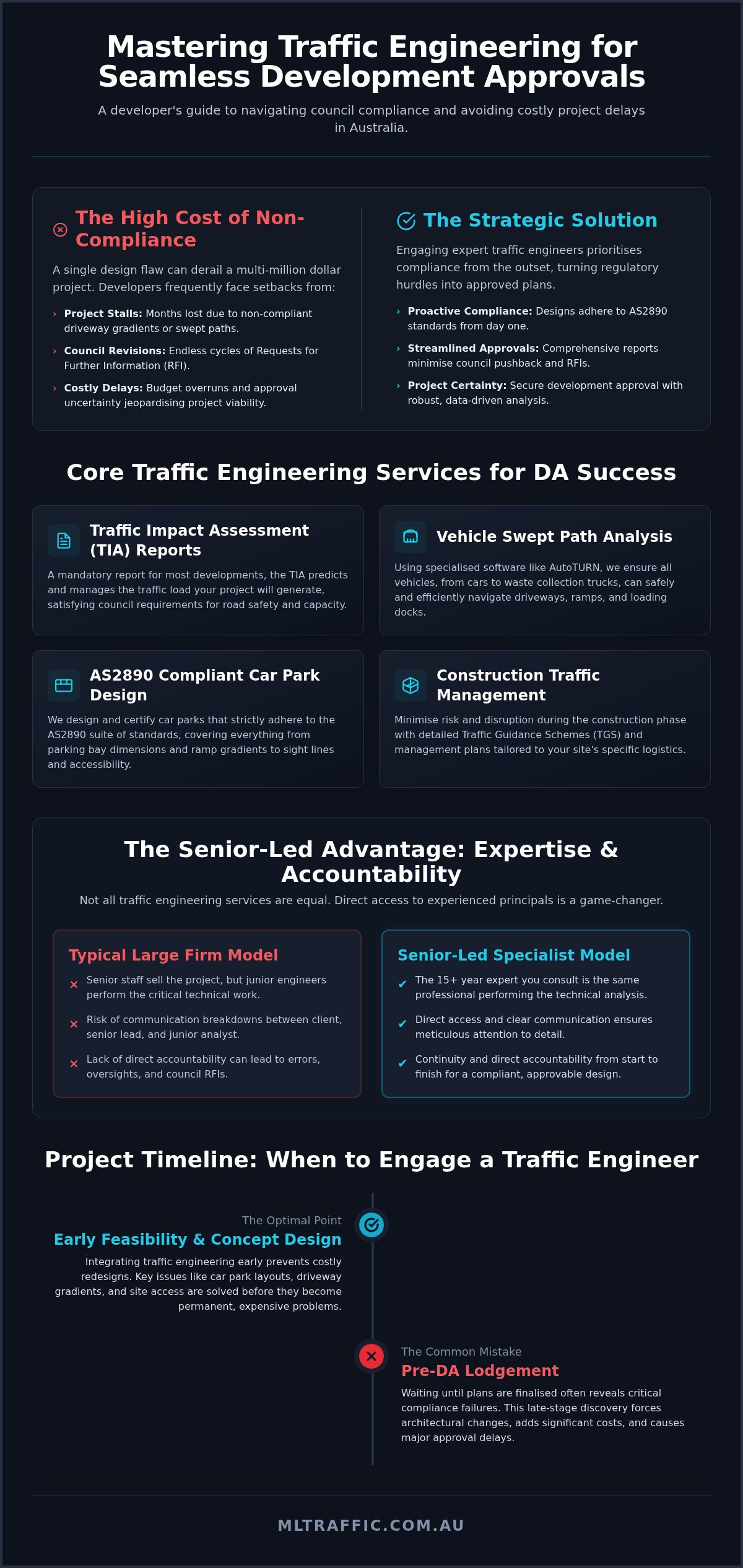
Developers should engage a traffic engineer during the early feasibility or concept design phase. It’s a common mistake to wait until the development application is nearly ready for lodgement. Early involvement prevents costly redesigns that occur when a car park layout or driveway gradient fails to meet AS2890 requirements. Professional intervention is essential whenever a change in land use occurs that increases vehicle or pedestrian activity, such as converting a warehouse into a residential complex or expanding a retail centre.
At ML Traffic Engineers Australia, we bring over 15 years of industry experience to every project. Our senior-led approach means the expert you consult with is the same professional performing the technical analysis. This continuity ensures that your traffic engineering requirements are handled with meticulous attention to detail and direct accountability. You can learn more about our specific traffic engineering services to see how we support diverse development types across the region.
The Core of Compliance: Traffic Impact Assessment (TIA) Reports
A Traffic Impact Assessment is a mandatory requirement for most medium-to-large scale developments. It functions as a technical bridge between your architectural vision and the reality of the surrounding road network. The primary purpose of this report is to analyse existing traffic conditions and predict the additional load generated by the new project. When you utilise traffic engineering services sydney, you ensure this predictive modelling is based on verified industry data rather than guesswork.
Each report must satisfy specific council guidelines and state-based transport authority requirements. A well-prepared TIA can significantly reduce the volume of Requests for Information (RFI) from authorities. These requests often cause months of delays. Integrating professional traffic engineering services sydney into your planning stage is the most effective way to manage these regulatory expectations. We provide a document that anticipates council concerns regarding road safety and capacity to streamline the approval process.
Key Components of a Robust Traffic Report
A high-quality TIA incorporates several technical layers to withstand council scrutiny. We start with trip generation and distribution modelling, using industry-standard data to calculate how many vehicle movements your site will create during peak hours. Intersection analysis is another critical component. Using specialised software like SIDRA, we assess the “Level of Service” at nearby intersections. This determines if the project will cause unacceptable delays for other road users. We also evaluate public transport accessibility and active transport links, such as cycling and walking paths, to provide a holistic view of site access.
Addressing Parking Demand and Supply
Parking is often the most contentious part of a development application. We determine the required number of parking spaces based on your specific land-use type and local planning controls. If your site has a parking shortfall, we can often justify it through empirical data or by highlighting proximity to major transport hubs. Our goal is to ensure the proposed parking layout doesn’t lead to on-street congestion or safety hazards. We look at the practicalities of how vehicles enter and exit the site to prevent queuing on public roads. If you’re concerned about meeting council parking codes, you can contact our senior engineers for a direct assessment of your site’s capacity.
AS2890 Compliance: Car Park Design and Swept Path Analysis
Every car park design in Australia must adhere to the AS2890 suite of standards. These regulations govern everything from stall dimensions to the gradient of a driveway ramp. Failure to meet these specific metrics is the most common reason for a development application to be rejected by local authorities. When engaging traffic engineering services sydney, developers receive technical assurance that every centimetre of their site plan complies with national safety and accessibility requirements. Our senior principals review every layout to identify non-compliance issues before they reach the council planner’s desk.
The Importance of Vehicle Swept Path Analysis
We use specialised software like AutoTURN to simulate vehicle movements across a proposed site. This process, known as swept path analysis, visualises how a B99 car or a heavy rigid vehicle (HRV) turns within tight spaces. It’s not just about passenger cars. We must ensure waste collection vehicles can access loading bays without needing dangerous multiple-point turns or reversing into traffic. This analysis is a critical component of council approval because it proves the site is functional for its intended use. Accurate simulations prevent the massive costs associated with modifying concrete structures or kerbs after they’ve been built. By seeing the vehicle’s footprint in a digital environment, we can adjust the design to save space while maintaining safety.
Optimising Car Park Layouts for Efficiency
Compliance doesn’t have to mean a reduction in total parking yield. Our senior engineers balance the maximum number of bays with the need for compliant manoeuvring areas. We perform detailed driveway ramp grade assessments to ensure vehicles don’t scrape their undercarriages on steep transitions. Aisle widths must be sufficient for two-way traffic where required, and blind-spot assessments are conducted to protect pedestrians in shared zones. We also verify that sight distances at property boundaries meet safety standards, particularly for vehicles exiting onto busy roads. These meticulous checks ensure that the technical work we perform stands up to the most rigorous council review. Providing a compliant layout from the start is the most cost-effective way to manage your traffic engineering services sydney requirements. Our assessments typically include:
- Stall dimensions and clearance heights for AS2890.1 compliance.
- Driveway ramp gradients and transition zones.
- Aisle widths and internal circulation patterns.
- Sight distance at access points for pedestrian and vehicle safety.
- Loading dock logistics for heavy rigid vehicles.
Traffic Guidance Schemes and Construction Management
Construction Traffic Management Plans (CTMP) serve as the operational blueprint for a development’s build phase. These documents manage the temporary yet significant risks that occur when a construction site interfaces with the public road network. While the CTMP provides the high-level strategy, a Traffic Guidance Scheme (TGS) delivers the technical layout. It specifies the exact placement of signs, cones, and barriers required to protect both workers and road users. Compliance with state-specific codes of practice is mandatory for any work performed within the road reserve. Our traffic engineering services sydney ensure these plans are approved quickly by local councils and transport authorities to keep your project on schedule.
Managing Pedestrian and Vehicle Safety
Maintaining safety on a live construction site requires meticulous planning of truck ingress and egress points. We design these access zones to prevent heavy vehicles from performing dangerous manoeuvres or reversing blindly onto public roads. Our engineers create temporary diversions that maintain traffic flow while ensuring pedestrians are physically separated from construction activity. We also handle the coordination with local councils for road occupancy permits. This proactive approach prevents the fines and work stoppages that occur when site logistics haven’t been properly vetted by a qualified traffic professional. Every safety plan we produce is reviewed by a senior principal to ensure it meets the highest technical standards.
Waste Management Planning for Sites
A comprehensive Waste Management Plan is often a critical condition of consent for modern developments. We integrate waste collection routes into the overall traffic flow to ensure garbage trucks can navigate the site without obstructing residents or delivery vehicles. Vertical clearance is a frequent failure point in development applications that lack senior oversight. We verify that basement heights and overhead services accommodate the specific reach and height requirements of collection vehicles. Meeting council requirements for on-site storage involves more than just finding space for bins. It requires a technical assessment of how those bins are moved to the collection point. Our senior engineers use AutoTURN to verify these movements, ensuring the technical work stands up to the most rigorous council scrutiny.
By choosing senior-led traffic engineering services sydney, you’re guaranteed that the engineer who designs your final car park also understands your construction logistics. This continuity of service prevents the errors that occur when different firms handle the DA and construction phases. If you need a compliant CTMP or a technical waste assessment, speak directly with our senior principals to discuss your project requirements today.
Why Senior Expertise Matters for Your Traffic Engineering Requirements
Many large engineering firms operate on a volume-based model. Senior partners often secure the contract before delegating the actual technical work to junior staff. This hierarchy creates a significant risk of communication gaps and leads to slower response times when a council transport planner issues a Request for Information (RFI). When you engage traffic engineering services sydney developers rely on, you’re choosing a model that prioritises direct access to senior principals. This ensures that the expertise you pay for is the expertise applied to your project from inception to approval.
Choosing the right traffic engineering services sydney provider means your project avoids the information loss that occurs during the transition from the initial site assessment to the final report. A “no-gatekeeper” approach ensures the engineer you speak with is the one performing the technical analysis. Senior engineers are better equipped to handle complex negotiations with local authorities. They understand the technical nuances that can sway a council’s decision on a marginal parking shortfall or a non-standard driveway gradient. Direct accountability from a seasoned expert speeds up the response to council RFIs and reduces the likelihood of costly redesigns.
The Value of 15+ Years of Industry Experience
Industry experience spanning more than 15 years provides a deep understanding of how different councils interpret Australian Standards. While national codes provide the baseline, the practical application often varies between specific local government areas. Senior expertise allows for the development of creative engineering solutions for constrained or difficult sites where a standard approach might fail. We maintain a proven track record across residential, commercial, and industrial sectors. This breadth of experience allows us to anticipate potential bottlenecks and address them in the initial design phase, saving significant time and capital during the construction stage.
Ensuring Accountability and Precision
Technical precision is non-negotiable in civil design. We conduct senior-led reviews of every vehicle swept path diagram and car parking certification to ensure total compliance with AS2890. This level of oversight ensures the accuracy of trip generation data, which is critical for intersection analysis and overall site impact assessments. Accountability rests directly with our principals, not a rotating team of junior consultants. You can visit our services page to see how our senior team can assist your project and provide the technical certainty your development requires.
Secure Your Project’s Future with Senior Engineering Oversight
Mastering the intricacies of council compliance requires more than just submitting a report. It demands a rigorous adherence to the AS2890 suite of standards and a proactive approach to traffic impact assessments. By prioritising technical accuracy in car park design and vehicle swept path analysis, you eliminate the common causes of planning delays and costly structural revisions. This technical foundation ensures your project stands up to the most demanding regulatory scrutiny.
Access to 15+ years of specialist experience ensures your project is handled with the meticulous attention to detail that only a senior principal can provide. Our commitment to direct engineer-to-client communication means your technical work is performed by the same expert who understands your project’s unique constraints. When you require professional traffic engineering services sydney developers can depend on, choosing senior oversight is the most effective way to guarantee results. We provide the technical certainty needed to move from development application to construction with confidence. We look forward to helping you achieve a successful project outcome.
Get a fee proposal for your traffic engineering services from our senior principals today.
Frequently Asked Questions
What is the difference between a Traffic Impact Assessment and a Traffic Management Plan?
A Traffic Impact Assessment (TIA) focuses on the long-term operational impact of a development on the surrounding road network. It predicts trip generation and assesses intersection capacity for the final occupied state of the project. A Traffic Management Plan (TMP) or Construction Traffic Management Plan (CTMP) addresses the temporary logistics of the build phase. When engaging traffic engineering services sydney, these documents work together to ensure both construction and operational phases meet council expectations.
Do I need a swept path analysis for a small residential development?
Yes, councils frequently require swept path analysis for small-scale residential projects to prove that vehicles can enter and exit the site in a forward direction. This is especially critical for sites with narrow driveways or limited internal manoeuvring space. We use specialised software to simulate the turning circles of a B99 vehicle. This technical evidence ensures your driveway and parking layout comply with local planning controls before the DA is lodged.
What is AS2890.1 and why is it important for my car park design?
AS2890.1 is the Australian Standard for off-street car parking. It specifies the mandatory dimensions for parking stalls, aisle widths, and driveway gradients for passenger vehicles. Adherence to this standard is essential because councils will reject any design that fails to meet these technical benchmarks. Correct application of AS2890.1 prevents vehicle scraping on ramps and ensures that all users can safely navigate the facility without property damage or pedestrian risk.
How long does it typically take to prepare a traffic report for a DA?
The preparation of a traffic report generally takes between one and two weeks depending on the project’s complexity and the required data collection. Complex developments requiring detailed intersection modelling or extensive parking demand assessments may take longer. Engaging professional consultancy early in the design process allows for the identification of potential issues. This proactive approach ensures the final report is technically robust and ready for council submission without unnecessary delays.
Can a traffic engineer help if the council has already rejected my parking layout?
Yes, we specialise in redesigning non-compliant layouts to meet council requirements. If your parking design was rejected, we perform a detailed audit against AS2890 standards to identify the specific failure points. Our senior engineers then provide technical solutions to rectify these issues while attempting to maintain your required parking yield. We often find that minor adjustments to aisle widths or ramp gradients can turn a rejected plan into a compliant one.
What is a Traffic Guidance Scheme (TGS) in the context of NSW projects?
A Traffic Guidance Scheme (TGS), formerly known as a Traffic Control Plan (TCP), is a detailed diagram showing the arrangement of temporary traffic control devices. It is a mandatory requirement for any construction work in NSW that impacts the road reserve. The TGS specifies the exact location of signs, barriers, and cones to ensure the safety of workers and the public. These schemes must be prepared by qualified professionals to meet state regulatory codes.
How does trip generation data affect my development application?
Trip generation data determines the volume of additional traffic your development will contribute to the local road network during peak hours. Councils use this data to assess whether nearby intersections can handle the increased load without a significant drop in the “Level of Service.” If the trip generation is high, you might be required to fund road upgrades or implement traffic calming measures. Accurate data from senior engineers prevents overestimating these impacts and avoids unnecessary infrastructure costs.
Why is senior engineer involvement critical for complex traffic assessments?
Senior engineer involvement ensures that complex traffic assessments benefit from high-level technical oversight and direct accountability. Experienced principals possess the professional judgement required to negotiate with council transport planners on marginal compliance issues. They understand the nuances of the AS2890 suite and can provide creative engineering solutions that junior staff might overlook. This senior-led approach is a hallmark of the traffic engineering services sydney developers trust, resulting in a higher probability of fast-tracked development application approvals.

Disclaimer
The content on www.mltraffic.com.au, including all technical articles, guides, and resources, is provided for general informational and educational purposes only. It is not intended to constitute professional advice in traffic engineering, transportation planning, development approvals, or any other technical or legal field.
While ML Traffic Engineers makes every reasonable effort to ensure the accuracy, completeness, and timeliness of the information published, we do not provide any warranties or representations (express or implied) regarding its reliability, suitability, or availability for any particular purpose. Any reliance you place on the content is strictly at your own risk.
In no event shall ML Traffic Engineers, its directors, employees, authors, or affiliates be liable for any direct, indirect, incidental, special, consequential, or punitive damages (including, without limitation, loss of profits, data, or business opportunities) arising out of or in connection with the use of, or inability to use, any information provided on this website.
The articles and guides on this site are not a substitute for engaging a qualified, registered professional traffic engineer (such as an NPER or RPEQ engineer) to assess your specific project requirements. For tailored advice, compliance assessments, or traffic engineering services, please contact a competent professional.
This disclaimer may be updated from time to time without notice. By accessing or using this website, you agree to be bound by the most current version of this disclaimer.
