
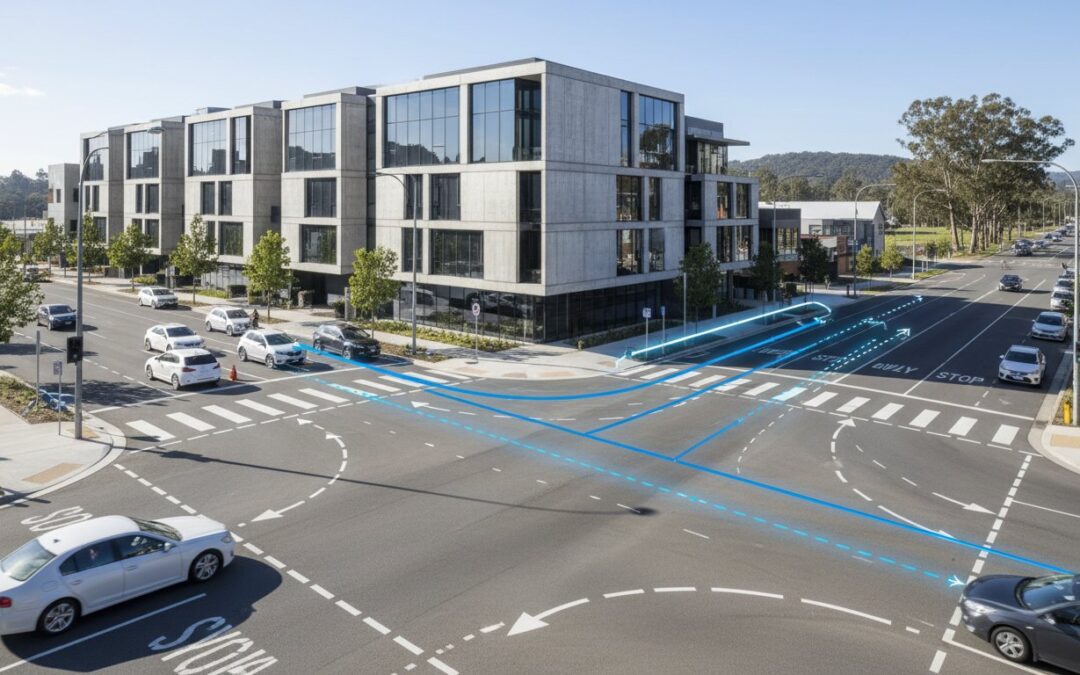
With road fatalities in Australia increasing by 7.8 percent to 1,286 deaths in the year ending March 2026, council scrutiny of new developments has reached an all-time high. You likely recognize that a development application’s success hinges on more than just vehicle counts. It requires technical proof that your site won’t contribute to the 30 billion dollar annual cost of road trauma. Integrating specific traffic impact assessment road safety considerations is no longer optional. It’s a strategic requirement to de-risk your project and avoid the costly redesigns that stem from poor access planning.
At ML Traffic Engineers Australia, we understand the frustration of receiving unexpected council objections or struggling with confusing AS 2890 standards. This guide provides a comprehensive technical reference on how road safety data and accident prevention strategies are integrated into TIAs to secure faster DA approval. We’ll preview the latest February 2026 Austroads updates, the shift toward multimodal design in the September 2024 NSW GTIA, and the "Safe System" principles necessary to deliver a clean report with no safety-related objections. By prioritizing these technical factors early, you ensure a development that is safe for future tenants and the public.
Key Takeaways
- Learn how the “Safe System” approach is integrated into modern traffic impact assessment road safety considerations to meet updated Austroads and state-specific standards.
- Discover how Vehicle Swept Path Analysis and AutoTURN simulations pre-empt low-speed collisions and ensure car park design compliance.
- Identify critical site-specific safety factors, including the analysis of historical accident data and the strategic placement of proposed access points.
- Understand how to translate technical safety data into council-approved infrastructure changes and robust Traffic Guidance Schemes for the construction phase.
- See why senior-led oversight is vital for interpreting complex safety reports and ensuring the engineer who quotes the project is the one performing the technical work.
Table of Contents
-
The Role of Road Safety in Modern Traffic Impact Assessments
-
Technical Analysis: Using Swept Paths and Sight Lines to Pre-empt Accidents
-
Mitigation Strategies: Translating Safety Data into Council-Approved Designs
-
Why Principal-Led Traffic Engineering is Vital for Road Safety Compliance
The Role of Road Safety in Modern Traffic Impact Assessments
As of 2026, the integration of road safety within the Traffic Impact Assessment (TIA) framework has evolved from a secondary checklist to a primary regulatory hurdle. Councils now prioritize granular safety data when evaluating high-density residential or commercial development applications (DAs). This shift ensures that infrastructure handles not only the volume of traffic but also the inherent risks associated with vehicle and pedestrian interaction. By addressing traffic impact assessment road safety considerations during the initial design phase, developers avoid the need for retrospective accident investigations after the project is operational. A robust modern road safety strategy identifies potential conflict points before they become liabilities.
To better understand the fundamental components of this technical analysis, watch this overview:
The Safe System Approach for Private Developments
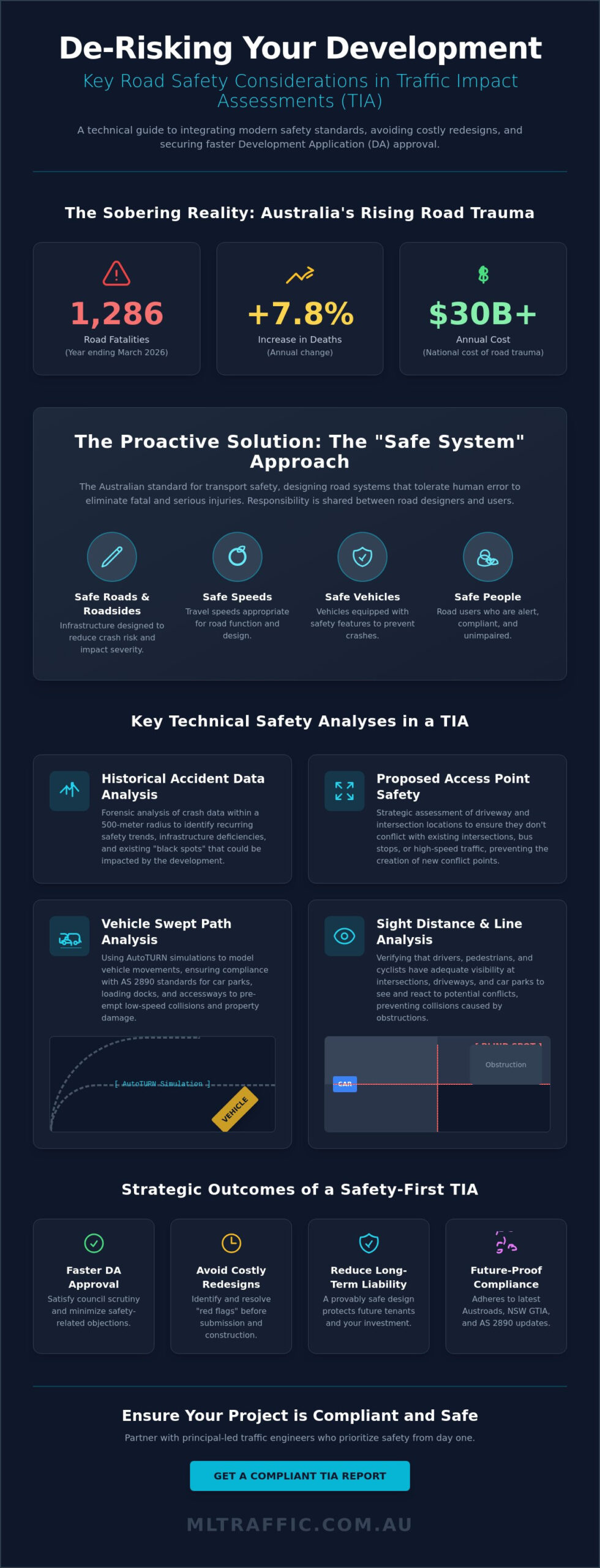
The Safe System approach is the current Australian standard for transport safety, focusing on the shared responsibility between road designers and users to eliminate fatal and serious injuries. It operates on the principle that while humans make mistakes, the road system should be designed to absorb those errors without catastrophic results. For private developments, this means applying human error tolerance to driveway ramp grades, intersection sight distances, and internal car park layouts. We focus on creating environments where safe speeds and safe vehicle movements are physically encouraged by the design. This involves analyzing how safe roads, safe speeds, safe vehicles, and safe people interact within your site’s specific context.
De-risking Your Development Application
A safety-first TIA acts as a strategic de-risking tool. Identifying safety "red flags," such as restricted sight lines or inadequate vehicle swept paths, before council submission prevents costly redesigns and delays. Beyond securing a "clean" TIA report, these considerations impact your long-term project insurance and liability. Compliance with Australian Standards like AS 2890.1 is the baseline; however, demonstrating a proactive approach to accident prevention often results in faster DA approval. At ML Traffic Engineers Australia, our traffic engineering services ensure that every assessment is overseen by a principal who understands exactly what council engineers look for in a safety-compliant submission. We provide the technical proof required to satisfy rigorous safety audits.
Key Road Safety Considerations Within a TIA Framework
A comprehensive assessment begins with a forensic analysis of the existing road environment. We analyze historical crash data within a 500-meter radius of the proposed site to identify recurring safety trends or infrastructure deficiencies. This data informs how the new development will interact with the current network and whether existing "black spots" require mitigation. When addressing traffic impact assessment road safety considerations, we evaluate if the projected increase in traffic volume will exacerbate these known risks or create new conflict points for local residents. Following the national framework outlined in the Austroads Guide to Traffic Management ensures that mitigation strategies are based on empirical evidence rather than assumptions.
Access point safety is a critical component of our technical review. We assess driveway locations to ensure they don’t conflict with existing intersections, bus stops, or high-speed traffic flows. Managing the interaction between heavy vehicles and passenger cars requires precise modeling, especially for industrial or retail developments. We use Intersection Analysis to verify that heavy vehicle movements don’t compromise the safety of other road users. This includes evaluating the impact of queuing vehicles on the through-traffic flow, which can lead to rear-end collisions if not properly managed through dedicated turning lanes or signal adjustments. Our traffic engineering services provide the technical rigor needed to address these site-specific constraints effectively.
Sight Distance and Intersection Safety
Compliance with Austroads and Australian Standards (AS 2890.1) for sight lines is non-negotiable. We identify potential obstructions such as street furniture, landscaping, and signage that could impair a driver’s visibility when exiting the site. This is especially vital for high-turnover access points like childcare centers or fast-food outlets where frequent turning movements occur throughout the day. We ensure that both Safe Intersection Sight Distance (SISD) and Approach Sight Distance (ASD) are maintained under all conditions. If your project involves complex entry points, ML Traffic Engineers Australia can provide a detailed Sight Distance Assessment to satisfy council requirements.
Pedestrian and Cyclist Safety Integration
Modern assessments must account for the safety of non-motorized road users. We design safe "desire lines" that reflect how people actually move through and around the site. This involves creating physical separation between pedestrian paths and heavy vehicle loading zones to prevent accidents in shared environments. All designs must adhere to DDA (Disability Discrimination Act) requirements to ensure accessibility for all users, including those with mobility aids. We also evaluate the impact of the development on existing cycling infrastructure, ensuring that new driveway crossings don’t create "blind spots" for cyclists traveling at speed along the frontage road.
Technical Analysis: Using Swept Paths and Sight Lines to Pre-empt Accidents
Technical modeling is the foundation of accident prevention in any development. We use software like AutoTURN to simulate real-world heavy vehicle movements within your site. This ensures that waste collection trucks and delivery vans don’t clip curbs or encroach on pedestrian zones. While many assessments treat these as basic maneuvers, we view them as critical traffic impact assessment road safety considerations. A failed swept path analysis doesn’t just mean a tight turn. It indicates a high probability of low-speed collisions and structural damage over the life of the building. We provide the technical proof that your site can handle its expected vehicle mix without compromising public safety.
Driveway ramp grades are equally important for risk mitigation. A grade that is too steep causes vehicle scraping. This leads to driver hesitation and distraction at the exact moment they should be scanning for pedestrians on the footpath. We assess these grades against AS 2890.1 to ensure smooth ingress and egress. Compliance with the Western Australian Transport Impact Assessment (TIA) guidelines requires this level of technical rigor. By identifying these hazards early, we prevent the need for expensive retrospective modifications after construction is complete.
The Engineering Behind Collision Prevention
We calculate "worst-case" maneuvers for every project. This includes simulating the largest service vehicle expected on-site, such as an 8.8m Medium Rigid Vehicle (MRV) or a 12.5m Heavy Rigid Vehicle (HRV). We also prioritize emergency vehicle access. If a fire truck or ambulance cannot navigate a tight corner or access a loading bay, the safety of future tenants is compromised. Our engineers analyze these paths to ensure adequate clearance and safety margins. For a deeper look at these techniques, read our guide on Swept Path Analysis: A Complete Guide for Australian Developments.
AS 2890 Compliance as a Safety Minimum
AS 2890.1 provides the baseline safety margins for off-street car parking. However, minimum compliance is often insufficient for high-traffic commercial environments. We design for the reality of human error. This means recommending wider bays or more generous circulation aisles in areas where the risk of side-swipe collisions is high. Our senior engineers evaluate these car park designs to ensure they don’t just meet the letter of the law but provide a safe environment for all users. Explore our resource on AS 2890.1 Explained: The Ultimate Guide to Compliant Car Park Design for more details on these essential standards.
Mitigation Strategies: Translating Safety Data into Council-Approved Designs
Once technical analysis identifies potential risks, we translate traffic impact assessment road safety considerations into physical or operational changes that satisfy council requirements. This process bridges the gap between raw data and a constructible site plan. We often propose physical infrastructure changes, such as median strips to prevent hazardous right-hand turns or dedicated turning lanes to reduce rear-end collision risks. Traffic calming measures, like speed humps or narrowed carriageways, are also utilized to maintain safe speeds within the development. Effective mitigation isn’t just about adding features; it’s about negotiating with council on design trade-offs that maintain safety while preserving the project’s commercial viability.
If you require a technical report that pre-empts council objections and secures approval, request a quote from our senior traffic engineers.
Physical vs. Operational Mitigation
Choosing between physical and operational mitigation depends on site constraints and the severity of the identified risk. Physical changes, such as structural road widening or intersection upgrades, offer permanent safety benefits but involve higher capital costs. Operational mitigation, including signage, line marking, or time-restricted access, provides a more cost-effective alternative for managing peak-hour safety. We perform a cost-benefit analysis for each strategy to ensure the proposed solution is both effective and proportionate to the development’s impact. For complex high-density sites, an operational management plan may be required to dictate how loading and waste collection occur during off-peak periods to minimize conflict with commuters.
Construction Safety and Traffic Management
Safety obligations begin long before the first tenant moves in. Construction-phase safety is a major priority for councils and state authorities. We implement a Traffic Guidance Scheme (TGS) to manage the safe movement of workers, plant equipment, and the general public during building works. A robust Traffic Management Plan (TMP) is an essential part of the TIA process, detailing how construction traffic will access the site without compromising local road safety performance. Ensuring the safety of the public during the development phase is a legal requirement that protects your project from liability and work-stoppage orders. For a deeper dive into these requirements, see The Ultimate Guide to Traffic Management Plans for Australian Developers.
Why Principal-Led Traffic Engineering is Vital for Road Safety Compliance
Safety-critical engineering requires a level of accountability that only a principal-led firm can provide. When a report carries the name of a senior engineer with 30 to 40 years of experience, it carries weight with local authorities. At ML Traffic Engineers, we operate on a specific promise: the traffic consultant who provides the quote, does the work. This ensures that traffic impact assessment road safety considerations are never delegated to inexperienced juniors. We take full responsibility for the technical accuracy of our assessments, from car park design to complex intersection analysis. Accountability isn’t just a buzzword; it’s a requirement for securing a development’s long-term safety and compliance.
Interpreting historical crash data and accident reports requires more than just basic data entry. It requires a seasoned perspective to determine if a past incident was an isolated human error or a symptom of a systemic infrastructure failure. By leveraging our history with over 10,000 sites, we provide proven safety solutions for a vast range of developments:
-
High-density residential apartments and mixed-use towers
-
Industrial warehouses and logistics distribution centers
-
Retail shopping centers and high-turnover fast-food outlets
-
Childcare centers, schools, and educational facilities
-
Specialized land uses including temples, medical clinics, and bars
This depth of knowledge allows us to pre-empt council objections before they are even raised. We understand the bureaucratic requirements of traffic engineering inside and out, ensuring that your TIA report is meticulously prepared to avoid costly redesigns.
Direct Access to Expertise
Junior-led reports frequently miss subtle safety hazards such as driveway ramp grade issues or obscured sight lines that only become apparent during the construction phase. These oversights lead to expensive retrospective fixes and planning delays. Principal-led advocacy is vital during council negotiations. When a council engineer questions a design choice, having Michael Lee or Benny Chen available for direct technical guidance ensures a swift, authoritative resolution. Direct access to our principals means there are no gatekeepers. You get a direct line to the experts who are actually performing the technical work on your project.
National Reach, Local Expertise
We apply national Austroads safety standards while tailoring our analysis to the specific local government requirements of your site. This dual focus ensures your TIA is robust enough to withstand the most rigorous council scrutiny, regardless of the jurisdiction. Whether you’re developing a retail hub in Sydney or an industrial warehouse in Perth, our senior staff are involved in every stage of the safety analysis. Explore the expertise of our team About ML Traffic Engineers to see how our dependability and meticulous approach drive successful planning outcomes for our clients.
Secure Your Development Approval Through Technical Safety Excellence
Integrating traffic impact assessment road safety considerations into your project design is more than a regulatory requirement; it’s a strategic de-risking tool. By applying the Safe System approach and conducting rigorous technical analysis, including Vehicle Swept Path Analysis and Sight Distance Assessments, you ensure your development meets the highest Australian Standards. These strategies don’t just prevent accidents. They pre-empt costly council objections and streamline the DA approval process for high-density and commercial sites alike.
ML Traffic Engineers brings over 15 years of industry experience and a track record of successfully assessing 10,000+ sites across Australia. We operate on a unique promise of accountability: the senior principal who quotes your project is the one who performs the technical work. This direct access to Michael Lee or Benny Chen ensures your safety-critical reports are meticulous, dependable, and authoritative. You don’t have to deal with junior staff or bureaucratic delays.
Contact ML Traffic Engineers for a principal-led Traffic Impact Assessment to ensure your development is safe, compliant, and ready for approval. We look forward to helping you move your project forward with confidence.
Frequently Asked Questions
What is the most common road safety reason for a DA rejection?
Inadequate sight distance at the proposed access point is the primary reason for DA rejections. If a driver exiting your site cannot clearly see oncoming traffic within the Safe Intersection Sight Distance (SISD) requirements, council will deem the development unsafe. Non-compliant driveway locations that conflict with existing intersections or bus stops also trigger immediate objections from council engineers.
How does a Traffic Impact Assessment differ from a Road Safety Audit?
A Traffic Impact Assessment is a predictive report submitted during the planning phase to evaluate how a new development will affect the surrounding transport network. In contrast, a Road Safety Audit is a formal, independent examination of a road project’s safety performance at specific design or operational stages. While we integrate safety data into our TIAs, we do not perform independent Road Safety Audits.
Is swept path analysis mandatory for all residential developments?
Swept path analysis isn’t required for single dwellings, but it’s mandatory for most multi-unit developments and apartments. You must prove that waste collection trucks and emergency vehicles can enter and exit the site in a forward direction. We use specialized software to simulate these movements, ensuring your car park design complies with local council waste management policies and fire safety access requirements.
How far back should accident history data go in a TIA report?
Standard practice requires analyzing at least five years of historical crash data in the vicinity of the site. This timeframe provides a statistically significant window to identify recurring safety trends or infrastructure "black spots." Evaluating this data is a core part of addressing traffic impact assessment road safety considerations to ensure your development doesn’t exacerbate existing local hazards.
Can I use a TIA to argue against a council-mandated road upgrade?
Yes, a TIA can serve as a technical rebuttal if the data proves the development’s impact is negligible. If our analysis shows that the existing infrastructure has sufficient spare capacity and that safety margins remain within acceptable limits, you can often negotiate out of expensive road works. We provide the empirical proof needed to challenge unreasonable developer contribution requests or unnecessary physical upgrades.
What Australian Standards govern safety in car park design?
The primary standards are AS 2890.1 for off-street car parking and AS 2890.6 for off-street parking for people with disabilities. These documents dictate the minimum requirements for bay dimensions, aisle widths, and driveway ramp grades. Following these standards is the baseline for safety compliance, ensuring that vehicle movements don’t create hazards for pedestrians or lead to low-speed structural collisions.
How much weight does council give to pedestrian safety vs. vehicle flow?
Modern Australian planning guidelines increasingly prioritize pedestrian safety over vehicle throughput. Under the "Safe System" approach, councils often require designs that prioritize vulnerable road users, even if it reduces vehicle efficiency. Demonstrating robust traffic impact assessment road safety considerations for pedestrians, such as clear sight lines and separated pathways, is often more important for approval than proving high vehicle capacity.
What happens if my site cannot meet the standard sight distance requirements?
If your site has physical constraints that prevent standard sight distance, you must propose engineered mitigation strategies. This might involve relocating the driveway, implementing specific signage, or using mirrors, though mirrors are often a last resort for councils. Our senior engineers specialize in negotiating these design trade-offs with council to find a technical solution that maintains safety without compromising your site’s layout.
Which areas do you cover?
We are traffic engineers servicing Melbourne, Sydney, Brisbane, Gold Coast, Hobart, Perth, Adelaide, Darwin, Canberra and surrounding areas.

Disclaimer
The content on www.mltraffic.com.au, including all technical articles, guides, and resources, is provided for general informational and educational purposes only. It is not intended to constitute professional advice in traffic engineering, transportation planning, development approvals, or any other technical or legal field.
While ML Traffic Engineers makes every reasonable effort to ensure the accuracy, completeness, and timeliness of the information published, we do not provide any warranties or representations (express or implied) regarding its reliability, suitability, or availability for any particular purpose. Any reliance you place on the content is strictly at your own risk.
In no event shall ML Traffic Engineers, its directors, employees, authors, or affiliates be liable for any direct, indirect, incidental, special, consequential, or punitive damages (including, without limitation, loss of profits, data, or business opportunities) arising out of or in connection with the use of, or inability to use, any information provided on this website.
The articles and guides on this site are not a substitute for engaging a qualified, registered professional traffic engineer (such as an NPER or RPEQ engineer) to assess your specific project requirements. For tailored advice, compliance assessments, or traffic engineering services, please contact a competent professional.
This disclaimer may be updated from time to time without notice. By accessing or using this website, you agree to be bound by the most current version of this disclaimer.
