
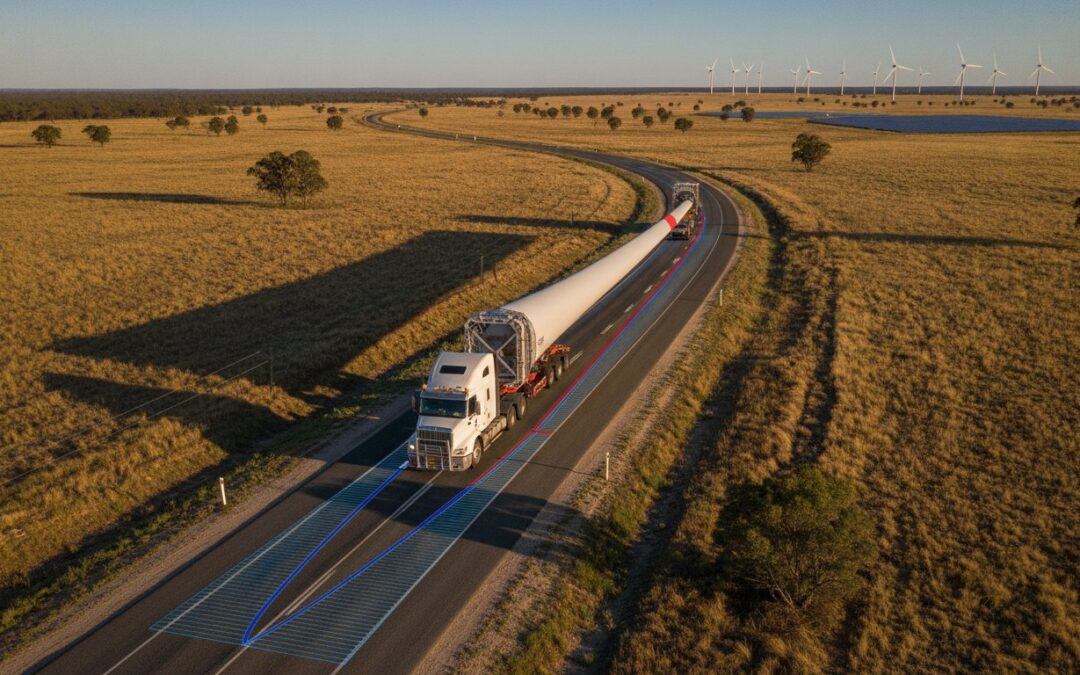
A single rejected Traffic Impact Assessment can halt a multi-million dollar development before the first turbine blade even arrives on site. As the sector prepares for $120 billion in investment throughout 2026, the margin for error in traffic management for renewable energy projects has effectively vanished. You understand that securing DA approval hinges on more than just site capacity; it requires a bulletproof plan for moving Oversize Over Mass (OSOM) components through restrictive corridors and remote locations while meeting strict regulatory standards.
This guide explains how specialized traffic engineering ensures regulatory compliance and logistical efficiency for large-scale wind, solar, and battery storage developments. We’ll detail the technical requirements for meeting the 11th Edition of the Manual on Uniform Traffic Control Devices (MUTCD), which became a mandatory national standard in January 2026, and the specific assessments needed for seamless approvals. You’ll learn how precise vehicle swept path analysis and professional intersection design prevent the logistical failures that commonly derail infrastructure projects.
Key Takeaways
- Learn how a technical Traffic Impact Assessment (TIA) secures DA approval by analyzing construction-phase impacts on existing road networks.
- Understand the critical role of Vehicle Swept Path Analysis in simulating the transport of Oversize Over Mass (OSOM) components through restrictive corridors.
- Discover how specialized traffic management for renewable energy projects ensures logistical efficiency across the entire project lifecycle, from construction to decommissioning.
- Identify the engineering requirements for maintaining compliance with national transport regulations in remote locations with limited infrastructure.
- Gain insights into how direct collaboration with senior engineering principals minimizes bureaucratic delays and enhances technical accountability.
The Critical Role of Traffic Management for Renewable Energy Projects
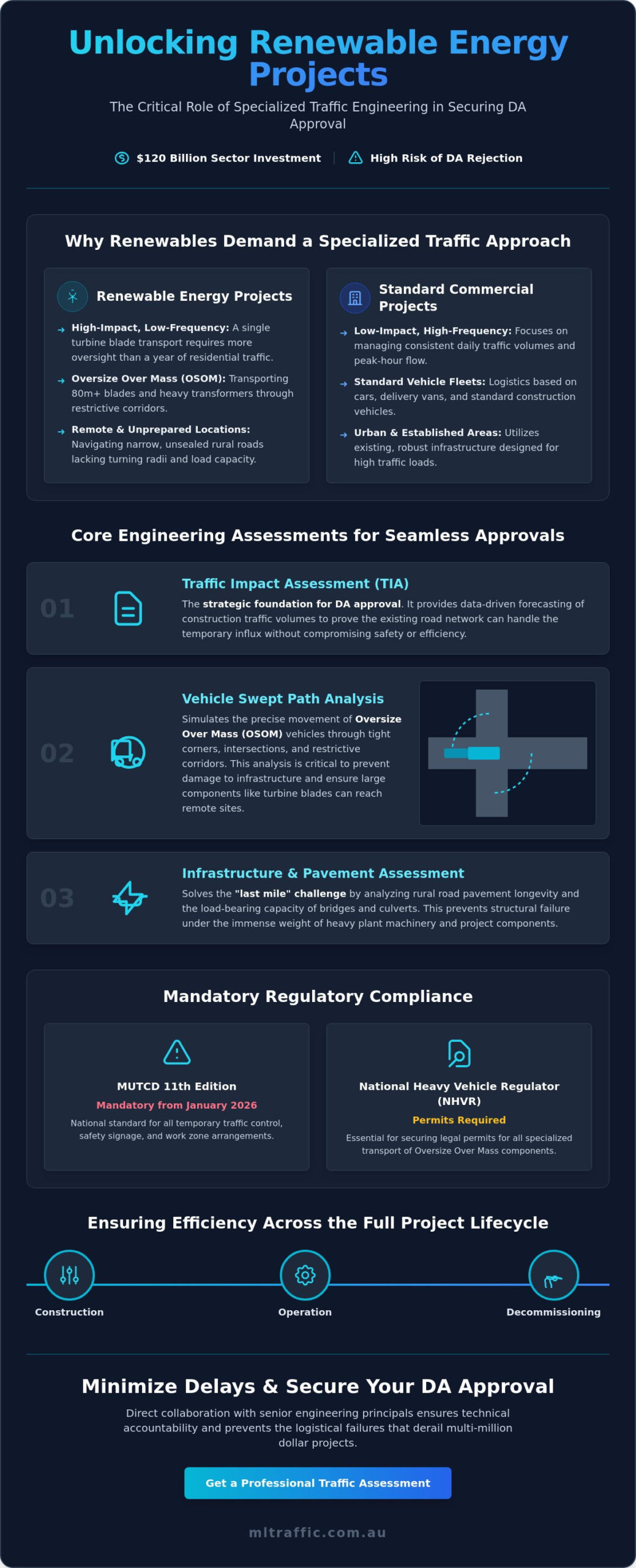
Traffic management for renewable energy projects is a specialized engineering discipline. It encompasses the strategic planning required for the transport, installation, and maintenance of green energy assets. This includes large-scale wind turbines, solar arrays, and utility-scale battery storage systems. Unlike standard commercial developments that prioritize daily traffic volume, renewable projects focus on high-impact, low-frequency movements. A single turbine blade transport requires more technical oversight than a year of residential traffic. Engineering reports serve as the primary evidence for securing Development Application (DA) approvals. This renewable energy overview details the diverse technologies driving the global energy transition, all of which require robust logistical support.
To better understand the scale of these logistical requirements, watch this video on modern traffic management concepts:
Why Renewables Require a Unique Traffic Approach
Renewable projects present unique logistical hurdles that standard civil planning often overlooks. Standard commercial traffic planning addresses consistent vehicle flow and peak-hour congestion. Renewable logistics center on the transport of Oversize Over Mass (OSOM) components. Most project sites are located in remote regions with unsealed or narrow rural roads. This creates a significant “last mile” challenge. Engineering assessments must determine if existing infrastructure can support heavy plant machinery. We analyze road pavement longevity to prevent structural failure during the construction phase. These rural environments often lack the turning radii or load-bearing capacity required for 80-meter turbine blades or heavy transformers. Precise engineering ensures these components reach the site without damaging local assets.
The reliability of these components is often a result of advanced fabrication techniques. For instance, the Australian manufacturing sector utilizes specialized robotic welding technology from TME Systems Pty Ltd to ensure the structural integrity of large-scale renewable energy infrastructure before it ever reaches the road.
Navigating Regulatory Frameworks in 2026
Compliance with regulatory frameworks is mandatory for project commencement. As of January 2026, all projects must align with the 11th Edition of the Manual on Uniform Traffic Control Devices (MUTCD). This national standard dictates the requirements for temporary traffic control and safety signage. Developers must also coordinate with the National Heavy Vehicle Regulator (NHVR) to secure permits for specialized transport. Professional engineering reports address these legal requirements while mitigating community concerns. Clear data regarding road safety and noise levels helps build local trust. Our comprehensive traffic engineering services provide the documentation necessary to satisfy both local councils and state authorities. It’s the only way to ensure a project remains on schedule and within budget.
Engineering Compliance: Traffic Impact Assessments (TIA) for DA Approval
A comprehensive Traffic Impact Assessment is mandatory for most large-scale renewable developments. While a Traffic Guidance Scheme (TGS) provides the physical layout for temporary signage and barriers, the TIA serves as the strategic foundation. It analyzes the long-term effect of construction traffic on existing road networks. This distinction is critical for developers who often mistake one for the other. Effective traffic management for renewable energy projects requires data-driven forecasting of traffic volumes during peak construction phases. This ensures that the influx of heavy haulage and contractor vehicles doesn’t exceed the capacity of local infrastructure.
The TIA process aligns with broader national goals to modernize infrastructure and reduce emissions. Programs such as those outlined in the Traffic Impact Assessments for DA Approval highlight the role of traffic monitoring and management in achieving sustainable energy targets. By documenting these impacts early, developers provide councils with the necessary technical assurance to move forward. Accurate data prevents the common delays associated with inadequate or incomplete transport reports.
Core Components of a Renewable TIA
Baseline traffic counts and existing road condition audits establish the necessary starting point for any assessment. We model trip generation for staff, specialized contractors, and heavy haulage vehicles to predict peak loads. Sight distance assessments at proposed site entry points are vital to ensure that vehicles entering and exiting the site have sufficient visibility to maintain safety. We also perform detailed intersection analysis to determine if existing infrastructure requires temporary or permanent modification to handle increased volumes.
Mitigation Strategies and Safety Statements
Identifying potential impacts is only the first step. The engineering report must also propose viable mitigation strategies. These often include road upgrades or temporary reinforcements designed to handle the massive weights of turbine components. We also develop a Statement of Environmental Effects (SEE) regarding transport. This document addresses potential disturbances to local commuters and ensures that pedestrian safety remains a priority in project zones. If your project faces complex site access issues, you can speak with our senior principals to discuss a tailored assessment strategy.
Our approach ensures that every TIA is meticulous and results-oriented. We focus on meeting strict Australian Standards and local council requirements to prevent delays in the approval process. The goal is to provide a clear, technical path to DA approval through authoritative engineering data and professional site assessments.
Strategic Vehicle Swept Path Analysis for Specialized Infrastructure
Theoretical site access is insufficient for high-stakes infrastructure. Effective traffic management for renewable energy projects relies on precise data regarding vehicle maneuverability. Specialized components, such as wind turbine blades and heavy substation transformers, require a detailed Swept Path Analysis to verify that transport is physically possible. We utilize AutoTURN software to simulate real-world vehicle maneuvers across every segment of the proposed transport route. This engineering process identifies critical ‘pinch points’ on rural and unsealed roads before any equipment leaves the factory. Identifying these constraints early prevents costly logistical failures and ensures the project remains compliant with AS 2890.2 standards for commercial vehicle access.
Planning for Oversized Overmass (OSOM) Loads
Transporting Oversized Overmass (OSOM) loads presents extreme engineering challenges. Modern wind turbine blades often exceed 80 meters in length, necessitating a massive turn radius that standard rural intersections cannot accommodate. Our analysis focuses on three primary technical areas:
- Turn Radius Simulation: We model the exact articulation of multi-axle trailers to determine the required road width at every bend.
- Vertical Clearance Assessment: Large substation transformers require significant height clearance; we assess overhead obstacles to prevent infrastructure strikes.
- Driveway Ramp Grade Evaluation: Heavy haulage trailers have limited ground clearance. We perform a Driveway Ramp Grade Assessment to ensure vehicles don’t bottom out when entering the site.
Mitigating Risk Through Digital Simulation
Digital simulation is a cost-management tool. It’s significantly cheaper to identify a clearance issue in a software model than to discover it during a physical transport operation. In the same way that industrial digitalization experts like PLM-Sme FZC use software to optimize product lifecycles, swept path analysis provides councils and road authorities with visual proof of vehicle accessibility. This technical certainty reduces the need for unnecessary road widening and minimizes the project’s physical footprint.
Beyond the main access routes, we integrate these simulations into the broader Car Park Design for Operations and Maintenance (O&M) buildings. Even these secondary facilities must accommodate heavy service vehicles and emergency assets. By applying rigorous engineering standards to every vehicle movement, we eliminate the guesswork that often leads to project delays. This meticulous approach ensures that every OSOM movement is backed by authoritative data and professional certification.
Managing the Project Lifecycle: From Construction to Decommissioning
Traffic management for renewable energy projects is not a static requirement. It evolves through four distinct phases: pre-construction, construction, operations and maintenance (O&M), and decommissioning. Each phase presents unique engineering challenges and regulatory hurdles. The construction phase represents the highest risk period due to the volume of heavy vehicle movements and the transport of specialized components. Conversely, the operational phase involves lower traffic volumes but requires permanent, compliant access solutions that satisfy long-term safety standards. Professional oversight ensures that the transition between these phases is seamless and documented for regulatory bodies.
Construction Traffic Management Plans (TMP)
A comprehensive Traffic Management Plan is essential for coordinating site movements during the build. We focus on logistical precision to minimize community impact. This involves scheduling heavy haulage deliveries to avoid local school bus routes and peak rural traffic times. For any temporary road modifications, we develop a Traffic Guidance Scheme (TGS) that provides the physical layout for signage and safety barriers. These plans ensure that high-frequency construction movements don’t compromise local road safety or infrastructure integrity.
Operations and Maintenance (O&M) Access
Post-construction traffic requirements shift toward long-term site viability. Permanent site entries must adhere to Australian Standards, specifically regarding sight distance and intersection geometry. We conduct detailed assessments to ensure O&M facilities accommodate staff and service vehicles without overflow. Emergency vehicle access is a critical component of the site design. The internal road network must support rapid deployment of emergency assets throughout the project’s multi-decade lifespan. This technical continuity prevents the need for costly retrofitting later in the project’s life.
The decommissioning phase is the final, often ignored, stage of the project lifecycle. It requires a reverse logistical plan to manage the removal of large-scale assets. This involves the same technical rigor as the initial construction phase, including swept path analysis for OSOM vehicles and updated structural assessments of local roads. Planning for the end of the project’s life during the initial DA phase demonstrates a commitment to long-term infrastructure accountability. If you require a lifecycle-wide strategy for your development, contact our senior principals for direct technical guidance.
Partnering with ML Traffic Engineers for National Renewable Projects
ML Traffic Engineers brings over 15 years of specialized experience to the civil engineering and transport planning sector. Our firm provides comprehensive support for developers across all Australian jurisdictions, ensuring that complex infrastructure projects meet every regulatory milestone. We manage the entire technical workflow, from the initial Traffic Impact Assessment (TIA) Report to final Vehicle Swept Path Analysis certification. This end-to-end service model eliminates the need for multiple consultants and ensures technical consistency throughout the project lifecycle. Our expertise in traffic management for renewable energy projects is backed by a proven track record of successful Development Applications in diverse and challenging environments.
We understand the bureaucratic requirements of state authorities and local councils. Our reports are designed to withstand rigorous scrutiny and provide the technical certainty required for large-scale investment. We offer a full suite of specialized services, including:
- Traffic Impact Assessment (TIA) Reports
- Vehicle Swept Path Analysis (AutoTURN)
- Traffic Guidance Scheme (TGS) Development
- Driveway Ramp Grade Assessments
- Intersection and Sight Distance Analysis
- Car Parking Demand and Design Assessments
Why Senior Expertise Matters in Renewables
Our firm operates on a “no-gatekeepers” philosophy. You’ll have direct access to the senior principals responsible for your project’s technical output. This approach ensures maximum accountability and precision in every assessment. Unlike larger, impersonal firms, the expert who initiates your client relationship is the one performing the technical work. This personnel continuity promise is a core signature of our professional practice. We provide meticulous attention to detail during negotiations with council and state authorities. This senior-level involvement is critical when addressing the high-stakes logistics of wind, solar, and battery storage developments.
Streamlining Your Approval Process
Reducing the risk of a Request for Further Information (RFI) is a primary objective of our engineering process. Incomplete or vague transport reports are a leading cause of approval delays. We provide exhaustive documentation that addresses every potential concern before it’s raised by authorities. Our team has extensive experience across a vast range of land-use categories and project environments, from remote rural corridors to sensitive urban interfaces. This breadth of practical experience allows us to anticipate and mitigate logistical challenges effectively. If you’re ready to secure a technically sound foundation for your next development, contact our senior engineers to discuss your specific project requirements.
Securing Technical Approval for 2026 Renewable Developments
Successful renewable developments depend on moving from broad transport concepts to precise engineering data. You’ve seen how a meticulous Traffic Impact Assessment and accurate Vehicle Swept Path Analysis form the technical backbone of a successful DA approval. Effective traffic management for renewable energy projects requires a commitment to national standards and a deep understanding of the logistical lifecycle, from initial construction to future decommissioning. This technical rigor prevents the costly delays and logistical failures that often stall large-scale infrastructure.
ML Traffic Engineers provides the technical precision and accountability needed to navigate these complex regulatory environments. With over 15 years of specialist experience, we ensure your project meets all Australian Standards and NHVR compliance requirements. Our direct principal involvement in every report guarantees that you receive authoritative advice without bureaucratic gatekeepers. We’re ready to provide the meticulous documentation and expert negotiation skills your next project demands.
Secure your project’s approval with expert Traffic Engineering services from ML Traffic Engineers.
We look forward to helping you deliver a compliant and efficient energy future.
Frequently Asked Questions
What is the difference between a TMP and a TGS for a solar farm?
A Traffic Management Plan (TMP) is a strategic document that outlines the overall transport strategy, including haulage routes, vehicle frequencies, and scheduling. A Traffic Guidance Scheme (TGS) is a technical diagram showing the physical placement of signs and barriers for temporary road works. Solar farms require both to manage high-volume construction deliveries safely and legally. The TMP provides the logic, while the TGS provides the site-specific execution instructions.
When is a Traffic Impact Assessment (TIA) required for a battery storage project?
A TIA Report is mandatory when a battery storage project is expected to generate significant vehicle movements or impact existing road infrastructure. While operational traffic is minimal, the construction phase involves heavy haulage of containerized battery units and transformers. Councils require this data-driven report to verify that local roads can support these specialized loads without structural damage. It’s a critical component of the DA approval process for utility-scale storage.
How long does it take to prepare a Swept Path Analysis for oversized loads?
Preparation time for a Vehicle Swept Path Analysis typically ranges from three to five business days depending on the number of intersections and the complexity of the Oversize Over Mass (OSOM) vehicles. We use AutoTURN software to simulate movements for turbine blades or substation components. This timeline ensures every technical pinch point is identified and mitigated before the project moves to the permit phase. Complex routes with multiple intersections may require additional time for exhaustive modeling.
Does my renewable project need to comply with AS 2890.1 or AS 2890.2?
Renewable projects must comply with both standards to ensure full regulatory alignment. AS 2890.1 governs off-street car parking for staff and light vehicles at Operations and Maintenance (O&M) buildings. AS 2890.2 dictates the requirements for off-street commercial vehicle facilities, which is the primary standard for the heavy haulage and plant machinery used in traffic management for renewable energy projects. Adherence to both ensures that every vehicle type is safely accommodated on site.
Can a traffic engineer help with the Statement of Environmental Effects (SEE)?
Traffic engineers provide the essential transport and logistics data required for a Statement of Environmental Effects (SEE). We supply technical evidence regarding road safety, noise mitigation, and pavement impact during the construction phase. This professional input ensures the SEE accurately reflects how the project will manage its environmental and community footprint through strategic engineering. It’s an important step in demonstrating project viability to state authorities and local councils.
What are the common traffic-related reasons for DA refusal in renewable projects?
DA refusal often stems from inadequate sight distance assessments or flawed swept path simulations that fail to prove vehicle accessibility. Councils also reject applications that don’t account for local school bus times or provide insufficient intersection analysis. Professional engineering reports eliminate these risks by providing exhaustive, data-backed proof of logistical feasibility. Without this technical certainty, authorities can’t approve the development due to safety and infrastructure concerns.
How do traffic engineers assess the impact on unsealed rural roads?
We assess unsealed rural roads through detailed pavement condition audits and structural capacity assessments. This involves identifying existing deficiencies and calculating the impact of heavy axle loads during the construction phase. Our reports recommend specific road upgrades or temporary reinforcements to ensure the infrastructure remains viable for both the project and the local community. This meticulous approach prevents road failure and minimizes the project’s long-term maintenance liability.
What role does the NHVR play in renewable energy traffic planning?
The National Heavy Vehicle Regulator (NHVR) coordinates the permit process for OSOM vehicles used in renewable energy developments. They ensure that heavy vehicle movements comply with the Heavy Vehicle National Law (HVNL). Our role involves providing the technical swept path data and route assessments the NHVR requires to issue these essential transport permits. This coordination is vital for the successful traffic management for renewable energy projects involving oversized components.

Disclaimer
The content on www.mltraffic.com.au, including all technical articles, guides, and resources, is provided for general informational and educational purposes only. It is not intended to constitute professional advice in traffic engineering, transportation planning, development approvals, or any other technical or legal field.
While ML Traffic Engineers makes every reasonable effort to ensure the accuracy, completeness, and timeliness of the information published, we do not provide any warranties or representations (express or implied) regarding its reliability, suitability, or availability for any particular purpose. Any reliance you place on the content is strictly at your own risk.
In no event shall ML Traffic Engineers, its directors, employees, authors, or affiliates be liable for any direct, indirect, incidental, special, consequential, or punitive damages (including, without limitation, loss of profits, data, or business opportunities) arising out of or in connection with the use of, or inability to use, any information provided on this website.
The articles and guides on this site are not a substitute for engaging a qualified, registered professional traffic engineer (such as an NPER or RPEQ engineer) to assess your specific project requirements. For tailored advice, compliance assessments, or traffic engineering services, please contact a competent professional.
This disclaimer may be updated from time to time without notice. By accessing or using this website, you agree to be bound by the most current version of this disclaimer.
