
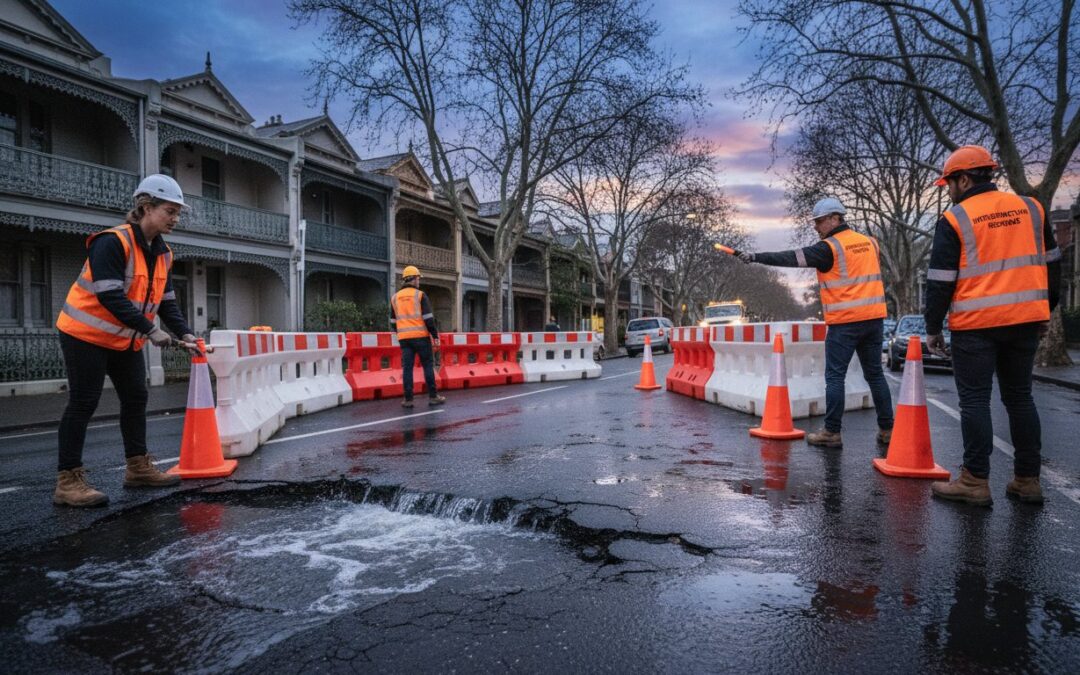
In an emergency infrastructure failure, the 60 minutes following the initial report determine whether your response is a professional success or a significant legal liability. When a water main bursts or a power line falls, the pressure to restore services immediately is immense. You likely feel the tension between the need for speed and the rigid requirements of a formal traffic management plan for emergency works. Every second of delay increases public risk, yet bypassing safety protocols can lead to catastrophic accidents and heavy fines from state regulators.
This guide provides the technical clarity you need to balance rapid deployment with Australian regulatory compliance. You’ll learn how to transition from immediate short-term fixes to a fully documented Traffic Guidance Scheme (TGS) without exposing your crew to unnecessary risk or your company to WorkSafe investigations. We’ll examine the specific triggers for formal documentation, the essential elements of an emergency setup, and the documentation protocols that satisfy both AS 1742.3 and local road authority requirements.
Key Takeaways
- Understand the legal distinction between emergency and planned works in Australia to ensure your site remains compliant under immediate pressure.
- Identify the essential equipment, including short-term signage and temporary barricades, required for a rapid-response traffic guidance scheme.
- Mitigate legal liability by learning when to transition from a tactical setup to a formal traffic management plan for emergency works.
- Master a structured response for urgent repairs, starting with immediate hazard identification and the deployment of tactical control devices.
- Leverage professional engineering expertise for rapid-turnaround documentation to maintain safety and compliance during critical infrastructure failures.
Table of Contents
-
Essential Components of an Emergency Traffic Management Plan
-
Step-by-Step Guide to Implementing Emergency Traffic Control
Defining Emergency Works and Regulatory Requirements
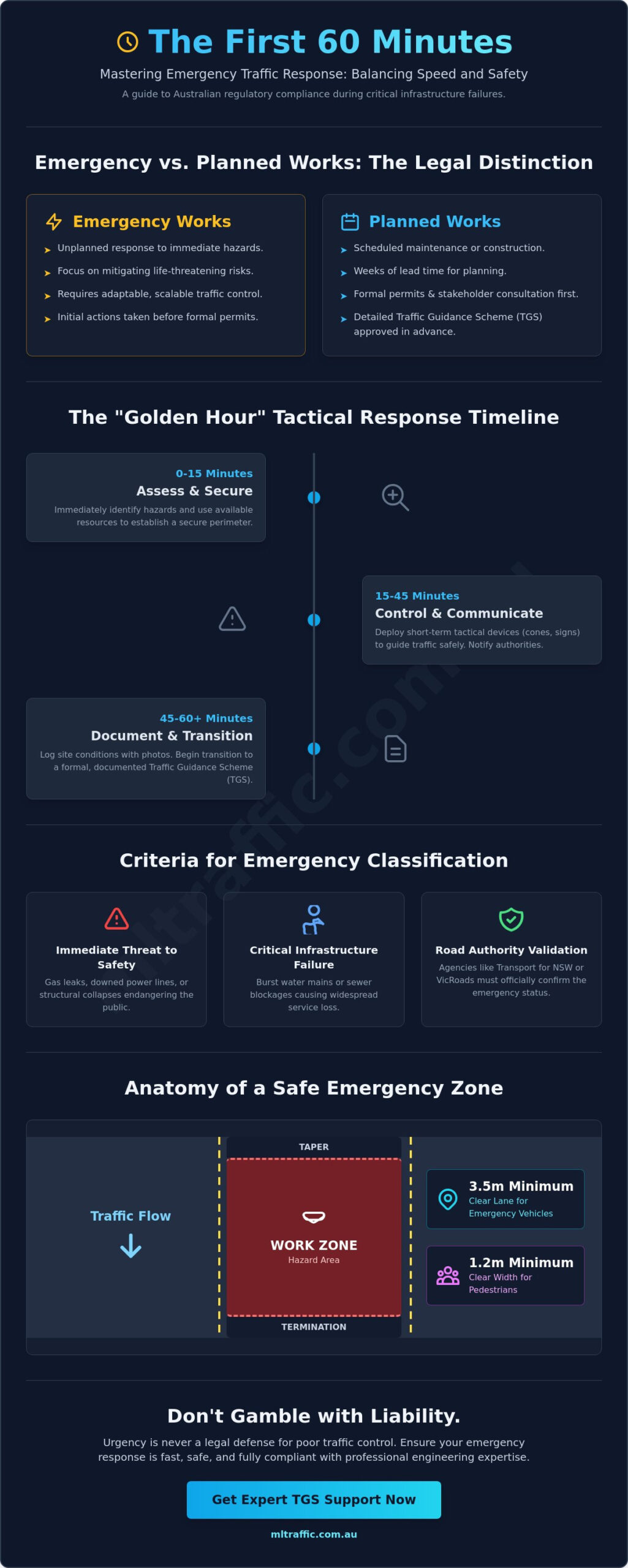
Emergency works are unplanned responses to immediate hazards that require an instant site presence. Unlike planned maintenance, which involves weeks of lead time for permit approvals and stakeholder consultation, an emergency response prioritises the mitigation of life-threatening risks. A traffic management plan for emergency works must be adaptable and scalable, as site conditions are often volatile during the initial response phase. The primary objective is to stabilise the area while maintaining the safest possible flow of vehicles and pedestrians.
To better understand the technical requirements of rapid deployment, watch this helpful video:
Regulatory compliance in Australia is dictated by the Australian Standard AS 1742.3:2019. This document sets the benchmark for how Road traffic control is implemented to protect workers and the public. State-specific manuals, such as the NSW Traffic Control at Work Sites (TCAWS) or the Victorian Code of Practice, add local layers of compliance. Practitioners must adhere to these standards even when speed is critical. Failure to follow these protocols can lead to heavy fines and significant legal exposure for the contractor and the asset owner.
Criteria for Emergency Classification
-
Immediate threat to safety: This includes gas leaks, downed high-voltage power lines, or structural collapses that endanger the public or private property.
-
Critical infrastructure failure: Major bursts in water mains or sewer blockages that require rapid intervention to prevent widespread service loss or environmental damage.
-
Road Authority validation: Agencies like Transport for NSW or VicRoads must confirm the emergency status. If an authority determines the work is not urgent, they will require a standard permit application process.
Duty of Care and Liability
Urgency is never a legal defense for poor traffic control. Under the Work Health and Safety (WHS) Act 2011, site supervisors are responsible for managing risks so far as is reasonably practicable. During the first hour of a response, crews must use available resources to establish a secure perimeter. This initial setup acts as a precursor to a formal traffic management plan for emergency works.
Documenting site conditions immediately through photographs and logs is a mandatory requirement. This evidence justifies the emergency intervention and protects the business from liability if an incident occurs. For complex sites, engaging professional traffic engineering services ensures that the transition from emergency response to a long-term Traffic Guidance Scheme (TGS) meets all legislative requirements. Emergency status is temporary. Once the immediate hazard is contained, the site transitions into a standard construction zone, requiring full Road Occupancy Licences (ROL) and standard signage.
Essential Components of an Emergency Traffic Management Plan
A Traffic Guidance Scheme (TGS) for short-duration works is a technical diagram illustrating the specific arrangement of signs and devices required to manage traffic safely during temporary road occupations. For any urgent traffic management plan for emergency works, the priority is rapid deployment without compromising the safety of workers or the public. Every scheme must include designated tapers, work zones, and termination areas that align with AS 1742.3 standards. These components ensure that vehicles are diverted away from hazards in a predictable manner; this reduces the risk of secondary collisions near the repair site.
In high-traffic urban environments like the Sydney CBD or Melbourne’s inner suburbs, pedestrian safety is a critical requirement. Plans must account for a minimum 1.2-metre clear width on footpaths; if this isn’t possible, engineers must provide alternative routed access with physical barricades. First responder access is equally vital. Emergency vehicles require a minimum 3.5-metre clear lane width to pass through work zones. When site conditions change rapidly, professional traffic engineering services provide the technical oversight needed to maintain compliance while site crews focus on repairs.
Signage and Delineation Standards
Effective delineation starts with the correct application of T1-1 "Emergency Works" and T1-3 "Road Plant Ahead" signs. These must be placed at specific lead-in distances based on the posted speed limit. For a 50 km/h urban road, signs are typically spaced at 15-metre intervals, whereas 80 km/h zones require 30-metre spacing. Visibility is a non-negotiable factor for night-time repairs. All signage must use Class 400 or higher retroreflective material to ensure they’re visible under headlight illumination. Cones and bollards should be spaced no more than 4 metres apart in the taper section to prevent vehicles from entering the work area accidentally.
Communication and Site Coordination
The Site Supervisor acts as the central point for all traffic movements. They’re responsible for ensuring the traffic management plan for emergency works is implemented exactly as drawn. This role involves maintaining a direct communication chain with local road authorities and the Transport Management Centre (TMC). Modern coordination often relies on real-time data from GPS-based traffic apps to monitor congestion levels around the site. If delays exceed 15 minutes, the supervisor must have the authority to adjust the scheme or request additional traffic controllers. This proactive approach prevents gridlock and ensures that emergency repair crews can work without the distraction of unmanaged traffic flow.
Tactical Response vs. Formal TGS: Managing Liability
Immediate response to a burst water main or a downed power line requires a tactical setup. This is usually a site-specific arrangement implemented by the first responder using a standard template from the AGTTM (Austroads Guide to Temporary Traffic Management). It focuses on immediate hazard isolation. However, a tactical setup isn’t a long-term solution. If the repair work isn’t completed within the first few hours, the liability profile changes. Moving from a reactive stance to a formalised traffic management plan for emergency works is the only way to manage legal exposure effectively.
The 24-Hour Rule for Documentation
Most Australian road authorities expect a transition from tactical response to a formal Traffic Management Plan within 24 hours. This shift is critical for compliance. Hand-drawn sketches or "best fit" sign placements don’t hold up in court if an incident occurs on day two. You need a professional CAD-based Traffic Guidance Scheme (TGS) that accurately reflects the site conditions. Council notification is mandatory for extended emergency road closures. Failing to provide a formal TGS can result in immediate work stop orders. Professional engineers ensure these plans meet AS 1742.3 requirements, providing a legal shield for the contractor. At ML Traffic Engineers, we’ve seen how quickly a site can be shut down when documentation lags behind the physical works.
Eliminating Compliance Gaps
Compliance gaps often appear when emergency repairs require heavy machinery. A standard tactical setup might block a lane, but it doesn’t always account for the turning circle of a 20-tonne excavator or a concrete agitator. Using Swept Path Analysis is essential here. It proves that emergency vehicles and heavy plant can enter and exit the site without encroaching on live traffic lanes or hitting overhead assets. This technical validation prevents the "temporary trap" where short-term fixes become long-term risks due to inadequate safety margins.
Common mistakes that lead to council fines include:
-
Insufficient taper lengths for high-speed road diversions.
-
Missing pedestrian management around excavation zones.
-
Inadequate night-time lighting or delineators.
-
Failure to update the traffic management plan for emergency works when site conditions change.
Our senior consultants, Michael Lee and Benny Chen, provide direct oversight on these complex transitions. We ensure your site remains compliant with Australian Standards throughout the entire repair lifecycle. This direct involvement removes the bureaucracy often found in larger firms. We focus on results and technical accuracy. If your emergency works extend beyond a single shift, contact our traffic engineering team to formalise your setup. This protects your workers and the public while insulating your firm from heavy fines and litigation.
Step-by-Step Guide to Implementing Emergency Traffic Control
Execution of a traffic management plan for emergency works must be immediate. There’s no time for delay when a water main bursts or a structural failure occurs. The process follows a strict hierarchy of safety and compliance to protect both the public and the work crew. Following these five steps ensures the site remains functional and legally compliant under Australian Standards.
-
Step 1: Immediate Risk Assessment. Conduct a dynamic hazard identification. Assess approach speeds, sight-line obstructions, and pedestrian volumes. Identify overhead power lines or underground assets that might impact the setup.
-
Step 2: Tactical Deployment. Position cones and signage according to AS 1742.3. Ensure tapers provide adequate warning distances based on the posted speed limit. For a 60km/h zone, this typically requires a 15-metre taper.
-
Step 3: Notification. Alert the local council or state road authority like Transport for NSW or VicRoads. If the incident blocks a major arterial road, notify emergency services to coordinate diversions and ensure site access.
-
Step 4: Continuous Monitoring. Observe traffic flow. If queues extend beyond 200 metres or impact nearby signalised intersections, you must adjust the layout.
-
Step 5: Professional Validation. For works extending beyond the initial response phase (typically 24 hours), engage a traffic engineer to document and validate a formal Traffic Guidance Scheme (TGS).
The First 30 Minutes: Site Stabilisation
The initial half-hour determines the safety of the entire operation. Crew safety is the absolute priority. You must establish a "Safe Work Zone" before any heavy equipment leaves the vehicle. This involves setting out an initial taper to shield workers from live traffic. Use temporary "Prepare to Stop" or "Roadwork Ahead" signs at least 50 metres from the site in 50km/h zones. If congestion builds rapidly, implement manual traffic control immediately to prevent secondary accidents and gridlock.
Monitoring and Iteration
Traffic conditions are fluid. A setup that works at 10:00 AM often fails during the 3:30 PM school rush. Site supervisors must assess queue lengths every 15 to 30 minutes. If traffic volumes shift, the TGS requires adjustment. It’s vital to document all modifications. Record the time and specific reason for moving any signage or cones in the site diary. This documentation provides a legal audit trail if an incident occurs. Compliance is a continuous process of refinement, not a set-and-forget task.
For complex emergency sites requiring professional oversight and RPEQ certification, consult our experienced traffic engineering team to ensure your site meets all Australian Standards and regulatory requirements.
Expert Engineering for Critical Infrastructure Response
ML Traffic Engineers provides the technical expertise required when critical infrastructure fails. A traffic management plan for emergency works isn’t just a safety requirement; it’s a legal necessity for Australian contractors. We assist with rapid-turnaround documentation to ensure sites remain compliant from the first hour. Our engineers have completed over 10,000 sites since 2005. This volume of experience allows us to identify risks that junior consultants might overlook.
Having a professional traffic engineer on call is essential for major projects. When a gas line ruptures or a power pole falls, the immediate priority is safety. However, the secondary priority is maintaining legal compliance to avoid heavy fines from state road authorities. All emergency documentation must adhere to the rigorous Traffic Engineering standards required for state and local government approval. We minimize project delays by delivering accurate, RPEQ-certified reports that withstand scrutiny from road authorities.
Our Approach to Urgent Traffic Solutions
Clients get direct access to senior engineers for immediate technical advice. We don’t use gatekeepers. The consultant who provides your quote performs the engineering work. This accountability is vital during a crisis. Our team understands the nuances of high-traffic road networks and complex land-use types, from residential apartments to industrial warehouses.
-
Rapid preparation of compliant Traffic Guidance Schemes (TGS) for immediate council submission.
-
Direct consultation with Michael Lee or Benny Chen for senior-level technical oversight.
-
Application of AS 1742.3 requirements to ensure site safety and regulatory adherence.
-
Experience managing complex intersections and high-volume pedestrian zones.
Contact ML Traffic Engineers for Compliance Support
We provide the technical backing needed to protect your project from liability. Emergency works often evolve. A site that starts as a burst water main might require weeks of remediation. We ensure your traffic management plan for emergency works transitions seamlessly into a compliant long-term site plan without interrupting the workflow or risking safety breaches. Our focus is helping private clients and contractors meet their obligations through meticulous, results-oriented engineering.
Contact our expert traffic engineers for your next project to secure professional, RPEQ-certified support and ensure your site meets every Australian standard from day one.
Secure Your Site with Compliant Emergency Traffic Engineering
Managing unforeseen infrastructure failures demands more than a quick reaction. It requires a rigorous traffic management plan for emergency works that aligns with AS 1742 and AS 2890 requirements. Transitioning from an initial tactical response to a formal Traffic Guidance Scheme (TGS) is essential for mitigating legal liability and ensuring public safety. ML Traffic Engineers brings over 15 years of industry experience to every critical response project. We’ve completed assessments for over 10,000 sites across Australia, ensuring every design meets strict regulatory benchmarks. You’ll work directly with our principal engineers because we believe the consultant who provides your quote should be the one doing the work. This direct accountability eliminates bureaucratic delays when time is a critical factor. Don’t risk non-compliance or site accidents during high-pressure repairs. Our team delivers the technical precision needed for complex emergency scenarios. Our senior staff, with between 30 and 40 years of experience each, oversee every project to guarantee results. Get a professional Traffic Management Plan for your project today to ensure your site remains safe and fully compliant. We look forward to assisting with your next critical infrastructure project.
Frequently Asked Questions
Do I need a formal traffic management plan for works lasting less than an hour?
You must have a documented safety procedure for any works on or near a road, regardless of the duration. For short-term works lasting less than 60 minutes, a generic Traffic Guidance Scheme (TGS) often suffices. The site must still meet AS 1742.3 safety standards to protect workers and the public. Failure to implement a basic setup can lead to immediate fines under state-specific workplace health and safety laws.
Can I close a road immediately for a major emergency without council approval?
You can close a road immediately if there’s an imminent threat to life or property, such as a burst water main or a collapsed structure. Emergency services and utility providers use emergency powers under various state Road Acts to secure these sites. You’re required to notify the relevant council or state road authority, like Transport for NSW, within 2 to 4 hours of the initial closure to formalise the arrangement.
What Australian Standards apply to emergency traffic management?
The primary standard is AS 1742.3:2019, which details traffic control requirements for works on roads. Additionally, the Austroads Guide to Temporary Traffic Management (AGTTM) Parts 1 through 10 provides the technical framework used across all Australian jurisdictions. These documents dictate the placement of signage, taper lengths, and the specific qualifications required for personnel implementing a traffic management plan for emergency works.
Who is liable if an accident occurs in an emergency traffic zone?
Liability typically rests with the organization in control of the worksite, which is usually the principal contractor or utility provider. If the traffic setup doesn’t comply with AS 1742.3, the Person Conducting a Business or Undertaking (PCBU) faces significant legal exposure. Insurance claims are frequently denied if the traffic management plan for emergency works was absent or incorrectly implemented when the incident occurred.
How quickly can a Traffic Guidance Scheme (TGS) be prepared for urgent works?
A qualified traffic designer can often produce a standard TGS within 30 to 60 minutes for urgent repairs. For complex intersections, this process might take 2 to 4 hours. Many professional firms maintain a library of generic TGS templates that are modified on-site by a ticketed controller to suit the specific emergency conditions as soon as they arrive.
What is the difference between a TMP and a TGS in an emergency context?
A Traffic Management Plan (TMP) is a strategic document outlining project risks, stakeholder impacts, and legislative compliance. In contrast, a TGS is a technical diagram showing the exact placement of signs and cones. For emergency works, the TGS is the most critical document for the immediate site setup, while the TMP provides the broader safety and administrative framework for the ongoing repair.
Are there specific signage requirements for night-time emergency repairs?
Night-time repairs require Class 1 retroreflective signage as specified in AS 1742.3. You must use traffic cones with reflective sleeves or illuminated bollards to ensure visibility. In high-speed zones where limits exceed 80 km/h, flashing yellow lamps and vehicle-mounted attenuators are often mandatory. Any temporary lighting must be positioned carefully so it doesn’t blind approaching motorists.
Do I need a traffic engineer to sign off on an emergency setup?
Most standard emergency setups only require a person with a "Design and Inspect" qualification to sign off on the TGS. However, complex sites or those involving significant changes to road geometry may require an RPEQ or equivalent state-registered traffic engineer. It’s essential to check local council requirements, as some jurisdictions mandate professional engineering sign-off for any closures on arterial roads.
Which areas do you cover?
We are traffic engineers servicing Abbotsbury, Abbotsford, Acacia Gardens, Agnes Banks, Airds, Alexandria, Alfords Point, Allambie Heights, Allawah, Ambarvale, Angus, Annandale, Annangrove, Arcadia, Arncliffe, Arndell Park, Artarmon, Ashbury, Ashcroft, Ashfield, Asquith, Auburn, Austral, Avalon Beach, Badgerys Creek, Balgowlah, Balgowlah Heights, Balmain, Balmain East, Bangor, Banksia, Banksmeadow, Bankstown, Bankstown Aerodrome, Barangaroo, Barden Ridge, Bardia, Bardwell Park, Bardwell Valley, Bass Hill, Baulkham Hills, Bayview, Beacon Hill, Beaconsfield, Beaumont Hills, Beecroft, Belfield, Bella Vista, Bellevue Hill, Belmore, Belrose, Berala, Berkshire Park, Berowra, Berowra Heights, Berowra Waters, Berrilee, Beverley Park, Beverly Hills, Bexley, Bexley North, Bidwill, Bilgola Beach, Bilgola Plateau, Birchgrove, Birrong, Blackett, Blacktown, Blair Athol, Blairmount, Blakehurst, Bligh Park, Bondi, Bondi Beach, Bondi Junction, Bonnet Bay, Bonnyrigg, Bonnyrigg Heights, Bossley Park, Botany, Bow Bowing, Box Hill, Bradbury, Bradfield, Breakfast Point, Brighton-Le-Sands, Bringelly, Bronte, Brooklyn, Brookvale, Bundeena, Bungarribee, Burraneer, Burwood, Burwood Heights, Busby, Cabarita, Cabramatta, Cabramatta West, Caddens, Cambridge Gardens, Cambridge Park, Camellia, Cammeray, Campbelltown, Camperdown, Campsie, Canada Bay, Canley Heights, Canley Vale, Canoelands, Canterbury, Caringbah, Caringbah South, Carlingford, Carlton, Carnes Hill, Carramar, Carss Park, Cartwright, Castle Cove, Castle Hill, Castlecrag, Castlereagh, Casula, Catherine Field, Cattai, Cecil Hills, Cecil Park, Centennial Park, Chatswood, Chatswood West, Cheltenham, Cherrybrook, Chester Hill, Chifley, Chippendale, Chipping Norton, Chiswick, Chullora, Church Point, Claremont Meadows, Clarendon, Clareville, Claymore, Clemton Park, Clontarf, Clovelly, Clyde, Coasters Retreat, Cobbitty, Colebee, Collaroy, Collaroy Plateau, Colyton, Como, Concord, Concord West, Condell Park, Connells Point, Constitution Hill, Coogee, Cottage Point, Cowan, Cranebrook, Cremorne, Cremorne Point, Cromer, Cronulla, Crows Nest, Croydon, Croydon Park, Curl Curl, Currans Hill, Currawong Beach, Daceyville, Dangar Island, Darling Point, Darlinghurst, Darlington, Davidson, Dawes Point, Dean Park, Dee Why, Denham Court, Denistone, Denistone East, Denistone West, Dharruk, Dolans Bay, Dolls Point, Doonside, Double Bay, Dover Heights, Drummoyne, Duffys Forest, Dulwich Hill, Dundas, Dundas Valley, Dural, Eagle Vale, Earlwood, East Hills, East Killara, East Lindfield, East Ryde, Eastern Creek, Eastgardens, Eastlakes, Eastwood, Edensor Park, Edgecliff, Edmondson Park, Elanora Heights, Elderslie, Elizabeth Bay, Elizabeth Hills, Elvina Bay, Emerton, Enfield, Engadine, Englorie Park, Enmore, Epping, Ermington, Erskine Park, Erskineville, Eschol Park, Eveleigh, Fairfield, Fairfield East, Fairfield Heights, Fairfield West, Fairlight, Fiddletown, Five Dock, Forest Glen, Forest Lodge, Forestville, Frenchs Forest, Freshwater, Gables, Galston, Georges Hall, Gilead, Girraween, Gladesville, Glebe, Gledswood Hills, Glen Alpine, Glendenning, Glenfield, Glenhaven, Glenmore Park, Glenorie, Glenwood, Gordon, Grantham Farm, Granville, Grays Point, Great Mackerel Beach, Green Valley, Greenacre, Greendale, Greenfield Park, Greenhills Beach, Greenwich, Gregory Hills, Greystanes, Guildford, Guildford West, Gymea, Gymea Bay, Haberfield, Hammondville, Harrington Park, Harris Park, Hassall Grove, Haymarket, Heathcote, Hebersham, Heckenberg, Henley, Hillsdale, Hinchinbrook, Hobartville, Holroyd, Holsworthy, Homebush, Homebush West, Horningsea Park, Hornsby, Hornsby Heights, Horsley Park, Hoxton Park, Hunters Hill, Huntingwood, Huntleys Cove, Huntleys Point, Hurlstone Park, Hurstville, Hurstville Grove, Illawong, Ingleburn, Ingleside, Jamisontown, Jannali, Jordan Springs, Kangaroo Point, Kareela, Kearns, Kellyville, Kellyville Ridge, Kemps Creek, Kensington, Kenthurst, Kentlyn, Killara, Killarney Heights, Kings Langley, Kings Park, Kingsford, Kingsgrove, Kingswood, Kirkham, Kirrawee, Kirribilli, Kogarah, Kogarah Bay, Ku-ring-gai Chase, Kurnell, Kurraba Point, Kyeemagh, Kyle Bay, La Perouse, Lakemba, Lalor Park, Lane Cove, Lane Cove North, Lane Cove West, Lansdowne, Lansvale, Laughtondale, Lavender Bay, Leets Vale, Leichhardt, Len Waters Estate, Leppington, Lethbridge Park, Leumeah, Lewisham, Liberty Grove, Lidcombe, Lilli Pilli, Lilyfield, Lindfield, Linley Point, Little Bay, Liverpool, Llandilo, Loftus, Londonderry, Long Point, Longueville, Lovett Bay, Lower Portland, Lucas Heights, Luddenham, Lugarno, Lurnea, Macquarie Fields, Macquarie Links, Macquarie Park, Maianbar, Malabar, Manly, Manly Vale, Maraylya, Marayong, Maroota, Maroubra, Marrickville, Marsden Park, Marsfield, Mascot, Matraville, Mays Hill, McCarrs Creek, McGraths Hill, McMahons Point, Meadowbank, Melonba, Melrose Park, Menai, Menangle Park, Merrylands, Merrylands West, Middle Cove, Middle Dural, Middleton Grange, Miller, Millers Point, Milperra, Milsons Passage, Milsons Point, Minchinbury, Minto, Minto Heights, Miranda, Mona Vale, Monterey, Moore Park, Moorebank, Morning Bay, Mortdale, Mortlake, Mosman, Mount Annan, Mount Colah, Mount Druitt, Mount Kuring-Gai, Mount Lewis, Mount Pritchard, Mount Vernon, Mulgoa, Mulgrave, Narellan, Narellan Vale, Naremburn, Narrabeen, Narraweena, Narwee, Nelson, Neutral Bay, Newington, Newport, Newtown, Nirimba Fields, Normanhurst, North Balgowlah, North Bondi, North Curl Curl, North Epping, North Kellyville, North Manly, North Narrabeen, North Parramatta, North Rocks, North Ryde, North St Marys, North Strathfield, North Sydney, North Turramurra, North Wahroonga, North Willoughby, Northbridge, Northmead, Northwood, Norwest, Oakhurst, Oakville, Oatlands, Oatley, Old Guildford, Old Toongabbie, Oran Park, Orchard Hills, Oxford Falls, Oxley Park, Oyster Bay, Paddington, Padstow, Padstow Heights, Pagewood, Palm Beach, Panania, Parklea, Parramatta, Peakhurst, Peakhurst Heights, Pemulwuy, Pendle Hill, Pennant Hills, Penrith, Penshurst, Petersham, Phillip Bay, Picnic Point, Pitt Town, Pleasure Point, Plumpton, Point Piper, Port Botany, Port Hacking, Potts Hill, Potts Point, Prairiewood, Prestons, Prospect, Punchbowl, Putney, Pymble, Pyrmont, Quakers Hill, Queens Park, Queenscliff, Raby, Ramsgate, Ramsgate Beach, Randwick, Redfern, Regents Park, Regentville, Revesby, Revesby Heights, Rhodes, Richards, Richmond, Riverstone, Riverview, Riverwood, Rockdale, Rodd Point, Rookwood, Rooty Hill, Ropes Crossing, Rose Bay, Rosebery, Rosehill, Roselands, Rosemeadow, Roseville, Roseville Chase, Rossmore, Rouse Hill, Rozelle, Ruse, Rushcutters Bay, Russell Lea, Rydalmere, Ryde, Sackville North, Sadleir, Sandringham, Sandy Point, Sans Souci, Schofields, Scotland Island, Seaforth, Sefton, Seven Hills, Shalvey, Shanes Park, Silverwater, Singletons Mill, Smeaton Grange, Smithfield, South Coogee, South Granville, South Hurstville, South Maroota, South Penrith, South Turramurra, South Wentworthville, South Windsor, Spring Farm, St Andrews, St Clair, St Helens Park, St Ives, St Ives Chase, St Johns Park, St Leonards, St Marys, St Peters, Stanhope Gardens, Stanmore, Strathfield, Strathfield South, Summer Hill, Surry Hills, Sutherland, Sydenham, Sydney, Sydney Olympic Park, Sylvania, Sylvania Waters, Tallawong, Tamarama, Taren Point, Telopea, Tempe, Tennyson Point, Terrey Hills, The Ponds, The Rocks, Thornleigh, Toongabbie, Tregear, Turramurra, Turrella, Ultimo, Varroville, Vaucluse, Villawood, Vineyard, Voyager Point, Wahroonga, Waitara, Wakeley, Wareemba, Warrawee, Warriewood, Warwick Farm, Waterfall, Waterloo, Watsons Bay, Wattle Grove, Waverley, Waverton, Wedderburn, Wentworth Point, Wentworthville, Werrington, Werrington County, Werrington Downs, West Hoxton, West Pennant Hills, West Pymble, West Ryde, Westleigh, Westmead, Wetherill Park, Whalan, Whale Beach, Wheeler Heights, Wiley Park, Willmot, Willoughby, Willoughby East, Windsor, Windsor Downs, Winston Hills, Wisemans Ferry, Wolli Creek, Wollstonecraft, Woodbine, Woodcroft, Woodpark, Woollahra, Woolloomooloo, Woolooware, Woolwich, Woronora, Woronora Heights, Yagoona, Yarrawarrah, Yennora, Yowie Bay, Zetland.

Disclaimer
The content on www.mltraffic.com.au, including all technical articles, guides, and resources, is provided for general informational and educational purposes only. It is not intended to constitute professional advice in traffic engineering, transportation planning, development approvals, or any other technical or legal field.
While ML Traffic Engineers makes every reasonable effort to ensure the accuracy, completeness, and timeliness of the information published, we do not provide any warranties or representations (express or implied) regarding its reliability, suitability, or availability for any particular purpose. Any reliance you place on the content is strictly at your own risk.
In no event shall ML Traffic Engineers, its directors, employees, authors, or affiliates be liable for any direct, indirect, incidental, special, consequential, or punitive damages (including, without limitation, loss of profits, data, or business opportunities) arising out of or in connection with the use of, or inability to use, any information provided on this website.
The articles and guides on this site are not a substitute for engaging a qualified, registered professional traffic engineer (such as an NPER or RPEQ engineer) to assess your specific project requirements. For tailored advice, compliance assessments, or traffic engineering services, please contact a competent professional.
This disclaimer may be updated from time to time without notice. By accessing or using this website, you agree to be bound by the most current version of this disclaimer.
