

A professional driveway safety audit is a critical component of any development application (DA) in Tasmania. For developers, architects, and project managers, it is the key to ensuring your project meets Australian Standards and secures council approval without costly delays. This technical assessment moves beyond a simple drawing, providing the certified analysis needed to satisfy local councils from Hobart to Launceston.
A driveway safety audit is not just a checkbox; it is a technical risk-mitigation tool that protects developers from future liability and planning failure. It transforms a potential bureaucratic hurdle into an essential project asset, ensuring safe, compliant, and efficient vehicle access for the life of the development.
Why Professional Traffic Engineering is Critical for Your DA in Hobart
A driveway safety audit is a formal, technical examination of a proposed or existing vehicle access point. Its purpose is to ensure safe and efficient operation for all users. For any development in Tasmania, from a multi-unit residential complex in Hobart to a commercial facility in a regional centre, this report is fundamental to the DA process.
- It identifies and mitigates potential conflict points between vehicles, pedestrians, and cyclists at the property boundary and beyond.
- Local Tasmanian councils mandate these reports to verify that a proposed access design complies with national safety standards and local planning schemes before granting development consent.
- The audit often forms a crucial part of a broader Traffic Impact Assessment, providing the detailed evidence needed to justify the project’s traffic arrangements.
The Consequences of Poor Driveway Design
Overlooking the technical details of access design can lead to significant setbacks. A non-compliant driveway is more than an inconvenience; it is a serious liability.
According to Traffic engineering, this is a well-documented area of ongoing research and practical application.
- Legal Liability: Developers can be held liable if an access point fails to meet established safety benchmarks, leading to an accident.
- Operational Failures: Poor geometry, inadequate sight lines, or incorrect grades can cause traffic congestion, property damage, and unsafe conditions for pedestrians.
- Costly Retrofitting: Fixing a non-compliant driveway after construction is a developer’s nightmare, involving expensive demolition, redesign, and reconstruction, all while disrupting the finished site.
When to Engage a Traffic Engineer for Your Tasmanian Project
Engaging a specialist traffic engineer early in the planning phase is the most effective way to de-risk your project. The ideal time is during the initial site layout and design stage, well before DA submission.
- Early Involvement: An engineer can provide critical input on site access locations and geometry, preventing the need for costly redesigns later.
- Navigating Council Requirements: A specialist traffic engineer understands the specific requirements of Tasmanian councils and can provide a report that carries more weight than a generalist assessment.
- Maximising Site Potential: By optimising access design early, an engineer helps ensure the final layout is both safe and commercially viable, maximising your site’s yield.
Technical Components of a Professional Driveway Assessment
A compliant driveway safety audit goes far beyond a simple sketch. It is a detailed technical analysis grounded in established engineering principles and Australian Standards. A professional report will rigorously assess every element of the proposed access point.
- Sight Distance: A detailed analysis of sight distance requirements based on the speed environment of the adjacent road network.
- Driveway Width and Geometry: Evaluating the driveway width, kerb returns, and alignment to ensure it can safely accommodate the expected volume and type of traffic.
- Pedestrian Safety: A thorough assessment of pedestrian visibility and ‘sight-line’ splays at the property boundary to ensure drivers and walkers can see each other.
- Ramp Grades and Transitions: A critical analysis of driveway grades to prevent vehicles from “bottoming out” or scraping, ensuring accessibility for all vehicle types.
Sight Distance and Visibility Analysis
Clear visibility is the cornerstone of a safe access point. Our analysis ensures drivers have adequate time to see and react to potential hazards.
Research published by SA residential driveway design standard shows that this is a well-documented area of ongoing research and practical application.
- We calculate Safe Intersection Sight Distance (SISD) and Approach Sight Distance (ASD) based on verified vehicle speeds and road geometry. SISD is the minimum distance required for a driver on a major road to see a vehicle entering from a driveway and stop safely, as defined by Austroads guidelines.
- Our reports identify and provide mitigation strategies for obstructions such as fences, landscaping, signage, and utility infrastructure that may impede sight lines.
Vehicle Manoeuvrability and Access
A driveway must be designed to accommodate the largest vehicle expected to use the site, from a standard car (B99 design vehicle) to a service or heavy rigid vehicle (SRV or HRV).
- We ensure the design is functional for the largest design vehicle, preventing situations where trucks or vans are forced to mount kerbs or cross centre lines.
- Using advanced software, we undertake a detailed swept path analysis to verify vehicle safety, providing clear diagrams that prove to council the design works in practice.
- We provide expert guidance on access arrangements, such as ‘left-in, left-out’ only configurations, to enhance safety on busy arterial roads.
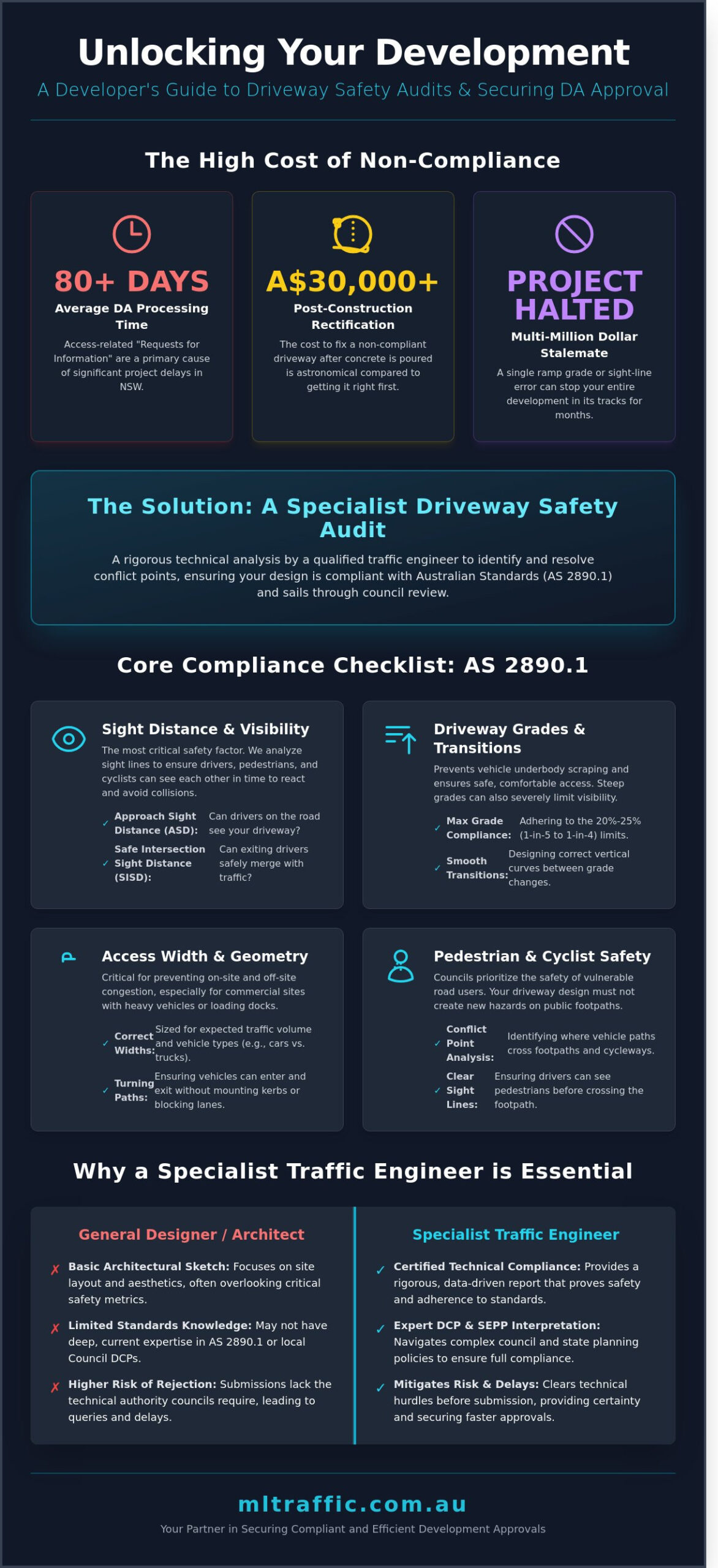
Mitigating Risk: Why Specialist Traffic Engineering Matters
Property developers often ask if their architect or civil engineer can handle the driveway design. While they play a vital role, a specialist traffic engineer provides a level of certified analysis that is essential for mitigating risk and securing approval.
- Certified Design vs. a Sketch: An architect’s plan shows intent, but a traffic engineer’s report provides the certified proof that the design complies with all relevant Australian Standards and safety principles.
- Interpreting Grey Areas: We are experts at interpreting the nuances of local council planning schemes and Development Control Plans (DCPs), ensuring our designs are defensible.
- Addressing Nuanced Safety Issues: General civil engineers may overlook subtle but critical traffic safety issues, such as pedestrian desire lines or the impact of queuing vehicles, which can lead to council rejection.
Expert Witness and Council Liaison
Our role extends beyond report writing. We provide the expert support needed to navigate the complexities of the approval process.
- Our senior engineers are equipped to defend the findings of our reports to council planners, providing clear, evidence-based arguments.
- We have extensive experience navigating the sometimes-conflicting requirements of state road authorities and local Tasmanian councils.
- With over 15 years of experience, ML Traffic has built a reputation for credible, robust analysis, which builds immediate rapport with assessing officers.
The ‘Principal-led’ Advantage
At ML Traffic, we operate on a unique model that guarantees expertise and accountability. This is our signature promise to every client.
- “The traffic consultant who provides the quote, does the work.” You will deal directly with a senior, principal-level engineer from start to finish.
- This senior-level involvement drastically reduces the risk of errors and council Requests for Information (RFIs), saving you time and money.
- Our team, including principals Michael Lee and Benny Chen, brings decades of specialised experience to every project. Learn more about their expertise on our About Us page.
Compliance Checklist: AS 2890.1 and National Design Standards
Compliance with Australian Standards is non-negotiable. Our audits provide a systematic check to ensure every aspect of your car park and access design meets the required benchmarks.
- AS 2890.1:2004: We verify every detail against AS 2890.1 (Off-street car parking), the foundational document for car park and access design in Australia.
- AS 2890.2: For commercial and industrial projects, we integrate compliance with AS 2890.2, which governs loading docks and heavy vehicle facilities.
- Driveway Ramp Grades: We meticulously check ramp grades and transitions against the maximum allowable percentages to prevent vehicle scraping.
- Pedestrian Sight Lines: Our reports confirm that the ‘Sight Distance at Property Boundary’ requirements are met, ensuring pedestrian safety.
Navigating AS 2890.1 Requirements
AS 2890.1 is a highly technical document. We translate its complex requirements into a practical, compliant design for your site.
- We determine the correct ‘User Class’ for your development, which dictates critical design parameters like aisle and driveway widths.
- Our assessment ensures that driveway locations are sufficiently offset from intersections to meet the minimum Australian Standards for safety.
- For a deeper dive into these technical requirements, see our guide on AS 2890.1 compliance.
Driveway Ramp Grade Design
Designing compliant ramps, particularly on steep sites common in areas of Hobart, requires specialist expertise.
- We design the specific grade changes and transitions required to create smooth ‘break-over’ angles that prevent vehicle damage.
- We develop solutions for challenging, steep sites that maintain safety and accessibility without compromising the design. A 1 in 20 (5%) transition grade is used at the top and bottom of steep driveway ramps to provide a gradual change that prevents the front or rear of a vehicle from scraping the pavement.
Securing Council Approval with ML Traffic Engineers
A professional driveway safety audit is a key part of a successful development strategy. ML Traffic provides the specialist expertise to ensure your project’s traffic components are a source of strength in your DA submission.
- We help you integrate the traffic assessment into your wider traffic engineering strategy for a seamless application.
- Our national reach means we can apply our standards-compliant expertise to any project across Tasmania and Australia.
- For developers facing challenging access requirements from a Tasmanian council, we provide the robust, evidence-based reporting needed to achieve a positive outcome.
Our Comprehensive Suite of Services
Beyond driveway safety, we offer a full range of traffic engineering services to support your development from concept to completion.
- Our complementary services include Car Parking Demand Assessments, Intersection Analysis, and Traffic Guidance Schemes (TGS).
- Visit our Services page for a full list of the land-use types we cover.
- Our track record of over 10,000 assessed sites is your mark of reliability and experience.
Get Started on Your Traffic Assessment
Initiating a report with us is a straightforward process designed to get you the answers you need quickly.
- To provide an accurate quote, we typically require architectural plans (site plan, floor plans) and any relevant correspondence from council.
- A professional safety audit report is typically turned around efficiently to meet your project deadlines.
- Get a professional quote for your driveway safety audit today and gain direct access to our senior traffic consultants.

Disclaimer
The content on www.mltraffic.com.au, including all technical articles, guides, and resources, is provided for general informational and educational purposes only. It is not intended to constitute professional advice in traffic engineering, transportation planning, development approvals, or any other technical or legal field.
While ML Traffic Engineers makes every reasonable effort to ensure the accuracy, completeness, and timeliness of the information published, we do not provide any warranties or representations (express or implied) regarding its reliability, suitability, or availability for any particular purpose. Any reliance you place on the content is strictly at your own risk.
In no event shall ML Traffic Engineers, its directors, employees, authors, or affiliates be liable for any direct, indirect, incidental, special, consequential, or punitive damages (including, without limitation, loss of profits, data, or business opportunities) arising out of or in connection with the use of, or inability to use, any information provided on this website.
The articles and guides on this site are not a substitute for engaging a qualified, registered professional traffic engineer (such as an NPER or RPEQ engineer) to assess your specific project requirements. For tailored advice, compliance assessments, or traffic engineering services, please contact a competent professional.
This disclaimer may be updated from time to time without notice. By accessing or using this website, you agree to be bound by the most current version of this disclaimer.
